around, on Rennell Island
pp. 52-56 · Read in the full issue
Travel
Some doctoring, and much around, on Rennell Island
The Polynesian outliers of Sol omon Islands probably represent the least visited and least de veloped Polynesian islands in the Pacific today. Some, such as the high islands of Tikopia and Anu ta, have become well known through the work of anthropolog ists in what seem ideal “laborat ory” settings. The remote atolls of Ontong Java (Lord Howe atoll) and Sikaiana are served by monthly ships out of Honiara, capital of Solomon Islands, and earn their income through copra and trochus shells. The large raised atolls of Rennell and Bel lona are the only ones served by air, with fares from Honiara $6l and $7l to Bellona and Rennell respectively.
The presence of an air link might give a false impression of easy accessibility it certainly did with us. But Rennell is among the largest raised atolls in the world, and the four villages of east Rennell, our destination, can only be reached by a strenu ous journey by land and sea. This part of the island contains the largest lake in the South Pacific,
Lake Tegano, occupying most of east Rennell, and representing the former lagoon of the island, which is now surrounded by tall, ragged coral limestone cliffs.
Landing at Tigoa airstrip in west Rennell on one of Solair’s eight-seater Britten-Norman Is landers, we first took the island’s only tractor down to the seaport village of Lavagu, driving for three hours over a bumpy track cut through dense rainforest, and stopping at various villages to load and unload pandanus, pas sengers and produce from the tractor’s trailers.
The villages consist of pan danus huts, often built on stilts, with the more affluent sporting corrugated iron roofs. Spending the night at Lavagu in Kangava Bay (the only safe anchorage on Rennell), we went swimming over forests of brightly colored staghorn coral in the calm glassy waters of the bay. ‘ There are some small freshwater pools along the beach, fed by springs, which are ideal for rinsing off after a swim. Across the bay we could see the islet where the first
Dr STEPHEN WEINSTEIN and his nursing sister wife ELISABETH earlier this year did a six-weeks stint on Solomon Islands’ Rennell Island, carrying out a malaria study, and getting to know the local people and their lifestyle. Later, they visited Malaita.
This month, in the first of two reports, Dr Weinstein tells of their experiences on Rennell.
three Christian missionaries were killed by the Rennellese in 1910,
in a dispute apparently arising
from the desire of the natives to possess iron tools.
Partly because of this incident, the islanders acquired a reputa tion for ferocity, and Rennell remained in virtual isolation from the outside world until 1938, when it was christianised along with its sister island of Bellona. Thus they became two of the last Polynesian islands to give up their traditional relig ions, with only Tikopia and Anu ta remaining to do so later, in the 19505.
Though first discovered by Europeans in the 17905, Rennell
was seldom visited, having little to interest traders. From the early 19305, the government of the British Solomon Islands Protec torate declared Rennell, along with some of the other Polyne sian outliers, “closed districts” that could not be visited without special permission, to protect the non-immune natives from Euro pean infectious diseases.
The following morning we set off from the beach at Lavagu in a fibreglass dinghy for the two hour trip (cost $2) to Te uhugago, the landing site on the coast serving the eastern half of the island. Our boat hugged the rough limestone coast, covered with dense vegetation, with
fringing reefs on the outside. The sea is very rich here with flying fish leaving the water ahead of us and to the side, occasional schools of dolphins rolling by, and a manta-ray winging its way up into the air.
Teuhugago is a white coral sand beach with coconut palms and forbidding grey limestone cliffs rising vertically behind it.
Here are storage sheds for boats, canoes and outboard engines, used to meet the inter-island ship on its monthly visits.
Now began the hardest part of the journey; first a 120-metre climb up “Jacob’s ladder’’, a winding concrete stairway, snak ing its way to the top of the cliff at an almost 90 deg. angle. On reaching the top we were too exhausted to appreciate the splendid views of the brown reef separating the crystal clear wa ters of the lagoon inside and the deep blue sea breaking on the outside.
The hike down the other side over moist trails on sharp, moss covered limestones, with tall trees, vines, and creepers virtual
ly blocking out daylight in many places, wasn’t made any easier by our being overloaded with baggage we simply had not anticipated the roughness of the trail. We took three hours to do what is normally a one-hour walk, despite being helped by some of the young men from the village who came to meet us on the trail, and revived us with fresh green drinking coconuts.
Local legend says that when Mautikitiki (Maui), the demigod fisherman of the islands, fished up Rennell from the ocean floor, he placed it upside down, and this accounts for the irregular, jagged surface. After another six weeks of covering similar trails by foot, the legend seemed more believable.
When we finally arrived in Tegano, a village with the same name as the lake on whose shore it lies, we plunged into the cool ing brackish waters of the lake.
The final stage of the journey was a one-hour ride by dugout canoe to Hutuna village, a few kilometres further east on the lake shore. Our host, Sogo, a 50-
year-old fisherman and wood carver, took us to his house, one of the few in the village with a corrugated iron roof, most others being of traditional pandanus.
The fact is even more impressive when one realises that every piece of roofing iron, as well as the rare water-tank and outboard engine, every litre of petrol, etc, has to be hand-carried over steep
jungle trails, and finally brought
to its destination by dugout canoe on the lake.
Part of out six-week stay in east Rennell was spent assisting with a malaria survey on behalf
The lake people
of the Solomon Islands Health Department. This involved tak ing blood from about 250 people in three of the four villages around the lake, as well as col lecting mosquito larvae at vari ous locations to determine if the malaria-carrying Anopheles mosquito was indeed present in Rennell, as some earlier sporadic reports of sightings suggested.
In some cases the surveys were well organised by the local nurse or village health aide, who would line people up to have their fingers pricked while acting as interpreter and record-keeper.
In other cases we would carry our equipment from house to house, testing people who were unable or reluctant to come in for testing. This latter method was often slower, but it was much more interesting.
Other medical work consisted of two-weekly visits to the cor rugated iron clinic in Tegano village. We had obtained li
cences from the Health Depart ment in Honiara for my wife and me to practice nursing and medicine respectively. We work ed with the local registered nurse, Hadrick, treating cases of flu, asthma, broncho
phneumonia, gastro-enteritis,
and various cuts and bruises with the limited stock of medicines available at the clinic. Other clin-
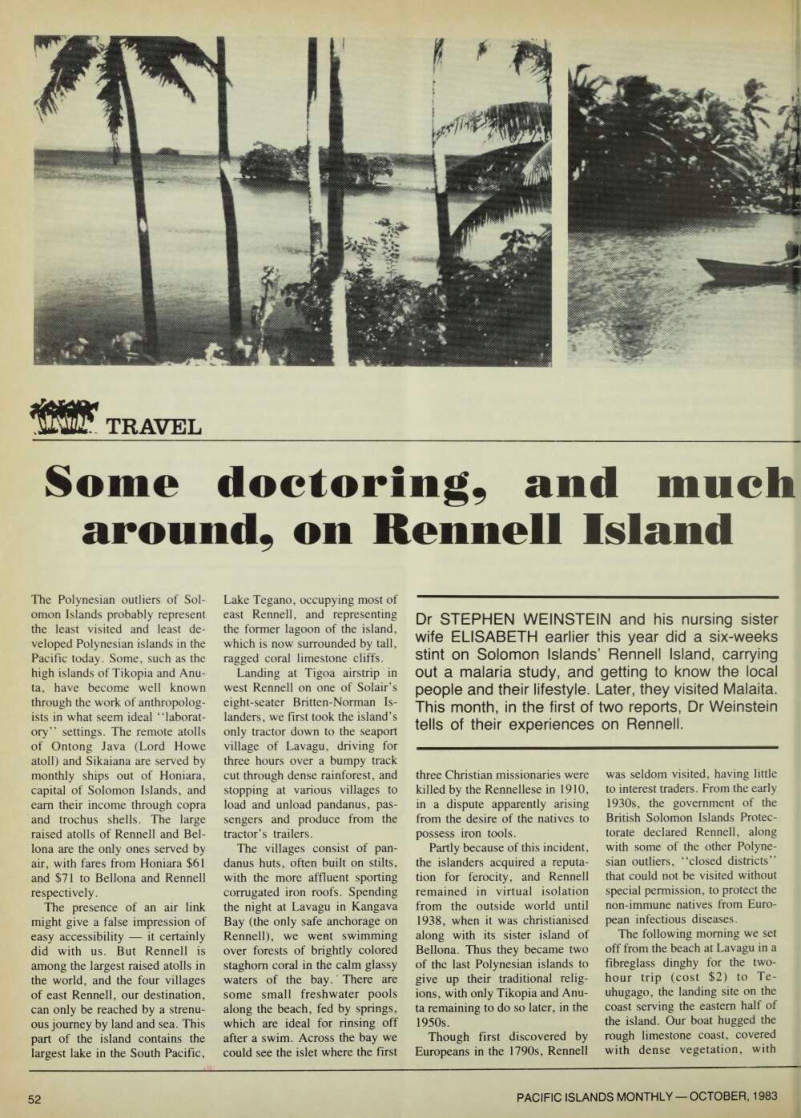
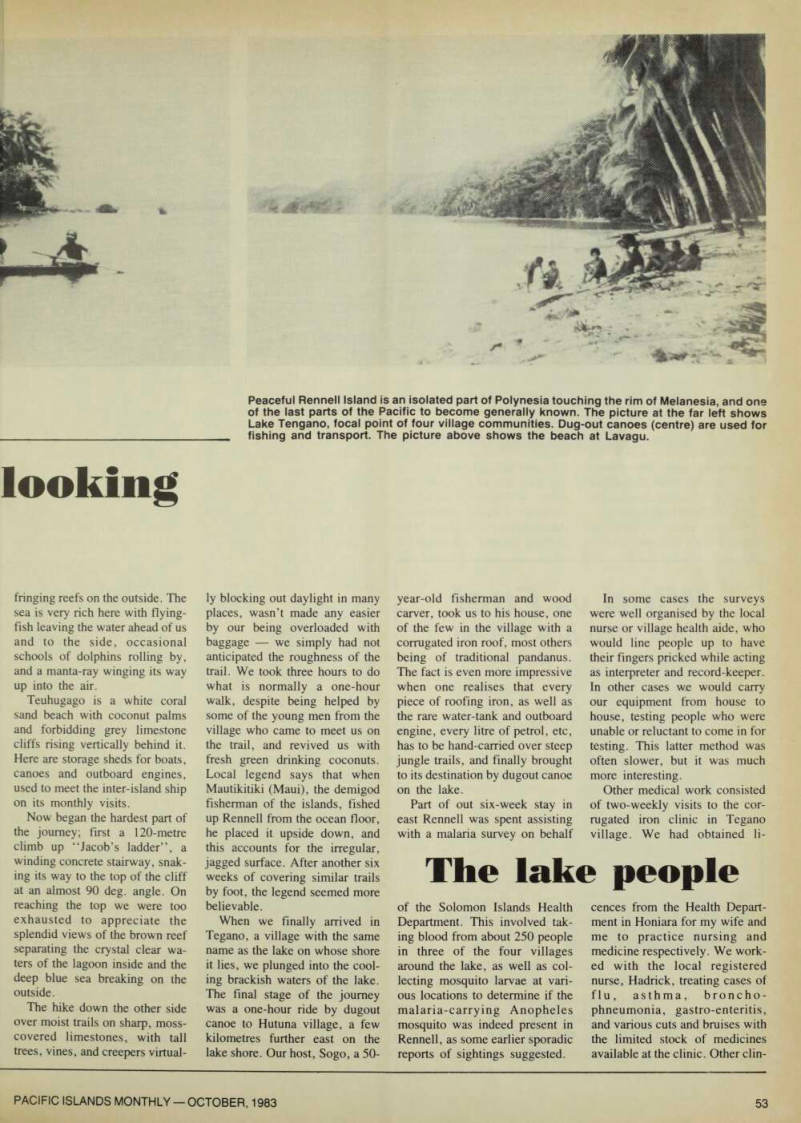
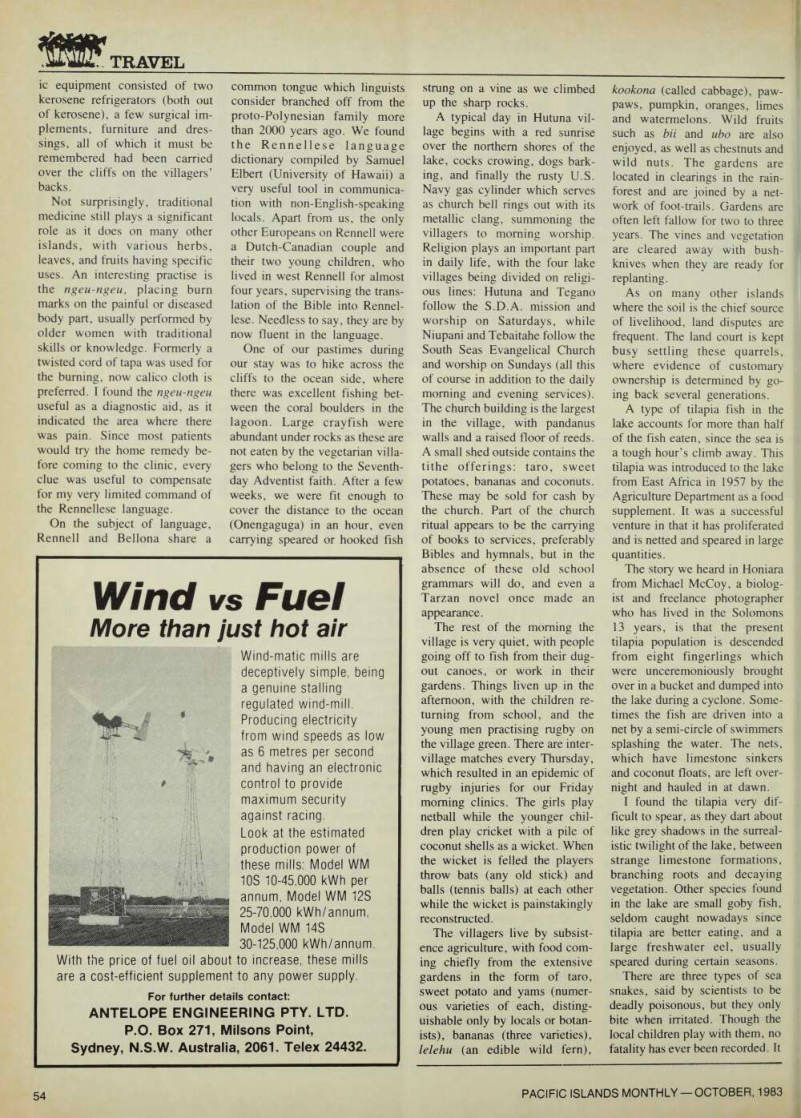
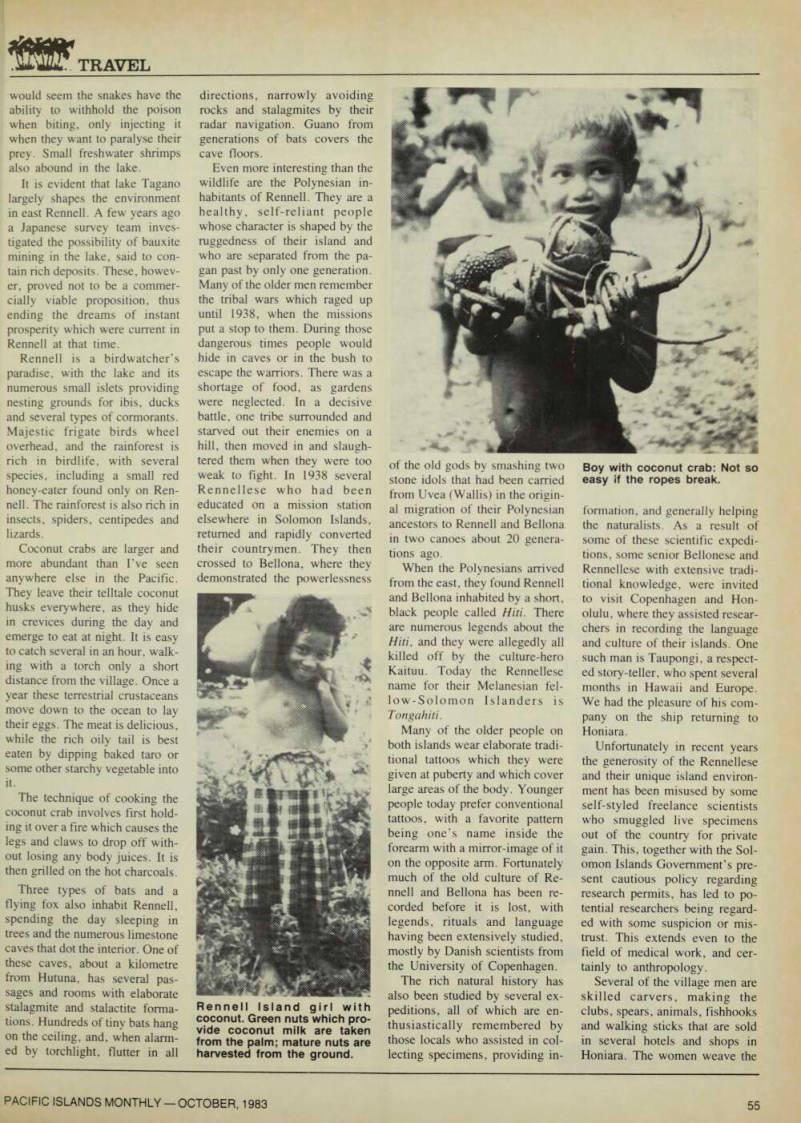
Peaceful Rennell Island is an isolated part of Polynesia touching the rim of Melanesia, and one of the last parts of the Pacific to become generally known. The picture at the far left shows Lake Tengano, focal point of four village communities. Dug-out canoes (centre) are used for fishing and transport. The picture above shows the beach at Lavagu.
ic equipment consisted of two kerosene refrigerators (both out of kerosene), a few surgical im plements, furniture and dres sings, all of which it must be remembered had been carried over the cliffs on the villagers’ backs.
Not surprisingly, traditional medicine still plays a significant role as it does on many other islands, with various herbs, leaves, and fruits having specific uses. An interesting practise is the ngeu-ngeu, placing burn marks on the painful or diseased body part, usually performed by older women with traditional skills or knowledge. Formerly a twisted cord of tapa was used for the burning, now calico cloth is preferred. I found the ngeu-ngeu useful as a diagnostic aid, as it indicated the area where there was pain. Since most patients would try the home remedy be fore coming to the clinic, every clue was useful to compensate for my very limited command of the Rennellese language.
On the subject of language, Rennell and Bellona share a
common tongue which linguists consider branched off from the proto-Polynesian family more than 2000 years ago. We found the Rennellese language dictionary compiled by Samuel Elbert (University of Hawaii) a very useful tool in communica tion with non-English-speaking locals. Apart from us, the only other Europeans on Rennell were a Dutch-Canadian couple and their two young children, who lived in west Rennell for almost four years, supervising the trans lation of the Bible into Rennel lese. Needless to say, they are by now fluent in the language.
One of our pastimes during our stay was to hike across the cliffs to the ocean side, where there was excellent fishing bet ween the coral boulders in the lagoon. Large crayfish were abundant under rocks as these are not eaten by the vegetarian villa gers who belong to the Seventh day Adventist faith. After a few weeks, we were fit enough to cover the distance to the ocean (Onengaguga) in an hour, even carrying speared or hooked fish
strung on a vine as we climbed up the sharp rocks.
A typical day in Hutuna vil lage begins with a red sunrise over the northern shores of the lake, cocks crowing, dogs bark ing, and finally the rusty U.S.
Navy gas cylinder which serves as church bell rings out with its
metallic clang, summoning the
villagers to morning worship.
Religion plays an important part in daily life, with the four lake villages being divided on religi ous lines: Hutuna and Tegano follow the S.D.A. mission and
worship on Saturdays, while
Niupani and Tebaitahe follow the South Seas Evangelical Church and worship on Sundays (all this of course in addition to the daily
morning and evening services).
The church building is the largest in the village, with pandanus walls and a raised floor of reeds.
A small shed outside contains the tithe offerings: taro, sweet potatoes, bananas and coconuts.
These may be sold for cash by the church. Part of the church ritual appears to be the carrying of books to services, preferably Bibles and hymnals, but in the absence of these old school grammars will do, and even a Tarzan novel once made an appearance.
The rest of the morning the village is very quiet, with people going off to fish from their dug out canoes, or work in their gardens. Things liven up in the afternoon, with the children re turning from school, and the young men practising rugby on the village green. There are inter village matches every Thursday, which resulted in an epidemic of
rugby injuries for our Friday
morning clinics. The girls play
netball while the younger chil dren play cricket with a pile of coconut shells as a wicket. When the wicket is felled the players throw bats (any old stick) and balls (tennis balls) at each other while the wicket is painstakingly reconstructed.
The villagers live by subsist ence agriculture, with food com ing chiefly from the extensive gardens in the form of taro, sweet potato and yams (numer ous varieties of each, disting uishable only by locals or botan ists), bananas (three varieties), lelehu (an edible wild fern),
kookona (called cabbage), paw paws, pumpkin, oranges, limes and watermelons. Wild fruits such as bii and übo are also enjoyed, as well as chestnuts and wild nuts. The gardens are located in clearings in the rain forest and are joined by a net work of foot-trails. Gardens are often left fallow for two to three years. The vines and vegetation are cleared away with bush knives when they are ready for replanting.
As on many other islands where the soil is the chief source of livelihood, land disputes are frequent. The land court is kept busy settling these quarrels, where evidence of customary ownership is determined by go ing back several generations.
A type of tilapia fish in the lake accounts for more than half of the fish eaten, since the sea is a tough hour’s climb away. This tilapia was introduced to the lake from East Africa in 1957 by the Agriculture Department as a food supplement. It was a successful venture in that it has proliferated and is netted and speared in large quantities.
The story we heard in Honiara from Michael McCoy, a biolog ist and freelance photographer who has lived in the Solomons 13 years, is that the present tilapia population is descended from eight fingerlings which were unceremoniously brought over in a bucket and dumped into the lake during a cyclone. Some times the fish are driven into a net by a semi-circle of swimmers splashing the water. The nets, which have limestone sinkers and coconut floats, are left over night and hauled in at dawn.
I found the tilapia very dif ficult to spear, as they dart about like grey shadows in the surreal istic twilight of the lake, between strange limestone formations, branching roots and decaying vegetation. Other species found in the lake are small goby fish, seldom caught nowadays since tilapia are better eating, and a large freshwater eel, usually speared during certain seasons.
There are three types of sea snakes, said by scientists to be deadly poisonous, but they only bite when irritated. Though the local children play with them, no fatality has ever been recorded. It
would seem the snakes have the ability to withhold the poison when biting, only injecting it when they want to paralyse their prey. Small freshwater shrimps also abound in the lake.
It is evident that lake Tagano largely shapes the environment in east Rennell. A few years ago a Japanese survey team inves tigated the possibility of bauxite mining in the lake, said to con tain rich deposits. These, howev er, proved not to be a commer cially viable proposition, thus ending the dreams of instant prosperity which were current in Rennell at that time.
Rennell is a birdwatcher’s paradise, with the lake and its numerous small islets providing nesting grounds for ibis, ducks and several types of cormorants.
Majestic frigate birds wheel
overhead, and the rainforest is rich in birdlife, with several species, including a small red honey-eater found only on Ren nell. The rainforest is also rich in
insects, spiders, centipedes and
lizards.
Coconut crabs are larger and more abundant than I’ve seen anywhere else in the Pacific.
They leave their telltale coconut husks everywhere, as they hide in crevices during the day and emerge to eat at night. It is easy to catch several in an hour, walk ing with a torch only a short distance from the village. Once a year these terrestrial crustaceans move down to the ocean to lay their eggs. The meat is delicious, while the rich oily tail is best eaten by dipping baked taro or some other starchy vegetable into it.
The technique of cooking the coconut crab involves first hold ing it over a fire which causes the legs and claws to drop off with out losing any body juices. It is then grilled on the hot charcoals.
Three types of bats and a flying fox also inhabit Rennell,
spending the day sleeping in
trees and the numerous limestone caves that dot the interior. One of these caves, about a kilometre from Hutuna, has several pas sages and rooms with elaborate stalagmite and stalactite forma tions. Hundreds of tiny bats hang on the ceiling, and, when alarm ed by torchlight, flutter in all
directions, narrowly avoiding rocks and stalagmites by their radar navigation. Guano from generations of bats covers the cave floors.
Even more interesting than the wildlife are the Polynesian in habitants of Rennell. They are a healthy, self-reliant people whose character is shaped by the ruggedness of their island and who are separated from the pa gan past by only one generation.
Many of the older men remember the tribal wars which raged up until 1938, when the missions put a stop to them. During those dangerous times people would hide in caves or in the bush to escape the warriors. There was a shortage of food, as gardens were neglected. In a decisive battle, one tribe surrounded and starved out their enemies on a hill, then moved in and slaugh tered them when they were too weak to fight. In 1938 several Rennellese who had been educated on a mission station elsewhere in Solomon Islands, returned and rapidly converted their countrymen. They then crossed to Bellona, where they demonstrated the powerlessness
of the old gods by smashing two stone idols that had been carried from Uvea (Wallis) in the origin al migration of their Polynesian ancestors to Rennell and Bellona in two canoes about 20 genera tions ago.
When the Polynesians arrived from the east, they found Rennell and Bellona inhabited by a short, black people called Hiti. There are numerous legends about the Hiti, and they were allegedly all killed off by the culture-hero Kaituu. Today the Rennellese name for their Melanesian fel low-Solomon Islanders is Tongahiti.
Many of the older people on both islands wear elaborate tradi tional tattoos which they were given at puberty and which cover large areas of the body. Younger people today prefer conventional tattoos, with a favorite pattern being one’s name inside the forearm with a mirror-image of it on the opposite arm. Fortunately much of the old culture of Re nnell and Bellona has been re corded before it is lost, with legends, rituals and language having been extensively studied, mostly by Danish scientists from the University of Copenhagen.
The rich natural history has also been studied by several ex peditions, all of which are en thusiastically remembered by those locals who assisted in col lecting specimens, providing in
formation, and generally helping the naturalists. As a result of some of these scientific expedi tions, some senior Bellonese and Rennellese with extensive tradi tional knowledge, were invited to visit Copenhagen and Hon olulu, where they assisted resear chers in recording the language and culture of their islands. One such man is Taupongi, a respect ed story-teller, who spent several months in Hawaii and Europe.
We had the pleasure of his com pany on the ship returning to Honiara.
Unfortunately in recent years the generosity of the Rennellese and their unique island environ ment has been misused by some self-styled freelance scientists who smuggled live specimens out of the country for private gain. This, together with the Sol omon Islands Government’s pre sent cautious policy regarding research permits, has led to po tential researchers being regard ed with some suspicion or mis trust. This extends even to the field of medical work, and cer tainly to anthropology.
Several of the village men are skilled carvers, making the clubs, spears, animals, fishhooks and walking sticks that are sold in several hotels and shops in Honiara. The women weave the
Rennell Island girl with coconut. Green nuts which pro vide coconut milk are taken from the palm; mature nuts are harvested from the ground.
Boy with coconut crab: Not so easy if the ropes break.
square handbags of pandanus that are seen all over the Sol omons, and fine sleeping mats.
The handicrafts represent one of the few sources of income for Rennell and Bellona, together with occasional fish, crayfish, coconut crabs and taro sent to Honiara by the monthly ship.
There is a small shop in Niupani (in a room of a private home) stocking small quantities of soap, razor blades, diving goggles, corned beef, chewing gum and tobacco. The latter, in the form of twisted sticks of sticky black tobacco, we found to be a more useful medium of exchange than cash in a place where the money economy has just begun to scratch the surface.
An interesting local phenome non is that of Kagobai (PIM Dec. ’79 p 27), a deaf mute who lives on an islet in the lake just outside Hutuna village. This old man has a unique sign language used only by him and understood by all his fellow Rennellese, enabling him to be a functioning member of the community. His sign lan guage has been recorded photo graphically by a Danish resear cher, Rolf Kuschefwho lived
with Kagobai on his island to learn his language.
Despite the air link in far away west Rennell, “boat day’’ at the beach of Teuhugago remains the major event of the month. School is cancelled, Hutuna practically becomes a ghost town with the
whole population having moved
to Tegano the night before, so as to be able to get on the trail over the cliffs to the sea early on the morning of the great day.
Though we arrived in west Re nnell by air, we chose to leave east Rennell six weeks later by ship, and so participated in the great migration of canoes con verging on Tegano the previous
day.
That night Tegano was a hive of activity, with every house occupied and people cooking on the grass outside. The following morning the village was awake early, and all morning people with heavy loads of taro, bag gage, strings of fish and coconuts were making their way alone or in groups over the steep, jagged cliffs and down to the beach.
Some had even spent the night on the beach. The inter-island ship, the Leili built in 1982 and
given to Solomon Islands as compensation/aid/gift from Ja pan, was seen coming over from Lavagu where it had been an chored for the night.
A small market was set up on the beach with taro and other produce being sold to the ship’s crew and passengers, while ar
riving and departing passengers
and their luggage were ferried out across the coral reef all morn ing by the ship’s dinghy and shore boats. After all departing passengers had boarded and said goodbye, we weighed anchor and headed for Lavagu.
Trawling lines were towed be hind the ship and we were lucky enough to steam through a school of skipjack tuna, hooking two.
Our last night in Rennell like so many others with a bright moon and clear, starry skies was spent at anchor at Lavagu, from where we had set off for east Rennell six weeks before.
The next morning we were at Bellona, where more passengers boarded, including a local rugby team, so that every inch of deck space was crowded with people, coconuts, baggage, chickens and even a pig tied to a pole. The
Melanesian crew of nine hardly had room to move about, but got us safely to Guadalcanal the fol
lowing morning. Everyone put
on their best clothes and crowded excitedly to the rails when Hon iara came into view at 9 am.
Though tourism in the Sol omon Islands is expanding, very few visitors go to Rennell Island, perhaps due to lack of facilities.
A cruise ship, the Lindblad Ex plorer, stopped briefly at the landing at Teuhugago last year, where the passengers were enter tained by local dances and songs.
Their last stop had been Tikopia, so they had retraced the route of a drift voyage by a Tikopian canoe in which three people reached Rennell in the early part of the century.
For the visitor who does not mind living in pandanus houses and doing his or her share of paddling in dugout canoes, Re nnell Island offers an opportunity to share the lifestyle of a unique Polynesian culture in the rugged but beautiful environment by the shores of Lake Tegano. • Next month: To Malaita for “rest and recreation