The policies that
pp. 37-40 · Read in the full issue

hid a non-policy
As the termination of the U.S.
Trust Territory of the Pacific Islands (TTPI) appears to be drawing near, one hears a good bit of talk about the territory in Honolulu nowadays. One thing is generally agreed: the record of the U.S. administration in the TTPI has left much to be desired, and many observers describe it as a failure. Such an opinion was voiced by John Condon, America’s first ambassador to Fiji. At the end of his term of office, and after much travel south of the equator, the former envoy toured Micronesia. Soon after, addressing a group in Hon olulu, Condon commented: “It is beyond my ability to either exp lain or understand the failures of our Trust Territory administra tion.” (Honolulu Advertiser, August 13, 1980).
One also hears explanations which purportedly account for the poor American record in Micronesia. Two are especially common, and relate to different periods of American rule. First, it is maintained that for the first decade and a half after World War 11, the U.S. pursued an “ethnographic zoo” policy which was designed to preserve
indigenous cultures and keep the islanders out of the mainstream of the modem world. Second, it is suggested that in the early
1960 s the “zoo” policy was
abandoned and the U.S. adopted a strategy calculated to entrap Micronesians in a web of economic dependency which would keep them firmly within the sphere of American influence for the indefinite future.
There is no doubt that 1) Mic ronesians have become accus tomed to a lifestyle which they cannot maintain, and 2) the fi nancial subsidies which the U.S. will provide to them are the envy of perhaps most other Pacific states. It is also true that the U.S. is getting what it wants out of the arrangement: a guarantee of military access to the area while the same is denied to others.
What is not accurate is the charge that all this is the result of a well planned, long term, and conscious policy. Similarly, in the early years of the American administration, there was never a “zoo” policy.
In fact, the U.S. has never had a clearly formulated or coherent policy towards Micronesia. As one Department of State official
has commented: “To suggest that we ever had an overall poli cy for Micronesia is to give us (the federal government) credit for being better organised than we are.”
In reality, the history of the U.S. administration of Mic ronesia is much more com plicated than critics would sug gest, and while many factors have shaped America’s involve ment in the islands, six are most salient: 1) the TTPI is quite dis tant from Washington, D.C., and major decisions affecting the ter ritory have often been made in the nation’s capital by individu als with little familiarity with the islands; 2) the vast majority of Americans are completely una ware that the TTPI exists, and, as a result, there is no significant political lobby to look after Mic ronesian interests; 3) in the last analysis, the needs of the Depart ment of Defense have always been served; 4) American ideolo gy about the U.S. as a democrat ic nation has precluded Ameri cans from thinking of themselves as a colonial power; 5) Ameri cans commonly assume that money, especially large sums of money, can solve practically any problem; 6) the TTPI’s 150,000 people are divided into nine separate ethno-linguistic groups, and unity has always been an artifice of colonial powers.
Immediately after World War 11, Micronesia was administered by the U.S. Navy. Within the
U.S., there was considerable de bate about the area’s future. Un like classical “colonies,” Mic ronesia did not have economic resources of interest to the U.S.
The military, however, ad vocated annexation because of its
strategic location. The Depart
ment of State was opposed to the acquisition of a new colony be cause such an action would have been difficult to defend in the newly formed U.N. However, the concept of a strategic U.N.
Trust Territory satisfied the military and allowed the U.S. to control the islands without actual annexation. Under the strategic trust agreement, the U.S. was entitled to establish military bases, but it also had an obliga tion to guide the islanders to self government or independence, to protect their health and welfare, to promote economic self sufficiency, and to further educa tion achievement.
In 1951, the Department of Interior became the administer ing agency. Looking back, this foreshadowed the territory’s fu ture. Interior had responsibility for managing national forests, parks, and other natural re sources. However, it was not equipped to deal with human beings, as evidenced by its re cord with the Bureau of Indian affairs. Interior was not a colo nial service, did not conceive of itself as such, and saw no reason to train personnel to serve ab road. Officials posted to Mic ronesia received no training,
A View from Honolulu Robert C. Kiste
and, once in the territory, often remained isolated in small American enclaves. Only a few ever learned the indigenous lan guages and most stayed only a few years.
The records of both the navy administration and civilian rule through the 1950 s were much the
same. As suggested, policies
were made in far-off Washing ton, D.C., by officials with little or no direct knowledge of Mic ronesia. As the military’s interest prevailed, private citizens were allowed to enter the area only with security clearance. In the Marshalls, Kwajalein emerged as an important military base after the war. Also in the Marshalls, between 1946 and 1958, nuclear tests were conducted at Bikini and Enewetak. In the west, the northern Marianas remained under navy control until the early 19605. Large sections of Saipan island were closed off and used by the Central Intelligence Agen cy for the training of Nationalist Chinese troops.
Little happened elsewhere. No plans were developed for the future, and war-devastated areas were not rehabilitated. No mea sures were taken to promote economic self-sufficiency or political independence. District legislatures with limited powers were created, ad universal educa tion was established by the
founding of elementary schools.
Opportunities for more advanced education were limited, and no effort was made to create a pan- Micronesian identity. Islanders remained relatively isolated with their respective languages and cultural traditions.
Such remained the situation until the early 19605. It was the period which is referred to as being guided by the zoo philosophy. In reality, there is no evidence that the U.S. had such a policy. Rather, it appears that as long as the military was satisfied, other government agencies were simply not interested in an area so remote from the U.S. and about which the American public was ignorant. Territory budgets were meagre: an appropriations ceiling of $7.5 million a year was set for the entire territory. Actual funds allocated never averaged that amount throughout the first decade of American rule.
In the early 1960 s the U.S. came under severe criticism for the lack of progress in the territ ory, and U.N. visiting missions deplored the lack of economic
President was embarrassed
development. President Kennedy
was embarrassed by the U.S. record, and, in 1962, his ad ministration decided that condi tions in Micronesia had to be improved. It appears that on the one hand Kennedy was idealistic enough to be concerned with the welfare of Micronesians. On the other hand, it is also clear that he wanted to enhance the image of the U.S. in the islands so that
Micronesia would eventually opt for a permanent association with the U.S. Exactly how this was to be achieved was not specified. It was decided that education had to be improved and a large scale crash program was launched to hire American teachers to im prove the quality of English lan guage instruction. The overall budget for the TTPI was doubled to over $l6 million.
In 1962, Kennedy appointed
economist Anthony Solomon to head a commission to investigate conditions in the islands. The
resulting Solomon Report indi
cated that conditions were quite deplorable. It also advised that if the U.S. wished to keep Mic ronesia within its sphere of influ ence, improvements had to be made to ensure that the islanders would indeed desire a close and
continued relationship with the U.S. The report specifically re commended greater attention to economic development, with
emphasis on agriculture, along
with better health and education programs and capital improve ment projects.
The Solomon Report became infamous and acquired the repu tation of being America’s covert plan to seduce Micronesians. In
reality, it had little direct influ ence on future events. Certainly the recommendations on economic development were never followed, and there is evi dence that the report was shelved with Kennedy’s assassination and the coming of the Johnson administration.
Nonetheless, the TTPI had be come the focus of greater atten tion. Annual budgets were stead ily increased reaching about $25 million by 1967 and $5O million by 1970. By the end of the 19705, the all-time high of ap proximately $lOO million was reached. Crash programs on sev eral fronts were initiated. A mas sive school construction effort was launched, and opportunities for secondary and university edu cation were vastly increased. In 1966, President Johnson sent large numbers of Peace Corps volunteers to the territory.
In a very real sense, the effort to develop Micronesia went out of control. Working on the as sumption that social welfare ef forts designed for the U.S. were also appropriate to Micronesia,
well-intentioned Congressmen
introduced legislation making the islands eligible for a multitude of welfare programs. By the late
1970 s 166 separate programs
were introduced at a cost of $3O million. There was no co ordination among them, and they included such inappropriate items as large-scale food subsidy programs (with a subsistence economy, most Micronesians fall below the cash income level which delineates the American poor), financial aid to the elderly (in societies which revere and
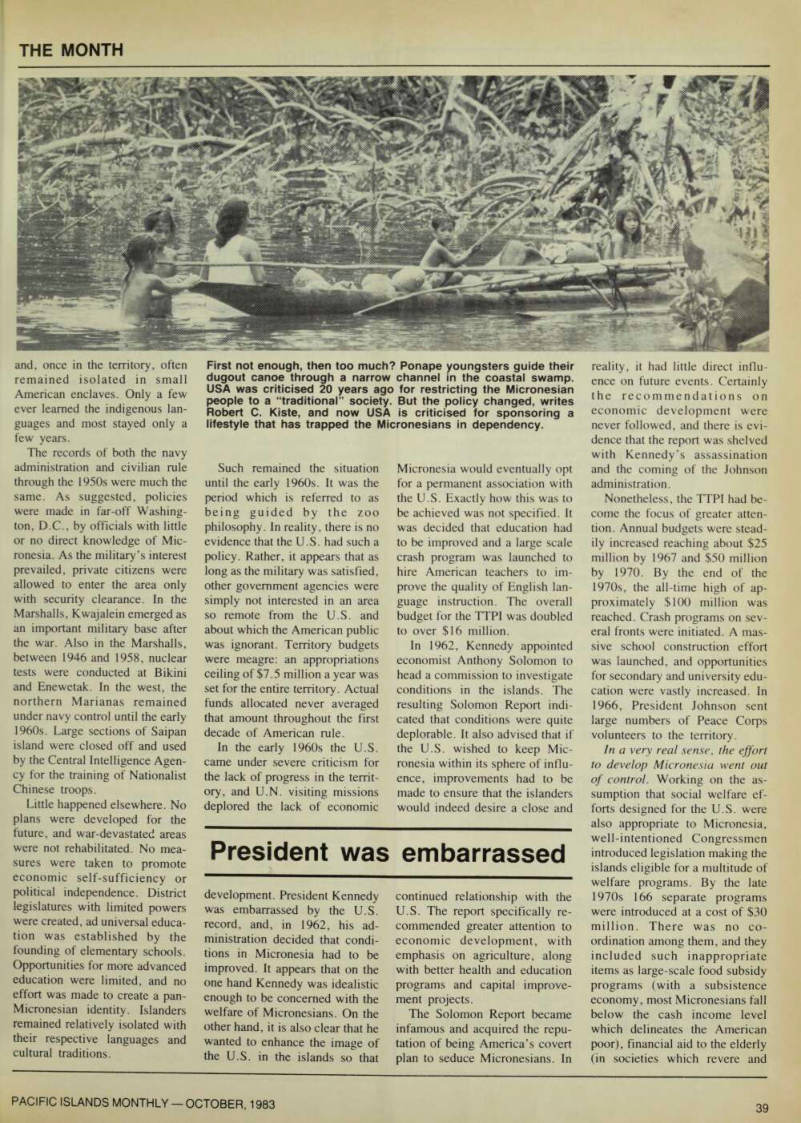
First not enough, then too much? Ponape youngsters guide their dugout canoe through a narrow channel in the coastal swamp.
USA was criticised 20 years ago for restricting the Micronesian people to a “traditional” society. But the policy changed, writes Robert C. Kiste, and now USA is criticised for sponsoring a lifestyle that has trapped the Micronesians in dependency.
provide for elders), and job train ing programs designed for the disadvantaged in urban America.
All the above measures were accompanied by a continued neg lect of economic development which would allow Micronesians
any degree of self-sufficiency.
Indeed, the territory’s crash programs and the federal welfare efforts had the opposite effect: Micronesians flocked to the ad ministrative centres to gain em ployment with government agen cies, and to take advantage of welfare programs, and today’s urban centers are the lasting re sult. The educational effort, while massive, has been general ly poor in quality. It produced a plethora of liberal arts majors, but few individuals with the technical skills to maintain publ ic services.
In the political arena, signific ant change began early in this period of artificial affluence. A long promised Congress of Mic ronesia became a reality in 1965.
Impatient with the slowness of American response to Microne sian desires for self determination, it created a com
mission to explore possible polit
ical arrangements suitable for Micronesia.
Negotiations with the U.S. be gan in 1969. Initially, three po tential options for the territory as a whole were considered by the commission: independence, in tegration with the U.S., and a status of free association with the U.S (a status suggested by the already existing arrangement bet ween the Cook Islands and New Zealand).
Independence was never seri ously considered by most Mic ronesians because of the absence of a viable economy. Initially, the Americans rejected free as sociation and proposed common wealth status, which was tan tamount to incorporation within the U.S. The latter was rejected by the Micronesians with the exception of the Marianas. Be cause of their long contact with Western powers dating back to the Spanish era, the people of the Marianas are the most accul turated of all Micronesians, and they desired permanent affilia tion with the U.S. Americans
encouraged separatist sentiments
by opening separate negotiations
with the Marianas. The inten tions of the U.S. were clear.
With the withdrawal of troops from Vietnam, the Marianas of fered the U.S. a defence perime ter in the western Pacific.
Reflecting cultural and ling
uistic differences, and disparities in resources, other divisions soon occurred. The Marshalls had the largest copra industry in the TTPI. It combined with tax and wages revenues from the Kwaja lein military base to give the Marshalls a larger financial base than other districts. Reluctant to share their wealth, the Marshalls opted for separate negotiations, and the U.S. agreed to consider free association.
Palau followed suit. Multi national oil industries have long viewed Palau as an ideal site for a superport storage facility, and the U.S. military has interest in a potential base there. Sensing po tential financial windfalls from these sources, Palau began sepa rate talks with the U.S.
All of this brings us to the contemporary scene. The Marianas have voted for and are impatient to implement their commonwealth status. The Federated States of Micronesia (Yap, Truk, Ponape, and Kos rae) seem to be moving fairly easily towards free association.
Palau’s movement towards that same status is clouded by nuclear issues, and the plebiscite in the Marshalls on future political status has recently occurred.
It cannot be said that all this has occurred in an orderly or planned way. As suggested, and as in the case of the welfare programs, events snow-balled and were out of control. There were no well formulated policies which were implemented and followed. At the time, some parts of officialdom in Washing ton, D.C. simply had to be aware that Micronesians were slipping into a state of great economic dependency. However, no one blew the whistle and attempted to arrest this development. The is lands will be closely linked to the U.S. for foreseeable future, and U.S. defence interests will be served as they have been served since World War 11. In this re spect at least, there has been continuity in the territory.
Robert C. Kiste.