Tales of Viking
pp. 31-33 · Read in the full issue
late-comers
How is it, many people have asked over the years, that the famed voyagers of the Viking nations were absent from Pacific waters during the great age of discovery from 1500 to 1800?
All the history books tell us that it was not until 1845 that the Danish Government sent out the frigate Galathea on a voyage around the world. Its successful completion immediately prompt ed Denmark’s northern rival, the United Kingdom of Sweden and Norway, to despatch the frigate Eugenie on a similar mission in 1851. The purpose was no longer exploration, but trade promotion.
The reason for the absence of these countries from the earlier,
exploratory, phase of European
activities in the Pacific was sim ply this: they were far too busy fighting each other during those
three centuries to have the means or the energy left over to take part.
However, there is now reason to modify the widely accepted notion that the two naval frigates mentioned above were the first Scandinavian vessels to enter the Pacific.
As a result of research by the Swedish historian Ebbe Aspeg ren in various local and overseas archives including Sydney’s Mitchell Library he has clear ly established that no fewer than four Swedish merchant vessels traded in the Pacific between 1839 and 1846. Since the results of Mr Aspegren’s fascinating studies have only recently been published in Swedish, we wish to summarise them here for the be nefit of readers of PIM.
First, having emphasised the
effects of constant warfare in Scandinavia during the preceding centuries, we feel it only proper to point out that the explanation for the sudden burst of maritime activities in Sweden in the 1830 s was that an era of peace had “broken” out at that time an era which, happily, persists to
this day.
Foremost among the new and breezy promotors of international trade who then emerged was a self-made businessman, Carl Frederik Liljevalch. He had be come rich by exporting timber to the continent and the British Isles in his own ships. He had them built in the northern part of Swe den which in those days was a
truly under-developed region,
where both labor and raw mate rials were to be had very cheap ly. Soon, he also began looking to America, and his brother Olof took the unusual step of setting himself up as a shipping agent in Chile.
It was only a short time before Carl Frederik devised a huge trading scheme centred on his Chile-based brother. What was
rather more surprising was his decision to send out a ship on a three-stage mission which in volved the remote and in Sweden little-known colony of Australia.
The ship chosen for this pioneering effort was a brand new bark of 135 tonnes to which Mr Liljevalch gave the name Mary Ann, in honor of his sister in-law in Chile. She was to be commanded by a captain. Nils Ringman, who seemed particu larly well qualified for the job, having just come home to Swe den after 12 years of service on foreign ships which had taken him to all the oceans of the world. According to his own account, he had excellent rela tions in the Pacific where, among other things, he had been em ployed by Queen Pomare as cap tain of a pearl lugger. He was even willing to invest part of the fortune he had amassed in the
Liljevalch venture.
Alas, at the last minute, Ring man was exposed as a swindler.
It seems that he had stolen the ship, pearls and all, from poor Queen Pomare, and headed for Australia.
Command of the Mary Ann was then given to the only man available at short notice, the 24-
year-old captain Nils Wemgren.
The ship left Stockholm on Au gust 29, 1839, and made an uneventful passage to Port Jack son in eight months a period not considered excessive in those
days.
Mr Liljevalch’s expectations
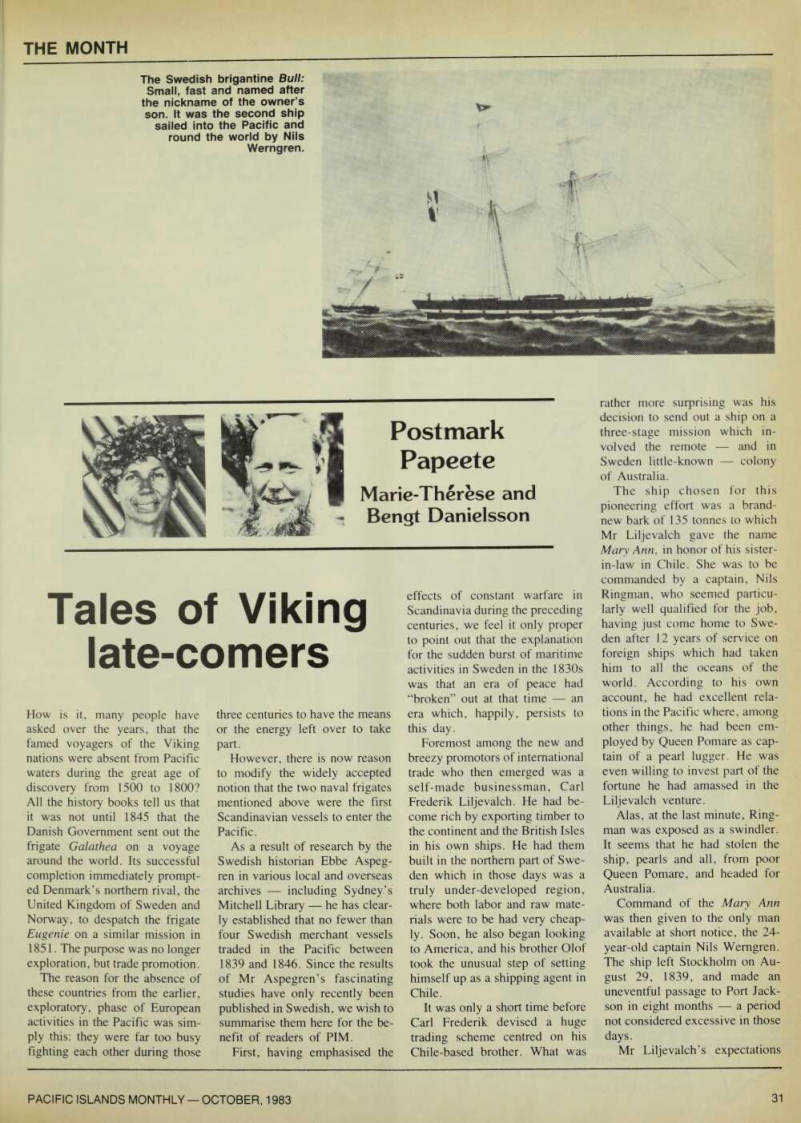
The Swedish brigantine Bull: Small, fast and named after the nickname of the owner’s son. It was the second ship sailed into the Pacific and round the world by Nils Werngren.
Postmark Papeete Maric-Thérèse and Bengt Danielsson
were immediately fulfilled: the whole cargo of timber, sail cloth and iron was snapped up by a local merchant at a very satisfac tory price.
Next, a full load of coal (120 tonnes) was taken on at Newcas tle, whose destination, in accord ance with long-established trade patterns, was Chile. As usual, the trans-Pacific passage along the roaring forties took about three months. In Chile, the coal was replaced by copper which, in the following stage of the voy age, was transported to feed the hungry furnaces of Britain. On the home run from Swansea to Sweden, Mary Ann had a cargo of 1050 barrels of salt. She an chored in Stockholm harbor on May 3, 1841, after an absence of only a year and eight months.
She was also the first Swedish vessel to have circumnavigated the world an exploit which passed totally unnoticed by the Swedish press and public of the day.
The profits must have been substantial, for within three months three more ships were sent out on a similar ventures.
The first vessel to sail for Port Jackson was Liljevalch’s largest, the brig Edward, of 300 tonnes.
Its captain, Edward Norman, had long been in Liljevalch’s service.
The cargo was much more diver sified than on the previous trip, comprising not only timber, tar and iron, but also tools, oars, furniture, pre-fabricated houses, and, last but not least, smoked reindeer meat. She also embark ed the first group of Swedish emigrants to Australia, nine all told, and all men.
Mr Liljevalch also persuaded captain Nils Wemgren to do a repeat performance in a slightly larger vessel, the 171-tonne Bull. (The choice of an English name is explained by the fact that this was the nickname of one of Liljevalch’s sons).
A rival shipowner in Gotheburg liked the Liljevalch scheme so much that he de spatched one of his own vessels, the Caledonia, on a similar mis sion. She left less than a fortnight after the Bull had departed on October 20, 1841. This led to the unusual sight in Port Jackson in June 1842 of these three ships moored side by side, all flying the Swedish flag.
Leaving Australia, the Edward and the Caledonia followed the route and trading pattern estab lished by the pioneering voyage of Mary Ann in 1839-41.
As for Wemgren and the Bull, they departed from it in a most unfortunate manner. While in Sydney Wemgren met and sign ed a charter agreement with the notorious trader-pirate Andrew Cheyne, whose own account of the ensuing voyage to the Loyal ty Islands has been published by the Australian historian Dorothy Shineberg.
The charter fee was 170 pounds a month and this seemed good money to Wemgren. But he then dis covered that every landfall in volved murderous battles with the native sandalwood suppliers, who, with much justification, constantly felt cheated. Since the full story has been told by Chey ne (who left the Bull in Ponape) it is sufficient here to record that captain Wemgren miraculously escaped unhurt, was able to de liver the blood-stained sandal wood in Macao, and eventually sailed home with a valuable car go of Chinese tea and silk, for which he found a buyer in Hamburg.
With such a skilled and de voted captain at his disposal, Liljevalch sent out Wemgren on yet another trading voyage to the Pacific only a month after his return. The ship was the same, the Bull, which was small, but had proved itself to be a fast sailer. Once more she carried a varied assortmentof goods for the Australian market, including this time kerbstones, buckets, paper, and small boats.
However, demand was sur prisingly slack, and after six dis appointing weeks in Port Jackson Wemgren decided in April 1844 to try his luck in the islands.
His first port of call was Tahiti which, he suspected, harbored some Swedish sailors who had deserted during his previous voy ages. His arrival coincided with the outbreak of the French- Tahitian war, and, according to his own diary, he afforded pro tection to Queen Pomare for some time on board the Bull.
Hostilities in Tahiti made business very difficult. Accord ingly, Wemgren set sail for Hawaii, where he managed to
dispose of the remaining cargo.
From there he headed for the Philippines. In November 1844, he took on cargo in the new British trading post of Hong
Kong.
Still ready for any profitable scheme, he next agreed to carry much needed fresh supplies to the Russian garrison at Petropav lovsk, Kamkatcha. From there the winds and currents almost compelled him to sail across to the American side of the Pacific, where he bought furs.
Then he returned to Hawaii, where he knew that the American shipping agents had huge stocks of whale oil, but not enough ships to transport it to New England.
With a full cargo of oil he was thus soon on his way south to Tahiti and thence around Cape Horn.
After discharging the barrels of oil at New Bedford, and tak ing on a new cargo of rice and cotton in New York, the Bull was at long last back in Stockholm in June 1846. The total distance
logged by Wemgren in his sec
ond circumnavigation, lasting two years nine months, was an impressive 55,000 nautical miles.
Captain Wemgren continued to serve with distinction on vari ous vessels engaged in the Aust ralian and South American trade for the next eight years. But the hardships he had suffered took their toll, and in 1854, at the age of 39, he confessed to feeling “quite tired”, and decided to take on the relatively humdrum job of skippering a coastal vessel which ran a shuttle service between the Swedish city of Malmo, Copenhagen and Liibeck.
He retired in 1873 and died in
1897, leaving behind a manu script journal and various notes, recently brought to light by Ebbe
Aspegren’s diligent research.
These documents, and Mr As pegren’s research, clearly estab lish Nils Wemgren’s claim to the modest fame of having been a pioneer of Swedish-Australian trade relations, and the first Swedish navigator to sail around the world in his own vessel. —
Marie-Thérèse and Bengt Danielsson.
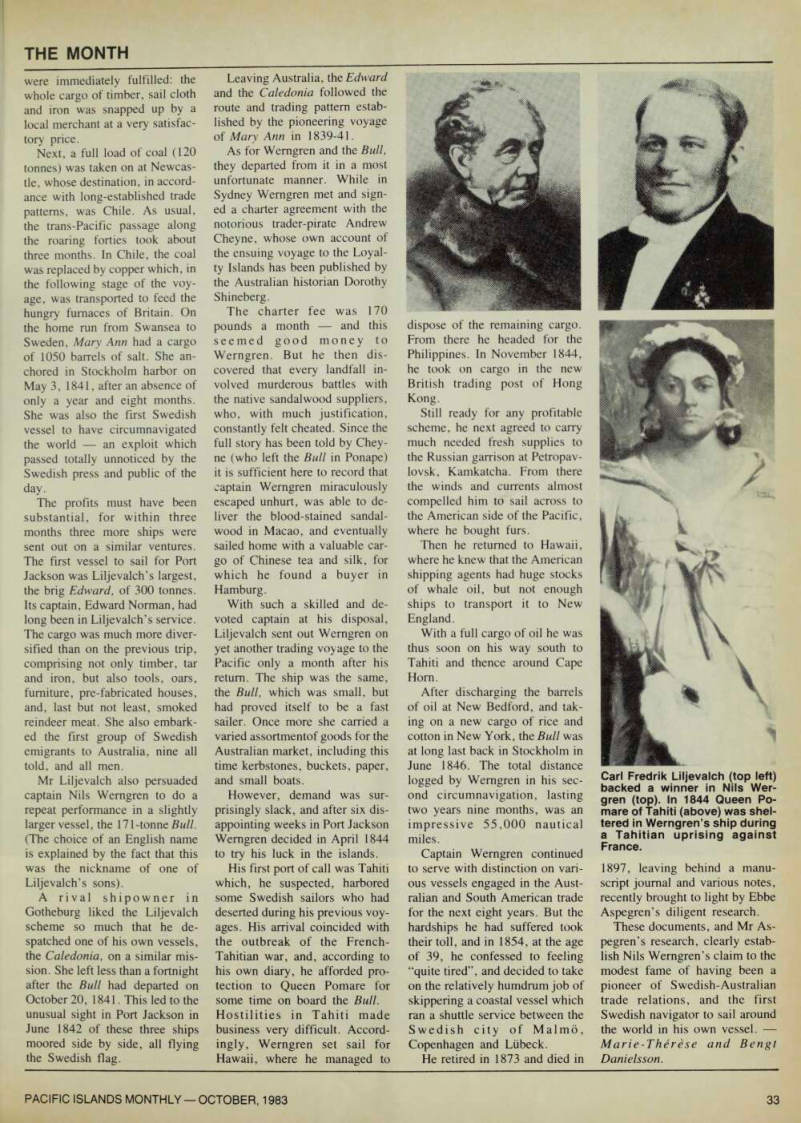
Carl Fredrik Liljevalch (top left) backed a winner in Nils Wer gren (top). In 1844 Queen Po mare of Tahiti (above) was shel tered in Werngren’s ship during a Tahitian uprising against France.