How much longer can
pp. 13-15 · Read in the full issue
Political Currents
South Pacific Forum
How much longer can consensus rule?
The Pacific way, the Melanesian way, the Islands way and a string of other names to describe the same thing have always had a
clear-cut meaning. Simply they
mean that group attitudes are expressed by consensus. There’s no voting, no coercion, and a gentle give and take determines
inter-government regional
policies. That’s the way the South Pacific Forum countries have worked since their organ isation was formed in 1971.
But the 14th meeting of Forum countries, held a few weeks ago in the Australian capital, Canber ra, saw the emergence of a new attitude which suggests that con sensus may not last forever as a
working policy. Something har
der in the form of voting may well become necessary, accord ing to some of the bolder dele gates and officials.
New Zealand Prime Minister Robert Muldoon, who emerged as perhaps the most outspoken and controversial figure at the talks, went on public record con cerning consensus. At a press briefing towards the end of the talks (the talks themselves are held in camera) he said “There’s
no doubt that consensus is get ting harder to achieve”.
Part of this difficulty is clearly caused by the type of subject now coming before the heads of government who make up the
Forum delegates. Although the
Forum was created as a political organisation, free of the con straints affecting the South Pacif ic Conference, a large part of its involvement has been in subjects
The 14th conference of the South Pacific Forum countries, held this year in Australia, urged a peace ful move towards self-determination in New Caledonia* decided to hold later discussions on nuclear issues, and included a clash between Aust ralia and New Zealand over the Forum Shipping Line.
ANGUS SMALES reports on the talks.
which were not inherently con troversial. Consensus worked fine to adopt a uniform attitude to these issues.
Recent Forum meetings how ever, and the Canberra one was no exception, have delved more deeply into controversial issues.
Even where apparent consensus was achieved it is obvious that the different countries, their offi
cials and even their newspapers have different views on what they believe emerged from the conference.
Although the general attitudes of the talks are encapsulated in
an official communique (see page 17), varying constructions are already being put on the wording.
The three major issues which came before the Forum were the financial straits of the Pacific Forum Shipping Line, the matter of self-determination for French administered New Caledonia and the nuclear controversy involv
ing nuclear testing, nuclear waste dumping, nuclear power and
nuclear military applications.
The shipping debate de veloped into a clash between New Zealand and Australia, and despite a move by Fiji it is still indefinite whether the shipping line will get the money it needs to continue operating. The nuc lear debate failed to endorse a suggestion by the comparatively young Labor government of Australia that the Pacific should be declared a nuclear-free zone, although the steady pressure of nuclear awareness remained evi dent. The attitudes towards what was defined as French colonial ism in the Pacific followed fairly predictable lines and did not push as hard as many lobbyists had
hoped.
The Forum Shipping Line op erates three ships under a service sponsored by the Forum coun tries. The principal role of the line is to bring sea transport to
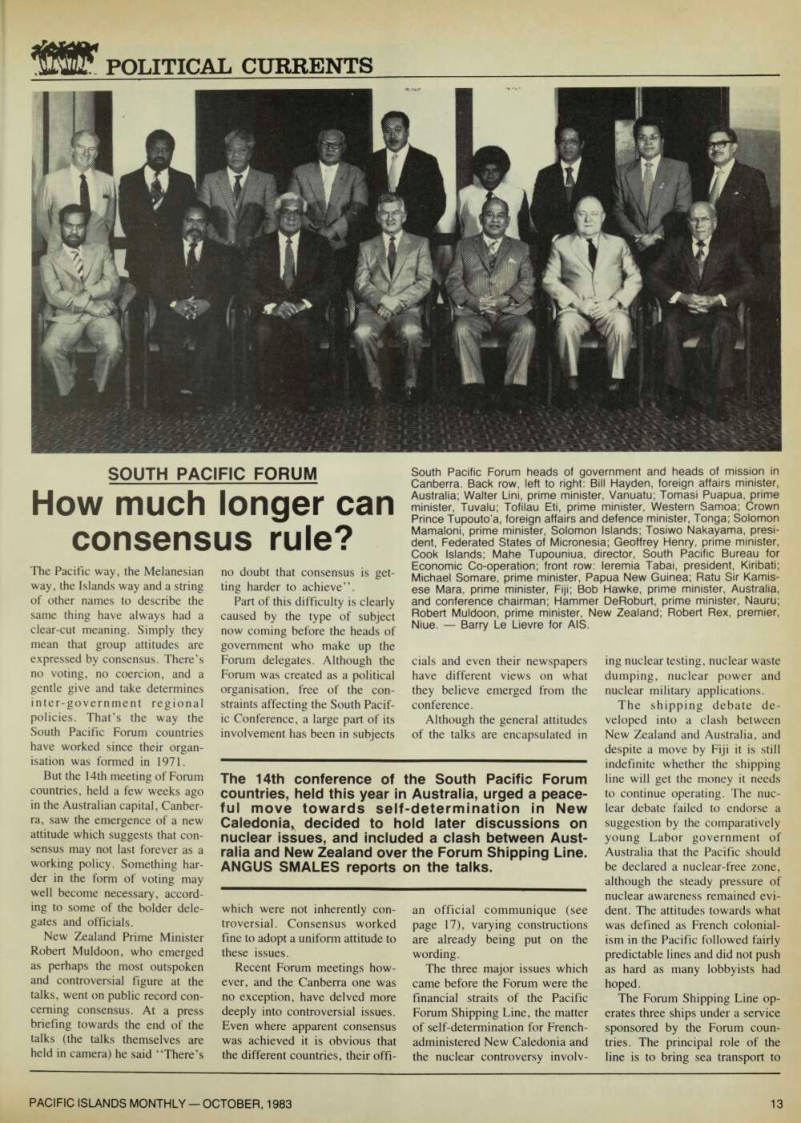
South Pacific Forum heads of government and heads of mission in Canberra. Back row, left to right: Bill Hayden, foreign affairs minister, Australia; Walter Uni, prime minister, Vanuatu: Tomasi Puapua, prime minister, Tuvalu; Tofilau Eti, prime minister, Western Samoa; Crown Prince Tupouto’a, foreign affairs and defence minister, Tonga; Solomon Mamaloni, prime minister, Solomon Islands; Tosiwo Nakayama, presi dent, Federated States of Micronesia: Geoffrey Henry, prime minister, Cook Islands; Mahe Tupouniua, director, South Pacific Bureau for Economic Co-operation; front row: leremia Tabai, president, Kiribati; Michael Somare, prime minister, Papua New Guinea; Ratu Sir Kamis ese Mara, prime minister, Fiji; Bob Hawke, prime minister, Australia, and conference chairman; Hammer DeRoburt, prime minister, Nauru; Robert Muldoon, prime minister, New Zealand; Robert Rex, premier, Niue. - Barry Le Lievre for AIS.
remote areas which have ship ping problems, but the line has been losing money. Australia has refused to give further aid in what is effectively an attitude of not wanting to send good money after bad, but New Zealand (and the management of the line) be lieves that the line will be over the hump if it can receive further immediate aid.
Mr Muldoon was angered by Australian attitudes. He claimed that Australians had alleged that the line was supported by New Zealand only because it helped New Zealand exports. Mr Mul doon accused the Australian De velopment Assistance Bureau of giving “Pacific ignorant” advice to the Australian government ab out the viability of the line. He would not be drawn into criti cism of the new Australian gov ernment, but said the govern ment was being fed incorrect information and advice. As a result, he claimed, the Pacific Forum line was being destroyed and Australia carried much of the blame for refusing further aid.
He said the Australian bureaucrats had no conception of the need for regular and assured shipping transport to remote Pacific island countries. All the bureaucrats understood about transport, he said, was getting in a car and driving out of Canberra.
He refused to concede that the Australian decision to stop furth er aid might be soundly based. “I know more about the Pacific than they do,” he said. “Now the line is dying. The lack of further aid is killing it” he said.
The Australian delegate to the Forum conference, Foreign Minister Bill Hayden, rejected Mr Muldoon’s accusation that Australian politicians were act ing on incorrect advice from the public service. Mr Hayden said “I make the decisions. No bureaucrat makes decisions for me.” He said he had been given a huge range of documentary evidence about the viability of the line. Australia had claimed from the start, he said, that the line was uneconomic and now New Zealand which had strongly endorsed the line was looking for
someone to blame because the line was failing. Mr Hayden said Australia was not completely abandoning the line. The govern ment would permit Island gov ernments to divert their Aust ralian aid to the line if they so wished. Mr Muldoon countered later with a statement which said the line had “come to the end of the road”.
Shortly before the Forum dele gates began returning to their countries there was a new de velopment in the bid to save the shipping line. The Fiji Prime Minister, Ratu Sir Kamisese Ma ra, called a meeting of Pacific countries which belong to the Africa-Caribbean-Pacific group, a collection of developing coun tries receiving European Economic Community aid. The Pacific members of the group are Papua New Guinea, Fiji. Sol omon Islands, Vanuatu, Western
Samoa, Tonga, Kiribati and Tuvalu. The ACP Pacific group decided to seek permission from the European Community to di vert their unused aid to the ship
ping line.
The Chairman of the Forum Line, Mr Harry Julian, was jubil ant at the decision and claimed that the line “is back in business again”. But Mr Muldoon re mained pessimistic and said he believed the line was still in trouble.
On nuclear issues the Forum rejected an Australian proposal to declare a nuclear free zone in the Pacific. Although the Forum
discussions were in camera and
despite an acknowledged general
objection to French nuclear test ing, there is clearly a lack of general agreement on the overall nuclear situation. One of the is sues which caused a failure to reach agreement concerned the operation of nuclear-powered ships and nuclear-armed aircraft.
Some delegates wanted to de clare a nuclear-free zone, but did not object to nuclear-powered ships and nuclear-armed aircraft in the zone a situation which was untenable to the hard-line countries.
The main indication which emerged from the talks was that a nuclear-weapon-free zone was a possibility for the future, even if nuclear power and nuclear pro
pulsion were permitted.
The meeting decided that it needed more time to consider the full implications of the Aust ralian proposal and to carry out wide-ranging consultations aris ing from it. Mr Hayden, as dele gate for Australia, undertook to provide Forum countries with re ports on how nuclear-free pro posals and practices were con stituted in other parts of the world. Further discussion on nuclear issues was listed for next year’s meeting of Forum coun tries which will be held in Tuvalu.
In its attitude to France’s in volvement in New Caledonia the Forum countries labelled France’s involvement there as “a colonial situation” and made a series of general declarations ab out the legitimacy of the Kanak people’s moves for self determination and independence.
However the import of the deci sions was not as strong as lobby ists of whom there were many at the meeting had hoped.
The main impression which emerged from the conference at titude towards France was that the situation is far more sensitive than many of the lobbyists and activists acknowledge, and that finesse rather than hard cam paigning is needed. The Forum meeting welcomed moves al ready made by France to break down the colonial relationship, and urged both sides to approach
political change by peaceful
means.
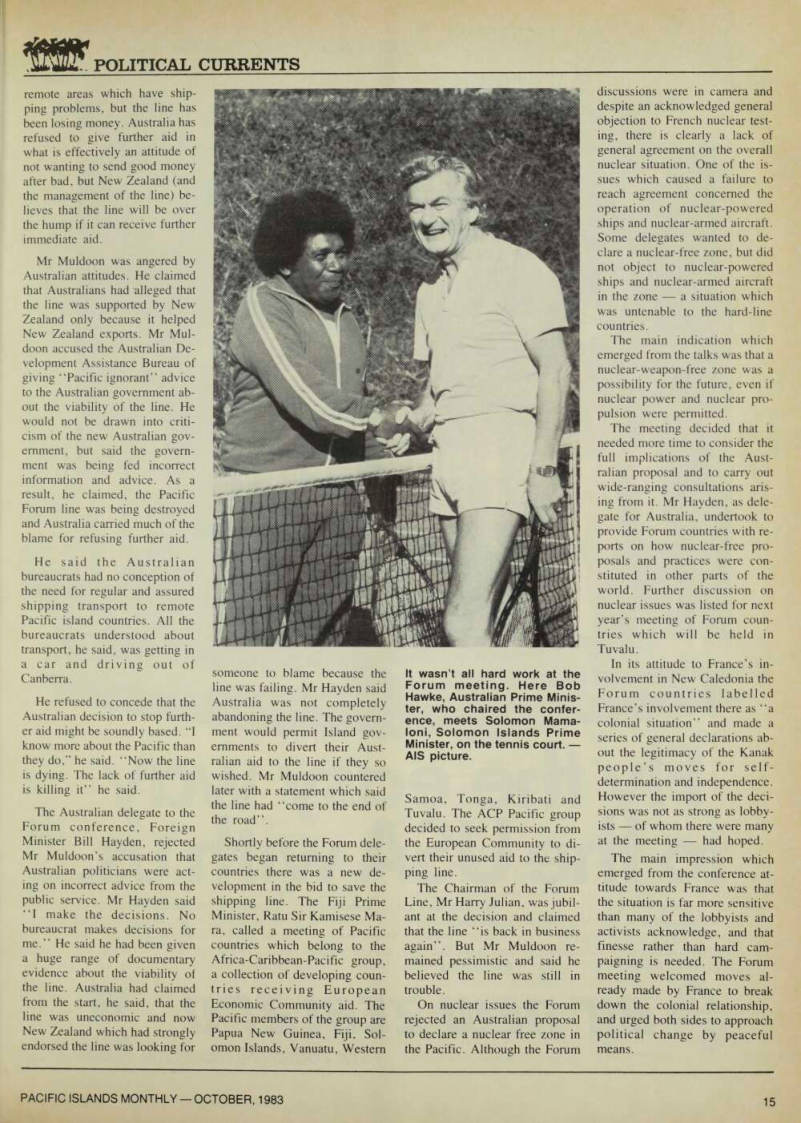
It wasn’t all hard work at the Forum meeting. Here Bob Hawke, Australian Prime Minis ter, who chaired the confer ence, meets Solomon Mama loni, Solomon Islands Prime Minister, on the tennis court.
AIS picture.