Malaysia sells
p. 63 · Read in the full issue
to the Pacific
In the past 10 years Malaysia has been undergoing a rapid period of internal change and growth as it shifts from a labor-intensive economy to a new economy based on technology and capital investment.
Rubber, the long-established staple export, still earns money for Malaysia but it has been outstripped by crude petroleum, palm oil and manufactures.
The development of the manu facturing industry is the most significant indicator of what is happening in today’s Malaysia.
Petroleum is at the top of the earning list, but manufactures come next ahead of palm oil, rubber, timber and tin. Present figures suggest that manufac tured goods provide about 20 percent of the country’s export earnings, and about a third of the manufactures is in the electronics and electronic components industry.
This month Malaysia will send a trade delegation to three Pacific Island countries Papua New Guinea, Solomon Islands and Fi ji. This is a direct result of the growth of the manufacturing in
dustry, followed by a drive to obtain new markets.
The range of goods available from the new Malaysia is impres sive. There is a wide range of basic food products, including meat, vegetable and fish pro ducts, and a big range of canned goods. Not surprisingly Malaysia has become a leading world sup plier of natural rubber products which go to the building, machinery and automotive indus tries, for domestic use and for medical and industrial users.
Wood and wood manufactured products are also exported. Other exports include glass and plast ics, tools, chemicals, clothing, fabrics, industrial machinery, marine equipment, office equip ment, building and construction materials and a wide range of metal and machined products.
In the electrical and electronic industries Malaysia produces and exports a huge range of compo nents and equipment, much of it representing newest world tech nology. It ranges from micro circuits to heavy machinery.
Malaysia has achieved its big shift to manufacturing strength by a number of significant policies. One of these has been to attract subsidiary or partnership operations in Malaysia by well established industrial companies throughout the world. The list of countries which now have opera tions in Malaysia is a long one. It includes UK, USA, Holland, West Germany, Sweden, Swit zerland, Japan, Australia, and New Zealand.
Because of its sound expansion policies and the recognition of investment and expertise from outside, Malaysia was able to achieve a real growth rate of about eight percent for the 10 years until 1980. The world re cession has affected growth, but even so the 1981 figure was between six and seven percent.
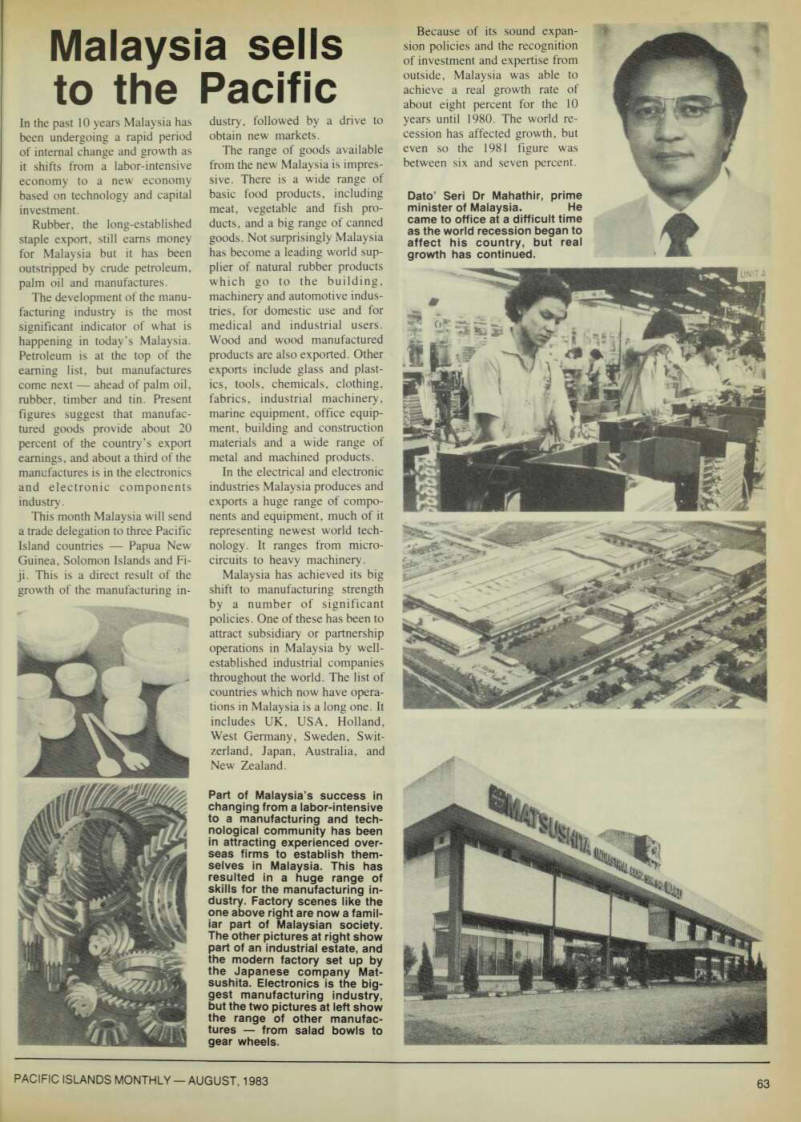
Part of Malaysia’s success in changing from a labor-intensive to a manufacturing and tech nological community has been
in attracting experienced over
seas firms to establish them selves in Malaysia. This has resulted in a huge range of skills for the manufacturing in dustry. Factory scenes like the one above right are now a famil iar part of Malaysian society.
The other pictures at right show part of an industrial estate, and the modern factory set up by the Japanese company Mat sushita. Electronics is the big
gest manufacturing industry,
but the two pictures at left show the range of other manufac tures - from salad bowls to gear wheels.
Dato’ Seri Dr Mahathir, prime minister of Malaysia. He came to office at a difficult time as the world recession began to affect his country, but real growth has continued.