the unknown’ - U.S. scientist
pp. 29-31 · Read in the full issue
Droughts And Storms
The weather of ’83: ‘We’re facing the unknown’ - U.S. scientist
Put simply, in this year’s extraordinary worldwide weather pat- ♦ * *u *• . terns, at the time ram should have been falling in the western Pacific, it was deluging the eastem Pacific.
In the west, the Philippines, the islands of Micronesia, the island continent of Australia, and island nations such as Fiji, experienced one of their worst-ever droughts. In the east, floods ravaged several South American countries, and French Polynesia,
which normally experiences eye-
lones about once in 100 years, suffered six, with their torrential rains, over the space of four months.
Eugene Rasmusson, chief of the diagnostic branch of the cli mate analysis centre of the U.S.
National Oceanic and Atmos pheric Administration (NOAA), says; "We are so far over the previous records they are not even close". In some cases the records are 300 per cent more
than previously.
At the core of the analysis made by climatologists of the unprecedented IWS3 weather patterns is the phenomenon known as Id Nine, or "Christ On Id". named such b\ South Amenc, fishermen because normally
begins near Christmas, when ab
normally warm and plankton
free waters ruin their fishing grounds.
As scientists describe it, El Nino is a little-understood event which drastically alters one of the main pillars of the world weather system.
Three places around the world near Indonesia, over Southern Africa, and over the Amazon basin generate much of the world’s weather.
They are called spots of “con vergence” and exist over large areas where the water or land is
quite warm. The warmth from
the ground rises rapidly, creating
great updrafts. The upward
movement of air currents pulls in nearby air masses.
The convergence centre in the southwest Pacific off Indonesia is said to be one of the most powerful but least stable. (It is pointed out that other converg ence centres stand against moun tain ranges and other topograph ical features that hold them in
place).
Scientists say it is the break down of the convergence centre off Indonesia and Australia, and
its reformation thousands of kilometres away towards South America, that has caused the 1983 weather patterns in the Pacific.
When the convergence centre moves towards South America it
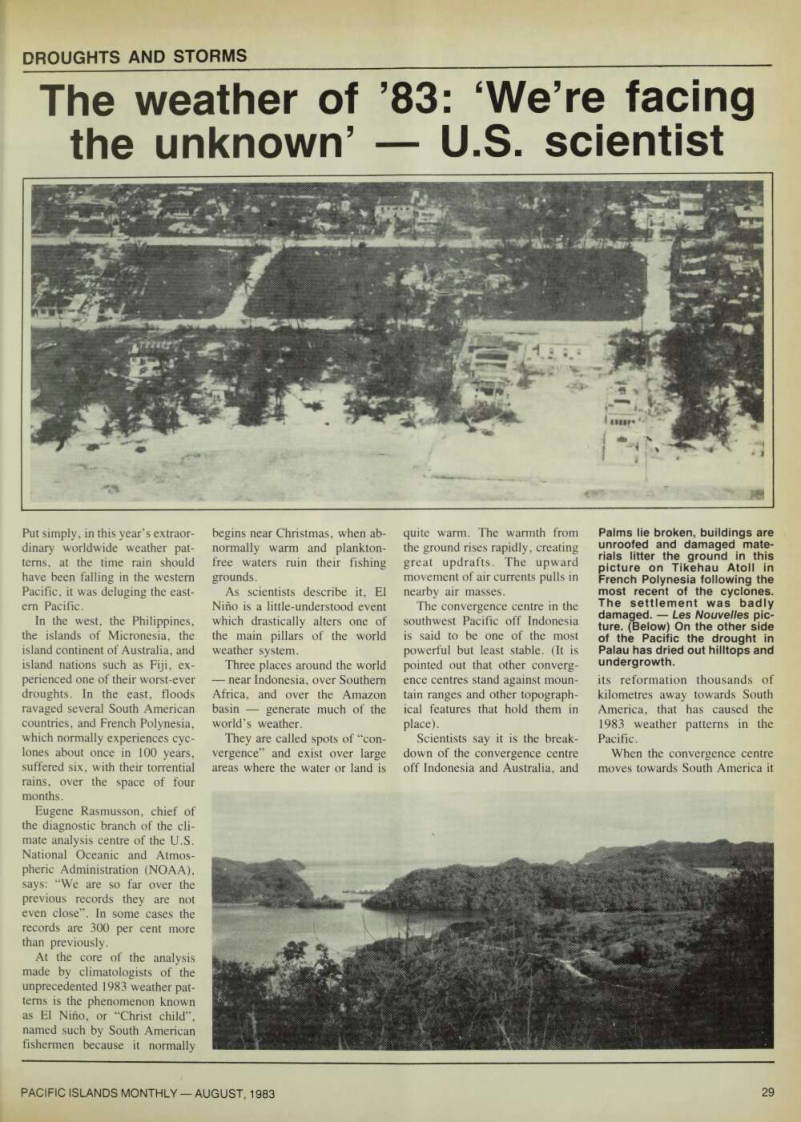
Palms lie broken, buildings are unroofed and damaged mate rials litter the ground in this picture on Tikehau Atoll in French Polynesia following the most recent of the cyclones.
The settlement was badly
damaged. - Les Nouvelles pic
ture. (Below) On the other side of the Pacific the drought in Palau has dried out hilltops and undergrowth.
takes rain away from Australia and the western Pacific and dumps it instead on Pacific is lands and the South American coast.
Mr Rasmusson said in June that although it was long past the time when El Nino should have ended, torrential rains and scorching drought beyond all re cords continued in South Ameri ca and other continents. Other meteorological signs, such as sea surface temperatures off South America, remained unusually high, more than 10 degrees above normal.
At the same time, one indi cator air pressure was almost back to normal in the South Pacific, where El Nino weather patterns are centred.
Mr Rasmusson said; “It is un believable to me that we can keep going with these two count er-trends. Either we will go back to more normal patterns, or we will have two years of El Nino back to back, something that is without precedent”.
As for predictions of which way the weather will go, Mr Rasmusson said: “It’s all speculation.
“We are in no-man’s land be cause this is so far beyond any thing we have experienced, an event so intense and so extreme that we can’t predict what will happen next”.
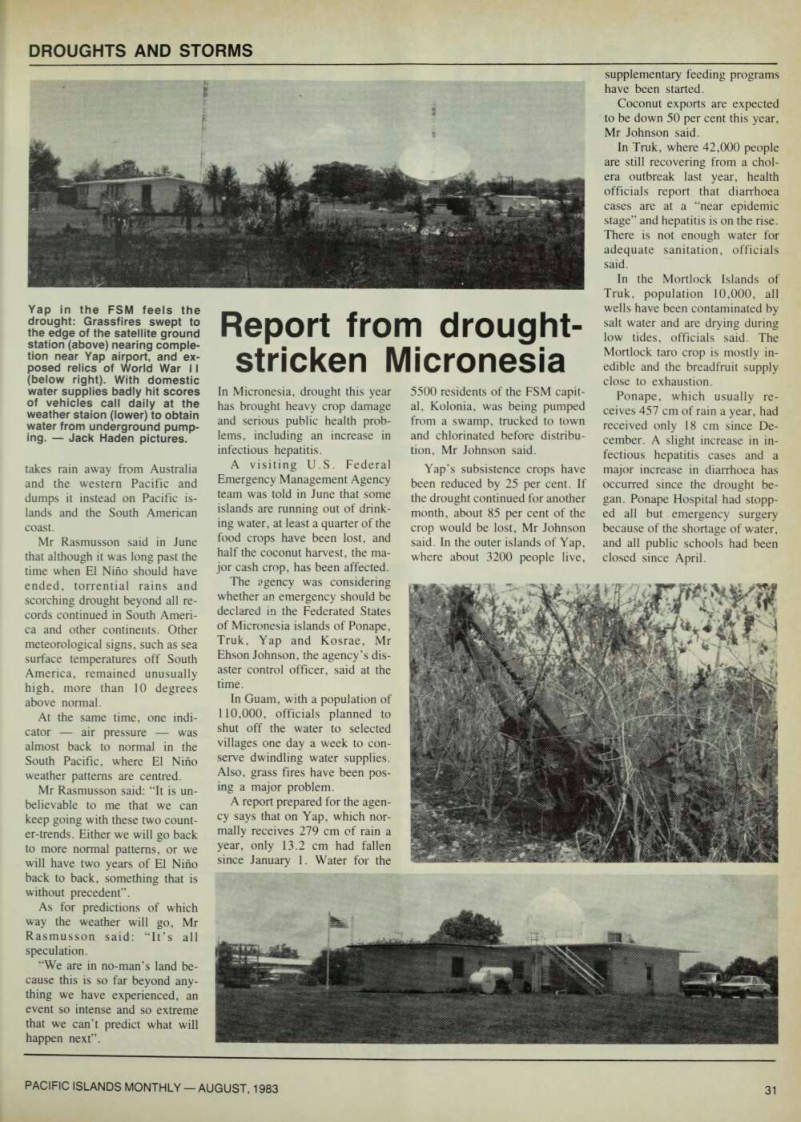
Yap in the FSM feels the drought: Grassfires swept to the edge of the satellite ground station (above) nearing comple tion near Yap airport, and ex posed relics of World War II (below right). With domestic water supplies badly hit scores of vehicles call daily at the weather staion (lower) to obtain water from underground pump
ing. - Jack Haden pictures.