Yachts
pp. 58-61 · Read in the full issue
Lan G. Menzies Re
ports from Rabaul,
Madang and Port
Moresby, Papua New
Guinea:
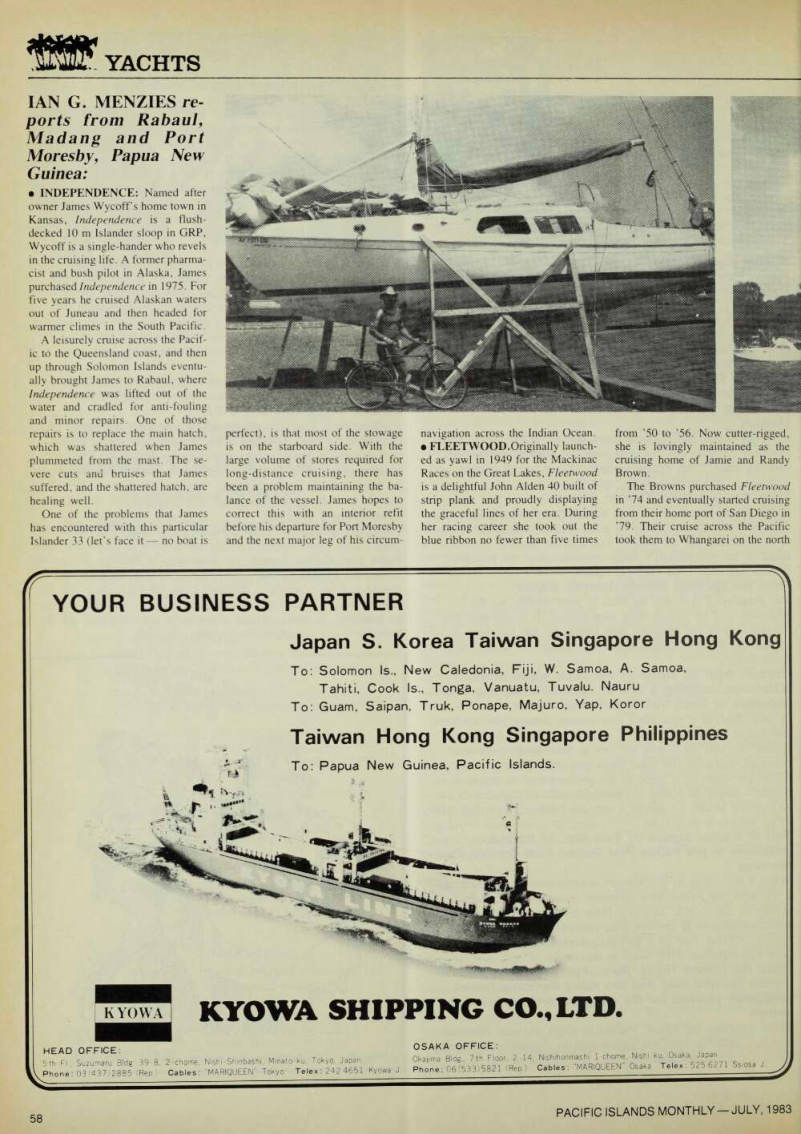
• INDEPENDENCE: Named after owner James Wycoff s home town in Kansas, Independence is a flush decked 10 m Islander sloop in GRP, Wycoff is a single-hander who revels in the cruising life. A former pharma cist and bush pilot in Alaska, James purchased Independence in 1975. For five years he cruised Alaskan waters out of Juneau and then headed for warmer climes in the South Pacific.
A leisurely cruise across the Pacif ic to the Queensland coast, and then up through Solomon Islands eventu ally brought James to Rabaul, where Independence was lifted out of the water and cradled for anti-fouling and minor repairs. One of those repairs is to replace the main hatch, which was shattered when James plummeted from the mast. The se vere cuts and bruises that James suffered, and the shattered hatch, are
healing well.
One of the problems that James has encountered with this particular Islander 33 (let’s face it no boat is
perfect), is that most of the stowage is on the starboard side. With the large volume of stores required for long-distance cruising, there has been a problem maintaining the ba lance of the vessel. James hopes to correct this with an interior refit before his departure for Port Moresby and the next major leg of his circum
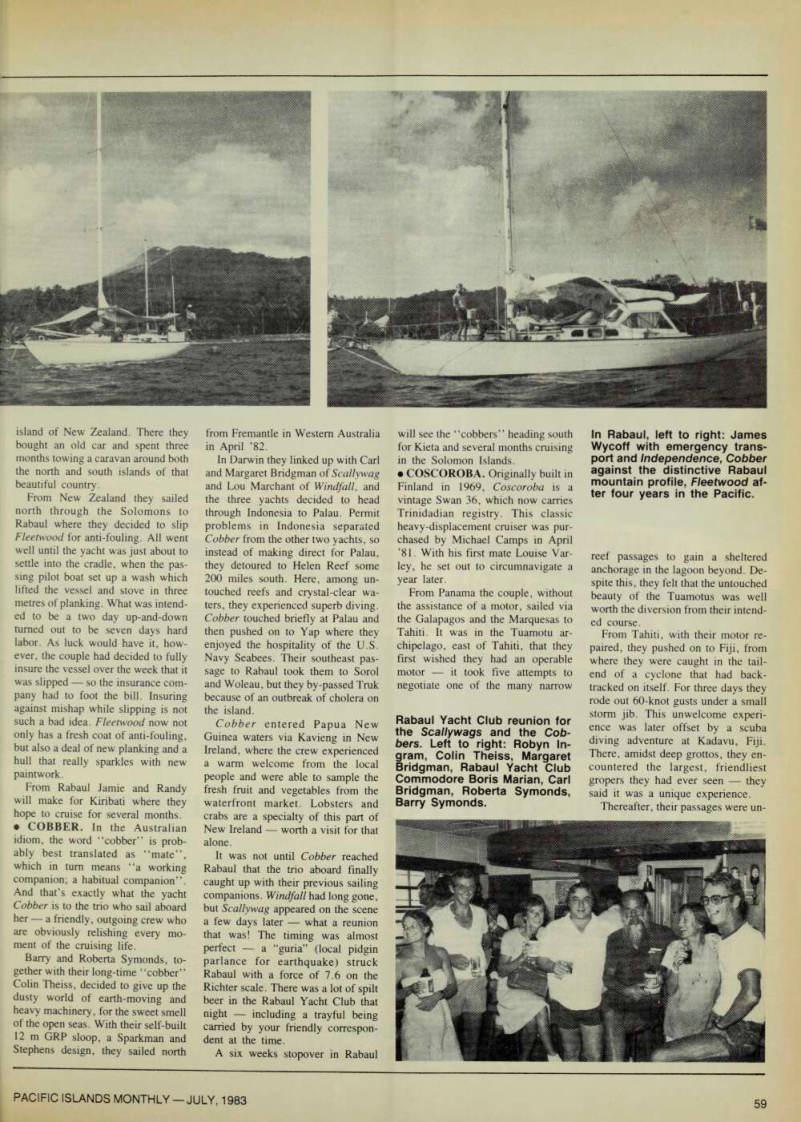
navigation across the Indian Ocean. • FLEETWOOD.Originally launch ed as yawl in 1949 for the Mackinac Races on the Great Lakes, Fleetwood is a delightful John Alden 40 built of
strip plank and proudly displaying
the graceful lines of her era. During her racing career she took out the blue ribbon no fewer than five times
from ’5O to ’56. Now cutter-rigged, she is lovingly maintained as the cruising home of Jamie and Randy Brown.
The Browns purchased Fleetwood in ’74 and eventually started cruising from their home port of San Diego in ’79. Their cruise across the Pacific took them to Whangarei on the north
island of New Zealand. There they bought an old car and spent three months towing a caravan around both the north and south islands of that beautiful country.
From New Zealand they sailed north through the Solomons to Rabaul where they decided to slip Fleetwood for anti-fouling. All went well until the yacht was just about to settle into the cradle, when the pas sing pilot boat set up a wash which lifted the vessel and stove in three metres of planking. What was intend ed to be a two day up-and-down turned out to be seven days hard labor. As luck would have it, how ever, the couple had decided to fully insure the vessel over the week that it was slipped so the insurance com pany had to foot the bill. Insuring against mishap while slipping is not such a bad idea. Fleetwood now not only has a fresh coat of anti-fouling, but also a deal of new planking and a hull that really sparkles with new
paintwork.
From Rabaul Jamie and Randy will make for Kiribati where they hope to cruise for several months. • COBBER. In the Australian idiom, the word “cobber” is prob ably best translated as “mate”, which in turn means “a working companion; a habitual companion”.
And that’s exactly what the yacht Cobber is to the trio who sail aboard her a friendly, outgoing crew who are obviously relishing every mo ment of the cruising life.
Barry and Roberta Symonds, to gether with their long-time “cobber”
Colin Theiss, decided to give up the dusty world of earth-moving and heavy machinery, for the sweet smell of the open seas. With their self-built 12 m GRP sloop, a Sparkman and
Stephens design, they sailed north
from Fremantle in Western Australia in April ’B2.
In Darwin they linked up with Carl
and Margaret Bridgman of Scallywag
and Lou Marchant of Windfall, and the three yachts decided to head through Indonesia to Palau. Permit problems in Indonesia separated Cobber from the other two yachts, so instead of making direct for Palau, they detoured to Helen Reef some 200 miles south. Here, among un touched reefs and crystal-clear wa ters, they experienced superb diving.
Cobber touched briefly at Palau and then pushed on to Yap where they enjoyed the hospitality of the U.S.
Navy Seabees. Their southeast pas sage to Rabaul took them to Sorol and Woleau, but they by-passed Truk because of an outbreak of cholera on the island.
Cobber entered Papua New Guinea waters via Kavieng in New Ireland, where the crew experienced a warm welcome from the local people and were able to sample the fresh fruit and vegetables from the waterfront market. Lobsters and crabs are a specialty of this part of New Ireland worth a visit for that alone.
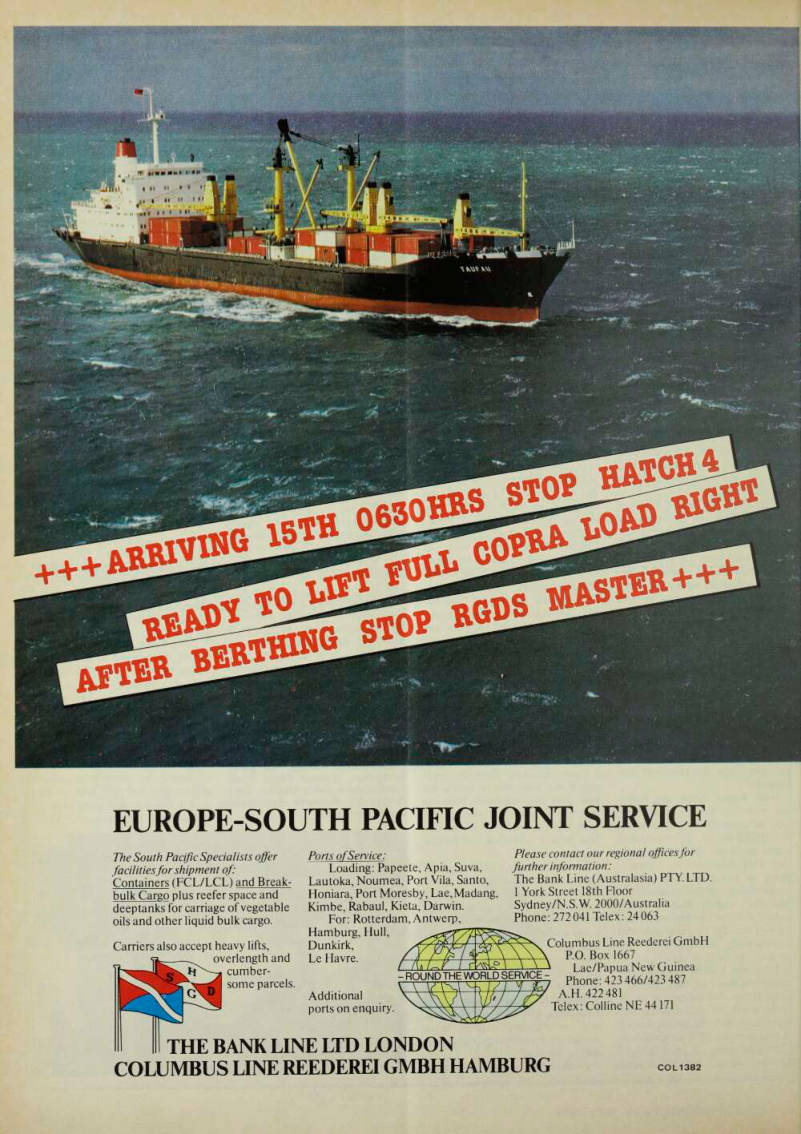
It was not until Cobber reached Rabaul that the trio aboard finally caught up with their previous sailing companions. Windfall had long gone, but Scallywag appeared on the scene a few days later what a reunion that was! The timing was almost perfect a “guria” (local pidgin
parlance for earthquake) struck
Rabaul with a force of 7.6 on the Richter scale. There was a lot of spilt beer in the Rabaul Yacht Club that
night including a trayful being
carried by your friendly correspon dent at the time.
A six weeks stopover in Rabaul
will see the “cobbers” heading south for Kieta and several months cruising in the Solomon Islands. • COSCOROBA. Originally built in Finland in 1969, Coscoroba is a vintage Swan 36, which now carries Trinidadian registry. This classic heavy-displacement cruiser was pur chased by Michael Camps in April ’Bl. With his first mate Louise Var ley, he set out to circumnavigate a year later.
From Panama the couple, without the assistance of a motor, sailed via the Galapagos and the Marquesas to Tahiti. It was in the Tuamotu ar chipelago, east of Tahiti, that they first wished they had an operable motor it took five attempts to negotiate one of the many narrow
reef passages to gain a sheltered anchorage in the lagoon beyond. De spite this, they felt that the untouched beauty of the Tuamotus was well worth the diversion from their intend ed course.
From Tahiti, with their motor re paired, they pushed on to Fiji, from where they were caught in the tail end of a cyclone that had back tracked on itself. For three days they rode out 60-knot gusts under a small storm jib. This unwelcome experi ence was later offset by a scuba diving adventure at Kadavu, Fiji.
There, amidst deep grottos, they en countered the largest, friendliest gropers they had ever seen they said it was a unique experience.
Thereafter, their passages were un-
Rabaul Yacht Club reunion for the Scallywags and the Cob bers. Left to right: Robyn In gram, Colin Theiss, Margaret Bridgman, Rabaul Yacht Club Commodore Boris Marian, Carl Bridgman, Roberta Symonds, Barry Symonds.
In Rabaul, left to right: James Wycoff with emergency trans port and Independence, Cobber against the distinctive Rabaul mountain profile, Fleetwood af ter four years in the Pacific.
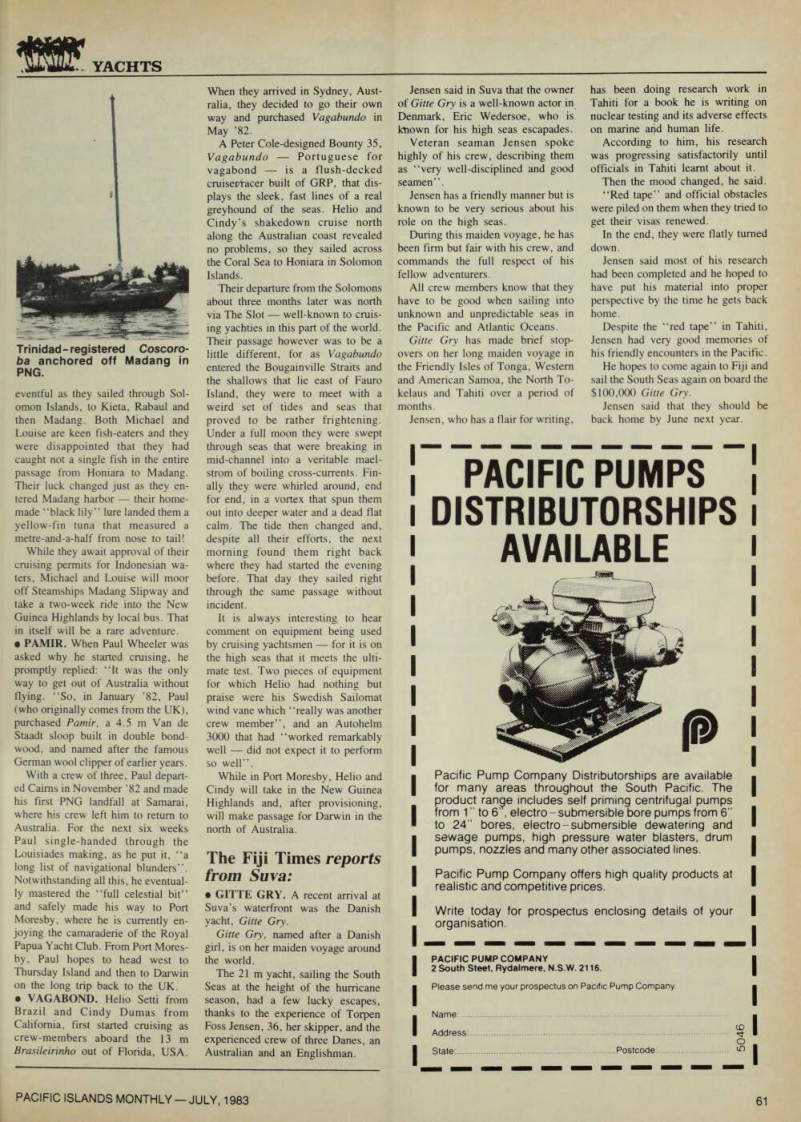
eventful as they sailed through Sol omon Islands, to Kieta, Rabaul and then Madang. Both Michael and Louise are keen fish-eaters and they were disappointed that they had caught not a single fish in the entire passage from Honiara to Madang.
Their luck changed just as they en tered Madang harbor their home made “black lily” lure landed them a yellow-fin tuna that measured a metre-and-a-half from nose to tail!
While they await approval of their cruising permits for Indonesian wa ters, Michael and Louise will moor
off Steamships Madang Slipway and
take a two-week ride into the New Guinea Highlands by local bus. That in itself will be a rare adventure, t PAMIR. When Paul Wheeler was asked why he started cruising, he
promptly replied: “It was the only
way to get out of Australia without flying. “So, in January ’B2, Paul (who originally comes from the UK), purchased Pamir, a 4.5 m Van de Staadt sloop built in double bond wood, and named after the famous German wool clipper of earlier years.
With a crew of three, Paul depart ed Cairns in November ’B2 and made his first PNG landfall at Samarai, where his crew left him to return to Australia. For the next six weeks
Paul single-handed through the
Louisiades making, as he put it, “a long list of navigational blunders”.
Notwithstanding all this, he eventual ly mastered the “full celestial bit” and safely made his way to Port Moresby, where he is currently en joying the camaraderie of the Royal Papua Yacht Club. From Port Mores by, Paul hopes to head west to Thursday Island and then to Darwin on the long trip back to the UK. • VAGABOND. Helio Setti from Brazil and Cindy Dumas from California, first started cruising as crew-members aboard the 13 m Brasileirinho out of Florida, USA.
When they arrived in Sydney, Aust ralia, they decided to go their own way and purchased Vagabundo in May ’B2.
A Peter Cole-designed Bounty 35, Vagabundo Portuguese for vagabond is a flush-decked cruiseriacer built of GRP, that dis plays the sleek, fast lines of a real greyhound of the seas. Helio and Cindy’s shakedown cruise north along the Australian coast revealed no problems, so they sailed across the Coral Sea to Honiara in Solomon Islands.
Their departure from the Solomons about three months later was north via The Slot well-known to cruis ing yachties in this part of the world.
Their passage however was to be a little different, for as Vagabundo entered the Bougainville Straits and the shallows that lie east of Fauro Island, they were to meet with a weird set of tides and seas that proved to be rather frightening.
Under a full moon they were swept through seas that were breaking in mid-channel into a veritable mael strom of boiling cross-currents. Fin ally they were whirled around, end for end, in a vortex that spun them out into deeper water and a dead flat calm. The tide then changed and, despite all their efforts, the next morning found them right back where they had started the evening before. That day they sailed right through the same passage without incident.
It is always interesting to hear comment on equipment being used by cruising yachtsmen for it is on the high seas that it meets the ulti mate test. Two pieces of equipment for which Helio had nothing but praise were his Swedish Sailomat wind vane which “really was another crew member”, and an Autohelm 3000 that had “worked remarkably well did not expect it to perform so well”.
While in Port Moresby, Helio and Cindy will take in the New Guinea Highlands and, after provisioning, will make passage for Darwin in the north of Australia.
The Fiji Times reports
from Suva:
• GITTE GRY. A recent arrival at Suva’s waterfront was the Danish yacht, Gitte Gry.
Gitte Gry, named after a Danish girl, is on her maiden voyage around the world.
The 21 m yacht, sailing the South Seas at the height of the hurricane season, had a few lucky escapes, thanks to the experience of Torpen Foss Jensen, 36, her skipper, and the experienced crew of three Danes, an Australian and an Englishman.
Jensen said in Suva that the owner of Gitte Gry is a well-known actor in Denmark, Eric Wedersoe, who is known for his high seas escapades.
Veteran seaman Jensen spoke highly of his crew, describing them as “very well-disciplined and good seamen”.
Jensen has a friendly manner but is known to be very serious about his role on the high seas.
During this maiden voyage, he has been firm but fair with his crew, and commands the full respect of his fellow adventurers.
All crew members know that they have to be good when sailing into unknown and unpredictable seas in the Pacific and Atlantic Oceans.
Gitte Gry has made brief stop overs on her long maiden voyage in the Friendly Isles of Tonga, Western and American Samoa, the North To kelaus and Tahiti over a period of months.
Jensen, who has a flair for writing.
has been doing research work in Tahiti for a book he is writing on nuclear testing and its adverse effects on marine and human life.
According to him, his research
was progressing satisfactorily until
officials in Tahiti learnt about it.
Then the mood changed, he said.
“Red tape” and official obstacles were piled on them when they tried to get their visas renewed.
In the end, they were flatly turned down.
Jensen said most of his research had been completed and he hoped to have put his material into proper perspective by the time he gets back home.
Despite the “red tape” in Tahiti, Jensen had very good memories of his friendly encounters in the Pacific.
He hopes to come again to Fiji and sail the South Seas again on board the $lOO,OOO Gitte Gry.
Jensen said that they should be back home by June next year.
Trinidad-registered Coscoro ba anchored off Madang in