No flowers for
pp. 21-24 · Read in the full issue

the visitor ...
The first and surest sign these days that something has gone wrong in Tahiti is that a traveller disembarking at Papeete’s Faaa airport will not be greeted by having a sweet-scented garland
of flowers hung round his neck, This does not mean at all that
Tahitian hospitality is breaking
down. It is simply that there are no more flower stalls, vendors or even flowers since Tahiti was
struck in early April by the most destructive of all the six cyclones that have devastated French Polynesia since December 1982 (PIM Mar. p3l, Apr. p 5, May p 23).
Despite all the recent experi ence, preparedness left much to be desired when the sixth cyc lone, Veena, hit Tahiti on the night of April 11-12. One expla nation for the curious apathy was undoubtedly the general feeling
that all cyclone danger just had to be over for this season at least.
But Veena, like those that had gone before, was full of dirty tricks. It seemed to be passing at a safe distance north of Tahiti, and in a westerly direction. But then it suddenly changed course and veered full speed towards Tahiti.
The hurricane-force gusts of Cyclone Reva a month before had followed a similar course,
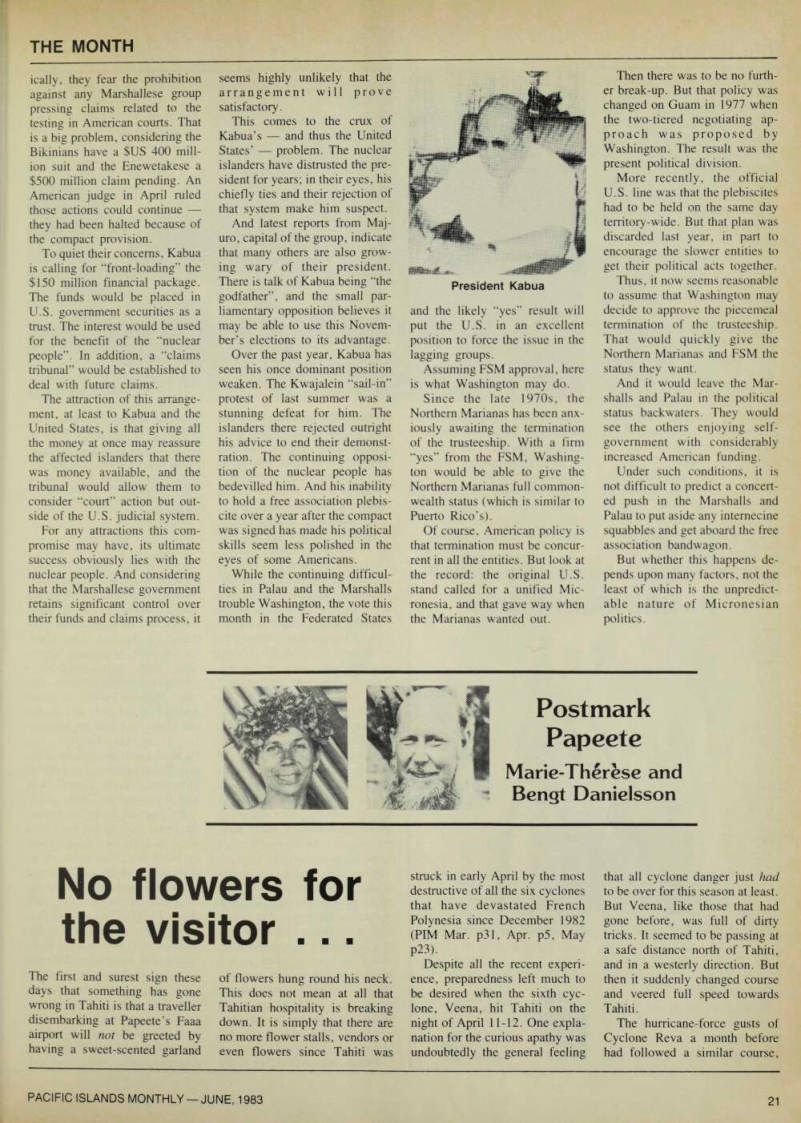
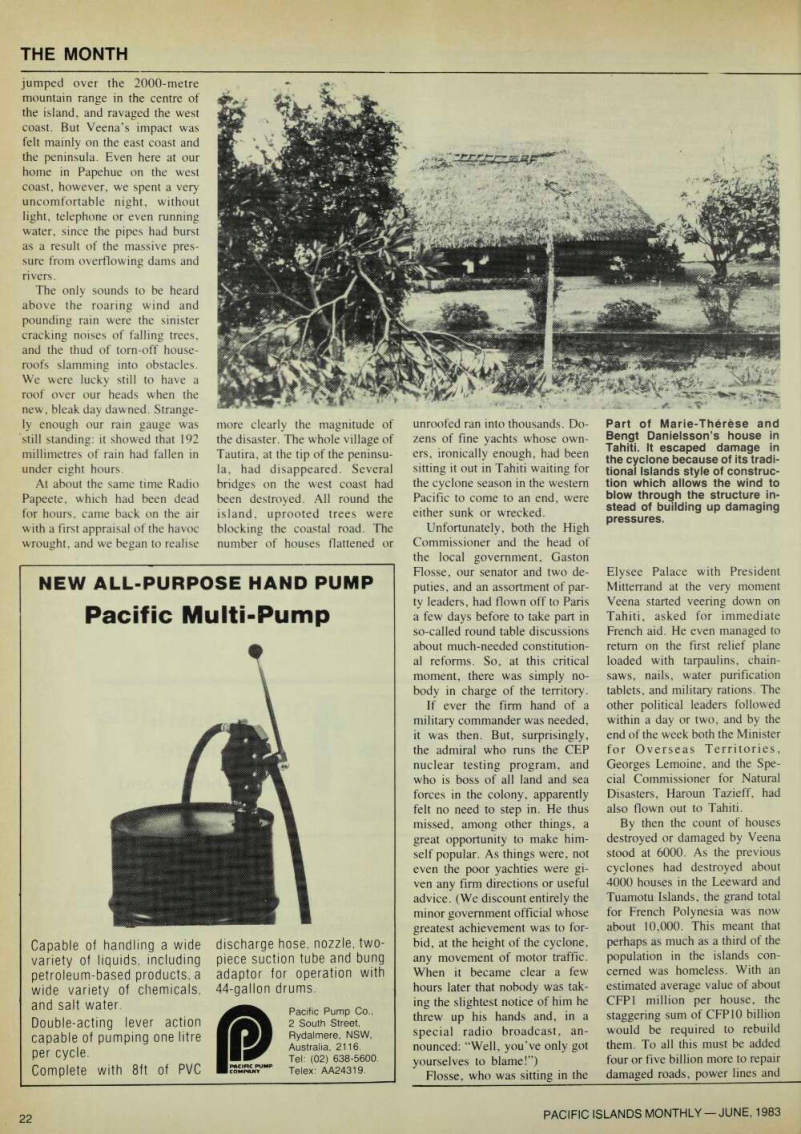
Postmark Papeete Marie-Thérèse and Bengt Danielsson
jumped over the 2000-metre mountain range in the centre of the island, and ravaged the west coast. But Veena’s impact was felt mainly on the east coast and the peninsula. Even here at our home in Papehue on the west coast, however, we spent a very uncomfortable night, without
light, telephone or even running
water, since the pipes had burst as a result of the massive pres sure from overflowing dams and rivers.
The only sounds to be heard above the roaring wind and pounding rain were the sinister cracking noises of falling trees, and the thud of tom-off house roofs slamming into obstacles.
We were lucky still to have a roof over our heads when the new, bleak day dawned. Strange ly enough our rain gauge was still standing: it showed that 192 millimetres of rain had fallen in under eight hours.
At about the same time Radio Papeete, which had been dead for hours, came back on the air with a first appraisal of the havoc wrought, and we began to realise
more clearly the magnitude of the disaster. The whole village of Tautira, at the tip of the peninsu la, had disappeared. Several bridges on the west coast had been destroyed. All round the island, uprooted trees were blocking the coastal road. The number of houses flattened or
unroofed ran into thousands. Do zens of fine yachts whose own ers, ironically enough, had been sitting it out in Tahiti waiting for the cyclone season in the western Pacific to come to an end, were either sunk or wrecked.
Unfortunately, both the High
Commissioner and the head of the local government, Gaston Flosse, our senator and two de puties, and an assortment of par ty leaders, had flown off to Paris a few days before to take part in so-called round table discussions about much-needed constitution al reforms. So, at this critical moment, there was simply no
body in charge of the territory.
If ever the firm hand of a military commander was needed, it was then. But, surprisingly, the admiral who runs the CEP nuclear testing program, and who is boss of all land and sea forces in the colony, apparently felt no need to step in. He thus missed, among other things, a great opportunity to make him self popular. As things were, not even the poor yachties were gi ven any firm directions or useful advice. (We discount entirely the minor government official whose greatest achievement was to for bid, at the height of the cyclone, any movement of motor traffic.
When it became clear a few hours later that nobody was tak ing the slightest notice of him he threw up his hands and, in a special radio broadcast, an nounced: “Well, you’ve only got yourselves to blame!”) Flosse, who was sitting in the
Elysee Palace with President Mitterrand at the very moment Veena started veering down on Tahiti, asked for immediate French aid. He even managed to return on the first relief plane loaded with tarpaulins, chain saws, nails, water purification tablets, and military rations. The other political leaders followed within a day or two, and by the end of the week both the Minister for Overseas Territories, Georges Lemoine, and the Spe cial Commissioner for Natural Disasters, Haroun Tazieff, had also flown out to Tahiti.
By then the count of houses destroyed or damaged by Veena stood at 6000. As the previous
cyclones had destroyed about
4000 houses in the Leeward and Tuamotu Islands, the grand total for French Polynesia was now about 10,000. This meant that perhaps as much as a third of the population in the islands con cerned was homeless. With an estimated average value of about CFPI million per house, the staggering sum of CFPIO billion would be required to rebuild them. To all this must be added four or five billion more to repair damaged roads, power lines and
Part of Marie-Thérèse and Bengt Danielsson’s house in Tahiti. It escaped damage in the cyclone because of its tradi tional Islands style of construc tion which allows the wind to blow through the structure in stead of building up damaging pressures.
public buildings such as schools and town halls.
The human losses must be said to be minimal, considering the force of this succession of cyc lones: 17 dead either crushed by falling walls or trees, or drowned at sea and about 200
injured.
As we have suggested before, the gravest consequences of these cyclones will be felt in the Tuamotu Islands, where exten sive damage has been done to the coconut plantations. The islan ders will be deprived for years of their only source of income, cop ra production. In consequence of this, large numbers of them no doubt will pack up and leave for the already over-crowded slums in and around Papeete.
The biggest post-cyclone
problem, of course, is where’s the money coming from to pay for the huge tasks of reconstruc tion and replanting?
The independent socialist par ty, la Mana te Nunaa, im mediately proposed that it could
easily be raised by introducing
income tax (hitherto unknown in the territory). This idea was re
jected outright by the ruling
Tahoeraa party of Gaston Flosse, who felt that a sense of “national solidarity” commanded France to come to our aid.
Considering the depressed
state of the French economy, the Paris government has already made an honorable effort by pro mising about CFPI billion in disaster relief. On top of that, the French parliament has launched a national relief appeal in the appa rent belief that the 300,000 or so French citizens who have served in one capacity or another in French Polynesia over the years will have such fond memories of their time here that they will chip in large sums. This remains to be seen.
In a noisy aside during his time in Tahiti, Commissioner Tazieff gave vent to the view that this sudden financial plight of the colony would have the beneficial effect of making the Polynesian leaders a little more humble, and less inclined to make impatient noises about such matters as con stitutional reforms and independ ence. Mr Tazieff probably now wishes he had kept his mouth shut, for Mr Lemoine in his turn
went out of his way to serve him a public rebuke, saying he had no right to make such statements, and that his competence was strictly limited to the technical problems of how to render the most effective assistance to cyc lone victims.
Even at this level, however, Mr Tazieff was no great success.
The only idea he really came up with was to advise us to build more solid houses in future. Emi nently sensible the advice may be, but it is certainly not original.
Many former Tahitian house owners had already been comp
laining about jerry-built housing
long before Mr Tazieff stepped off the plane. What is more, his advice only has relevance for those who can afford to build more solid houses. It means no thing at all to the poor slum dwellers living in shacks of masonite and corrugated iron that
they’ve hastily knocked together
for themselves. The one thing they have going for them is that many have been able to reassem ble their battered dwellings in a few days, whereas it will take months and years and millions of francs for the owners of plush villas to rebuild their homes.
It seems to us that an excellent intermediate solution to the hous ing problem would be to revert to
traditional Tahitian thatch roofed houses. We live in the oldest house of this type on the island.
For 50 years it has withstood everything that the elements could hurl against it for the good and simple reason that it has so many openings and interstices
that the wind blows clean
through it. A European-style
plank or brick house on the other hand offers solid resistance to wind, and is therefore that much more likely to be battered down, It’s also a fact that since modem times came to Tahiti, thousands
Testimony to a cyclone: Furni ture lies on the site of a Tahitian family’s house. Twisted sheets of iron hanging from a tree show the fate of the house itself.
of houses have been built on the slopes and hills above Papeete where there is no natural protec tion whatever against the on slaught of high winds.
While the great reconstruction debate was raging in Tahiti, a rumor spread that yet another cyclone was on its way. The meteorological station reluctant ly confirmed that this was so, but at the same time pointed out it was located about 1300 kilometres east of the Mar quesas, and was therefore most unlikely to reach French Poly nesia. However, as the days passed, the new cyclone, which was first dubbed Whisky and then William, described an eleg ant arch which eventually took it down through the eastern Tuamotus towards Moruroa. Un like Cyclones Nano, Orama and Reva, William did not score a direct hit. But, like Cyclone Vee na, it stirred up eight-metre waves, and must have created great problems for the 3000 men and 12 women living and work ing on the low atoll, especially as the 23 refuge platforms built on
the reef for use during disasters of this sort are only 4.5 metres tall, about half the height of Williams’ waves.
However, two days later a sufficient number of the drench ed atoll dwellers were fit enough to explode the first bomb in the long-delayed 1983 test series, showing the determination of the socialist Mitterrand government to pursue the nuclear follies of its
conservative predecessors.
As usual, Paris kept mum ab out the blast, whose strength was put at five-plus on the Richter scale by the New Zealand and
Dutch seismological
observatories.
An equally impenetrable si lence met all anxious inquiries as to what has happened during all these cyclones to the enormous pile of nuclear waste stored in metal drums and plastic bags on the north shore of Moruroa. Even the chatty Haroun Tazieff, who is touted as the great expert on safety problems at the atoll, ap parently couldn’t find a word to say about this important problem.
When it comes to explaining this unprecedented series of six cyclones in five months, local oceanographers and meteorolog ists have also been remarkably tightlipped. The reason is almost certainly that they just haven’t put in much time on the problems of long-range forecasting, and Pacific-wide studies. Nor do they seem to have had much contact with their colleagues in the other Pacific islands and the Rim countries.
Had they done so they would probably have been aware that the gradual increase in the temp erature of the ocean waters around the Marquesas Islands over recent years (it is now more than 32 degrees Celsius) was creating a perfect breeding ground for cyclones. This was demonstrated as early as March, 1981, when Moruroa was wash ed over for the first time.
Then, in 1982, as was observ ed by every inhabitant of French Polynesia, a strange new phenomenon occurred: the cool southeast tradewind called mara’amu by the Tahitians,
which normally blows between June through September, simply failed to appear. On the other hand, we had quite exceptionally warm westerly winds later in the year.
It is quite clear that the whole wind and water circulation sys tem in the eastern Pacific is in a process of change. We personal ly would not be at all suiprised if all these new phenomena are due in the first place to the wide spread tampering with nature that has been going on in the world for the past few generations. We refer to such features of today’s world as massive deforestation, the effects on the atmosphere of automobile fumes, industrial pol lution, and the detonation (by all A-bomb-possessing countries) of more than 1200 atomic bombs in
the atmosphere.
The big question everyone is asking in Tahiti is: Are these changes irreversible? Can we look forward to more years like this one, with a similar series of
devastating cyclones every year?
Marie-Thérèse and Bengt Danielsson.