A piecemeal end
pp. 19-21 · Read in the full issue

for the Trust?
Two general rules apply to the political decolonisation process in Micronesia: progress is not necessarily a function of either geographic area or population; and, more often than not, issues which appear to be of a bilateral nature (as in relations with the United States) in reality reflect internal political conditions.
Both apply to the hilt these days, as the American administered islands move ever so slowly towards full self government.
This month, barring any last minute complications, the sprawling Federated States of Micronesia comprised of Yap, Truk, Ponape and Kosrae will hold its plebiscite on the Free Association Compact.
While there are no guarantees, the outcome seems assured. The FSM is expected to approve free
association by a comfortable margin.
If so, the United States may be in an excellent position to use the FSM result to break deadlocks with Palau and the Marshall Is lands, both smaller geographical ly and in terms of population, but both stalemated in their ability to terminate the 36-year-old Trust Territory administration.
Palau, which held its plebis cite in February, has been in a holding pattern ever since. The compact was approved by a clear majority, but voters failed to override constitutional prohibi tions on nuclear materials.
Washington insists and rightly so that this is a constitutional issue and hence must be worked out by Palauans without Ameri can interference.
In the Marshalls, once thought to be the most politically cohe
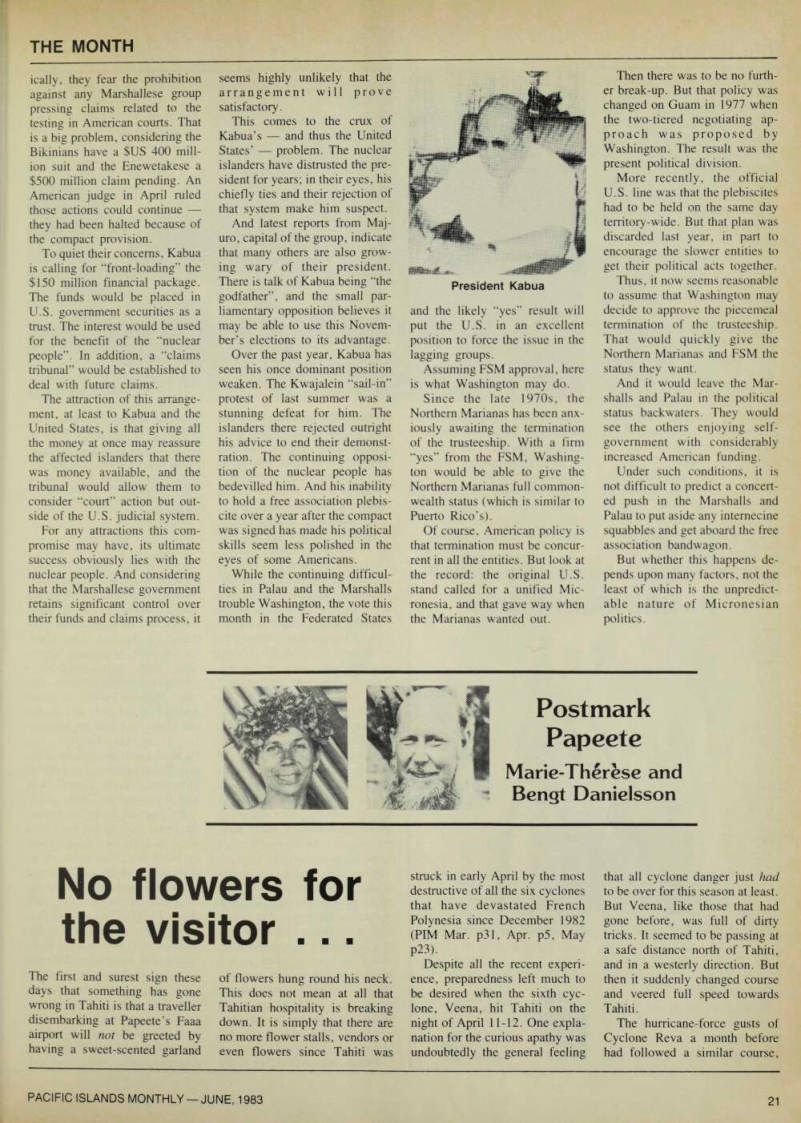
sive of the three entities headed towards free association, Presi dent Amata Kabua is struggling to maintain a semblance of the once firm grip he held on internal politics.
In late March, his government issued a so-called Mutual Securi ty Agreement the aim of which was supposedly to supersede the compact of Free Association.
The MSA proclaimed “independ ence without conditions” for the group, but in a most unusual move also declared that sovereignty would last only 15 years, the time frame agreed up on for free association. In addi tion, the document demanded millions more from the United States but without any of the fiscal oversight provisions writ ten into the compact. (The most important requires that 40 per cent of U.S. aid be devoted to capital project).
Richard Teare, deputy U.S. status negotiator, said shortly af ter Kabua presented the MSA to Ambassador Fred Zeder in Hon olulu, that the document would quickly be “a footnote to his
tory”. Teare, who joins the American mission in New Zea land next month, was proved correct in a matter of days.
Kabua’s government abruptly did an about-face and, for the first time since signing the com pact in May, 1982, publicly de clared its support for the embattl ed free association agreement.
In a letter to President Ronald Reagan, Kabua cited fears that “your great nation had aban doned serious consideration of free association” as well as re ports that the U.S. House of Representatives might not ap prove the status. But a few days of meeting with Zeder had “dis sipated” the fears, Kabua added.
What he proposed instead with active American encourage ment was a change in Section 177 of the free association agree ment, the controversial “nuclear” subsidiary document. The peo ples of Bikini, Enewetak, Rongelap and Utirik atolls, who were directly affected by Ameri can nuclear weapons testing dur ing the 1940 s and 19505, have strenuously opposed 177. Specif
Notes from the North Floyd K. Takeuchi on Micronesia
ically, they fear the prohibition against any Marshallese group pressing claims related to the testing in American courts. That is a big problem, considering the Bikinians have a SUS 400 mill ion suit and the Enewetakese a $5OO million claim pending. An American judge in April ruled those actions could continue they had been halted because of the compact provision.
To quiet their concerns, Kabua is calling for “front-loading” the $l5O million financial package.
The funds would be placed in U.S. government securities as a trust. The interest would be used for the benefit of the “nuclear people”. In addition, a “claims tribunal” would be established to deal with future claims.
The attraction of this arrange ment, at least to Kabua and the United States, is that giving all the money at once may reassure the affected islanders that there was money available, and the tribunal would allow them to consider “court” action but out side of the U.S. judicial system.
For any attractions this com promise may have, its ultimate success obviously lies with the
nuclear people. And considering
that the Marshallese government retains significant control over their funds and claims process, it
seems highly unlikely that the arrangement will prove
satisfactory.
This comes to the crux of Kabua’s and thus the United States’ problem. The nuclear islanders have distrusted the pre sident for years; in their eyes, his chiefly ties and their rejection of that system make him suspect.
And latest reports from Maj uro, capital of the group, indicate that many others are also grow ing wary of their president.
There is talk of Kabua being “the godfather”, and the small par
liamentary opposition believes it
may be able to use this Novem ber’s elections to its advantage.
Over the past year, Kabua has seen his once dominant position weaken. The Kwajalein “sail-in” protest of last summer was a stunning defeat for him. The islanders there rejected outright his advice to end their demonst
ration. The continuing opposi
tion of the nuclear people has bedevilled him. And his inability to hold a free association plebis cite over a year after the compact was signed has made his political skills seem less polished in the eyes of some Americans.
While the continuing difficul ties in Palau and the Marshalls trouble Washington, the vote this month in the Federated States
and the likely “yes” result will put the U.S. in an excellent position to force the issue in the lagging groups.
Assuming FSM approval, here is what Washington may do.
Since the late 19705, the Northern Marianas has been anx iously awaiting the termination of the trusteeship. With a firm “yes” from the FSM, Washing ton would be able to give the Northern Marianas full common wealth status (which is similar to Puerto Rico’s).
Of course, American policy is that termination must be concur rent in all the entities. But look at the record: the original U.S. stand called for a unified Mic ronesia, and that gave way when the Marianas wanted out.
Then there was to be no furth er break-up. But that policy was changed on Guam in 1977 when the two-tiered negotiating ap
proach was proposed by
Washington. The result was the present political division.
More recently, the official U.S. line was that the plebiscites had to be held on the same day territory-wide. But that plan was discarded last year, in part to encourage the slower entities to get their political acts together.
Thus, it now seems reasonable to assume that Washington may decide to approve the piecemeal termination of the trusteeship.
That would quickly give the Northern Marianas and FSM the status they want.
And it would leave the Mar shalls and Palau in the political status backwaters. They would see the others enjoying self government with considerably increased American funding.
Under such conditions, it is not difficult to predict a concert ed push in the Marshalls and Palau to put aside any internecine squabbles and get aboard the free
association bandwagon.
But whether this happens de pends upon many factors, not the least of which is the unpredict able nature of Micronesian
politics.
President Kabua