the gauntlet
pp. 10-11 · Read in the full issue
Politics Of Leadership
Vanuatu leadership: President Sokomanu throws down the gauntlet
Signs abounded as the June con gress of Vanuatu’s ruling Vanuaaku Party came closer that the congress could not only pro duce new divisions in the party’s ranks, but fundamental changes in the country’s political course.
The months of March-April saw two unsuccessful parliamen tary motions of no-confidence in the Prime Minister Father Walter Lini.
But, backed as they were by disgruntled former Vanuaaku Party ministers who had lost their jobs, and by the formal par liamentary opposition, it is perhaps easy to write them off as having no great significance.
Not so easily written off, how ever, is the position now taken by President Ati George Sokomanu in relation to the Lini government.
In a wide-ranging interview granted to Australian journalist Colleen Ryan in Port-Vila in April President Sokomanu clear
ly aligned himself with many of the government’s critics. He also made it clear he regards himself as the alternative prime minister to Father Lini.
The former George Kalkoa, a founding member of the Vanuaaku Party, a senior public servant in the British administra tion of the old condominium, and a political figure who enjoys widespread public support, would be a formidable challenger if a challenge to the leadership of Walter Lini were in fact to occur.
In the interview, published in the Sydney-based weekly The National Times (April 8-14), President Sokomanu made the following points: • On the latest no-confidence motion against Prime Minister Lini: “He has brought the whole thing on himself. There has not been proper consultation with the executive. He is not following party rules.
“The whole problem has
come because of lack of ad ministration and know-how at the top. It is on the executive side the Vanuaaku Party has no proper co-ordination.” • On advisers employed by various ministers: “Most minis ters have advisers whom I, as an old hand at administration, do
not consider suitable. We should have kept the expatriates we had before independence to work for a couple of years with us and train.
“Soon after independence most of the expatriates left or were replaced this was very sad I opposed it bitterly. This
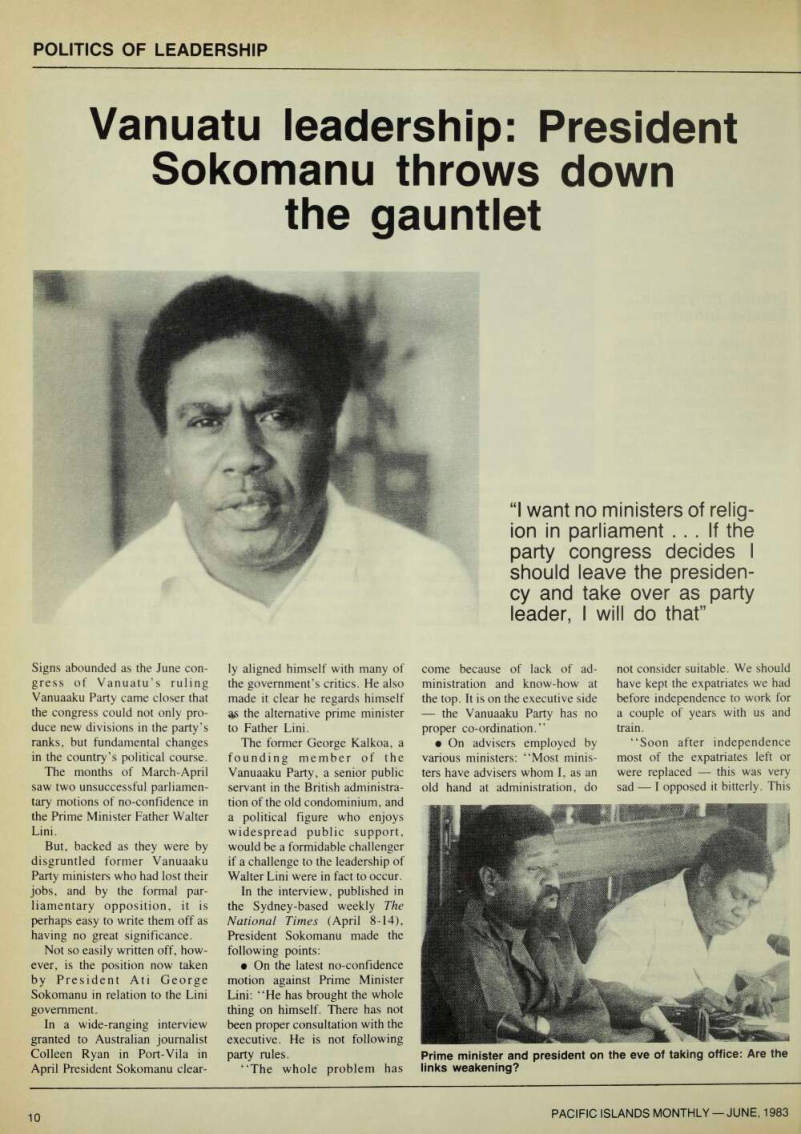
“I want no ministers of relig ion in parliament ... If the party congress decides I should leave the presiden cy and take over as party leader, I will do that”
Prime minister and president on the eve of taking office: Are the links weakening?
drastic change got the govern ment into trouble. It was just too sudden.” • Of the political appoint ments made by ministers (each can make five): “Some of the advisers they have brought in I just don’t know where they come from.” • Of accusations of Leftwing bias in the present government; “There are two types of social ism the foreign sort, or com munalism, which is part of our culture. I think the government is heading too much towards foreign socialism. And I have told them. I think we should bring the ideology back to what the country had before the Vanuaaku Party started.” • Of clergymen-MPs: “I think they should stay with the church. We have six Presbyte rian ministers, one Roman Catholic priest and an Anglican minister. For the next four years I want no ministers of religion in
parliament and that includes Father Lini.” • Of his personal future: “If things work out I will probably be elected (as president) for the next five years. But I am just waiting for the congress of the Vanuaaku Party in June. If they decide that I should leave the presidency and take over as Vanuaaku Party leader in the next parliament, then I will do that.” • Of his view of the next parliament; “This one has gone through the mill, next time you will have much better and more experienced people.”
Sokomanu outlined what Ryan called “his master plan” for the political future of the country.
“The government would be one of national unity, the seven-man Cabinet would comprise four Vanuaaku ministers, two from the Union of Moderate Parties, and one from the Vanuatu Inde pendent Alliance Party.
Some people share Sokomanu’s enthusiasm for him self as the next PM. John Naupa, a former minister of transport who was dismissed by Father Lini, told Ryan; “Sokomanu would be an ideal prime minis ter. Fresh blood in the party would change the thinking.
There are a lot of yes-men in the party now those who don’t stand back and consider the big ger issues. He would. And he would be a much steadier prime minister he is a diplomat, whereas some of the rest of us are not.”
But not all the people who count are of this view, Kalpokor Kalsakau, himself a formidable Vanuaaku Party figure and minister of finance, said: “Sokomanu will stay on as presi dent. He is just bored now. But it is his own fault for taking the job
on. We told him it would be only ceremonial.
In the course of her overall
appraisal of Sokomanu’s politic
al position, Ryan described him as “the ultimate pragmatist, and
obviously quite comfortable with
the expatriate business
community.”
Are the lines being drawn for a division of the Vanuaaku Party along the lines of “moderate pragmatism” on the one hand, and a more committed “radical ism” on the other?
Everyone who wishes Vanuatu well, and admires many of the achievements of the Vanuaaku Party, which has a record as probably the most cohesive and organised political party in the South Pacific, will hope that the June party congress succeeds in overcoming the threat of new
divisions.
Malcolm Salmon.
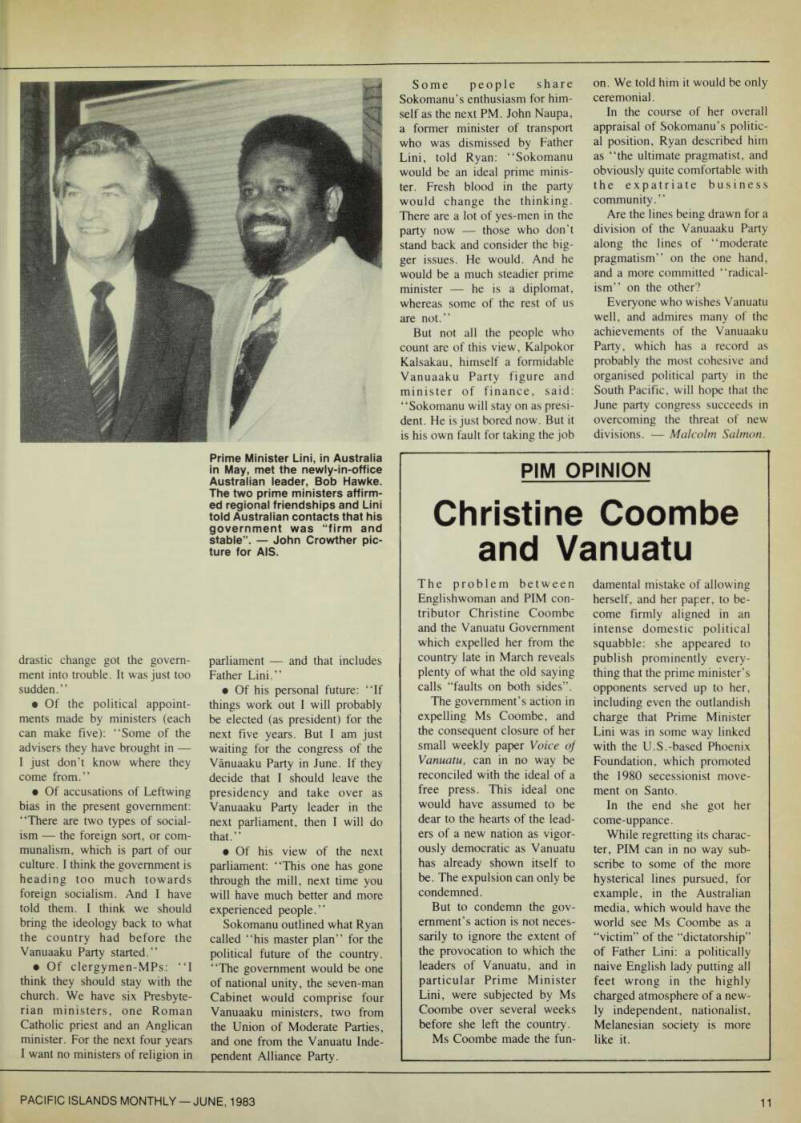
Prime Minister Lini, in Australia in May, met the newly-in-office Australian leader, Bob Hawke.
The two prime ministers affirm ed regional friendships and Lini told Australian contacts that his government was “firm and
stable”. - John Crowther pic
ture for AIS.