once claimed
pp. 7-9 · Read in the full issue
Letters
The man who once claimed Matthew Is.
Somehow or other the matter of Matthew Island keeps bobbing up. The present dispute between the governments of Vanuatu and France is only the latest instance.
Matthew which might as well be called “32 acres of nothing” was the subject of much dis cussion between Britain and France some years back. After they had divided up, to their apparent satisfaction, the shoals, reefs and islands left over they abandoned the matter. They did not in the slightest reckon with the kind of future dispute that has now broken out.
My personal part in the history of Matthew Island resulted from a discussion I had with the late Henri Martinet. He was then president of Transpac (now Air Caledonie), and I was chairman of New Hebrides Airways (now Air Melanesiae).
We were looking at possible future route structures beyond our two operating areas, and I asked him who owned Matthew Island. He didn’t know so we made inquiries and found it was not in fact owned by any country or persons. So we went to the Joint Court in Port-Vila and claimed it in our joint names. It cost us 15 shillings each.
Presumably someone from the Joint Court informed the Resi dent Commissioners, as I had hardly returned to my home is land of Tanna when a French warship pulled in to the harbor and picked up the French District Agent and took him to Matthew Island, apparently with the aim
of establishing a French claim.
They could not land, as landing there is very difficult, and the weather was bad.
The French District Agent on his return asked me what was the reason for my claim. I refused to state my reason, which annoyed him somewhat. Shortly after I myself tried to land on Matthew
with a bag of cement to make my claim valid by erecting a cement block. But once again it was too rough, so I had to swim ashore and plant a coconut. (The island is pure volcanic ash, so I doubt if the coconut grew . . .) The British Resident Commis sioner then spoke to me about my claim and suggested it be with
drawn, as it was costing the British Government a lot of time and money. It seems it had be come a matter of serious discus sion between Paris and London. I refused.
Some time later, I believe it was about two years, I received a letter from the British residency to the effect that as a result of discussions between Britain and
France concerning Conway
Reef, Matthew Island, and some others which escape my mem ory, it was agreed that Matthew would be allocated to New Caledonia. I replied immediately that it was not theirs to dispose of and that the decision was unac ceptable to me.
Later, Mr Martinet flew to Matthew is his Stinson L 5 light aircraft, and unfortunately se verely damaged the plane on landing. The French navy lifted him off with a helicopter. He again took off from New Caledonia in another aircraft to attempt to land on the island and repair his Stinson, but he got lost and landed in the sea, to be
picked up by the navy again.
Passing yachts reported the
aircraft on Matthew Island, so the Australian navy blew it up.
Thus, two aircraft had been lost so far on this exercise.
About the time of independ-
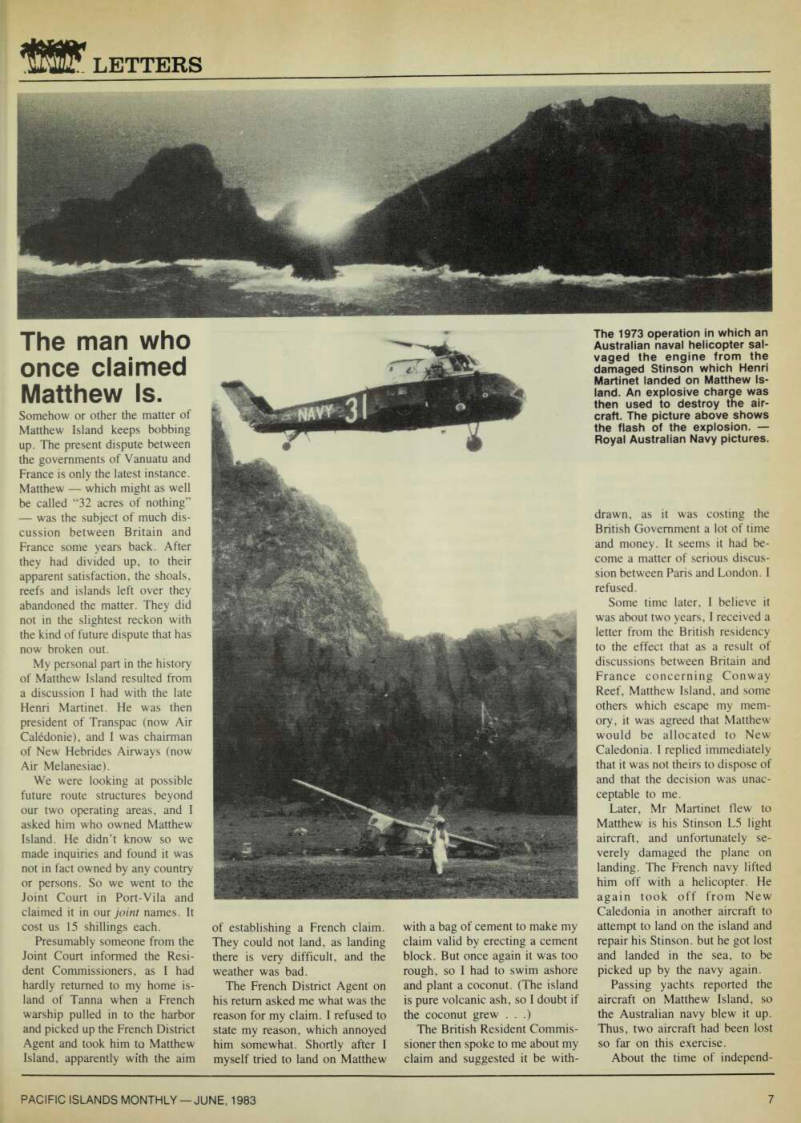
The 1973 operation in which an Australian naval helicopter sal vaged the engine from the damaged Stinson which Henri Martinet landed on Matthew Is land. An explosive charge was then used to destroy the air craft. The picture above shows the flash of the explosion. - Royal Australian Navy pictures.
ence of Vanuatu, I was ques tioned about my part in the claim on Matthew, as the records had disappeared from the Joint Court. One can only wonder why!
It now appears that the island has assumed importance again as the 200-mile maritime zone ex tends Vanuatu territories a con siderable distance if it is estab lished that the island belongs to Vanuatu which to me is obvi ous as the claim was made there.
It appears that both Vanuatu and New Caledonia are now ac tively pursuing claims to Matth ew Island right now perhaps there may be another Con dominium in the offing?
Henri Martinet lost two air craft and Britain and France a great deal of time and money, the French navy mounted two rescue operations and other operations in pursuit of their claim, the Australian navy became involv ed, and I understand a Con dominium vessel and later a Vanuatu vessel have all made the journey there.
There must be flags planted all over it, in addition to the French automatic weather station that has been put there.
Perhaps it would have been easier to form a republic there, as suggested by PIM years ago.
It certainly has been 32 acres of contention.
Bob Paul
Mt Tamborine Qld Australia
Land in Vanuatu:
An upbeat view
I wish to correct some of the statements and impressions given by Professor Jean Guiart in his letter to PIM (Feb. p 7). I found much of what he had to say romantic and poorly informed. 1. The great majority of plant ers (alienators) remaining in Vanuatu want to stay. A few, not most, want to sell out. 2. The “new brand of settlers” new alienators are in many cases Ni-Vanuatu themselves, seeking leases from customary land-owners on (intact, whole) plantations. On Malekula it is true that many plantations were appropriated by Malekulans and alienators ejected, but there is a totally different situation on San to (as there is for example bet ween Malaita and other parts of Solomon Islands in this respect). 3. Improvements on planta
tions have been assessed by gov ernment valuers at up to several hundred thousand dollars in indi vidual cases. This, by the way, includes fencing. 4. Vanuatu has an ideal cli mate for cattle development, and a good animal disease status (and, perhaps, better managed cattle than in New Caledonia). 5. Cattle contribute signific antly to the economic output of the country and are recognised as having an expanding future role. 6. The government’s Five Year Development Plan (1982- 86) explicitly states the revival of the plantation sector as a major objective, contrary to the claim that “the plantation system (is) no more a model for economic development” There is docu mented and obvious evidence for the intention of Ni-Vanuatu to continue plantations as intact, whole units. The few cases of reversion to family holdings have proved economically disastrous and socially unacceptable. 7. Capital for re-development and payment for improvements is indeed a major problem for Ni- Vanuatu and others wishing to participate in the revival of the sector. Skills are also a problem, though steps are being taken by the government to solve this. 8. The privilege of living in Vanuatu does not, in most peo ple’s conception, lie in loving
contemplation of the bush. It lies in the chance for economic de velopment in situations of great potential. 9. I presume that in “buying back the land” in New Caledonia the previous “alienators” are also compensated for improvements.
The difference in Vanuatu is that all land (not a small part) of it now belongs to the indigenous owners. I fail to see the praiseworthiness of the New Caledonian model.
In conclusion, stability “a prosperous and orderly Vanuatu” is on the way, and is not
helped by such false impressions
as those conveyed by Professor Guiart’s letter. Land leases are now being signed for both large and small properties, and invest
ment following. Those wishing
prosperity and order should in vest in that wish if they are sincere.
“Bullish On Vanuatu”
(Name and address supplied.)
Luganville Santo
Vanuatu
In quest of true
Trukese music
As I travelled across Micronesia earlier this year I tried to buy cassettes or discs of local music, either traditional or contempor ary. This was not as easy to do as you might think. On Truk, for instance, there was nothing av ailable in the local stores. After I had asked around I was told that if I sought out Ophin Reselap in the Treasury at the Legislative I might just strike pay dirt.
I met up with Ophin, who said that he would be able to provide me with a cassette of contempor ary Trukese love songs accom
panied by a small guitar band.
He rushed off to his home and I went off to await my outward flight at Truk Airport, where Ophin eventually arrived with a tape which I suspect he had just dubbed off.
Now I must admit that Trukese love songs may not appeal to everyone’s romantic ideals but I think that Ophin’s efforts through the Olophat Band and singers Raymond Jack and Evan celita are worthy of a wider audience. Ophin is a musician in search of encouragement from resources beyond Truk. He told
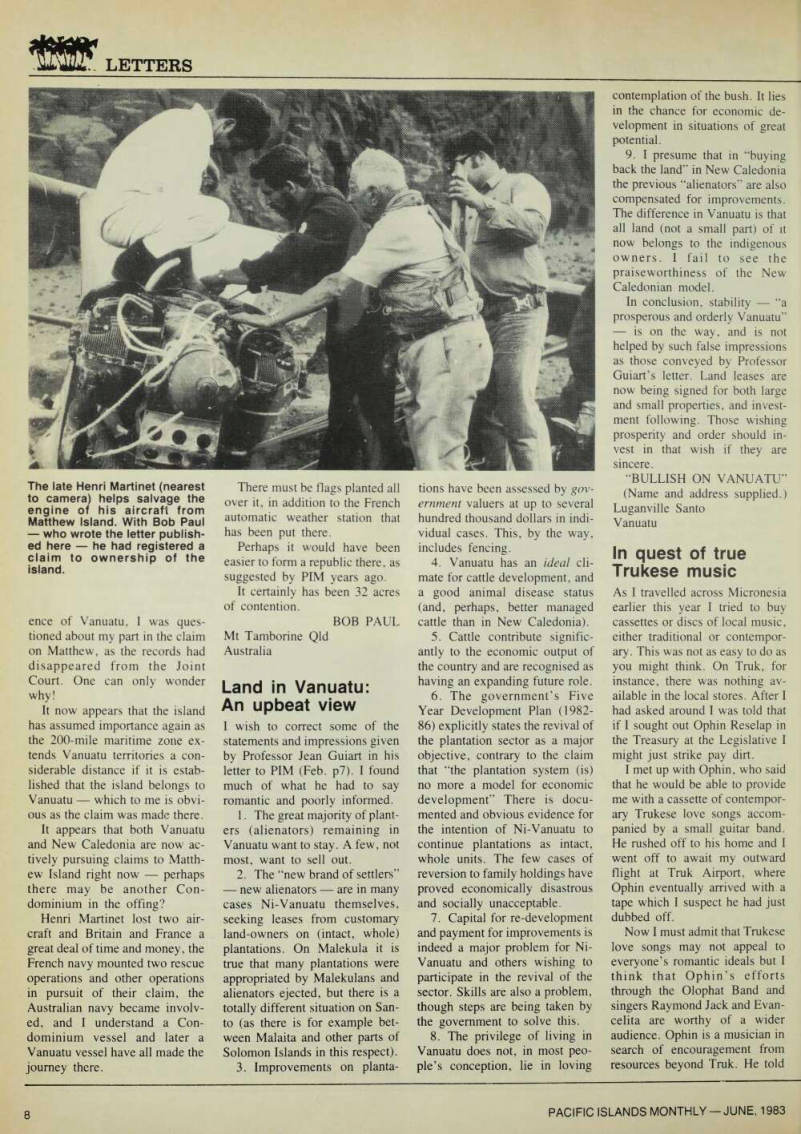
The late Henri Martinet (nearest to camera) helps salvage the engine of his aircraft from Matthew Island. With Bob Paul - who wrote the letter publish ed here - he had registered a claim to ownership of the island.
me that he is sure that some where out there is someone who will be able to give him technical advice, show him the way to help develop Trukese musical talent, and help him to produce and market Trukese music.
Is anybody out there listening?
W. G. Coppell
Macquarie University Sydney NSW Australia
French Polynesia:
Elusive inflation
While a large number of govern ment offices in French Polynesia appear to exist primarily for the benefit of those who sit in them, the Territorial Institute of Statist ics stands out, in our opinion, as a genuinely useful, efficiently run, agency. As we have said before in the columns of PIM, our one regret is that it came into being so late not until 1980.
This means that we are still total ly lacking in reliable statistical data for the time of the greatest social upheaval in the territory, the ’6os and ’7os, the period of the traumatic implantation of the CEP nuclear testing base.
This long delay in establishing an institute of such crucial im portance can, in our view, only be put down to an unfortunate reluctance on the part of the authorities to let unpleasant truths become too widely known.
Even today, most of the local mass media avoid making the sort of analysis that we attempted in our article “Fact, fiction and figuring in budget debate” (PIM Feb p 32). We are happy there fore that our item has prompted the director of the Territorial Institute of Statistics, Gerard Baudchon, to make a few re marks (PIM May p 7), a number of which are very pertinent.
Mr Baudchon’s first comment concerns the exact number of expatriate Frenchmen among employees of the local civil ser vice: he puts the figure at 28 per cent or 4500 out of 15,000.
This confirms only too well our more general statement that they constitute “a huge portion”. Nor should it be forgotten that it is they who fill all the top jobs. The one unavoidable conclusion from this state of affairs is that the
French Government is deter mined to maintain its firm grip on the colony.
In his second comment, Mr Baudchon likewise agrees with us that the unemployed in French Polynesia are “statistically non existent”, offering as the sole reason for this that “only the great developed nations have
good figures on unemployment”.
(Well, we always thought that France was a highly developed country, but never mind . . .).
Without putting forward any fi gure of his own, Mr Baudchon rejects out of hand our con sidered estimate of 20,000 unem ployed in the territory. He does this on a sort of pro tempore basis, saying that the next cen sus, scheduled for October 1983, will reveal all. We are sorry that we cannot share Mr Baudchon’s faith in the reliability of the forthcoming census because it will not be conducted, as it should be, by the Territorial In stitue of Statistics, but by the metropolitan French INSEE which in the past has, without fail, always botched the job.
Thirdly, we have the inflation problem. Here Mr Baudchon feels compelled to challenge our view that the real rate is much higher than the officially accept ed figure of 15 per cent per annum. Mr Baudchon takes the injured view that the integrity of his institute, and that of his agents in the field, are thrown into question by our statement.
This is a completely unnecessary inference.
What is wrong here has no thing to do with the quality of individuals, but everything to do with the methods employed in
arriving at the estimated inflation rate, and the often limited scope of the investigations undertaken.
For instance, the selection of items used to determine living costs is based on the French model, which simply does not
correspond with Polynesian
realities. This is why Vice- President Gaston Flosse, in his present endeavors to lower living costs, has concentrated on such locally essential items as rice, flour, sugar, condensed milk, fuel, oil, and corned beef. It is also of interest to note that it has
only been through resort to legis
lative measures to restrict profits and prices that he has succeeded in reducing an inflation rate which would otherwise certainly have been around 30 per cent.
Incidentally, we should like to know how the institute deals with the problem raised by the recent ly formed consumers’ associa tion, which has conducted its own investigation into retail prices in the local stores. Its findings were that, on practically all essential goods, prices vary enormously from store to store, with identical items costing twice as much in some stores as in others. Are the prices recorded by the institute the maximum, minimum, or average prices?
And what is the basis for the selection of stores whose prices are checked out by the institute?
Mr Baudchon informs us that his inspectors operate only in Tahiti and Moorea. This fact surely detracts from the value of his indices. What is meant is that
there is no protection whatever from price exploitation for the inhabitants of the remaining 50 or so islands in the territory.
Anybody who has lived in the outer islands, as we did for sev eral years, can testify to the outrageous manner in which de fenceless customers there are
constantly over-charged.
Last, but certainly not least, it can easily be proved that the
universally practised system of
“credit at the local store” also exacerbates the “natural” infla tion. By buying on credit the islanders who are rarely able to understand Chinese or Euro pean accounting systems are
again in an extremely weak posi
tion if they should want to pro tect themselves against over charging. Most never try.
Mr Baudchon may protest that his institute is unable or unau thorised to undertake investiga tions of such a far-reaching character. They must never theless be made if we are ever to discover the true level of infla tion which, we maintain, for the past 15 years at least has been much, much higher than the offi cially announced rate.
Marie-Therese And
Bengt Danielsson
Papehue Tahiti French Polynesia
After propaganda,
what?
Your February issue contained several letters concerning “Im perialist USA” etc. There always seems to be an abundance of slick liberal rhetoric when it comes to trying to belittle the leader of free world, the United State of America.
There are two major forces at each other’s throats on our planet. One force is the social-communist system led by Russia and the other is the free
enterprise-democratic system
mentored by the United States.
After hearing all the propaganda from both sides the question is, which system offers the most freedom and highest quality of life? The answer is obvious.
Aloha.
Fred Hemmings
Honolulu, Hawaii
Usa
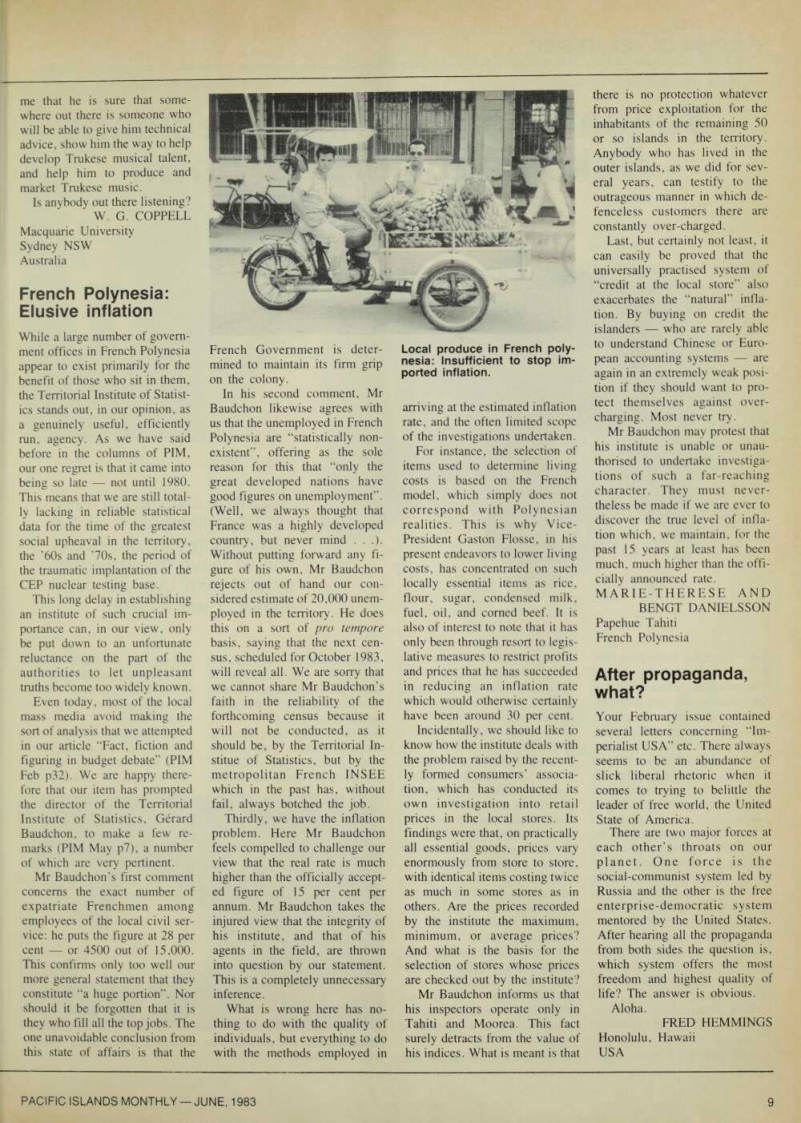
Local produce in French Poly nesia: Insufficient to stop im ported inflation.