Quiet election campaigning leads
p. 15 · Read in the full issue
Cook Islands
Quiet election campaigning leads up to dramatic result
TREVOR CLARKE reports from Rarotonga on the gener al election held in the Cook Islands on March 30. The election saw the return to power of the Cook Islands Party under the leadership of Geoffrey Henry, a cousin of the late Cooks leader, Albert Henry.
The March 30 general election in the Cook Islands saw the Cook Islands Party (CIP) swept back to power after five years in opposi tion, and the former prime minis ter, Sir Thomas Davis, lose his seat in Parliament.
Another casualty was former senior cabinet minister laveta Short, once regarded as top con tender to succeed Sir Thomas as leader of the Democratic Party (DP).
The lead-up to the election had been in marked contrast to the highly charged 1978 election campaigns, and their explosive aftermath of electoral petitions over the fly-in voter issue.
Although the DP had governed with a 16-six majority over the CIP as a result of the 1978 electoral petitions, the popular votes for the two parties had been very close. A closely fought election in 1983 was expected, and indeed occurred.
But the lead-up of 1983 was almost a non-event compared with 1978. Absent were the T shirts emblazoned with party slo gans, public banners, and the nightly packed public dances.
Absent also were the fear, intimi dation and other emotions that led to deep differences between neighbors, friends and families.
Public speakers avoided personal attacks.
A conscious effort had clearly been made to tone the campaign ing down. This was contributed to by a new policy of the govern ment-controlled radio and news paper which restricted the availa bility of time and space to the political parties. (This policy of course gave an additional advan tage to the ruling DP which retained the use of the media for “government” publicity.) The spate of electoral petitions which have followed recent elec tions in the Pacific influenced campaign organisers to ensure that there was no hint of electoral offences such as treating and bribery.
But the Cook Islands could not
completely abandon its penchant for sensations.
With the CIP under the leader ship of Geoffrey Henry returned to power on preliminary results of 14-10, the sensation occurred with the loss by Sir Thomas Davis of his seat to a moderate ranker in the CIP, Rei Jack.
Although Mr Jack is relatively prominent in his district he had not been a clear-cut choice of candidate for CIP, and he is not a forceful public speaker.
Sir Thomas was clearly stunn ed by the result and announced to reporters his intention to retire from politics before he informed his party. laveta Short was defeated in the Ngatangiia Constituency Rarotonga by first-time candi date Dr Terepai Maoate. Dr Ma oate is a former director of clinic al services in Raratonga, but in recent years has been living per manently in Aitutaki.
As in previous elections, the key to success lay in the con stituencies in Rarotonga. Here the CIP took seven seats to the DP’s two in the preliminary count (the DP had previously held all nine seats). This was amended on the final count when sitting member Harry Napa (DP) regained his seat by two votes over Raymond Pirangi (CIP).
This trimmed the 14-10 victory to a narrow but workable 13-11.
CIP leader Geoffrey Henry made a major contribution to his party’s success by leaving his safe seat in Aitutaki and standing for what was regarded as a mar ginal seat in Rarotonga. His clear victory in that seat stamped extra authority on his leadership, put ting to rest the challenge for leadership from Tupui Henry.
The parties retained all seats previously held in the outer is lands, with the DP winning the newly created third seat in the island of Mangaia. The CIP for its part took the new Overseas
constituency.
The Unity Movement led by former CIP cabinet minister Dr Joe Williams and comprising
persons formerly prominent in
the CIP and DP contested 19 of the 24 seats but failed badly.
Only Dr Williams, who polled 18.8 per cent of the votes in his constituency, had any effect on the result. The margins in all other constituences were such
that vote-splitting by Unity was
not a reason for defeat.
The overall popular vote for all constituences gave the CIP 50.1 per cent, DP 44.9 per cent, and Unity five per cent. As with the previous three elections, the difference between CIP and DP was less than five per cent 4.4 per cent this time. The turnout for the polls was 89 per cent of registered voters, with the Over
seas constituency having the
smallest voter turnout at 77 per cent.
As the pre-election campaigns
had been so quiet the reasons for the swing from DP to CIP were more subtle than previously. Few widespread issues had emerged in the debates. There was no doubt though that the CIP had retained its solid core of suppor ters and had won over others.
The loss of the DP probably began in 1981 when it increased the life of Parliament from four to five years without prior refer ence to the electorate. This had been seen by many as wrong in principle, but even more so be
cause of a belief that the increase had been chiefly designed to sec ure pension benefits for incum bent ministers. Widespread criti cism of high non-accountable ex penditure on ministerial overseas travel was another factor.
To a lesser extent the turnover tax introduced by the DP, al though now generally accepted by the business community, pro vided scope for dissatisfaction.
Of greater significance howev er was the individual perform ance of members and candidates in their constituencies. Sir Thomas Davis was regarded as having grown increasingly re mote from his constituency of Avatiu, laveta Short as having
left his involvement in Ngatan giia to the last year only. The CIP candidates by contrast were seen as performers, or at least potential performers, at the con stituency level.
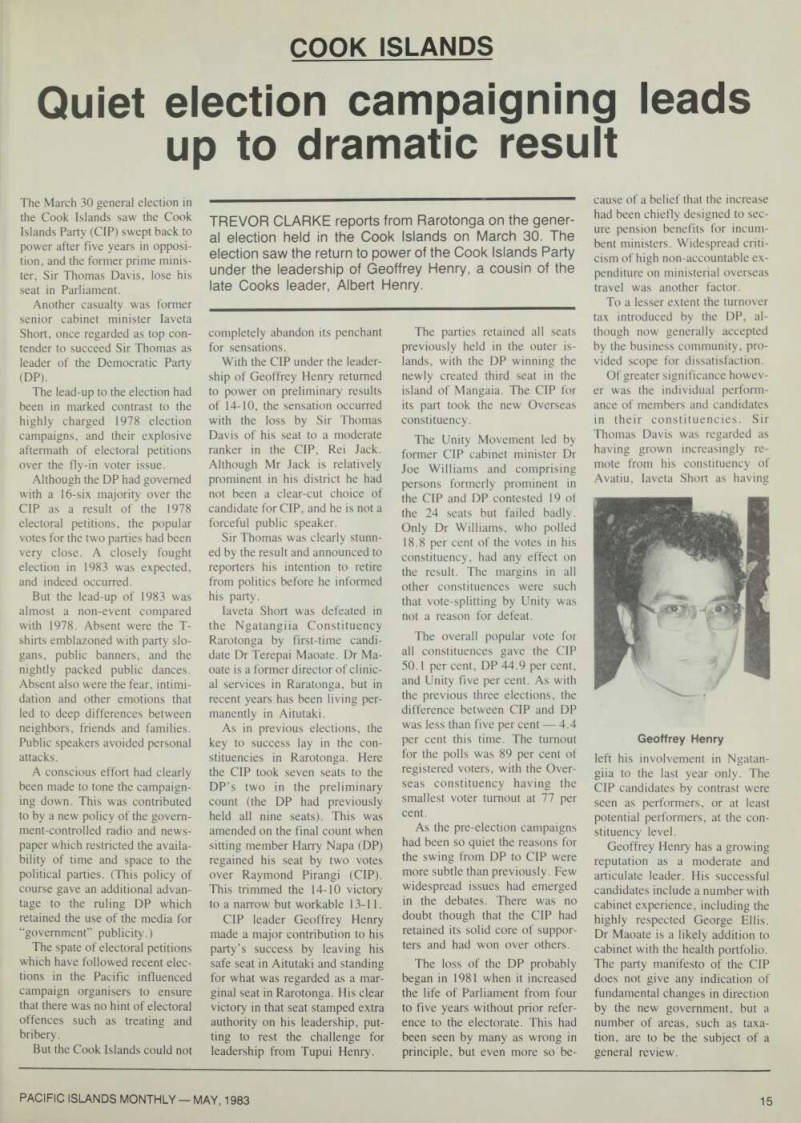
Geoffrey Henry has a growing reputation as a moderate and articulate leader. His successful candidates include a number with cabinet experience, including the highly respected George Ellis.
Dr Maoate is a likely addition to cabinet with the health portfolio.
The party manifesto of the CIP does not give any indication of fundamental changes in direction by the new government, but a number of areas, such as taxa tion, are to be the subject of a general review.
Geoffrey Henry