Statistician
pp. 7-9 · Read in the full issue
Letters
Statistician strikes back
In your February issue I read the article by Bengt and Marie- Therese Danielsson headed “Fact, fiction, and figuring in the budget debate.”
For the information of your readers, I want to go into a little more detail about employment
and unemployment figures, and
the inflation rate, in French Polynesia.
The “huge proportion of ex patriate Frenchmen” employed as civil servants and government employees is about 28 per cent when military personnel are in cluded, and 14 per cent if only civilian personnel are counted.
I agree with the authors when they say that unemployed people are “statistically non-existent” in French Polynesia. But it’s the same in many other countries in the Pacific and elsewhere. Only the big developed nations have
good figures on unemployment.
At the last census (April 29, 1977), 1689 unemployed persons were recorded, and the unem ployment rate was 3.8 per cent.
Even if it’s logical to think that this rate has increased, it is not reasonable to suggest that “there are probably about 20,000 poor devils” without jobs in 1983 in French Polynesia. It’s a gratuit ous affirmation absolutely with out foundation. The next census (October 15, 1983) will provide the answer.
The article further says: “Offi cially it (the inflation rate) was 15 per cent in 1982, but was actually at least twice as high.”
With this statement, the authors question my honesty, and the probity of my collaborators.
I don’t claim that the consum er price index of French Poly nesia is the best in the Pacific no price index in the world is perfect. I just think that this index is a good and objective “tool”. It has been built up from the results of a survey of house hold expenditures in 1979. Every month 8000 prices are recorded from about 200 shops and mar kets around Tahiti and Moorea.
As a statistician’s office, we try, and I think successfully, to
apply international recommenda tions (Commission of Statistics of the United Nations, New Delhi, November 8-19, 1976), and particularly the following one; “The credibility of statistics requires that the office of statist ics is, and has the reputation of
being, impartial and objective.”
This is a rule that all statisticians, even French ones, try to follow.
When the authors write that the inflation rate is actually twice the official result, I think it’s another gratuitous affirmation.
I hope Marie-Therese and Bengt Danielsson will explain in an early issue of PIM how they arrive at this conclusion. Then your readers will be fully informed.
Gerard Baudchon
Director, Territorial Institute of Statistics Papeete Tahiti French Polynesia
How “independent”
after all?
The process of granting inde pendence to the former colonies is almost completed, and what we get is trouble and uncertainty for all.
Why? It is because some for mer colonies became militant, too poor to feed themselves, and not experienced enough to look after their own affairs.
Economically, they haven’t got a chance of competing with the already developed countries.
The only alternative is to beg for a fair deal, or flirt with the super powers as some are doing at present.
Sometimes those who led their people to independence had to sacrifice their own people’s free dom by aligning themselves with communism, or some other form of socialism.
Socialism is a social state like that of Hitler’s Germany. World War II had to be fought for individual freedom.
The Russians didn’t die in the Pacific to liberate us, or even in Africa, so why do we have to look to Russia for help? Some people are trying to pit the Un ited States and its Western allies against the Soviet and its Eastern bloc, just because the developing countries cannot run the race.
Mismanagement and corrup-
tion cannot be tolerated in any independent country, and least of all in poor developing indepen dent countries.
There are more killings now than in colonial days. They ap pear to be wanton killings, simi lar to those in Nazi Germany.
There is more uncertainty about the future for most people, ex cept for those in power.
There is no such thing as non
alignment in developing coun
tries. One is either dependent on the Soviet and its bloc, or on the United States and its allies in one way or another, even if this dependence is concealed.
It is a matter of choice freedom for all, or for just a few who are in power for the time
being.
We cannot all be equal. But at least we should enjoy freedom.
Timothy Deje
Nauru Central Pacific
Indigestible
pancakes
I wish to express both my amaze ment and disappointment about an article in the February issue of
Pim.
As one interested in Pacific Island studies and an active re searcher into Pacific Island af fairs, I have always enjoyed reading your magazine. I find the contents diverse and informative.
However I believe that the article in the Tropicalities section, page 23 (PIM Feb 1983) on the Pan cake Manor in Brisbane has low
ered your previously high
standard.
This article is quite pointless and trivial and its attempts to give it a Pacific connection are miserable.
Am I to understand from this that PIM has gone the way of other less illustrious publications and is going to make general restaurant appraisals a regular feature? Perhaps I can anticipate a column by some self-appointed wine expert covering the “wines of the region”.
Ngaire Rea
Arncliffe NSW Australia There's no “Chinese Wall” bet ween the Pacific Islands and the rest of the world, and there are forms of pancake in the Islands just as there are everywhere else.
We found Professor Richard son’s article of considerable in terest, and its “Pacific connec tion” quite adequate. We have no present intention of introduc
ing a column on wines.
Pim.
We flew off
course ...
I would like to correct an errqr which appeared in your publica tion dated January 1983. The error appeared in an article on Edward Akilo Piawe on page 39 of that issue.
Mr Piawe was awarded a pilot scholarship from Australian Aerospace Pty Ltd, agents for the De Havilland Aircraft of Canada range of aircraft in Australia and the Pacific, and not from the Australian Flying Training School, who were the people contracted to train him.
Mr Piawe who has since re turned to Papua New Guinea is
What cost for a new nation any new nation - to keep its flag flying?
now employed by Air Niugini as a trainee pilot and is soon to start his Fokker F 27 course.
We of Australian Aerospace wish him every success and hap piness in his new career.
D. C. Newson
Manager
Australian Aerospace Yagoona
Nsw
Australia
On superior
outsiders
Dr Matthew Spriggs, I imagine, sees nothing invidious in the fact that he, rather than a native Hawaiian, is assistant professor of archaeology at the University of Hawaii at Manoa. “It just so happens,” I can imagine him saying, “that there are no native Hawaiians who are qualified ar chaeologists like I am.” As an
archaeologist, Dr Spriggs is
therefore superior to the native Hawaiian.
Dr Spriggs sets a good deal of store by superior qualifications.
With a doctorate of philosophy from the Australian National Un iversity, he finds that the report ing in PIM of anthropological
and particularly archaeological
research in the Pacific is “often inaccurate” (PIM Feb plO). He therefore suggests that PIM should get a qualified ar chaeologist to “check the accura cy of the reports that are publish ed in its pages”.
Dr Spriggs cites several cases in the September and October issues of 1982, which, he claims, were inaccurate. One was my review of Richard Feinberg’s
book Anuta in which I suggested that two outsiders a Prussian and a Lascar who were left on Tikopia in 1813 may have had some influence, both genetically and culturally, on the subsequent history of that island and on
neighboring Anuta.
I did not suggest that the Prus sian and the Lascar had to be superior to the Tikopians to have had children merely that, be ing human, it would have been strange if they did not. On the other hand, I did imply that as the Prussian and the Lascar would have arrived on Tikopia with some knowledge that the Tikopians didn’t have, it could well be that the Tikopians were smart enough to learn something from them.
Dr Spriggs, with his PhD from ANU, finds my ideas about Tikopia just as invidious as the theory expounded in my book The Lost Caravel. This is that castaways from the Spanish caravel San Lesmes, lost in the Eastern Pacific in the early 16th century, played a significant role both genetically and culturally on the various Polynesian islands where they happened to settle.
According to Dr Spriggs, my argument on this matter is of the same order as Erich von Dani ken’s claim that Kiribati was influenced by spacemen.
“When will Pacific prehistory and culture be properly credited to Pacific islanders themselves rather than to ‘superior’ outsid ers?” Dr Spriggs asks.
I believe, Mr Editor, that I know the answer. It is when “superior” outsiders such as Dr Spriggs, the Prussian, the Lascar
and “my” Spanish castaways
don’t happen to be around to exert an influence on the Pacific islanders’ history and culture.
Please note, however, that “superior” is Dr Spriggs’ term, not mine. I would expect that, in some accomplishments, Dr Spriggs, for example, would be considerably inferior to many Pacific islanders.
Robert Langdon
Canberra ACT Australia
Shark callers
not news Dr W. G. Coppell’s praise of Dennis O’Rourke’s documentary film The Shark Callers of Kontu (PIM, Mar. p2l) is good news, indeed. But those shark callers are not news.
Readers may remember my review of Glenys Koehnke’s fine book The Shark Callers (PIM, Aug. ’75). They may have read, too, lan Stuart’s review of that book {PNG Post-Courier, May 2, 1975), and Hank Nelson’s {Journal of Pacific History, Vol. 12, Pt. 4, 1977).
There are accounts of the shark callers by Hortense Pow dermaker (1933), W. C. Groves (1936), Gil Patten (1954), Bengt Anell (1955) and others. Perhaps the best one is in Otto Schlaginhaufen’s Muliama: Zwei Jahre unter Suedsee-Insulanern (1959). And, of course, Abel Janszoon Tasman, the great sailor, bartered beads for a shark off New Ireland on April 7, 1643. Tasman’s journal has a drawing of three islanders in a
canoe, one of them blowing a conch shell, an important tool used by shark callers.
Harry H. Jackman
Angaston, South Australia Australia
Give the credit
to France
While it is true that Mme Sol ange Petit-Skinner is “an an
thropologist and psychologist
from the United States’’ (PIM Feb.) in terms of residence, I am sure that those of the U.S. academic community who are familiar with her work would not want to deny France the credit for her training.
Albert J.Schutz
University of Hawaii Honolulu, Hawaii,
Usa
“Thank you, Papua
New Guinea ..
Since returning from Papua New Guinea in January, I have been purchasing PIM to keep up with the country’s events. I was inter ested in PNG before travelling there but now my interest has deepened a lot. My experiences in PNG will never be forgotten.
I am only 19 and it was my first venture alone anywhere, so there was some apprehension.
But what I found there was better than anything I could have wish ed for.
My thanks go to so many of PNG’s people who extended such a warm and unconditional welcome to me. Not only is the country itself beautiful, but, more importantly, the people are also.
My month in the country went much too quickly, every new face brought more stories and a new friendship. I have never felt warmth and care to such a degree before thanks Papua New Guinea.
Sure, Papua New Guinea has got its problems, so has Australia and every other country. But I found a very special people there, a people the country can be very proud of. Thanks again for everything, PNG, and keep up the great work.
Mark Cooper
Geelong, Victoria Australia
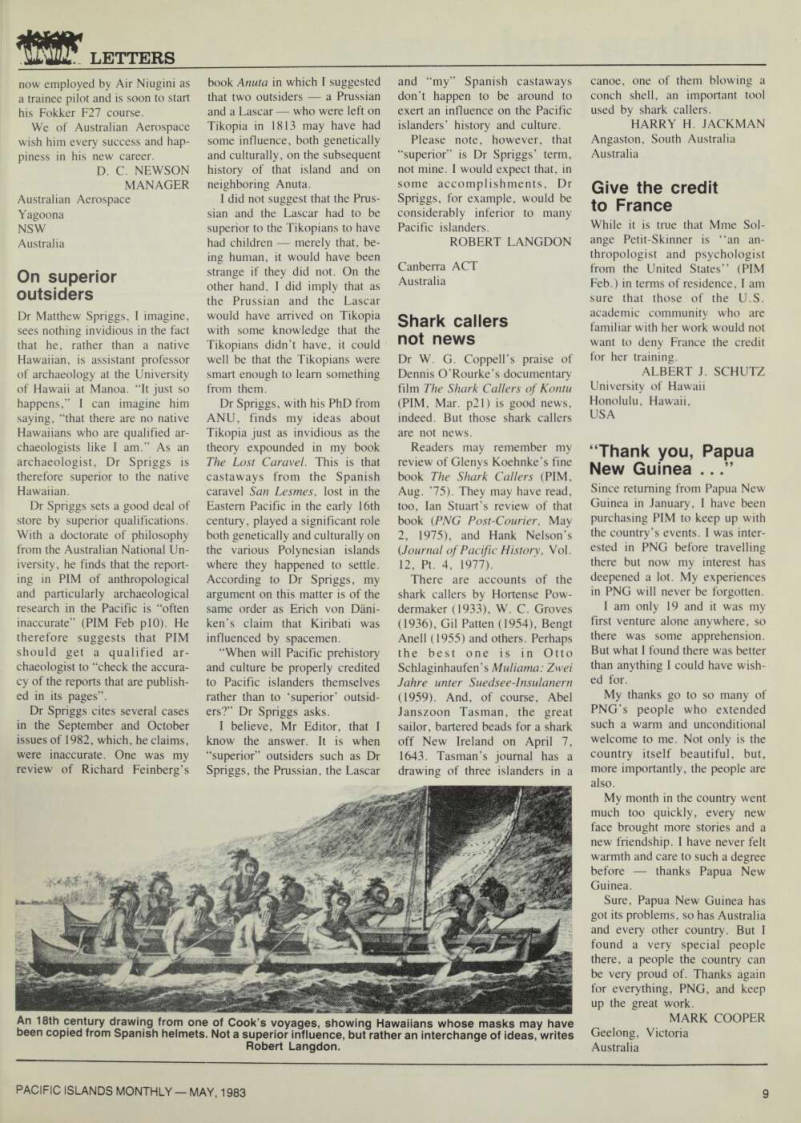
An 18th century drawing from one of Cook’s voyages, showing Hawaiians whose masks may have been copied from Spanish helmets. Not a superior influence, but rather an interchange of ideas, writes
Robert Langdon.