East-West Center?
pp. 29-30 · Read in the full issue
An Islands orientation for the East-West Center?
Since its inception in the early 19605, the East-West Center (EWC) in Hawaii has been charged by the U.S. Congress to help bridge Asia, the Pacific Is lands and the U.S. During much of that time, the EWC has inter preted that mandate to literally bridge Asia and America, and for the most part ignore the islands in between.
That’s changing, if very slow ly. One of the most encouraging developments indicative of the EWC’s evolving islands orienta
tion took place in January (17- 21) with a week-long Pacific Islands Area Seminar. The pro ject, co-ordinated by the EWC’s Pacific Islands Development Program and by diplomat-in residence William Bodde, brought together a very diverse group of 45 specialists from many areas. They included academics, diplomats, military officers and aid and foundation specialists.
As island conferences go, the seminar’s program wasn’t par-
ticularly notable. It included ex tensive and well presented back ground on the Pacific, discussion of current issues (both political and economic) and other contem porary matters. If anything, the program managed to condense into a few days what normally is presented in two or three similar meetings.
What was particularly impor tant was that the seminar may represent the EWC’s first serious attempt to venture into the is lands outside of its normal bureaucratic framework.
A few points are noteworthy: • A surprisingly diverse group attended, paying upwards of SUSSOO in tuition fees alone.
In the diplomatic contingent, there was a Chilean, a Japanese, a Canadian and two Germans.
American representatives in cluded foreign service officers from the U.S. missions in Suva and Port Moresby. In addition, those planners in the Hawaii based military command who de al with the islands were in attend ance. An indication of the inter-
est generated by the program in the South Pacific was the pre sense of South Pacific Commis sion Secretary-General Francis Bugotu for the entire week. • The program was billed as a comprehensive introduction to the region, and it did its job well.
The expectation is that the EWC, perhaps early next year, will fol low-up with another seminar.
EWC President Victor Li has indicated his interest, and most participants were in favor of such a move. A more narrowly focused program seems likely. • For the Hawaii-based con tingent, one of the “surprising” elements of the seminar was the very large number of island specialists in residence here. It made the point that Hawaii does
have the resources to expand its Pacific role, a theme the state’s
governor, George Ariyoshi, has
begun pushing with increasing seriousness. • There were areas of weakness. The lack of a larger number of islanders was trouble some. Ambassador Bodde says more would have attended, but had to cancel at the last minute.
The lack of any official French representative was also unfortu nate. That came about, apparent ly, because the EWC overlooked them when invitations were issued.
No doubt a draw of the Pacific Islands Area Seminar was its venue: Hawaii isn’t a bad place to spend a week or so discussing and debating the Pacific Islands.
But that shouldn’t take away from what took place in Hawaii in January. If the EWC takes the initiative and builds upon the foundation established by the seminar, it could be on the way towards making itself a real force
in island affairs.
Takeuchi.
Floyd K.
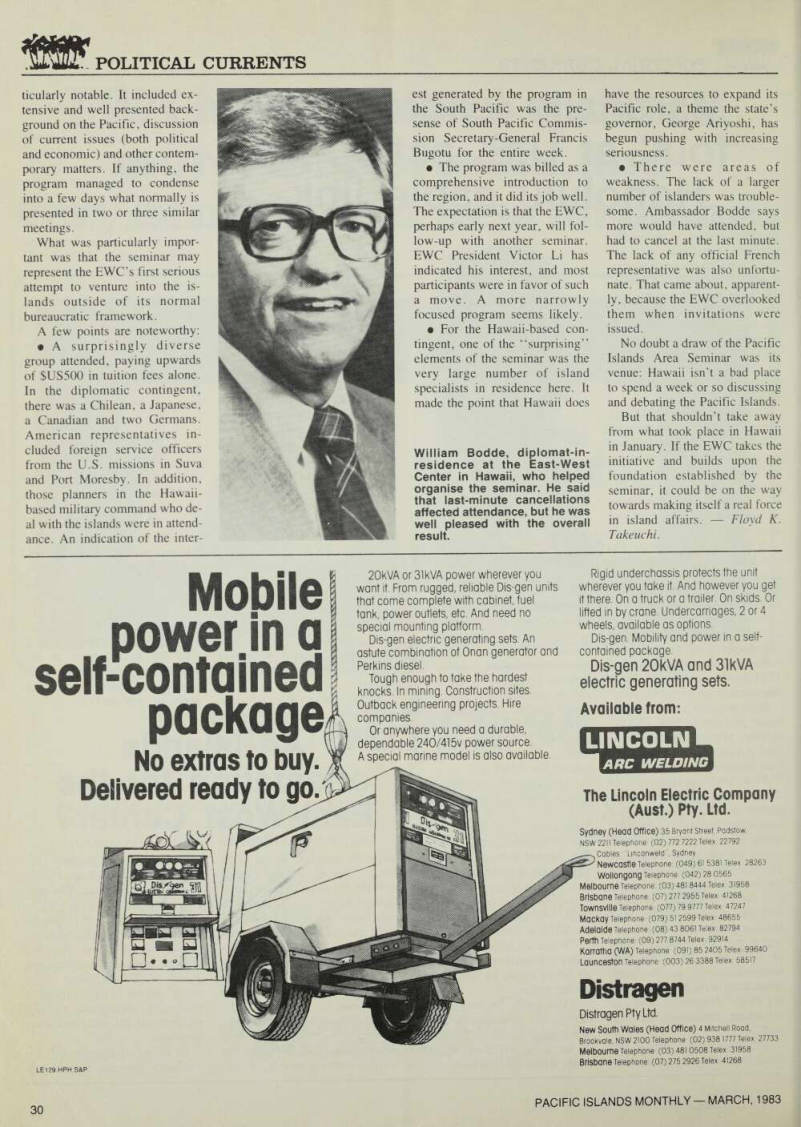
William Bodde, diplomat-in residence at the East-West Center in Hawaii, who helped organise the seminar. He said that last-minute cancellations affected attendance, but he was well pleased with the overall result.