Yachts
pp. 56-62 · Read in the full issue
Lan G. Menzies Re
ports from Port Mores
by, Madang and Rabaul,
Papua New Guinea.
The 1982 cruising season in Papua New Guinea waters was one of the best on record, no doubt due to the increased publicity this region is re ceiving through a variety of media.
One publication that is proving ex tremely popular is Alan Lucas’ book Cruising Papua New Guinea, a reasonably informative and accurate
guide on the subject.
With the advent of the cyclone season in the South Pacific nor
mally November through March
many yachts either headed north to the Philippines, south to Australia or sought the protected and popular wa ters of the Solomon Islands chain.
Here are a few that decided to stay in
Png.
• TAMAPATUM. Registered in Brisbane, Australia, the name of the 14 m ferro ketch is Aboriginal for “bunyip”, a mythical creature found in the legends of the original Australians.
Nick and Kay Bason, who hail from the United Kingdom, adapted a Wilf O’Kell design and commenced construction in 1974. Built along traditional lines, Tamapatum was launched five years later and then finally fitted out in Townsville. She is a beamy boat, which is carried well aft to provide spacious accommoda tion. The saloon, by most standards, is huge. As Kay says: “The only trouble is that our boat always gets chosen for the parties!’’
The Basons, with their two chil dren, Sam, nine, and Rosie, three, and their Sydney silky terrier Kooks, eventually departed Caims in June ’B2. They entered PNG via Samarai and then cruised the Louisiade Ar
chipelago, off the south-east coast of PNG for almost two months.
From there they explored north to Budibudi in the Laughlan Group, an experience they will long remember.
The people of these islands have little or no contact with the outside world and still build their canoes with en tirely natural materials wooden nails, vine lashings and woven grass sails. Nick particularly commented on the brilliant seamanship and navi gation exhibited by these seafarers on their long inter-island trading voy ages. Young Sam Bason, who loves sailing, soon became an avid follow er of model canoe racing to the extent that he was swapping his shorts and shirts for superbly crafted model canoes! It was with regret that the family left behind the outgoing friendliness of these people.
Tamapatum will remain for a while longer moored off the Royal Papua Yacht Club in Port Moresby, before they head west through the Torres Strait to the Gulf of
Carpentaria.
• NERISSA. Chip and Martha Jor don decided they would go cruising for their honeymoon that was in August ’79 and they’re still cruis ing! As Chip put it he had cruised previously with his family and got the bug Martha married into it!
Their home is an 11 m William Garden-designed wooden ketch, built as a one-off in Hong Kong in 1967.
Chip and Martha have had a lei surely cruise across the South Pacif ic, with an extended stopover in French Polynesia where Chip con tracted hepatitis. Their passage took them via American Samoa and Ton ga, to the Bay of Islands in New Zealand, where Nerissa underwent a major interior refit.
After six months in New Zealand, the couple headed for Fiji and from there made a very fast passage direct to Port Moresby in only 17 days.
During their stopover in Port Mores by they were able to enjoy the relax ed and friendly atmosphere of the Royal Papua Yacht Club and obtain their cruising permit for Indonesian waters. Their objective was to spend Christmas in Singapore.
A long time favorite with cruising yachtsmen, the PNG north-coast port of Madang offers truly sheltered an chorages, good slipways and a chance to catch up on a little mainte nance. It’s a good stopover before heading off to either Indonesia or the
Philippines.
• FOLLOW ME. It’s not often you come across a cruising boat that is registered in Switzerland, but that is
where Kurt Donz and Brunhilde Kastli come from in their 10 m Follow Me. A round-bilge steel ketch, Follow Me was built in Zurich and launched in July 1979 at Basle on the River Rhine, which is the only official Swiss port.
After cruising the Mediterranean, Kurt and Brunhilde headed across the Atlantic and through the Panama Canal to the Pacific. With the south-
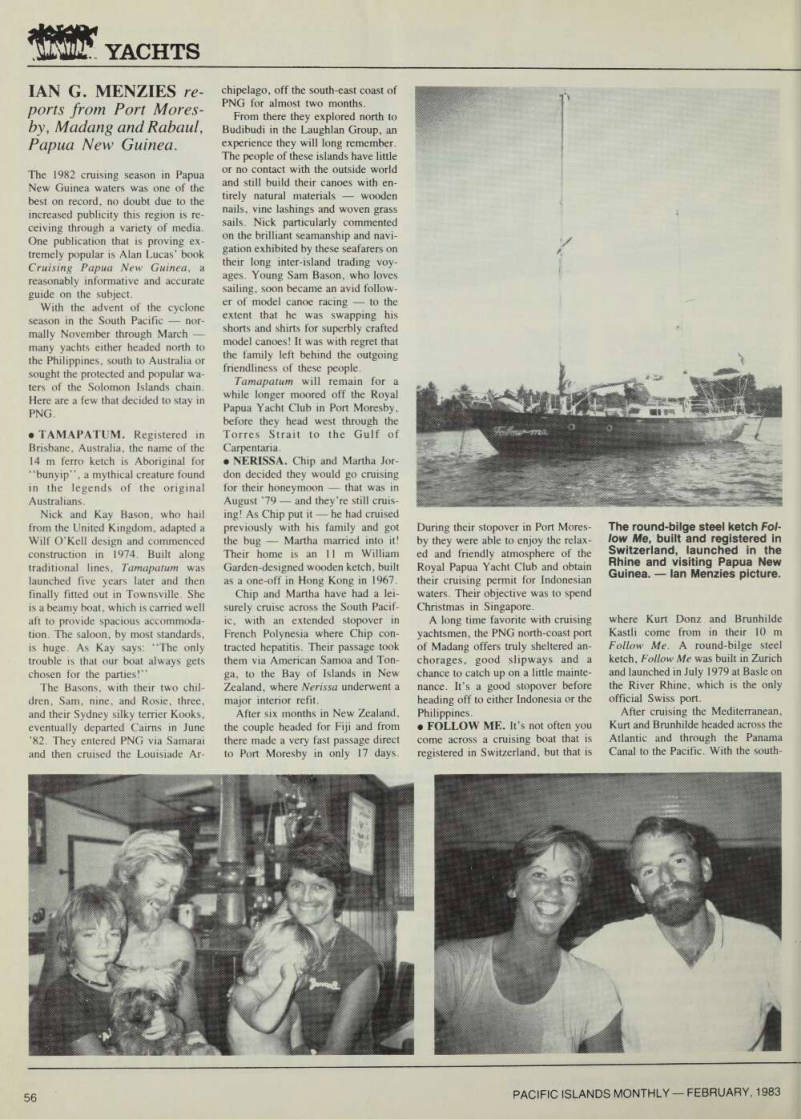
The round-bilge steel ketch Fol low Me, built and registered in Switzerland, launched in the Rhine and visiting Papua New Guinea. lan Menzies picture.
east trades behind them they arrived in Rabaul, via Solomon Islands in July ’B2 and then cruised along the coast of New Britain to Madang.
Along the way they met up with Polette (Basil and Nancy Campion) at Garove Island in the Vitu Group.
Like the Campions, the couple felt that the harbor at Garove, which is actually the crater of a sunken vol cano, was one of the safest they have ever visited. The German priest at the local Catholic mission made them feel especially welcome, and con ducted them on tours of the copra and cocoa plantations.
While based in Madang, Kurt and Brunhilde flew to Goroka in PNG’s
Eastern Highlands, to visit the fam ous “Show”. Held in late August every year, and alternating between Goroka and Mt. Hagen, the show attracts thousands of tribespeople from all over the Highlands, to per form their various dances in full traditional dress. For many of these people, the show is the only regular contact they have with civilisation as we know it. It’s literally the biggest
event of the year, with intense com petition (usually peaceful!) for the various prizes that are awarded pigs and cash.
From Madang, Follow Me was to head west to cruise in Indonesian waters. • APTERYX. Some cruising yachties stop over in Madang to have a rest from constant sea watches, some to wait for further cruising permits, and some to catch up on much-needed maintenance. But Jo and Pete Smith stopped over so that Jo could have a baby.
They, and their 12 m Apteryx were anchored in Madang for some months while Jo prepared for the “big event”. Meanwhile, Pete, a boat-builder by trade, was able to pick up some useful work to feed that extra mouth.
Both Jo and Pete, who are well known in New Zealand yachting cir cles for their numerous victories in half-ton class and ocean racing, have had a life-long ambition to go cruis ing. In July 1979, after completing their GRP cutter Apteryx in a little under 13 months, they realised that ambition and set sail for Fiji and the Pacific Islands. Apteryx, meaning
“flightless bird”, is appropriately
named, as the couple are both “Kiwis”. Pete has done a beautiful job on the boat and used satin finish red cedar and mahogany on the in
terior fittings.
In March ’B3, Jo, Pete and junior, will head for the Carolines, then make passage for the Philippines and hope to be in Hong Kong by Christmas. • WAVELENGTH. I first encoun tered the crew of Wavelength in Port Moresby after they had battled the south-east trades on their maiden voyage from their home port of Port Samson on Australia’s north-west coast. Then, they were three
Geoff Pilkington, Anne Hopkinson
and Nick Henderson. Now they are four, with the additional crew mem ber, Michelle Eldrid, joining them in
Madang.
Wavelength is a 14.3 m double chine, steel motor sailer, fitted with a sloop rig. With twin bilge keels and a big Volvo 105 hp diesel, Wavelength has proved to be a solid boat and fulfils her role as a commercial fish ing and charter vessel admirably.
Still retaining her refrigeration
equipment and brine tanks, though they have not been used, Geoff and Nick decided to remodel while in Madang and convert some of the main cargo hold into an additional double cabin.
On their passage from Port Mores
by to Madang, Wavelength sailed
through the Trobriand Islands, where the crew felt that the islanders were just a little too persistent in their efforts to sell their wares. Nick, who maintains a Kawasaki jet ski on board, had various adventures on his “machine” including offering to tow a local cruise ship! He was not so lucky in Finschhafen, however.
The 12 m GRP cutter Apteryx was built in New Zealand by Pete and Jo Smith and launch ed in 1979. It has been in PNG and will sail this year to Hong
Kong.
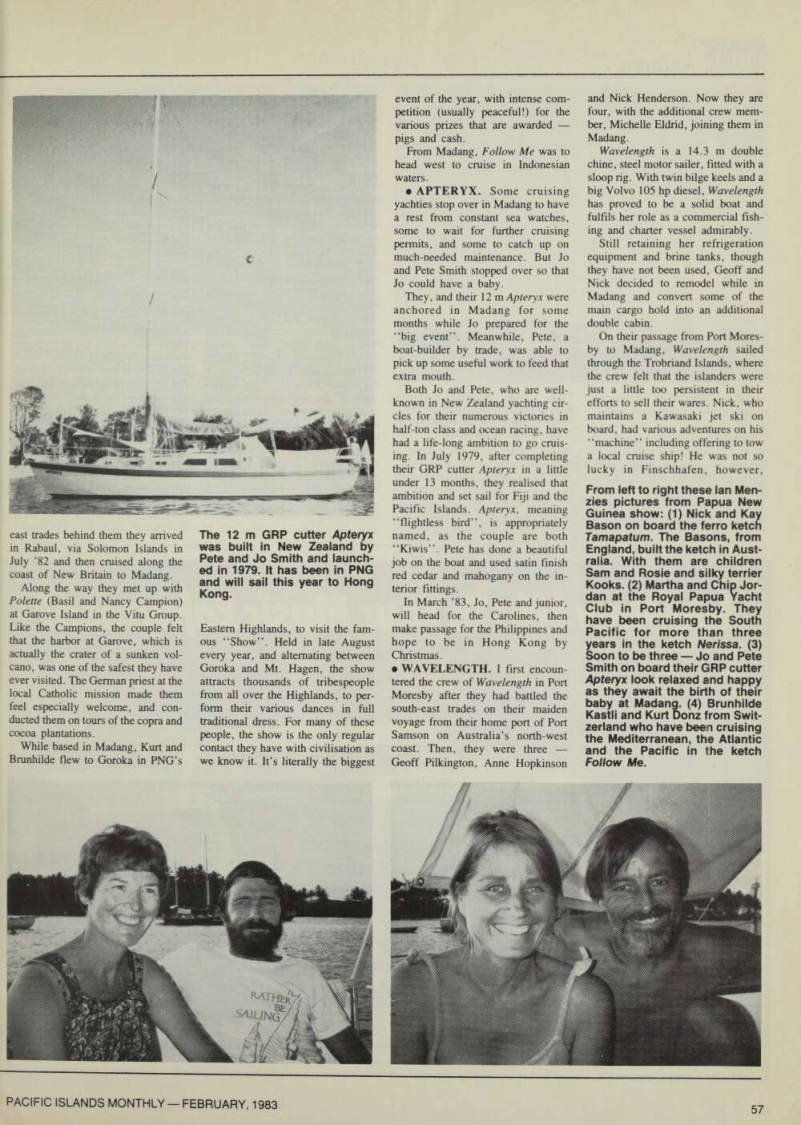
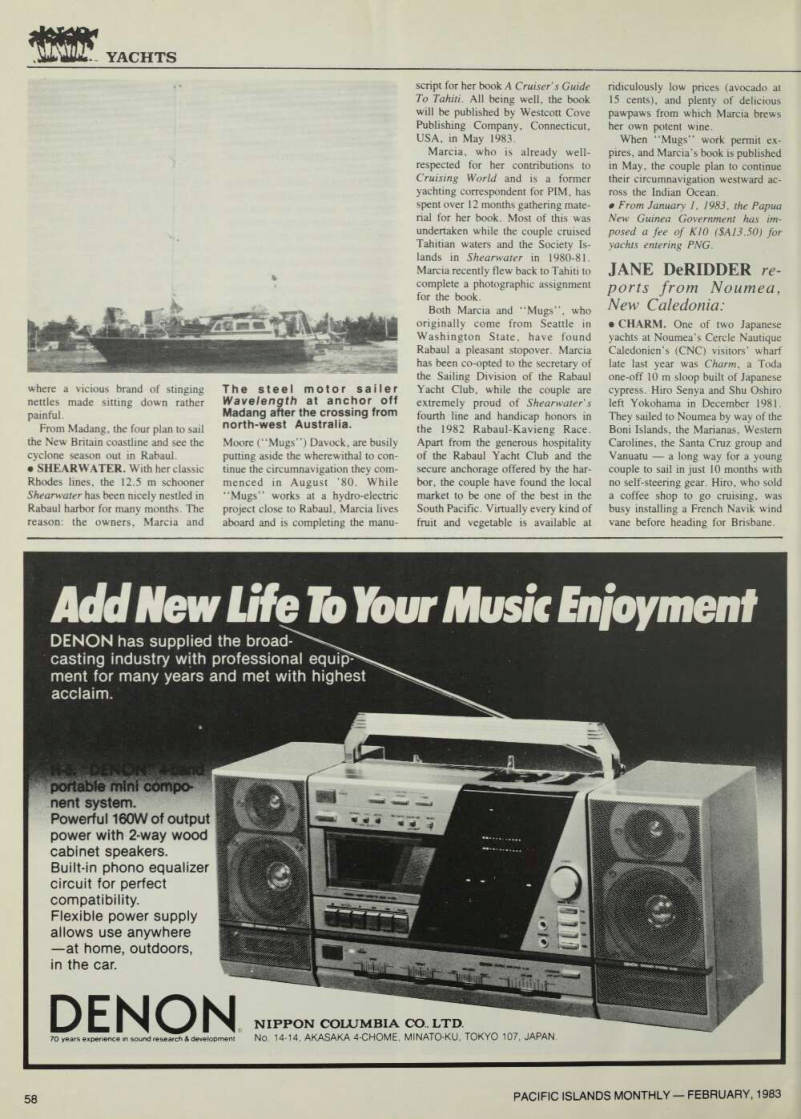
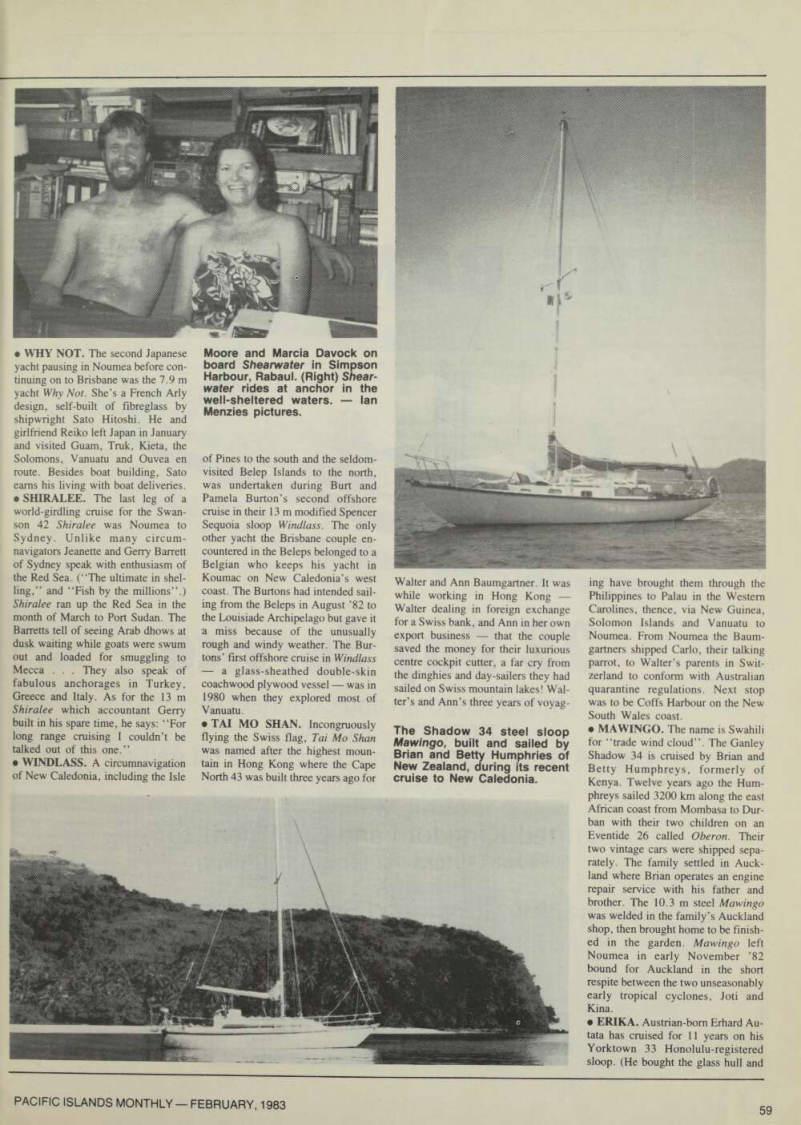
From left to right these lan Men zies pictures from Papua New Guinea show: (1) Nick and Kay Bason on board the ferro ketch Tamapatum. The Basons, from England, built the ketch in Aust ralia. With them are children Sam and Rosie and silky terrier Kooks. (2) Martha and Chip Jor dan at the Royal Papua Yacht Club in Port Moresby. They have been cruising the South Pacific for more than three years in the ketch Nerissa. (3) Soon to be three-Jo and Pete Smith on board their GRP cutter Apteryx look relaxed and happy as they await the birth of their
baby at Madang. (4) Brunhilde
Kastli and Kurt Donz from Swit zerland who have been cruising the Mediterranean, the Atlantic and the Pacific in the ketch Follow Me.
where a vicious brand of stinging nettles made sitting down rather painful.
From Madang, the four plan to sail the New Britain coastline and see the cyclone season out in Rabaul. • SHEARWATER. With her classic Rhodes lines, the 12.5 m schooner Shearwater has been nicely nestled in Rabaul harbor for many months. The reason: the owners, Marcia and
Moore (“Mugs”) Davock, are busily putting aside the wherewithal to con tinue the circumnavigation they com menced in August ’BO. While “Mugs” works at a hydro-electric project close to Rabaul, Marcia lives aboard and is completing the manu
script for her book A Cruiser’s Guide To Tahiti. All being well, the book will be published by Westcott Cove
Publishing Company, Connecticut,
USA, in May 1983.
Marcia, who is already wellrespected for her contributions to Cruising World and is a former yachting correspondent for PIM, has spent over 12 months gathering material for her book. Most of this was undertaken while the couple cruised Tahitian waters and the Society Islands in Shearwater in 1980-81.
Marcia recently flew back to Tahiti to
complete a photographic assignment
for the book.
Both Marcia and “Mugs”, who originally come from Seattle in Washington State, have found Rabaul a pleasant stopover. Marcia has been co-opted to the secretary of the Sailing Division of the Rabaul Yacht Club, while the couple are extremely proud of Shearwater s fourth line and handicap honors in the 1982 Rabaul-Kavieng Race.
Apart from the generous hospitality of the Rabaul Yacht Club and the secure anchorage offered by the harbor, the couple have found the local market to be one of the best in the South Pacific. Virtually every kind of fruit and vegetable is available at
ridiculously low prices (avocado at 15 cents), and plenty of delicious pawpaws from which Marcia brews her own potent wine.
When “Mugs” work permit ex pires, and Marcia’s book is published in May, the couple plan to continue their circumnavigation westward ac ross the Indian Ocean, From January 1, 1983, the Papua New Guinea Government has im posed a fee of KlO (5A13.50) for yachts entering PNG.
Jane Deridder Re
ports from No limed
K T . , ’ ™ ew Caledonia / • CHARM. One of two Japanese yachts at Noumea’s Cercle Nautique Caledonien’s (CNC) visitors’ wharf late last year was Charm , a Toda one-off 10 m sloop built of Japanese cypress. Hiro Senya and Shu Oshiro left Yokohama in December 1981.
They sailed to Noumea by way of the Boni Islands, the Marianas, Western Carolines, the Santa Cruz group and Vanuatu a long way for a young couple to sail in just 10 months with no self-steering gear. Hiro, who sold a coffee shop to go cruising, was busy installing a French Navik wind vane before heading for Brisbane.
The steel motor sailer Wavelength at anchor off Madang after the crossing from north-west Australia.
• WHY NOT. The second Japanese yacht pausing in Noumea before con tinuing on to Brisbane was the 7.9 m yacht Why Not. She’s a French Arly
design, self-built of fibreglass by
shipwright Sato Hitoshi. He and girlfriend Reiko left Japan in January and visited Guam, Truk, Kieta, the Solomons, Vanuatu and Ouvea en route. Besides boat building, Sato earns his living with boat deliveries. • SHIRALEE. The last leg of a world-girdling cruise for the Swan son 42 Shiralee was Noumea to Sydney. Unlike many circum navigators Jeanette and Gerry Barrett of Sydney speak with enthusiasm of the Red Sea. (“The ultimate in shel ling,” and “Fish by the millions”.) Shiralee ran up the Red Sea in the month of March to Port Sudan. The Barretts tell of seeing Arab dhows at dusk waiting while goats were swum out and loaded for smuggling to Mecca . . . They also speak of
fabulous anchorages in Turkey,
Greece and Italy. As for the 13 m Shiralee which accountant Gerry built in his spare time, he says: “For long range cruising I couldn’t be talked out of this one.” • WINDLASS. A circumnavigation of New Caledonia, including the Isle
of Pines to the south and the seldom visited Belep Islands to the north, was undertaken during Burt and Pamela Burton’s second offshore cruise in their 13 m modified Spencer
Sequoia sloop Windlass. The only
other yacht the Brisbane couple en countered in the Beleps belonged to a Belgian who keeps his yacht in Koumac on New Caledonia’s west coast. The Burtons had intended sail ing from the Beleps in August ’B2 to the Louisiade Archipelago but gave it a miss because of the unusually rough and windy weather. The Bur tons’ first offshore cruise in Windlass a glass-sheathed double-skin coachwood plywood vessel was in 1980 when they explored most of Vanuatu. • TAI MO SHAN. Incongruously flying the Swiss flag, Tai Mo Shan was named after the highest moun tain in Hong Kong where the Cape North 43 was built three years ago for
Walter and Ann Baumgartner. It was
while working in Hong Kong
Walter dealing in foreign exchange
for a Swiss bank, and Ann in her own export business that the couple saved the money for their luxurious centre cockpit cutter, a far cry from the dinghies and day-sailers they had sailed on Swiss mountain lakes! Wal ter’s and Ann’s three years of voyag-
ing have brought them through the Philippines to Palau in the Western Carolines, thence, via New Guinea, Solomon Islands and Vanuatu to Noumea. From Noumea the Baum gartners shipped Carlo, their talking parrot, to Walter’s parents in Swit zerland to conform with Australian quarantine regulations. Next stop was to be Coffs Harbour on the New South Wales coast. • MAWINGO. The name is Swahili for “trade wind cloud”. The Ganley Shadow 34 is cruised by Brian and
Betty Humphreys, formerly of
Kenya. Twelve years ago the Hum phreys sailed 3200 km along the east African coast from Mombasa to Dur ban with their two children on an Eventide 26 called Oberon. Their two vintage cars were shipped sepa rately. The family settled in Auck land where Brian operates an engine repair service with his father and brother. The 10.3 m steel Mawingo was welded in the family’s Auckland shop, then brought home to be finish ed in the garden. Mawingo left Noumea in early November ’B2 bound for Auckland in the short respite between the two unseasonably
early tropical cyclones, Joti and
Kina. • ERIKA. Austrian-born Erhard Au tata has cruised for 11 years on his Yorktown 33 Honolulu-registered sloop. (He bought the glass hull and
Moore and Marcia Davock on board Shearwater in Simpson
Harbour, Rabaul. (Right) Shear
water rides at anchor in the well-sheltered waters. lan
Menzies pictures.
The Shadow 34 steel sloop Mawingo, built and sailed by Brian and Betty Humphries of New Zealand, during its recent cruise to New Caledonia.
decks from Henry McKewen, the voice of Bugs Bunny!) Carpenter/ref rigeration mechanic, Erhard com pleted the kit boat in Long Beach, and outfitted it at Dana Point, California. He considers building boats a challenge, and far more fun than house-building, where “every thing is square”. Erhard plans to return to Tahiti after spending hur ricane season in Gladstone, Queens land “wind permitting”. About the appointments on red-hulled Erika, Erhard says: “Omega? I wasted my money on it. My digital depth soun der is the most important bit of
gear.”
• AERANDIR. With 17,000 km under the keel in 11 months, Aeran dir is earning her name slowly but surely, say Peter and Chris McHugh of their English-designed, Tasma nian-built half-tonner. ( Aerandir is a Tolkien “Silmarillian” name mean ing “sea wanderer”.) Peter, a clerk from Devonport, Tasmania, and Chris, a nurse from Christchurch, New Zealand, sailed their 9 m steel yacht as far as Pitcairn Island where, true to her name, Aerandir took off on her own to be caught 3 km offshore. Her 10 kg CQR anchor with 18 m of chain was retrieved by Steve Christian. Christian free-dived 15 m deep to bring up the end of the chafed anchor line. The McHughs approached New Caledonia’s Havan nah Passage during a westerly blow with zero visibility. They had to turn around and wait for two days.
“That’s when a Sat Nav would have been very nice,” Brian admitted.
Aerandir left Noumea in blustery
south-easterlies with Tropical Cyc
lone Kina at her heels, bound for Christchurch for refurbishing. • MANU-KA-RERE. A sistership to John Guzzwell’s Trekka, Manu- Ka-Rere, a cold-moulded 6 m sloop, is owned and sailed by New Zealan ders Cindy Slark, 25, and her brother Jon, 23. They were joined by their co-owner brother Matt, 22, for the Malololailai to Port-Vila Race.
Manu-Ka-Rere was the smallest but not the slowest of 17 cruising yachts taking part in what Jon termed “a perfect downwind race”. Then voyage from Noumea to Brisbane between Tropical Cyclones Joti and Kina will not have been in such idyllic conditions. During the five years that the three Slarks have own ed the mini-sloop it has fallen mainly to Cindy to sail and look after the vessel, for young Matt is a student at the University of Canterbury, and Jon spent three years on Tuvalu working as a diver with the New Zealand aid program engaged in
blasting and clearing channels
through the reefs of various islands.
Jon plans on taking a commercial diving course with a view to employ-
ment on oil rigs. Cindy, holder of a law degree, was working as a “post ie” before their departure, delivering mail by bicycle in Birkenhead. “Best job I’ve ever had,” she says. • HEBER. Bearing an Irish name, carrying an all South African crew, flying the red ensign and with port of registry London, Heber was built in Cork in 1917 as a fishing boat. This hefty 14-tonne gaff rigged wooden vessel (10.4 m waterline, 12.8 m overall, 1.8 m draft) has been totally rebuilt by Robin Smith in the 11 years he has owned and cruised her
framing, planking, decks, super
structure included. Robin even deepened the keel and copper-plated the hull below the waterline. It was while teaching, and rebuilding Heber in Capetown, that Robin met and married fellow teacher Jenny. Baby Nadine Smith was bom two months prematurely in Taio Hai in the Mar quesas. A minute 2 kg at birth, Nadine lost 400 grams before she took hold of life and became the healthy seven-month-old we saw in Noumea. Nadine’s Marquesan name
Taihia Hoata ite Moana means “be loved soft light which illuminates the ocean”. The Smith family and crew member Martin were waiting for the effects of Tropical Cyclone Kina to pass before heading for Brisbane. • SUSURUMBA. Don and Bridget Bruneski’s trimaran, with the melodious Zimbabwean name, is easily recognisable. She’s a red hulled Hedley Nichol 36 tri, sporting a wind generator with a Canadian maple leaf painted on the vane trail ing behind the whirling airfoil blades. Architect Don Bruneski of Rossland, British Columbia, says the heart of his electric generating sys tem is a generator sold by Hamilton Ferris of Santa Cruz, California, which is designed to work with a tow propeller. When a 6 hp OMC out board prop on its 1 m stainless steel shaft and 20 m of line is towed at 5 knots the device generates at 5 amps. (8 amps at 7 knots.) When the trima ran travels faster, the generator pro duces as much as 10 amps but it heats up and the propeller has to be hauled in. While in Suva, Don finished
building the wind generator using data supplied by Bridget’s sister Catherine who scoured London lib raries and additional info gleaned from the Department of Energy and the University of the South Pacific.
“It nas made such a difference to our lives,” they say. Susurumba has only an ouboard motor as auxiliary en gine. A Honda portable generator was formerly used to charge the batteries. Therefore alternative ener gy sources are even more important than they are to most other cruising vessels, particularly since Don and Rhodesian-bom Bridget like to keep in regular touch with family and friends worldwide by means of amateur radio contacts. (Call sign SWIED.) Before entering the South Pacific the Bruneskis spent over a year in Mexico’s Sea of Cortez based in Puerto Escondido. Here they adopted Baby Paul, now a sturdy, active little fellow with a good set of sea legs. Susurumba will sail from Noumea to Brisbane where Bridget is looking forward to space, time and regular playmates for Paul. Bridget says: “I just wish we could find some means of harnessing Paul’s energy!” • AKATES. The 12 m Akates, the “faithful friend” of Virgil’s Aeneid, is a Boro design yawl built of steel in Perth, Western Australia, then finish ed by owner Terry Hickey. Terry and Lois started cruising Akates in 1977 up the Queensland coast. Now retired and on their first offshore voyage, the
Perth couple plan on spending two
years or so in the Pacific, including hurricane season in New Caledonia where they are “fascinated by the color of the place, the flowers and dresses and everywhere the young people on their two-wheel matadore machines flat out, shirts flying, reck
lessly gay.”
Bridget, Paul and Don Bruneski on board Susurumba. (Left) Jen ny Smith and baby Nadine of Heber.
The superb Norwegian-designed Duen, home for Albert and Dotty Fletcher, motors out of Madang, PNG, for an offshore cruise.-lan Menzies picture.
• SILVIA. “Papa Blondie” missed his 65th birthday because of crossing the International Date Line. He is Herbert Jivegard, master of the blue hulled 9 m Albin Ballad, a half-tonne
fibreglass ocean cruising sloop
named after the Queen of Sweden and proudly flying the blue and gold flag. Herbert says that when he re tired from his 30 years as wholesale food broker and fulfilled a dream by leaving in June ’79 on his own small ship, “A new world opened to me”.
He learned to speak English, took up macrame and knot work, and began
writing travelling newsletters for
family, friends and former employ ees, many of whom have joined the vessel as guests particularly when Silvia was Caribbean-based in St Vincent for two years. Erik Hell strom 34, sales engineer for the Ger man BASF chemical company and longtime friend of Herbert’s, joined Silvia in St Thomas as first mate for her Pacific cruise. Though Herbert and Erik find the South Pacific not nearly as hot and sunny as they’d been led to believe, the “beautiful people, good friends and incredible hospitality’’ more than make up for it. Papa Blondie’s newsletter is pub lished in weekly instalments in a Swedish newspaper. • PANACHE. A survivor of Ton ga’s Cyclone Isaac, Panache was one of several yachts waiting in the rain in Noumea in mid-November for heavy weather to subside before set ting sail for Queensland. Tony Barra plans on a major refit for his eight year-old Catalina 30 in either Bris bane or Bundaberg. Panache’s crew member Jennifer Guilbert was look ing forward to getting underway for she loves ocean passages and speaks with enthusiasm of “clean air and tons of space ...” • FRISIA. When the Dutch vessel Frisia, a 14.3 m steel ketch, was caught in a gale on her maiden voyage from New Zealand to Suva, Hessel Dykstra became concerned for the well-being of his severely seasick wife and daughters. Seven year-old Michelle in particular was
suffering from severe dehydration
and it was feared she might go into shock. Abiding by radioed medical advice, Hessel arranged to have the three transferred to the Fiji vessel Tui Cakau which was in their vicinity.
Hessel’s Sat Nav fix made location an easy matter. The Tui Cakau low ered a lifeboat in its lee enabling the transfer to be made quickly and safe ly in spite of large swells running.
Again on radioed medical advice, treatment of the seasick patients took the form of flat Coca-Cola, glucose and dry cabin biscuits.
Aboard Frisia, 12-year-old Remco was promoted to first mate, a posi tion he has filled competently ever
since. The Dykstras were reunited in Suva and have enjoyed cruising their
family-built floating home in Fiji
waters. Fortunately the weather was fair for the sail from Suva to New Caledonia.
Frisia is a luxuriously appointed blue-hulled ketch. She was designed by Albert Blok, former chief draughtsman for the Dutch naval architect, H. W. DeVoogt. Hessel welded the hull himself. His wife Stella sandblasted it and took charge of sanding, painting and varnishing when the time came. In fact the whole family was involved in the six year project. For the Noumea- Brisbane leg of Frisia’s cruise, Stella
was planning on trying the relatively
new “sticker-behind-the-ear” sea
sickness remedy.
• BIG BEAR H. Wrecked near Christmas Island, the Vancouver registered schooner Big Bear H (PIM Oct. ’B2, p 73) struck a reef at night in mid-October in heavy rain squalls while en route to Hawaii with a delivery crew. Owner Helmut Petrak flew in with salvage experts but efforts to refloat the 13.7 m yacht were unsuccessful.
From Atlantic to Pacific in the Swedish yacht Silvia. Owner and skipper Herbert Jivegärd (top) and first mate Erik Hellström.