In praise of the Hawaiian canoe
pp. 43-44 · Read in the full issue
Hawaiian canoe
The Hawaiian Canoe. By Tom my Holmes. Produced and pub lished by Editions Ltd., P. O. Box 869, Hanalei, Kauai, Hawaii 96714, U.S.A. No ISBN, price, provided.
Your hearts are lifted by the flash of paddles, by the spray scatter ing the sunlight, by the thrust of strong suntanned backs that lean far forward at every stroke. You raise your eyes to the whole scene the blue horizon lifting with the swell, the blue bay, the crowded sand, the drinks and fast food stalls, the parallel pods of the boats striving to win: this is the Hawaiian canoe race, the latest phase in a maritime tradi tion thousands of years old. The sea-margin cultures of the Poly nesians are based upon canoes: the history and development of outrigger and double canoes from island Southeast Asia over the whole Pacific is a multi faceted story woven through hundreds of island cultures. The Hawaiian canoe is one facet of that kaleidoscope.
At 3600 metres, high on the bare rocky slopes of Mauna Kea, are 18 square kilometres of basalt mines. Selected pieces of the close-grained rock were used for the adzes for the hollowing and shaping of the canoes. Giant Koa trees were felled in the lowland forests, hollowed out and dragg ed to the sea. Then, with a gunnel sewn to each side, and end-pieces added, the hulls made the superbly adaptable seaworthy canoes of the ancient Hawaiians.
The single outrigger canoe for fishing had a float on the port side; two hulls fixed parallel to each other by booms made a double canoe for voyaging and coastal cargo.
The basic design persisted through the 19th century and then at the beginning of this century there was a revival of water sports in Hawaii with surf boards and canoes. From then on tourism took over and fostered the sports. Canoe racing led to the development of lighter, faster canoes, but the design is not so different from the ancient canoes that were so well adapted to Hawaiian waters.
Tommy Holmes has brought together the varied threads of this story with a superb collection of
“Frail, wonderfully organic canoes powered by plaited leaf sails and human sinew gingerly took to undiscovered seaways. The legacy of the canoe had begun. Its most eminent inheritors would be the Polynesians.” Tommy Holmes in the opening chapter of his book.
old photgraphs from archives and private sources. The quality and quantity of the material delights anyone who loves the surf, the beach, boats and skills, strength and agility of battle with (not against) the waves. I congratu late Tommy on the organisation of the work alone, never mind the 15 years research and the lifetime of experience sailing, building and talking about Hawaiian canoes. Topic after to pic is summarised systematically while the whole story is woven together in a harmony which matches that of the canoe in all its aspects.
There is a comprehensive list of dialect terms concerned with canoes, notes on all the compo nents, accessories, and food car ried on board. There is a chapter on canoe ladders, which make possible the colonisation of a steep rocky shore, another chap ter on burial canoes, another on rock art showing canoes, and a splendid collection of old photo graphs, mostly previously un
published, from private collec tions in Hawaii. There is also a guide to the design of modem racing canoes and canoe races.
One of the problems of the author was clearly whether to place the Hawaiian canoe in its wider setting or not. By concen trating on the local scene in all its facets, he perpetuated some downright errors that will no doubt be repeated by his friends and readers. For example, in the introduction by Abraham Prianaia we read; “It was not until after the settlement of the Hawaiian Islands that the Hawaiian canoe was developed.
What set it apart from other Polynesian type-canoes was its solid one-piece hull, made poss ible because of a providential supply of tall hardwood trees that the Hawaiians named Koa'\ Now it is evident that the basic construction of the Hawaiian canoe follows the principles that can be found over the whole route of the Polynesian migra tions from Southeast Asia, and
the only unique feature of the Hawaiian situation was that very large canoes could be cut from the huge single logs which hap pened to be available in Hawaii.
In atoll areas it was necessary to sew planks, and in French Poly nesia several trunks were joined to make the largest hulls. I speak only of the 200 years since con tact: upon first colonisation other islands might have had excep tionally large trees that had van ished long before first contact with Westerners. Small canoes almost everywhere were made with a single log.
To my mind Tommy Holmes shows too much respect for the opinions that have come down to us in the encyclopaedic work of Haddon and Homell (1936-38) on Pacific canoes. Discussing Hawaiian canoes, Homell says (pll in vol 1): “These spreaders gave support to the sides of the canoe, and it is probable that they represent true frames which have degenerated and now sub serve a new purpose.” Holmes quotes this as if at a loss to find a better mentor. In fact, the spreader is the sendang of the outrigger canoes of Bali and Madur and is a common feature of Pacific canoe construction.
The comb-cleats, like the spread ers to which they are locked, are a general feature known from excavated 12th-century Philip pine boats, from descriptions of the 17th-century Kora-Kora of the Moluccas and persisting down to our own time in many remote comers of the Pacific and island Southeast Asia. The gun nel or wash strake, and the end pieces forming stem and stem, are exactly as can be seen in many cultures, even by tourists on the beaches of Bali.
Although he has chosen to restrict the view to Hawaii alone, there are many details where a wider view would be of interest to Hawaiian readers and of value in a wider context. For example, the lowland and shoreline tree Hibiscus tiliaceus provides strong fibre for the maritime Au-
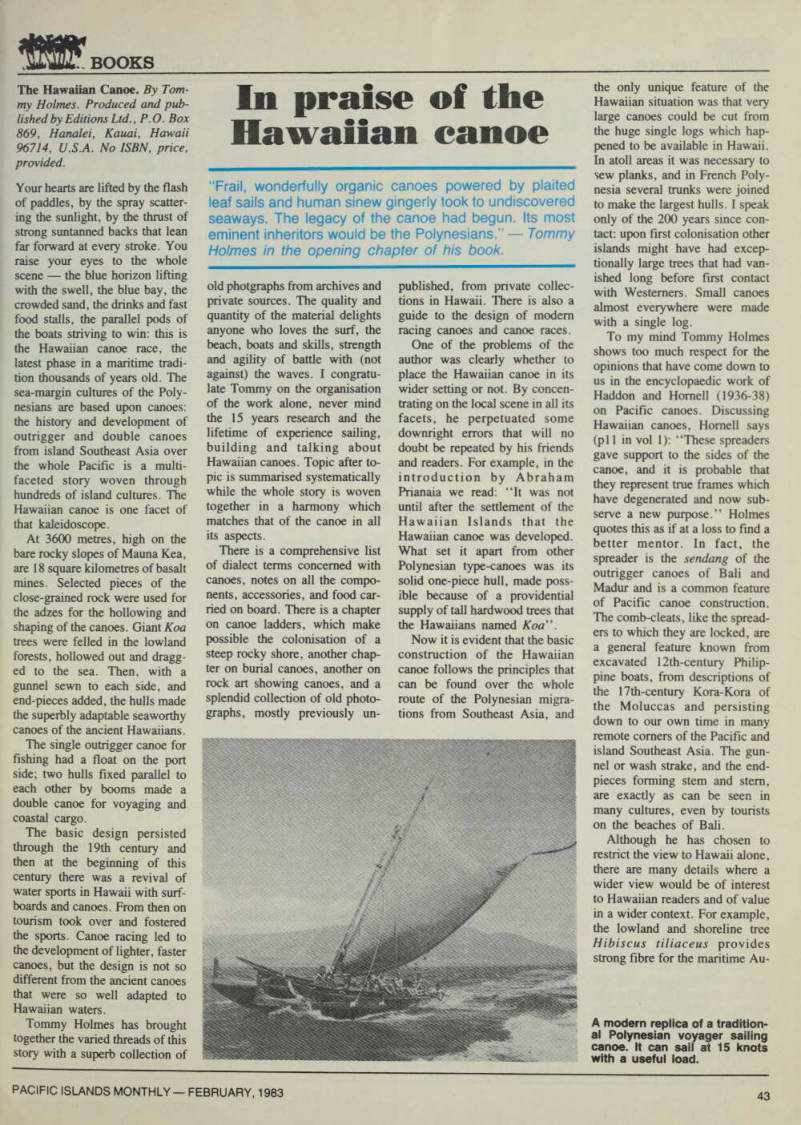
A modern replica of a tradition al Polynesian voyager sailing canoe. It can sail at 15 knots with a useful load.
stronesian cultures from Madagascar (where it is called Varu ) right across the Pacific (common name baru). Tommy does not comment on its wide usage, or on the linguistic shift to hau , because of the shortage of consonants in the Hawaiian dialect. This kind of information would have enriched the book all
through.
Sins of omission however, are readily excused when such a wealth of material for canoe en thusiasts is so excellently brought together. Sins of comis sion are negligible. Maybe one could say that some of the color photographs have been taken by a photo-joumalist for a glossy magazine, and maybe your typic al canoe-racing type would find no use for the high level of scholarship in the lists of Hawaiian dialect terms. For all interested in surfing, canoe rac ing, canoe design and the ancient maritime culture of pre-contact Hawaii, this is a marvellous col lection of information. The canoe itself is simple, but the story all gathered fills 200 pages packed with fascinating details, splendid illustrations and quota tions from all the significant ear
ly works on the topic.
G.
Adrian Horridge.
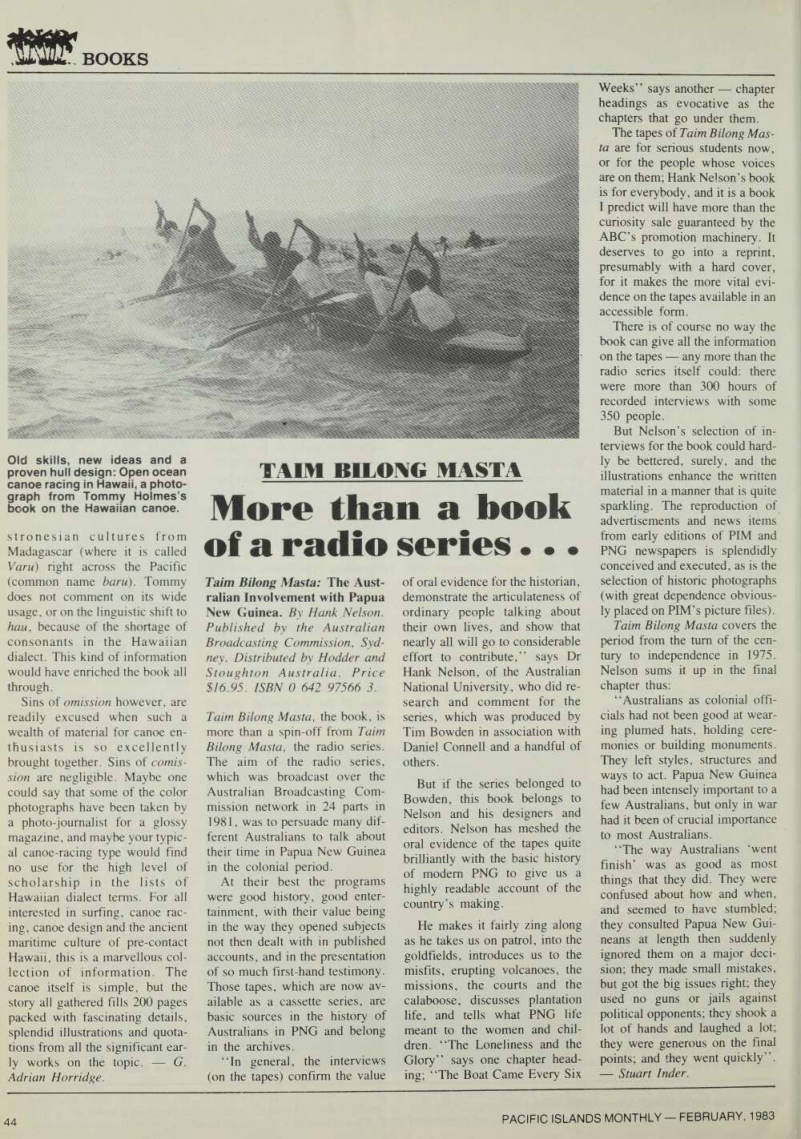
Old skills, new ideas and a proven hull design: Open ocean canoe racing in Hawaii, a photo graph from Tommy Holmes’s book on the Hawaiian canoe.