Government ousted
p. 33 · Read in the full issue
in Kiribati
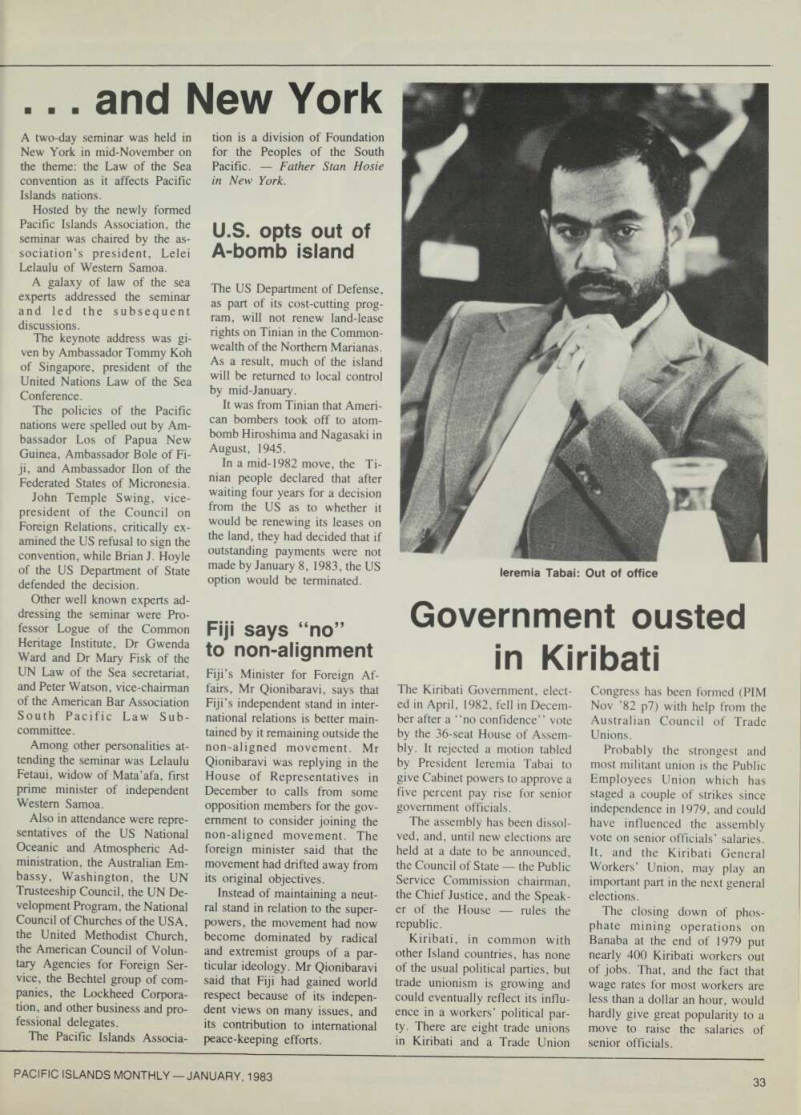
The Kiribati Government, elect ed in April, 1982, fell in Decem ber after a “no confidence’’ vote by the 36-seat House of Assem bly. It rejected a motion tabled by President leremia Tabai to give Cabinet powers to approve a five percent pay rise for senior government officials.
The assembly has been dissol ved, and, until new elections are held at a date to be announced, the Council of State the Public Service Commission chairman, the Chief Justice, and the Speak er of the House rules the republic.
Kiribati, in common with other Island countries, has none of the usual political parties, but trade unionism is growing and could eventually reflect its influ ence in a workers’ political par ty. There are eight trade unions in Kiribati and a Trade Union
Congress has been formed (PIM Nov ’B2 p 7) with help from the Australian Council of Trade Unions.
Probably the strongest and most militant union is the Public Employees Union which has staged a couple of strikes since independence in 1979, and could have influenced the assembly vote on senior officials’ salaries.
It, and the Kiribati General Workers’ Union, may play an important part in the next general elections.
The closing down of phos phate mining operations on Banaba at the end of 1979 put nearly 400 Kiribati workers out of jobs. That, and the fact that wage rates for most workers are less than a dollar an hour, would hardly give great popularity to a move to raise the salaries of senior officials.
leremia Tabai: Out of office