foreign nations” - Judge
p. 29 · Read in the full issue
Political Currents
Nauru President Loses $Us4Om Claim
“Court cannot probe acts of foreign nations” - Judge
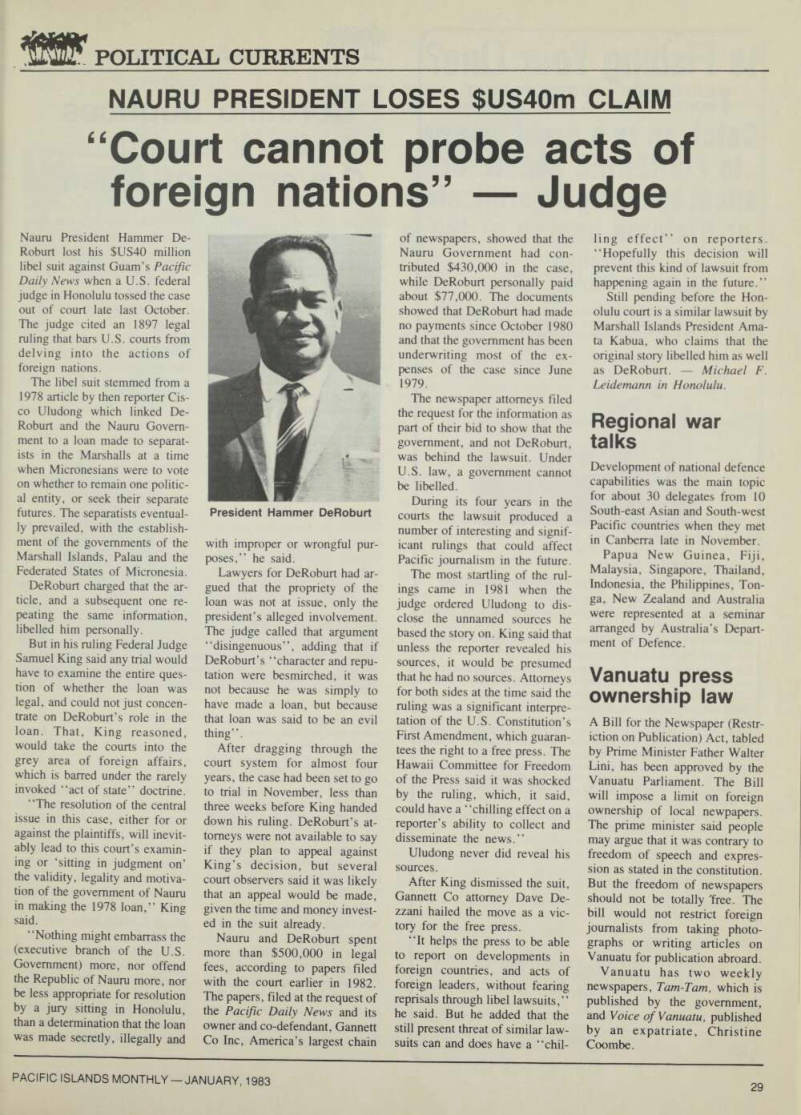
Nauru President Hammer De- Roburt lost his SUS4O million libel suit against Guam’s Pacific Daily News when a U.S. federal judge in Honolulu tossed the case out of court late last October.
The judge cited an 1897 legal ruling that bars U.S. courts from delving into the actions of foreign nations.
The libel suit stemmed from a 1978 article by then reporter Cis co Uludong which linked De- Roburt and the Nauru Govern ment to a loan made to separat ists in the Marshalls at a time when Micronesians were to vote on whether to remain one politic al entity, or seek their separate futures. The separatists eventual ly prevailed, with the establish ment of the governments of the Marshall Islands, Palau and the Federated States of Micronesia.
Deßoburt charged that the ar ticle, and a subsequent one re peating the same information, libelled him personally.
But in his ruling Federal Judge Samuel King said any trial would have to examine the entire ques tion of whether the loan was legal, and could not just concen trate on Deßoburt’s role in the loan. That, King reasoned, would take the courts into the grey area of foreign affairs, which is barred under the rarely invoked “act of state” doctrine.
“The resolution of the central issue in this case, either for or against the plaintiffs, will inevit ably lead to this court’s examin ing or ‘sitting in judgment on’ the validity, legality and motiva tion of the government of Nauru in making the 1978 loan,” King said.
“Nothing might embarrass the (executive branch of the U.S.
Government) more, nor offend the Republic of Nauru more, nor be less appropriate for resolution by a jury sitting in Honolulu, than a determination that the loan was made secretly, illegally and
with improper or wrongful pur poses,” he said.
Lawyers for Deßoburt had ar gued that the propriety of the loan was not at issue, only the president’s alleged involvement.
The judge called that argument “disingenuous”, adding that if Deßoburt’s “character and repu tation were besmirched, it was not because he was simply to have made a loan, but because that loan was said to be an evil thing”.
After dragging through the court system for almost four years, the case had been set to go to trial in November, less than three weeks before King handed down his ruling. Deßoburt’s at torneys were not available to say if they plan to appeal against King’s decision, but several court observers said it was likely that an appeal would be made, given the time and money invest ed in the suit already.
Nauru and Deßoburt spent more than $500,000 in legal fees, according to papers filed with the court earlier in 1982.
The papers, filed at the request of the Pacific Daily News and its owner and co-defendant, Gannett Co Inc, America’s largest chain
of newspapers, showed that the Nauru Government had con tributed $430,000 in the case, while Deßoburt personally paid about $77,000. The documents showed that Deßoburt had made no payments since October 1980 and that the government has been underwriting most of the ex penses of the case since June 1979.
The newspaper attorneys filed the request for the information as part of their bid to show that the government, and not Deßoburt, was behind the lawsuit. Under U.S. law, a government cannot be libelled.
During its four years in the courts the lawsuit produced a number of interesting and signif icant rulings that could affect Pacific journalism in the future.
The most startling of the rul ings came in 1981 when the judge ordered Uludong to dis close the unnamed sources he based the story on. King said that unless the reporter revealed his sources, it would be presumed that he had no sources. Attorneys for both sides at the time said the ruling was a significant interpre tation of the U.S. Constitution’s First Amendment, which guaran tees the right to a free press. The Hawaii Committee for Freedom of the Press said it was shocked by the ruling, which, it said, could have a “chilling effect on a reporter’s ability to collect and disseminate the news.”
Uludong never did reveal his sources.
After King dismissed the suit, Gannett Co attorney Dave De zzani hailed the move as a vic tory for the free press.
“It helps the press to be able to report on developments in foreign countries, and acts of foreign leaders, without fearing reprisals through libel lawsuits,” he said. But he added that the still present threat of similar law suits can and does have a “chil
ling effect” on reporters.
“Hopefully this decision will prevent this kind of lawsuit from happening again in the future.”
Still pending before the Hon olulu court is a similar lawsuit by Marshall Islands President Ama ta Kabua, who claims that the original story libelled him as well
as Deßoburt.
Michael F.
Leidemann in Honolulu.
Regional war
talks
Development of national defence capabilities was the main topic for about 30 delegates from 10 South-east Asian and South-west Pacific countries when they met in Canberra late in November.
Papua New Guinea, Fiji, Malaysia, Singapore, Thailand, Indonesia, the Philippines, Ton ga, New Zealand and Australia were represented at a seminar arranged by Australia’s Depart ment of Defence.
Vanuatu press
ownership law
A Bill for the Newspaper (Restr iction on Publication) Act, tabled by Prime Minister Father Walter Lini, has been approved by the Vanuatu Parliament. The Bill will impose a limit on foreign ownership of local newpapers.
The prime minister said people may argue that it was contrary to freedom of speech and expres sion as stated in the constitution.
But the freedom of newspapers should not be totally Tree. The bill would not restrict foreign journalists from taking photo graphs or writing articles on Vanuatu for publication abroard.
Vanuatu has two weekly newspapers, Tam-Tam, which is published by the government, and Voice of Vanuatu, published by an expatriate, Christine Coombe.
President Hammer DeRoburt