“Some petroleum
pp. 62-66 · Read in the full issue

Southwest Pacific: “Some petroleum potential”
Six South Pacific marine geolog ical and geophysical projects which ended in August (PIM Aug p 6) were aimed at better understanding the regional geol ogy, and the mineral and pet roleum potential, of the island arcs of the Southwest Pacific.
The projects were financed by Australia, New Zealand and the United States, and were carried out under the auspices of CCOP /SOPAC (Committee for Co ordination of Joint Prospecting for Mineral Resources in South Pacific Offshore Areas), the UN sponsored organisation based in Suva which is responsible for promoting offshore mineral ex ploration programs for member
countries in the South Pacific.
The research took place in the waters of Tonga, Fiji, Vanuatu, Solomon Islands and Papua New Guinea. Participating scientists came from the three donor coun tries, the five island countries involved, CCOP/SOPAC and France. Each project had Amen can and CCOP/SOPAC nominated co-chief scientists; the latter included Dr David Falvey of Sydney University and Dr Neville Exon of the Bureau of Mineral Resources (BMR), Can berra. Altogether there were 11 Australians aboard ship, drawn from both the Bureau of Mineral Resources and from universities belonging to the
Australian Consortium of Ocean Geoscientists (COGS).
Three projects used the 1500tonne United States Geological Survey research vessel S.P. Lee which normally works in the cold waters off the American west coast including Alaska. (There was certainly no lack of volun teers to work in the South Pacific for a change). The projects were designed to better evaluate the petroleum potential of offshore areas in Tonga, Vanuatu and the Solomons. Research started from Pago Pago in late March and ended in Rabaul in early June.
The S.P. Lee concentrated on sophisticated multichannel seis mic surveying which revealed details of the sedimentary strata to depths of more than 5 km beneath the sea bed. A great deal of computer processing and sci entific analysis is needed before final results will be available.
During the surveying, continu
ous measurements were also made of the earth’s magnetic and
gravity fields. These will provide additional information about the earth’s crust in the region.
Dredging and coring of outcrops will allow the scientists to de velop a more accurate idea of the
underlying strata.
Altogether about 8000 kilometres of high-quality seis mic data was obtained by the S.P. Lee in thick sedimentary basins south of Tonga, and bet ween the twin chains of islands in Vanuatu and the Solomons.
An initial interpretation of the results suggests that all three areas have some petroleum potential.
A short survey was carried out
in Rabaul harbor at the request of local vulcanologists to provide additional data for their surveill ance program.
The other three projects used the 300-tonne University of
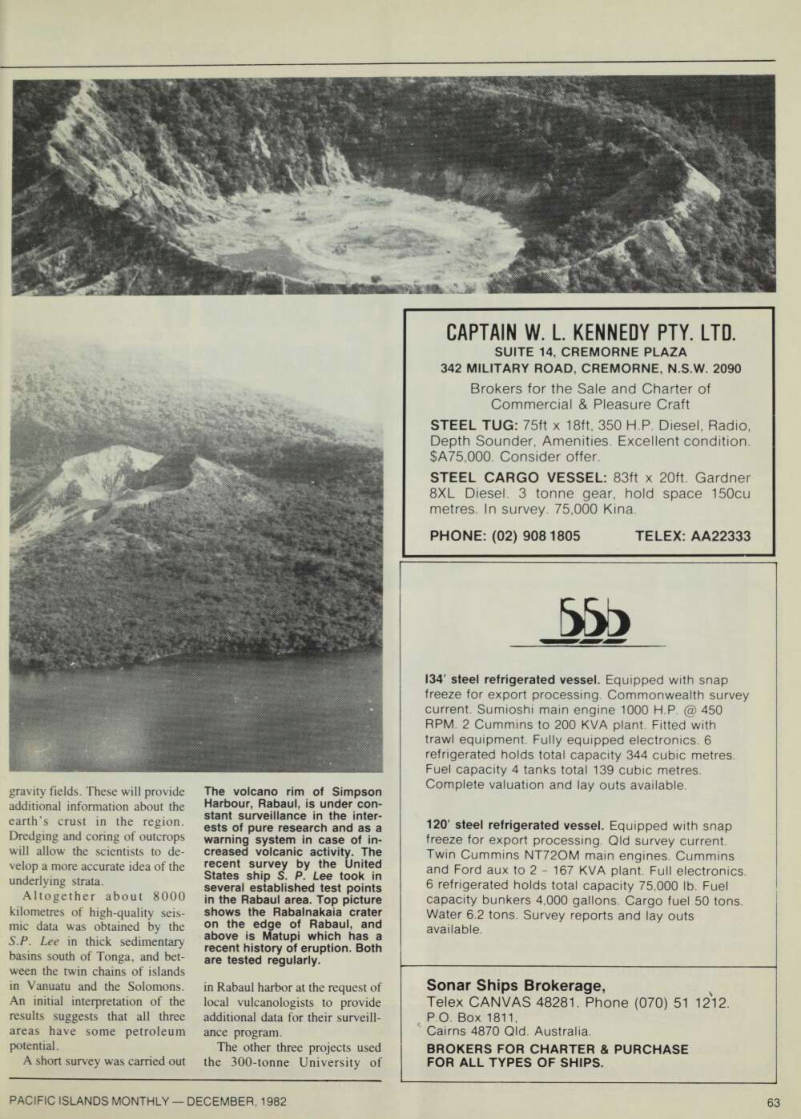
The volcano rim of Simpson Harbour, Rabaul, is under con stant surveillance in the inter ests of pure research and as a warning system in case of in creased volcanic activity. The recent survey by the United States ship S. P. Lee took in several established test points in the Rabaul area. Top picture shows the Rabalnakaia crater on the edge of Rabaul, and above is Matupi which has a recent history of eruption. Both are tested regularly.
Hawaii research vessel Kana Keoki. This vessel’s projects were generally of a more basic research nature than those con ducted with the Lee. Kana Keoki started from Pago Pago in late March, and ended at Honiara in early June. The first project was an investigation of the deep trench and volcanic islands 500 kilometres north of Fiji.
The second studied the rifting of the basaltic oceanic crust bet ween Fiji and Vanuatu, where it was hoped metal deposits would be forming as new basalt welled up to fill the rifts. The third concentrated on the eastern Sol omons Sea and sea floor to the nearby volcanic islands of New Georgia. Here the young crust of the sea floor apparently plunges beneath the islands, to be melted at depth, and then to be erupted as volcanic ash and lava.
Bank of Guam to
open on Ebeye
The Bank of Guam is expected to open a branch on the island of Ebeye, Marshall Islands Repub lic, in December.
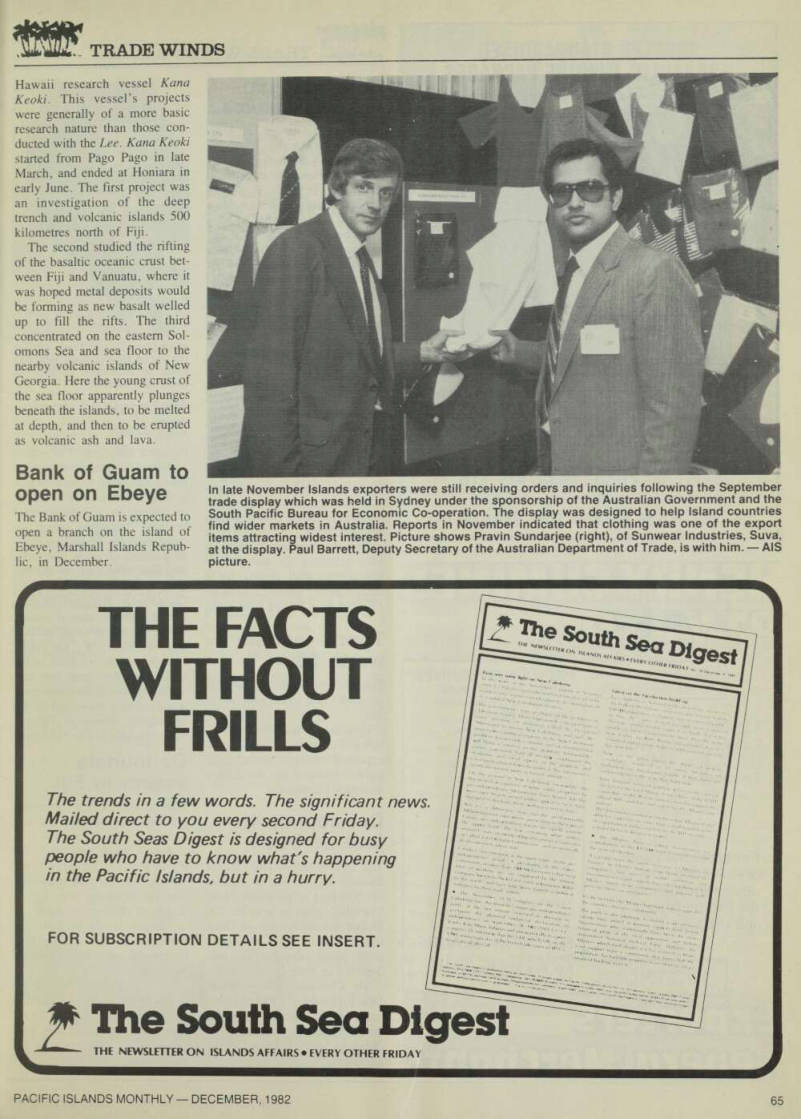
In late November Islands exporters were still receiving orders and inquiries following the September trade display which was held in Sydney under the sponsorship of the Australian Government and the South Pacific Bureau for Economic Co-operation. The display was designed to help Island countries find wider markets in Australia. Reports in November indicated that clothing was one of the export items attracting widest interest. Picture shows Pravin Sundarjee (right), of Sunwear Industries, Suva, at the display. Paul Barrett, Deputy Secretary of the Australian Department of Trade, is with him. AIS picture.
New Honolulu-
Fiji ship service
Beginning in October, the Mar shall Islands Maritime Company inaugurated a direct shipping ser vice from Honolulu to Fiji and Tonga.
Announcing the service, Mike Noland, president of the Maritime Company of the Pacif ic, general agents for the MIMC, said that until now cargo to Ton ga and Fiji from Honolulu had to be routed via Canada, the U.S.
West coast, and New Zealand before reaching its destination.
Ipseco plant
in action
The 12 mW power station built on Majuro by the British com pany Ipseco was expected to be supplying power by the end of November.
The plant cost the equivalent of SUS 24 million, which was borrowed by the Marshalls Gov ernment from the British-owned Midland Bank.
The government of Belau is also reported to have been negotiating with Ipseco for a similar power station, also to be financed by a British bank loan.
Tonga tourism
worth s6m
Tonga’s tourist industry brought in more than ST6 million in 1981.
Remittances from overseas to talled $l2 million, and copra exports $5 million, according to figures released by the Tonga Statistics Department.
Developing the
jade of Ouen
The Suva-based monthly Island Business reports that the curator of Noumea’s museum, Luc Chevalier, plans to help the 200 Melanesian inhabitants of Ouen Island, south of New Caledonia’s main island, develop the jade deposits on their home island.
Mr Chevalier told reporter Julie Richardson: “I would very much like to help them work on the mine and export the jade. The chief, Chief Tein, is very interested.”
Malaysians look
Fiji over
Malaysia may help Fiji with a variety of business ventures from prawn hatcheries to coconut pro cessing mills and tourist hotels, according to a high-powered business delegation which ac companied the Malaysian Prime Minister, Datuk Seri Dr Mahathir Mahamad, to the Oc tober Commonwealth Heads of Government Regional Meeting (CHOGRM) in Suva.
The delegation which included eight of Malaysia’s top indus trialists and bankers, hand picked by Dr Mahathir, spent four days travelling around the country and was favorably impressed by the investment climate in Fiji.
Zarine Nandan in The Fiji Times.
Oz tourists
swarm to Fiji
Australia’s current economic problems have started a tourist boom for Fiji.
Asha Lakhan reported in The Fiji Times in October: “Thousands of Australian tour ists are flooding into Fiji in search of cheaper holidays.
“Resort hotels in Nadi and Coral Coast areas are reporting occupancy rates well above 90 per cent.
“According to figures re leased by the Bureau of Statistics for August, visitors to Fiji for the first eight months of this year were up 7.1 per cent over the same months last year.”
Aiwa Olmi, Senior Trade Officer for Papua New Guinea, who has been in Australia selling his country’s exports.