Yachts
pp. 71-76 · Read in the full issue
Lorie Eichner Re
ports from Tamuning,
Guam:
• Hobie Alter, Jr. at the helm, with his wife as crew, won the Fourth Hobie-16 World Championships which were held at Papeete, Tahiti,
in August.
Alter, son of the man who design ed and started the Hobie class sailing catamarans, squeezed out Blaine Dodds of South Africa, winning the series by only one point after five
days of racing.
Going into the last two races the championship still belonged to any one of four contenders; lan Bashford and Brett Dryland, both of Australia, were at the top, followed by Alter and Dodds.
Bashford, who finished fifth over all, dropped out of contention in the fourth race of the finals when he only managed a 21st place finish after
making a tactical error by choosing
the inside of the course to sail.
Dryland, after a poor start, picked his way through the fleet and managed a third. Alter took his first win.
Dodds fought back in conditions that never exceeded 15 knot winds and won the last race, but the champ ionship went to Alter after he battled his way to a fourth place finish. At one point he was in the bottom half of the fleet but he picked his way through, passing the last two boats necessary for the victory on the last tack.
Dryland, winner of the Third Hobie Championships, was third, followed by Allen Egusa, a very consistent U.S. sailor. Bashford was fifth and Jeff Alter sixth. Mike
Furukawa of Hawaii was the top Pacific Islands finisher with 11th place and the top Tahitian was South Pacific Games winner Kitty Salmon in 24th place.
The championship drew particip ants from 29 countries, who qualified in their home countries for the right to represent them. Two dozen addi tional slots were won by crews that had lost out on their home waters but
placed high in a two-day qualifying
series held in Tahiti prior to the
championships.
Ninety-six crews took part in the championship series on Tuesday and Wednesday, and their numbers were cut to 48 for the finals sailed on
Friday and Saturday.
Winds were light in Matavai Bay, ranging from three to 10 knots during the first four days. On the fifth day winds were non-existent and no events were sailed, limiting the championship series before the cut to three races per crew.
On Friday, first day of the finals, winds were still light, but increased to 15 knots the next day for the last three races.
The next Hobie-16 world champ ionship will be sailed in Spain in June, 1984, and the next Hobie-14 championships are scheduled for the
Philippines.
Don Travers Re
ports from Tubuai,
Austral Islands,
French Polynesia:
• Haida Drummer. This
Valiant 11 m fibreglass sloop from Vancouver, Canada, arrived at Tubuai from New Zealand after a 20day voyage, with captain Dennis Rodd and crew Cindy Baker, Goran Bollden (Swedish) and Robyn Fade (New Zealand). Haida Drummer had cruised from Vancouver to New Zea land, stopping at California, Mexico, Marquesas, Tuamotus, Tahiti, Socie ty Islands, Cook Islands, Niue, Vavau and Fiji. Plans are to return to Canada via Tahiti, Hawaii and poss
ibly Alaska.
• Seaventure. An 11 M
Freeport fibreglass sloop from San
Francisco, with Glen Marks and Dan Matthews (PIM Jan ’B2), arrived in Tubuai after a 21-day voyage from New Zealand. Glen and Dan left California in August 1980 for Hawaii, Marquesas, Tuamotus, Tahiti and Society Islands, Suwar row, American and Western Samoa, Vavau, Fiji, Vanuatu, New Caledonia and New Zealand. After Tubuai they planned to continue to Raivavae, Borabora, Huahine for the fete and then return to America via Hawaii. • LA-NUI. An 11 m Atkin cutter
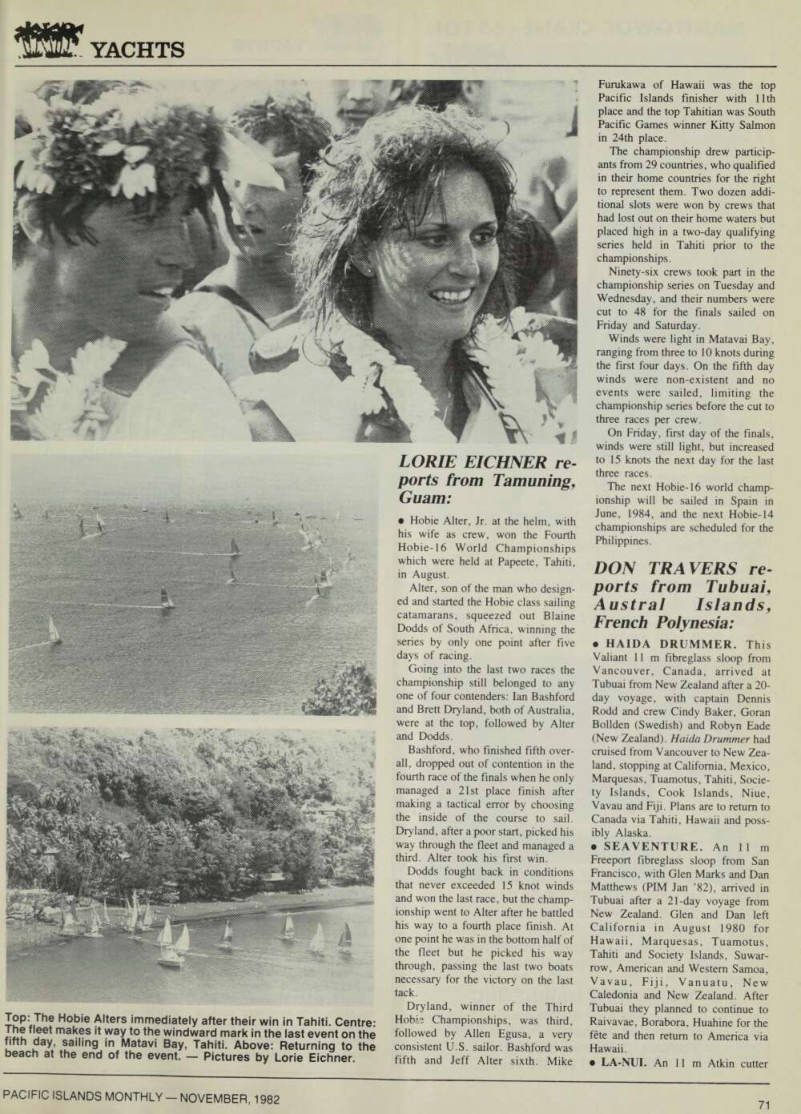
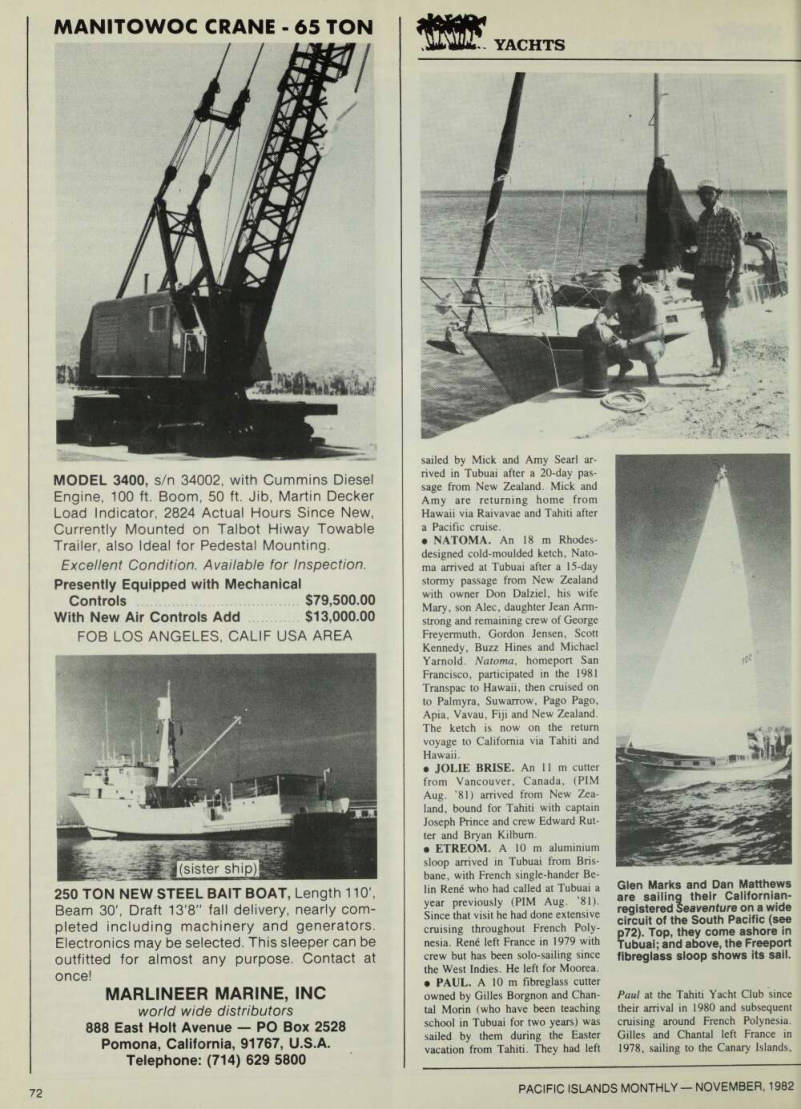
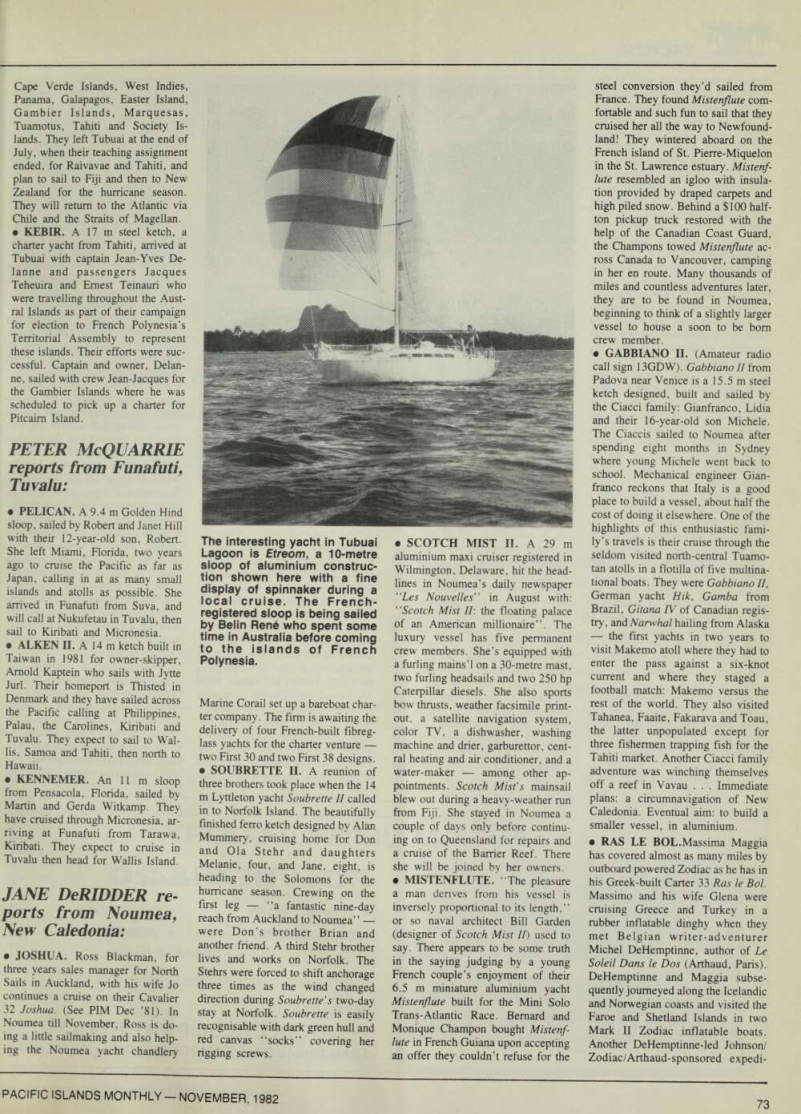
Top: The Hobie Alters immediately after their win in Tahiti. Centre: The fleet makes it way to the windward mark in the last event on the fifth day, sailing in Matavi Bay, Tahiti. Above: Returning to the beach at the end of the event. - Pictures by Lorie Eichner.
sailed by Mick and Amy Searl ar rived in Tubuai after a 20-day pas sage from New Zealand. Mick and Amy are returning home from Hawaii via Raivavae and Tahiti after a Pacific cruise. • N ATOM A. An 18 m Rhodes designed cold-moulded ketch, Nato ma arrived at Tubuai after a 15-day stormy passage from New Zealand with owner Don Dalziel, his wife Mary, son Alec, daughter Jean Arm strong and remaining crew of George Freyermuth, Gordon Jensen, Scott Kennedy, Buzz Hines and Michael Yarnold. Natoma, homeport San Francisco, participated in the 1981 Transpac to Hawaii, then cruised on to Palmyra, Suwarrow, Pago Pago, Apia, Vavau, Fiji and New Zealand.
The ketch is now on the return voyage to California via Tahiti and Hawaii. • JOLIE BRISK. An 11 m cutter from Vancouver, Canada, (PIM Aug. ’81) arrived from New Zea land, bound for Tahiti with captain Joseph Prince and crew Edward Rut ter and Bryan Kilbum. • ETREOM. A 10 m aluminium sloop arrived in Tubuai from Bris bane, with French single-hander Be lin Rene who had called at Tubuai a year previously (PIM Aug. ’81).
Since that visit he had done extensive
cruising throughout French Poly
nesia. Ren6 left France in 1979 with crew but has been solo-sailing since the West Indies. He left for Moorea. • PAUL. A 10 m fibreglass cutter owned by Gilles Borgnon and Chan tal Morin (who have been teaching school in Tubuai for two years) was sailed by them during the Easter vacation from Tahiti. They had left
Paul at the Tahiti Yacht Club since their arrival in 1980 and subsequent cruising around French Polynesia.
Gilles and Chantal left France in 1978, sailing to the Canary Islands,
Glen Marks and Dan Matthews are sailing their Californian registered Seaventure on a wide circuit of the South Pacific (see p72). Top, they come ashore in Tubuai; and above, the Freeport fibreglass sloop shows its sail.
Cape Verde Islands, West Indies, Panama, Galapagos, Easter Island, Gambier Islands, Marquesas, Tuamotus, Tahiti and Society Is lands. They left Tubuai at the end of July, when their teaching assignment ended, for Raivavae and Tahiti, and plan to sail to Fiji and then to New Zealand for the hurricane season.
They will return to the Atlantic via Chile and the Straits of Magellan. • KEBIR. A 17 m steel ketch, a charter yacht from Tahiti, arrived at Tubuai with captain Jean-Yves De lanne and passengers Jacques Teheuira and Ernest Teinauri who were travelling throughout the Aust ral Islands as part of their campaign for election to French Polynesia’s Territorial Assembly to represent these islands. Their efforts were suc cessful. Captain and owner, Delan ne, sailed with crew Jean-Jacques for the Gambier Islands where he was scheduled to pick up a charter for Pitcairn Island.
Peter Mcquarrie
reports from Funafuti,
Tuvalu:
• PELICAN. A 9.4 m Golden Hind sloop, sailed by Robert and Janet Hill with their 12-year-old son, Robert.
She left Miami, Florida, two years ago to cruise the Pacific as far as Japan, calling in at as many small islands and atolls as possible. She arrived in Funafuti from Suva, and will call at Nukufetau in Tuvalu, then sail to Kiribati and Micronesia. • ALKEN 11. A 14 m ketch built in Taiwan in 1981 for owner-skipper, Arnold Kaptein who sails with Jytte Jurl. Their homeport is Thisted in Denmark and they have sailed across the Pacific calling at Philippines, Palau, the Carolines, Kiribati and Tuvalu. They expect to sail to Wal lis, Samoa and Tahiti, then north to Hawaii. • KENNEMER. An 11 m sloop from Pensacola, Florida, sailed by Martin and Gerda Witkamp. They have cruised through Micronesia, ar riving at Funafuti from Tarawa, Kiribati. They expect to cruise in Tuvalu then head for Wallis Island.
Jane Deridder Re
ports from Noumea,
New Caledonia:
• JOSHUA. Ross Blackman, for three years sales manager for North Sails in Auckland, with his wife Jo continues a cruise on their Cavalier 32 Joshua. (See PIM Dec ’81). In Noumea till November, Ross is do ing a little sailmaking and also help ing the Noumea yacht chandlery
Marine Corail set up a bareboat char ter company. The firm is awaiting the delivery of four French-built fibreg lass yachts for the charter venture two First 30 and two First 38 designs. • SOUBRETTE 11. A reunion of three brothers took place when the 14 m Lyttleton yacht Soubrette II called in to Norfolk Island. The beautifully finished ferro ketch designed by Alan Mummery, cruising home for Don and Ola Stehr and daughters Melanie, four, and Jane, eight, is heading to the Solomons for the hurricane season. Crewing on the first leg “a fantastic nine-day reach from Auckland to Noumea” were Don’s brother Brian and another friend. A third Stehr brother lives and works on Norfolk. The Stehrs were forced to shift anchorage three times as the wind changed
direction during Soubrette’s two-day
stay at Norfolk. Soubrette is easily recognisable with dark green hull and red canvas “socks” covering her
rigging screws.
• SCOTCH MIST 11. A 29 m aluminium maxi cruiser registered in Wilmington, Delaware, hit the head lines in Noumea’s daily newspaper “Les Nouvelles” in August with: “Scotch Mist II: the floating palace of an American millionaire”. The luxury vessel has five permanent crew members. She’s equipped with a furling mains’l on a 30-metre mast, two furling headsails and two 250 hp Caterpillar diesels. She also sports bow thrusts, weather facsimile print out, a satellite navigation system, color TV, a dishwasher, washing machine and drier, garburettor, cent ral heating and air conditioner, and a water-maker among other ap pointments. Scotch Mist's mainsail blew out during a heavy-weather run from Fiji. She stayed in Noumea a couple of days only before continu ing on to Queensland for repairs and a cruise of the Barrier Reef. There she will be joined by her owners. • MISTENFLUTE.'“The pleasure a man derives from his vessel is inversely proportional to its length,” or so naval architect Bill Garden (designer of Scotch Mist If) used to say. There appears to be some truth in the saying judging by a young French couple’s enjoyment of their 6.5 m miniature aluminium yacht Mistenflute built for the Mini Solo Trans-Atlantic Race. Bernard and
Monique Champon bought Mistenf
lute in French Guiana upon accepting an offer they couldn’t refuse for the
steel conversion they’d sailed from France. They found Mistenflute com fortable and such fun to sail that they cruised her all the way to Newfound land! They wintered aboard on the French island of St. Pierre-Miquelon in the St. Lawrence estuary. Mistenf lute resembled an igloo with insula tion provided by draped carpets and high piled snow. Behind a $lOO half ton pickup truck restored with the help of the Canadian Coast Guard, the Champons towed Mistenflute ac ross Canada to Vancouver, camping in her en route. Many thousands of miles and countless adventures later, they are to be found in Noumea, beginning to think of a slightly larger vessel to house a soon to be bom crew member. • GABBIANO 11. (Amateur radio call sign 13GDW). Gabbiano II from Padova near Venice is a 15.5 m steel ketch designed, built and sailed by the Ciacci family; Gianfranco, Lidia and their 16-year-old son Michele.
The Ciaccis sailed to Noumea after spending eight months in Sydney where young Michele went back to school. Mechanical engineer Gian franco reckons that Italy is a good place to build a vessel, about half the cost of doing it elsewhere. One of the highlights of this enthusiastic fami ly’s travels is their cruise through the seldom visited north-central Tuamo tan atolls in a flotilla of five multina tional boats. They were Gabbiano 11, German yacht Hik, Gamba from Brazil, Gitana IV of Canadian regis try, and Narwhal hailing from Alaska the first yachts in two years to visit Makemo atoll where they had to enter the pass against a six-knot current and where they staged a football match: Makemo versus the rest of the world. They also visited Tahanea, Faaite, Fakarava and Toau, the latter unpopulated except for three fishermen trapping fish for the Tahiti market. Another Ciacci family adventure was winching themselves off a reef in Vavau . . . Immediate plans: a circumnavigation of New Caledonia. Eventual aim: to build a smaller vessel, in aluminium. • RAS LE BOL.Massima Maggia has covered almost as many miles by outboard powered Zodiac as he has in his Greek-built Carter 33 Ras le 801.
Massimo and his wife Glena were cruising Greece and Turkey in a rubber inflatable dinghy when they met Belgian writer-adventurer Michel DeHemptinne, author of Le Soleil Dans le Dos (Arthaud, Paris).
DeHemptinne and Maggia subse quently journeyed along the Icelandic and Norwegian coasts and visited the Faroe and Shetland Islands in two Mark II Zodiac inflatable boats.
Another DeHemptinne-led Johnson/
Zodiac/Arthaud-sponsored expedi-
The interesting yacht in Tubuai Lagoon is Etreom, a 10-metre sloop of aluminium construc tion shown here with a fine display of spinnaker during a local cruise. The French registered sloop is being sailed by Belin René who spent some time in Australia before coming to the islands of French Polynesia.
tion took them in two Mark V 5 m heavy duty Zodiacs from Singapore through Indonesia to Darwin by way of Sumatra, Java, Bali and the many smaller islands which dot the region, the longest passage being 560 kilometres. The 65 hp Johnson out board motors were fuelled from 800litre supplies carried in rubber tanks.
All this perhaps explains the name of the Maggia’s 10 m yacht: Ras le 80l can be loosely translated as “fed up”. Glena, Massima and his co owner brother share or take turns cruising on Ras le 801, sometimes leaving the yacht for months at a time while one or both brothers return to run their jointly owned fabric factory in Turin. Massima and Glena flew back to Italy from Noumea with hundreds of color slides leaving another Belgian friend, Louis Claus, to sail Ras le 80l in New Caledonia.
The Maggias will return next year to explore the Isle of Pines, the Loyal ties and Solomons. Meanwhile, when not conducting business, they’ll be skiing, mountaineering and writing of their adventures for the
Milan yachting magazine Mare
2000. • COOEE. Built in 1893 by Baileys Shipyard in Auckland, this 11 m gaff topsail cutter has been restored to “as new” status by her fifth owner in 90 years, Peter Cree of Timaru and Russell. Peter, Jennie Caims and Selwyn Cartridge sailed from Russell in the Bay of Islands to Vavau and Fiji, stopping for three days on Raoul Island in the Kermadecs en route to enjoy the fabled oranges and the hospitality of the five young men stationed there for the meteorology and lands survey station. Old-timer Cooee now boasts a New Zealand Category 1 rating but she was utterly run down and had swallows nesting inside when Peter bought her in 1976. He began by smashing out the delaminating plywood interior, even tually rebuilding it in red cedar and iroko. He refastened the hull, relaid
the decks, put in eight new floors and six keel bolts, and rerigged the ves sel; he even put the original counter back on the stem to visually balance the three-metre bow spirit. Cooee’s triple skin cold-moulded kauri plank ing has canvas soaked in red lead between skins. When cutting a bigger cockpit drain through the hull, Peter noted that the kauri is yellow still and smells just like new wood. In Noumea, Gladstone-bound, Peter mentioned plans to visit Sydney and Tasmania in a few months. Though he’d hate to part with Cooee “a magical boat” Peter dreams of building a 13 m gaff topsail schooner one day.
• SUNGLO. Family-built over a period of eight years as a floating home for the Enrights of Pukekohe, New Zealand, the 14 m tri-keeler ferro yacht Sunglo is one of the 1200 Hartley Tahitians plying the oceans of the world, and there are 800 more under construction worldwide. Peter and Freda Enright’s own layout has made the vessel ideal for its purpose, for Grant, Lynne, and Janette (aged 15, 14 and 11) each has completely separate light and airy study areas to work on their correspondence les sons. “We couldn’t have built it without the kids’ help,” Freda and Peter agree. The family’s first major voyage was a four-and-a-half month
4800-kilometre circumnavigation of New Zealand in company with yacht Wiremu. A Kiwi farmer’s well known ingenuity was demonstrated when Peter built a wooden propeller for Wiremu after she shed her folding prop in a remote area of the South Island. The two-bladed prop of
epoxy-coated Malaysian mahogany
took two hours to build and enabled Wiremu to go a knot faster. Peter carries with him all his power and hand tools and his welding gear.
From Noumea, Sunglo “the name on the paint can’’ will be heading for Brisbane after exploration up New Caledonia’s west coast.
• Wanderer V. (See Pim Feb.
’B2). She arrived in Noumea on September 8 from Port Vila. Susan and Eric Hiscock plan on heading for Australia next to spend several months on the NSW coast. • CYCLONE. The Swan 48 Cyc lone, a well known vessel in the South Pacific over the past several years, is being delivered to California from Fiji. Owner Gene Taatjes flew back to market some of the computer technology he has come up with while cruising on his elaborately
electronically equipped sloop. Al
ready holder of several patents as sociated with electronic navigation systems among other things it will be interesting to discover what this innovative electronics engineer comes up with next. Gene says that cruising on his own computer outfitted vessel gives him the time and state of mind necessary to pursue new ideas in computer application, particularly that associated with the
boating industry.
• VAHINE. It was a rough wind ward trip from Whangarei to Noumea for German yacht Vahine and a har rowing four-day sail from Ouvea to the Solomons under jib only and without a single sight. Ortwin and Ellie Ahrens were on their way to the Solomons’ Florida Group where Ort win is shipyard manager in Tulagi for
Visiting New Caledonia recently was the Valiant 40 cutter Linda E, built and registered in USA. Dan and Dorothy Wilson have made it their cruising home for five years.
the National Fisheries Development.
The shipyard is building a series of 25 m ferro fishing boats. Ortwin left a position as project manager for
Whangarei Engineering Company
(WECO) to take on the work in Tulagi. The 11 m aluminium sloop Vahine is the Ahrens’ own design and largely their own handiwork.
Ortwin and Ellie sailed from Ham burg to Whangarei eight years ago on an 8 m sloop, also called Vahine. • POUR SOI. “On schedule, on budget,” is the way Bruce and Lynn Kennedy from Edmonton, Canada, describe the cruise from Honolulu to Noumea in the Columbia 26 they bought in Hawaii for the voyage and sold in Noumea a few days after their arrival. Their “break” was planned as a one-way downwind tropical in terlude. “It’s been a good experience but a lot of work not what people expect. We’ve kept up a fairly stiff pace, rushing around trying to cram in a few more islands. In some ways going back to work will be a rest.”
Petroleum engineer Bruce will look for a rotating assignment on an oil rig while urban planner Lynn plans on doing graduate studies at the Univer sity of Victoria in British Columbia.
She may write a children’s book based on their Pacific experiences.
About cruising on an eight-metre vessel Bruce says: “I’ve seen many people with much more money tied up in their boat with far more
problems!”
• HOLOKIKI. Lost overboard from the Honolulu Holokiki was longtime ocean voyager Kamue la Roy who, with her husband Jim, was making the passage from the Phoenix Islands to Fiji on one of the first legs of a long-planned circum
navigation which had for months
been plagued by setbacks. On July
20, Kamuela had written from Hon olulu to a friend: “Only an hour from leaving. All systems seem to be go so we are going before something else
happens.” She disappeared during
her night watch some time after midnight about 1100 km north of Fiji. Friends all over the Pacific mourn the disappearance of a valued friend and fellow voyager and extend their deepest sympathy to Jim in his tragic loss. An experienced seafarer herself (onetime California fish boat skipper and captain on Honolulu tourist boats) Kamuela has described Jim as “the best small boat sailor I’ve ever encountered”. • LEEWAY, For a day and a half it had blown a steady 45 knots gusting considerably higher when at 2 a.m. on September 3 San Francisco yacht Leeway was knocked down “spread ers on the water” by enormous seas, the day before their New Caledonian landfall. Skipper Peter Earl’s first thought was of his 21-year-old son Robert alone at the helm of the Cascade 36 sloop. Moonlight re vealed lines floating in an otherwise empty cockpit and young Robert ab out 10 metres behind “swimming like mad” towards the wallowing vessel. (The clew had tom off the storm jib when the sail filled with water in the knockdown). Peter grabbed the helm, brought the boat around and made for his son. A third crew member, Dan Lannan (called Shyloh) tossed out the life-saving paraphernalia only to have it foul on the windvane steering gear. Robert was just able to grab the end of the
man-overboard-pole. Peter brought
Leeway up into the wind and Shyloh
hauled Robert aboard. The entire life-saving manoeuvre took approxi mately two minutes. Apparently a lucky ship. Leeway was one of the survivors when Hurricane Isaac struck Neiafu in Tonga’s Vavau Group. (See PIM May, June ’B2). • LIEMBA. “The South Pacific beats the West Indies hands down with French Polynesia a highlight,” say Nick and Sally Davies, three years out of Southampton on their Nicholson 35 Liemba. After the transit of the Panama Canal, Liemba headed north hugging the central American and Baja California coasts.
They report that accidentally hitting a whale off Magdalena Bay felt like “hitting a sandbank or a mudbank”.
Nick and Sally paused for two years in San Diego to fill the cruising kitty;
anaesthesiologist Nick was engaged
in lung research with UCSD (Univer sity of California in San Diego) while
Sally, a gynaecologist/obstetrician,
made a switch into pathology. Liem ba arrived in Noumea after a blustery all-windward trip from Fiji. When they explored the Tongan island groups not long after Hurricane Isaac struck, they were interested to see how many Haapai families are happi ly living in tents sent from Australia and New Zealand. • DERWENT. A boatload of bird
watchers 10 of them were sighted on a 12 m yellow-hulled sloop at the CNC overseas visitors’ quay in Noumea in early September about to leave on schedule on a southerly migration back to New Zealand by way of the Isle of Pines.
Zoologist/omithologist Tim Loveg rove is owner of the flush-decked ferro Sayers sloop and leader of a
four-month joint Ornithological Soci
ety of New Zealand and Auckland
University Zoology Department ex
pedition which left Whangarei in mid-May. The expedition’s main ob jectives are bird surveys including search for petrel colonies, location of tem and noddy breeding-roosting areas, sound recordings of en dangered forest species, and observa tion and photography of seabirds at sea. The Derwent scientists were also making rodent and crown of thorns
surveys, observing humpback whales
in Tonga, collecting Drosophila and
Mosquito species and studying coral
reef fish behavior. Lovegrove sug gest that small-boat voyagers keeping observations of seabirds at sea are urged to send their records to the Australasian Seabird Mapping Scheme. (Write to C. J. R. Robert son, Wildlife Service, Department of Internal Affairs, Wellington for pro cedure and forms). The Derwent will
Helmut and Anne Petrak, from Canada, have been cruising bet ween New Caledonia and Hawaii in their Big Bear H, a schooner rigged Down Easter 45.
probably make an expedition to Vanuatu next year under Tim’s lead ership using the same system which has worked so well for him to date that is, relying on a nucleus of six permanent expedition members and having others join the vessel for shorter portions of the voyage. Pas sages between island groups are made with a crew of eight at the most for Derwent has eight sea-going bunks. A family project, Derwent was completed in 15 months on the
Lovegrove farm in Waipu, just south
of Whangarei, by Tim, his father and two of his brothers starting with a Sayers-built ferro hull. A previous voyage was the ’7B Whangarei- Noumea Race. • COQUETTE. Yachts entering New Caledonia’s lagoon from the west via Boulari Passage now sail by yet another prominent wreck. It’s the yacht Coquette from Innisfail, Aust ralia. The 16 m ferro schooner fetch ed up on Recif Tabou after entering Boulari Pass at night. Tabou Reef is inside the lagoon on the northern flank of the passage and is marked by a light. Successive efforts to patch and refloat the nine-year-old New Guinea-built vessel have been unsuc cessful to date. Coquette’s wooden spars are still standing four months after the grounding. • TANGARORA. (The name means “Reef God’’). Only a week
before the wreck of the Coquette, the American Dreadnought 32 cutter Tangarora went up on a reef just south of Boulari Passage after a late afternoon landfall and a mistaken compass bearing. (Note that the ap proach course to Amedee light as marked on the charts is a true bear
ing, not a magnetic bearing). Skipper
Fred Landman attributes his naviga tional error to extreme fatigue after a rough 12-day passage from New Zea land, and to failing light. Tangarora floating off on a high springtide five days after grounding, the day before Coquette went up on nearby Recif Tabou. Surprisingly little damage was sustained by the strongly built balsa sandwich hull just superfi cial abrasions. Tangarora was hauled out by the CNC Travelift. After making repairs, Fred, with a crew member, left New Caledonia, Sol omon Islands-bound. • WHISPER. White-hulled Whis per of Sonoma to differentiate it from the Hal Roth’s black-hulled Whisper of Sausalito - was bought by Tim Murphy and Sue Stilson completely outfitted for cruising, right down to binoculars and bed ding, cutlery, radar and name. Flying beneath the spreaders of the Alberg 35 in Noumea’s Baie de L’Orphelinat is a green shamrock rampant on a white trailing houseflag, a not al together successful attempt to charm
away the effects of Murphy’s Law. (If anything can possibly go wrong it will . . . ) “Like the engine packing up just when we’re backing into a dock,’’ Sue explained. Sue and Tim
reckon that here in Noumea they’re tasting the best wine since they left
Sonoma, California. They’re heading
for Australia next to sample what the Aussie vineyards have to offer.
The 89-year-old gaff topsail cutter Cooee (see p74) is shown here in the Kermadec Islands this year after outpacing Joie de Vivre in the inaugural Black Heart Raoul Island Race. The fully-restored yacht is creating wide interest in Pacific ports. - Jennie Cairns picture.