Islands display in Australia
pp. 69-70 · Read in the full issue
sells wide range of products
Pacific Island countries displayed their products in Australia recently. They showed bubble gum and furniture, garlic peas and saddlery, clothing, beer, tinned goods and much more. ANGUS SMALES describes here the trade success of the display, held in the Australian government’s International Trade Development Centre in Sydney.
More than 70 companies and exporters from nine Pacific Is land countries attracted wide in terest at the Islands Trade Dis play which brought products from the Islands to the notice of Australian importers. Indications are that close to a million dollars of orders will come in from the Islands to Australia as a result of the display.
The countries represented were Cook Islands, Fiji, Kiribati, Niue, Papua New Guinea, Sol omon Islands, Tonga, Vanuatu and Western Samoa. The display was held at the Australian gov ernment’s International Trade Development Centre in Sydney as a project under the Australian Development Assistance Prog ram. It was organised by the Department of Trade and Re sources in conjunction with the South Pacific Bureau for Economic Co-operation, and each country which took part staffed its own stand.
“Bright new merchandise, something different and some thing right on your doorstep” was how Australian officials ad vertised the products on display.
There was no doubt that many of the products were unusual, and this led to some concern that sales would be merely of a short term novelty nature. Referring to items such as Pacific traditional carvings, ornaments and woven goods, some importers believed that the Island countries would be better served if they sold the goods at home. “It’s the sort of stuff that tourists would go for in a big way, but would be strictly limited on the Australian mar ket” was one comment.
But when it came to the point, the trade interest in these goods was extremely high. Representa tives of some of the smaller
countries said, too, that their tourist market was so limited that they could not make a sales industry viable by relying on visitors to buy their products.
There was never any doubt that the more general products would receive a good response.
They included such things as tinned food, snack foods, gar ments and furniture. Jewellery and ornaments also received a big response from the Australian representatives who discussed orders with the visitors.
The display dovetailed with the SPARTECA Agreement under which Australia grants concessional entry to products from Pacific Island countries.
SPARTECA, which New Zea land also supports, started fairly slowly but the Sydney display will add to its momentum. Near ly 400 representatives of Aust ralian importers and retailers visited the display over a period of a week. Their negotiations and potential negotiations fell into two main classes to buy goods direct as importers or to enter into agency arrangements with the Island exporters.
The Director of the Interna tional Trade Development Centre, Mr Frank Walsh, de scribed the results of the venture as “very encouraging.” He said that Australia was particularly
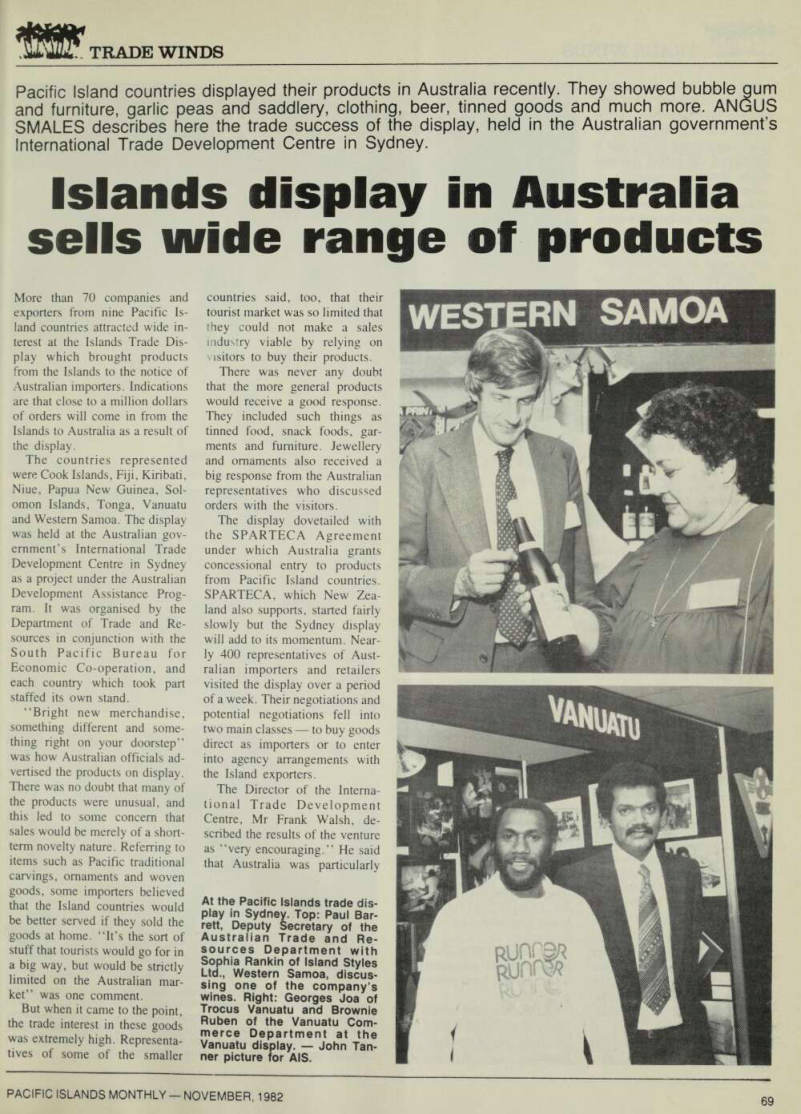
At the Pacific Islands trade dis play in Sydney. Top: Paul Bar rett, Deputy Secretary of the Australian Trade and Re sources Department with Sophia Rankin of Island Styles Ltd., Western Samoa, discus sing one of the company’s wines. Right: Georges Joa of Trocus Vanuatu and Brownie Ruben of the Vanuatu Com merce Department at the
Vanuatu display. - John Tan
ner picture for AIS.
suited to the trade requirements of Island exporters. This was because the Australian buying market was big enough to be significant but not so big that it outstripped the export potential of the Islands.
Agency arrangements in Aust ralia are likely to arise for five major classes of Island exports
confectionery, clothing, fur
niture, hand-made riding saddles and a range of food products.
Apart from any commercial considerations the display was a fascinating exhibition of Island
products, ranging from tradition
al arts and crafts to sophisticated manufactured articles.
Country by country, here are some of the results of the display;
Papua New Guinea:
Papua New Guinea believes it has sold orders approaching half a million dollars. The co ordinator of the PNG display, Mr Olmi, said that weaving, clo thing and beer had been the focus of inquiries, with strong interest also in furniture and furniture parts.
The South Pacific Brewery’s newly-packaged export lager, which is also the subject of sepa rate promotions in Australia and Hawaii, created wide interest and some sales inquiries.
Kagamuga National Products, a PNG group extracting essential oils, entered into negotiations on the export of pyrethrum which is used in insecticides. Clothing was another strongly-supported part of the PNG display.
TONGA; About two years ago Tonga established a small indus tries centre, and products from the centre were a major part of the Tonga display. Tonga pro ducts which created interest among Australian importers are riding saddles, hand-made knitt ed sweaters and cardigans (the wool comes from Australia and New Zealand), dessicated coconut, vanilla and kava.
FIJI: A strong part of the Fiji display was made up of snack foods of a completely new type on the Australian market. Cur ried dried peas, made to an In dian recipe, was one example.
Fiji confectionery, some of
which is already undergoing test marketing in Australia, also
created wide interest. Hand made jewellery, ropes and furni ture were also featured and re
ceived good inquiries. A new Fiji
product was a luxury soap made from coconut oil and palm oil.
Solomon Islands: Firm
inquiries were received for soaps and other toilet products, includ ing scented soaps based on coconut oil. Decorative timber also created inquiries, and par ticular technical interest was shown in timber obtained from
coconut palms.
KIRIBATI; Frozen reef fish and handcrafts made from shark fins and shells.
Western Samoa: Jams,
sauces and toppings based on passionfruit, mango, lime, guava and mango. Tentative talks are being held on the possibility of making bulk deliveries to Aust ralia for Australian-brand bottl ing. Dried tropical fruits for the health food market are also under assessment.
COOK ISLANDS: Shell neck laces and other ornaments, wo ven hats, and hand-painted wo men’s dresses.
NIUE: Coconut cream and honey in the comb created inter est from the specialised food market.
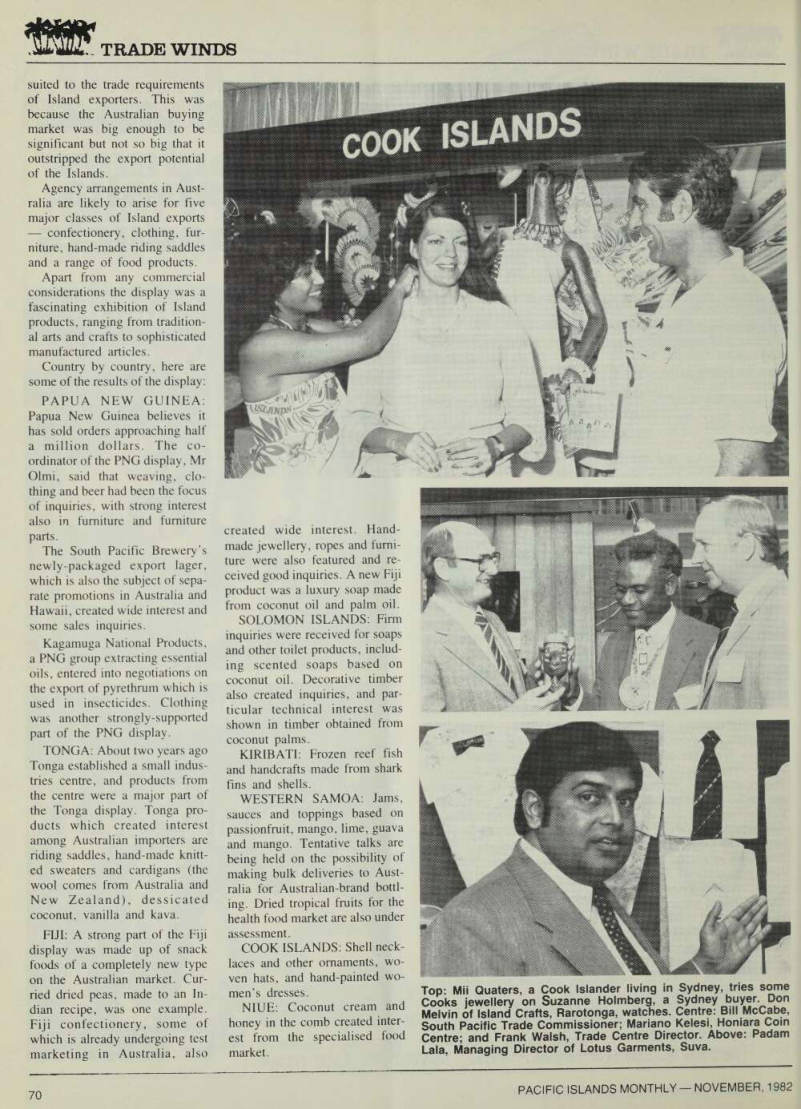
Top: Mii Quaters, a Cook Islander living in Sydney, tries some Cooks jewellery on Suzanne Holmberg, a Sydney buyer. Don Melvin of Island Crafts, Rarotonga, watches. Centre: Bill McCabe, South Pacific Trade Commissioner; Mariano Kelesi, Honiara Com Centre; and Frank Walsh, Trade Centre Director. Above: Padam Lala, Managing Director of Lotus Garments, Suva.