Coming to grips
pp. 15-17 · Read in the full issue

with the problem of youth suicide in W. Samoa
Suicide in any community poses difficulties not often presented by other problems. One cannot make laws to punish offenders, nor order inoculations, change the diet, increase or decrease taxes against it, or any of the other means usually available to government or those in authority at national or village level. The causes of the problem do not lend themselves to easy diagnoses or treatment, as they lie deep within the fabric of society, in the inter action of human relationships.
The causes have to do with such
“difficult-to-get-at” feelings as
self-esteem, respect and trust.
They feed on an over-emphasis of punishment, of extreme social distance, on frustration and
aggression.
To compound the difficulties of analysis and treatment, gather ing evidence of is ex tremely difficult. In the first place the prime witness is dead and buried, and the secondary witnesses invent arguments to demonstrate that in no way did their behavior contribute to the terrible event. Parents who have thrashed their child regularly, scolded him and ridiculed him in front of his peers, stand up at the Coroner’s inquest and say that they have no idea why their son took his life. And they have some justification if they have treated their other children to the same conditioning process and none of them had committed suicide. In the second place, the community at large doesn’t want to know about the problem of suicide because it reflects as a broad indicator on the state of mental health of a community.
Politicians duck the issue, and
civil servants conveniently point
out that suicide is not a responsi
bility of any particular depart
ment. Like many of life’s impor tant issues it lies across several departmental boundaries and finishes up falling down through the cracks between departments.
This article seeks to relate how
A spokesman for Western
Samoa’s Suicide Study Group
(PIM July p2B) said in August that the number of suicides had decreased noticeably since the group launched its anti-suicide campaign in May. He said it was impos sible to claim that the cam
paign was solely responsible
for the decrease, but the fact alone was reassuring. He said that one young person had
already voluntarily sought as
sistance from the group and
was sufficiently helped “to
avoid what could have be come a tragic outcome”. In the accompanying article, DENNIS OLIVER, Training Officer with the YMCA in Western Samoa and a found ing member of the group, tells how it was formed and how it is approaching its im portant task.
the people and organisations of Western Samoa are attempting to address the problem of suicide in their country. It is too early yet to report success as the plan of action is still being acted out.
In June 1981, on the initiative of the Young Men’s Christian Association (YMCA), a meeting was called of top representatives from the Health Department, the Justice Department, the Fellow ship of Christian Churches, and the YMCA. Copies of corres pondence between a previous Coroner and a Professor Murphy of McGill University, Montreal, Canada, were circulated to mem bers. A portion of one letter stated that “the international statistics on suicides during the 1970 s do not show any other country to have a suicide rate in males aged 15 to 24 which is as high as the Western Samoa one.”
The meeting resolved that al though firm facts were not readi ly available the problem was serious enough to warrant action.
Responsibilities were al located as follows: YMCA; in itiators, co-ordination, adminis tration; Justice Department; searching the records of Coron er’s inquests, presentation of the facts; Health Department: psychiatric advice, health educa tion, support research from re cords; Fellowship of Churches: data collection from the field, researching traditional conflict
resolution, community
discussions.
It was further agreed that the group was not responsible to any Minister or Board it was a
community group tackling a
community problem. It came to call itself “The Suicide Study Group”. Its objectives were to reduce the incidence of suicide in Western Samoa.
It was not until September 1981, when the group held its second meeting, that final ap proval was obtained to search the records of the Coroner’s Court.
Records back to 1970 were in reasonable condition, but records for the 1960 s were heaped up in a pile and were wet, mouldy and rat-eaten. No records at all were available prior to 1960. A clerk and two laborers were put to work to sort out the records for the 19605, and a probation offic er set to work collating the data for suicides for the period 1970 to 1981. The psychiatrist at the National Hospital had prepared a structured questionnaire with which to interview patients who were admitted as suspected of intention to commit suicide.
In April 1982 the major task of data collection was completed
and the Study Group met again.
The figures from the Justice De partment were lower than the
figures provided by the Health
Department so some back checking was required. The out come was an increase in the Justice Department figures to biing into the total data stored in Savaii and not transferred to head office in Apia. Even after this
adjustment the Justice Depart ment figures were 20 per cent lower than the Health Depart ment figures. The Justice Depart ment figures, however, were firm. Beside each number could be placed a name, a date of death and evidence to establish the circumstances.
Now that firm data was to hand, a decision had to be made as to what to do with it. The Study Group felt that a national Awareness Campaign was neces sary because: a) there was a high level of ignorance of the facts; b) many of those who had enough facts to suspect the worst were avoiding the problem by pretending it wasn’t there; c) it was believed by the Study Group that no significant reme dial action would be taken by the people of the community until they first came to the point of recognising and “owning” the problem. When they were wil ling to say “We have a prob lem” they may be ready to move on to the position of saying “What causes it and what can we do about it?”
The National Awareness Cam paign was planned to use five national radio programs and three press conferences over a two-week period.
There were several touchy areas to be skirted around. The group wanted to present the facts without attempting to put up theories on possible explanations of causes. The reason for this strategy was that in the first place there was no single obvious theory that fitted all the facts, and secondly if the Study Group attempted to “explain” the prob lem to the community, the com munity might then expect the Group to “cure” the problem. If the community was going to work on its own “cure” (and who else could do it?) then it should be involved in wrestling with trying to understand the causes for the problem. The
Study Group also wanted max imum coverage in the media without appearing to be alarmist, sordid, or sadistic. It realised there was a risk that the publicity might produce a wave of mild hysteria which could trigger off a rash of suicides. It was also sensitive to the fact that several details could not be exposed without fear of them adding to the suicide rate. For example if the exact lethal dose of paraquat was released, it may appeal to the gambling instinct in some potential suicide candidates to try a dose just a little less than fatal.
The painful aspect of death by paraquat was underplayed for fear that it might appeal to the cultural value placed on the abili ty to withstand pain as a mark of manliness. (The full body tattoo is one indication of the value that Samoan culture places on the ability to withstand pain.) A full description of the terrible agony of a person dying from paraquat poison was deliberately withheld for fear it would appeal to the masochistic nature in some.
The National Awareness Cam paign organised eight radio prog rams in both Samoan and English, eight newspaper articles and one editorial in four news papers to a total of 182 column inches, and a public meeting which over 60 people attended.
The program strategy at first
moved through three phases; 1.
Organising the Study Group. 2.
Conducting research by studying the data from Coroner’s inquests, and writing up the facts. 3. Dis seminating the facts through the National Awareness Campaign.
The fourth phase, set down for June-August 1982, involved at tempts to move discussion to the village level. Questions to which answers were being sought in villages with high suicide rates, along with encouragement of fered to the village people to strive to resolve the problem, included: What are the suicide facts in our village? What causes suicides in our village? What can we do to stop suicides in the future?
One factor that has been dis covered since the distribution of the Fact Sheet has been the changing ratio of matai (chiefs) to commoners. The national ratio of matai to commoners in 1961 was one matai to 24 commoners.
In 1981 the national ratio was one matai to 12 commoners.
The average ratio of matai to commoners in the four villages with the highest suicide rates is one matai to 1.6 other adults (over 15 years). Does this infor mation support the proposition that “too many cooks spoil the broth’’? Maybe, but when the matai/others ratio is calculated for all the villages in Western
Samoa it is clear that there is no such simple explanation. Some villages with a high matai/others ratio have a low suicide rate, and other villages with the same matai/others ratio have a high suicide rate. Certainly, the suicide rate is influenced not only by the number of power holders but also with how that power is exercised.
The reason for the rapid in crease in the number of matai is that voting in political elections is restricted to matai. In the months preceding each election several hundred new matai are created so that one village’s can didate can outvote another’s.
Consideration is seldom given to the traditional selection proce dures which sought carefully to select the best prospective matai for the job. Quantity has gone up, quality has probably come down.
Other factors warranting study are the communication patterns between parents and young adults; the heavy and frequent use of punishment at the family and village level as virtually the only means of controlling be havior; the level of trust within each family and within society; the apparently increasing fre quency of acts of violence per formed by Samoans on rugby and cricket fields, the village malae, and the streets of Apia;
the increased consumption of al coholic liquor and its contribu tion to family disputes.
As stated above, it is still too early to claim success for the work of Western Samoa’s Suicide Study Group. This is not surprising, given the magnitude of the problem.
World Health Organisation statistics on the 1980 rate of suicide per 100,000 of young men between the ages of 15 and 24 showed Switzerland with 32.6 as the worst afflicted country.
The comparable figure for Western Samoa (not included in the statistics) due allowance being made for the fact that according to the 1976 census there were 16,855 persons in this category in the country was 94.8, almost three times the Swiss figure.
Suicide Study
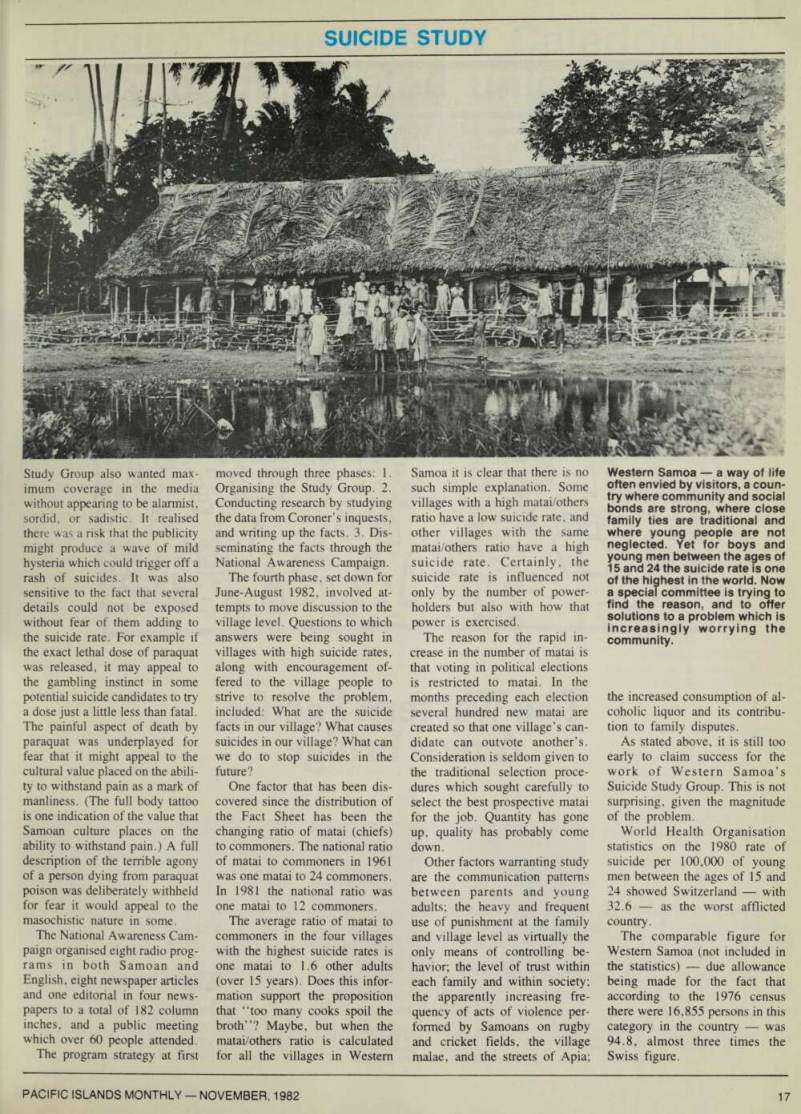
Western Samoa - a way of life often envied by visitors, a coun try where community and social bonds are strong, where close family ties are traditional and where young people are not neglected. Yet for boys and young men between the ages of 15 and 24 the suicide rate is one of the highest in the world. Now a special committee is trying to find the reason, and to offer solutions to a problem which is increasingly worrying the
community.