Questioning
pp. 8-13 · Read in the full issue

Letters
Questioning Vanuatu’s land policies
An Australian academic, Dr Alan W. Ward, has retired from his post as Director of Rural Lands in Vanuatu before his con tract was up. He has explained his reasons in an Open Letter to President Ati George Sokomanu and Prime Minister Father Wal ter Lini, a copy of which he has forwarded to PIM for publica tion. The letter follows: Your Excellency/Mr Prime Minister, As you know I have concluded my contract as Director of Rural Lands some months before its full term and returned to Aust ralia. The reasons are partly to do with my family circumstances but more to do with trends in land policy which made it in creasingly difficult for me to serve as principal executor of rural land administration in Vanuatu. Out of regard for the courtesy, kindness and eminent reasonableness of yourselves and many hundreds of village people whom I met in the course of duty, I should like to make it clear why, despite many regrets, I felt it best to step down.
The reason basically is that I believe that Vanuatu is putting at risk its economy, its relations with non-Melanesians domestic ally and its reputation interna
tionally, by a trend of policy
which is punitive towards the “alienators” the holders of former freehold titles who pre sently reside on and use about five per cent of Vanuatu’s land (the developed parts of alienated titles), who were either non
political or openly supportive of
the independence movement in 1979-81, and who hope to be come lessees under the new land tenure system. Furthermore, that the competition among custom claimants for control of the de veloped land is setting Melane sian against Melanesian and dis tracting the energies of the peo ple and the state away from genuine development and tends to favor the greedy, the selfish and the opportunistic; that these kinds of attitudes are being pan-
dered to by certain politicians who are pursuing political power through vote-catching programs which abandon national respon sibility and pander to greed and racial prejudice; that these trends threaten to overwhelm the essen tially reasonable objectives of the present Minister of Lands; and that a conscious effort of state craft and will by more thoughtful leaders is necessary to avert seri ous damage both to Vanuatu and to the southwest Pacific region.
The problem centres largely on the question of payment to the alienators for their improvements to the land when they are not granted a lease. At Independence the right of alienators to remain
on the land until either they were granted a lease or received pay ment for improvements on the land was a central aspect of the legal-political settlement. It was embodied in the 1979 Constitu tion and the Land Reform Regu lation, 1980. It was a fair under
taking which greatly helped in
attracting to the Vanuatu Gov ernment the respect and support of the region. It was an undertak ing that convinced many settlers in 1980 that they could expect fair treatment from an indepen dent Melanesian government, despite the doubts about who among the custom claimants would turn out to be their land lords, or the terms of the lease,
or value of payment for improve ments. It was enough to prevent many of them from joining the rebellion in 1980. Yet these are the people who now are under threat of eviction with little or no payment for improvements.
What has become of the undertaking to pay for improve ments? In the Vanuaaku Party Congress of July 1981 certain radical leaders, including the then Minister for Lands, Mr Seru, secured the passage of a resolution to the effect that no payment for improvements would be made. In April 1982, Mr Seru, no longer Minister, introduced into Parliament a pri vate member’s bill to the same effect. Government Ministers ab stained on the vote and the bill was defeated by the Opposition and government backbenchers.
In preparing and presenting the Government’s own law on the subject, the Alienated Land Act, 1982, the Minister for Lands, Mr Regenvanu, courageously held to the principle of payment for im provements when no lease was granted but had to concede that payment would be made over 10 years with no interest on the outstanding balance. The alienators are unanimous in ex pecting that they will never re ceive more than the first payment from custom claimants unless there is a government fund and guarantee for the payment. In effect they face expropriation in all but name. But even that is not enough for some politicians. In the campaign for the recent by
elections Mr Sope’s campaign
speeches referred to plans to seek amendments to the law to do away with payment for improve ments altogether, and this was being talked about in the villages at the time I left.
One consequence is a stated reluctance by custom claimants to conclude lease agreements, even very favorable ones, be cause of the possibility that they might yet be able to put the alienator off and take over the property for no payment at all.
Not all villagers wish this. Many of the older people would be happy to grant a lease and some of the thoughtful younger ones realise they could do better to use rental income to pay the interest on loans and make new develop-
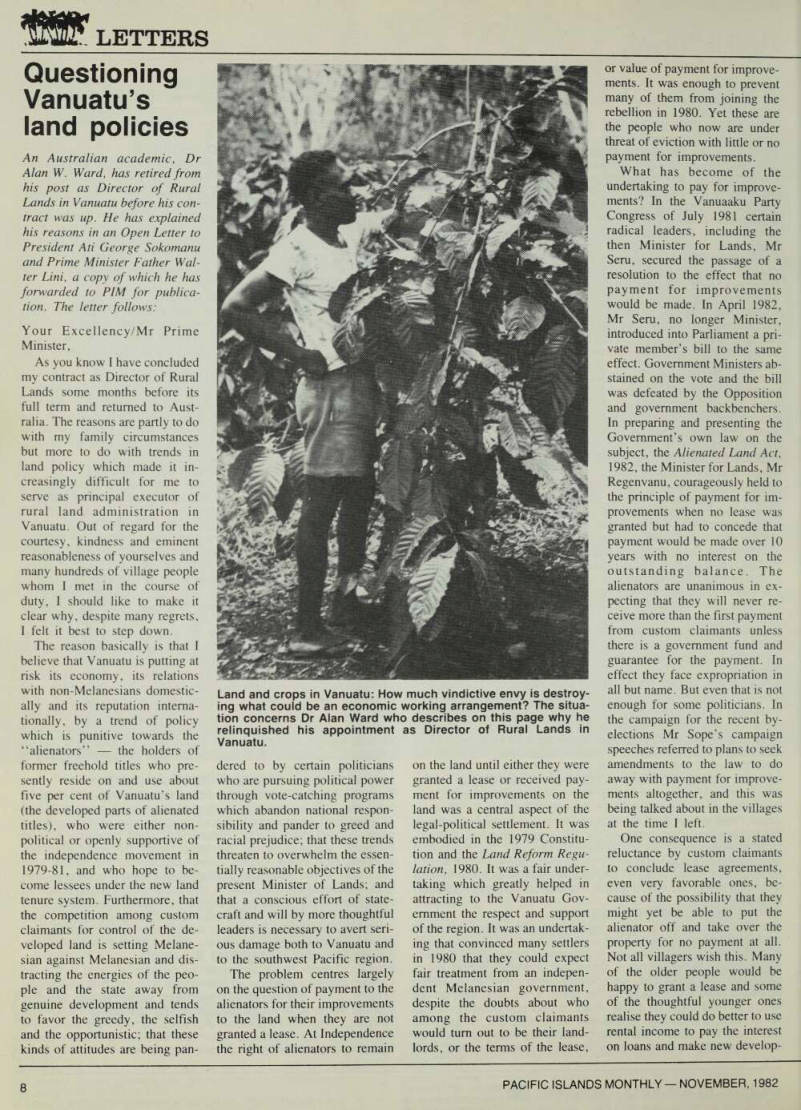
Land and crops in Vanuatu: How much vindictive envy is destroy ing what could be an economic working arrangement? The situa tion concerns Dr Alan Ward who describes on this page why he relinquished his appointment as Director of Rural Lands in Vanuatu.
ments on un-alienated land. The motivations for taking the land back are not always clear but they certainly include vindictive envy. Those who demand the land often have neither skills nor organisation nor capital to run a plantation or redevelop it. The government’s objectives of get ting ni-Vanuatu farmers into commercial agriculture, and maintaining and increasing pro duction, would be better attained by a combination of leasing and joint-venture arrangements with existing settlers, many of whom have acquired appropriate farm ing skills which they could pass on over the term of a lease. The present Minister knows this well but other members of the Vanuaaku Party are pandering only to emotional desires to take back the remaining five per cent of alienated land quickly. If they get their way the consequences will be harmful both to the Vanuatu economy and the image of Vanuatu as a country where just terms can be expected.
The consequences are even more serious for New Caledonia.
Already it is being said there, as a result of the tendency towards non-payment for improvements in Vanuatu (either to present re
tiring alienators, or to future les sees at the end of a lease) that the settlers’ worst fears of how they will be treated by an independent Melanesian government are be ing realised. Worst of all, it is being said that the rebels of 1980 are being proved right all along that the only course is to resist reform and prepare to fight. The results of that attitude are horr ible to imagine but it is precisely that attitude that the activities of Mr Seru and Mr Sope are encouraging.
The issue about payment for improvements can be defused. It is unlikely that aid donors will provide the money to pay for them but Vanuatu has its own resources some 55 million vatu of 1981 budget savings which could be spent on provid ing soft loans to custom claim ants who have real projects to buy back improvements and make new development rather than on a barracks for the Vanuatu Mobile Force in Luganville.
You will perhaps appreciate why, in a situation where, large ly because the confusion of claims and aspirations among custom rightholders prevented prompt agreement on leases and
encouraged thoughtless take overs of land, I felt I was assist ing in the demise of what is left of the rural economy and the hope of good relations between Melanesians and non- Melanesians on the land. Yet it is evident that there are leaders of sensibility and goodwill in the government, and among the peo ple in the villages. In your speech on the second anniversary of independence, Mr Prime Minister, you spoke of Christian principles, acceptance of moral resonsibilities and the building of a society of honest. God-fearing people in which there are neither exploiters or exploited. I am sure that all social democrats in our region would share your aspira tions. With regard to the settle ment of the land issue on just terms, conducive to good de velopment in Vanuatu, I indeed hope that your reasonableness and breadth of view, well known and respected by many, will be brought to bear and prevail over the wishes of the short-sighted, the greedy and the apostles of racial hate.
(Dr.) Alan W. Ward
La Trobe University, Melbourne, Vic., Australia.
The “warrior”
that wasn’t
I am sorry to react so slowly to a matter concerning PIM. As a matter of fact, my point concerns the photograph on the cover of your May issue. But I hope my
long friendship with the
magazine, coupled with the fact that what I have to say relates to personal experiences of mine, will help you to forgive me.
PlM’s May cover shows a Papuan man in “Kukukuku” (Enga) dress, alongside an air craft. Your description of the photograph says the man is “a Kukukuku warrior at Marawaka”.
I object strongly to the term “warrior”, and was surprised that PIM, which is certainly one of the most qualified publications dealing with the South Pacific,
and especially Papua New
Guinea, should appear to indulge in the sensationalism typical of
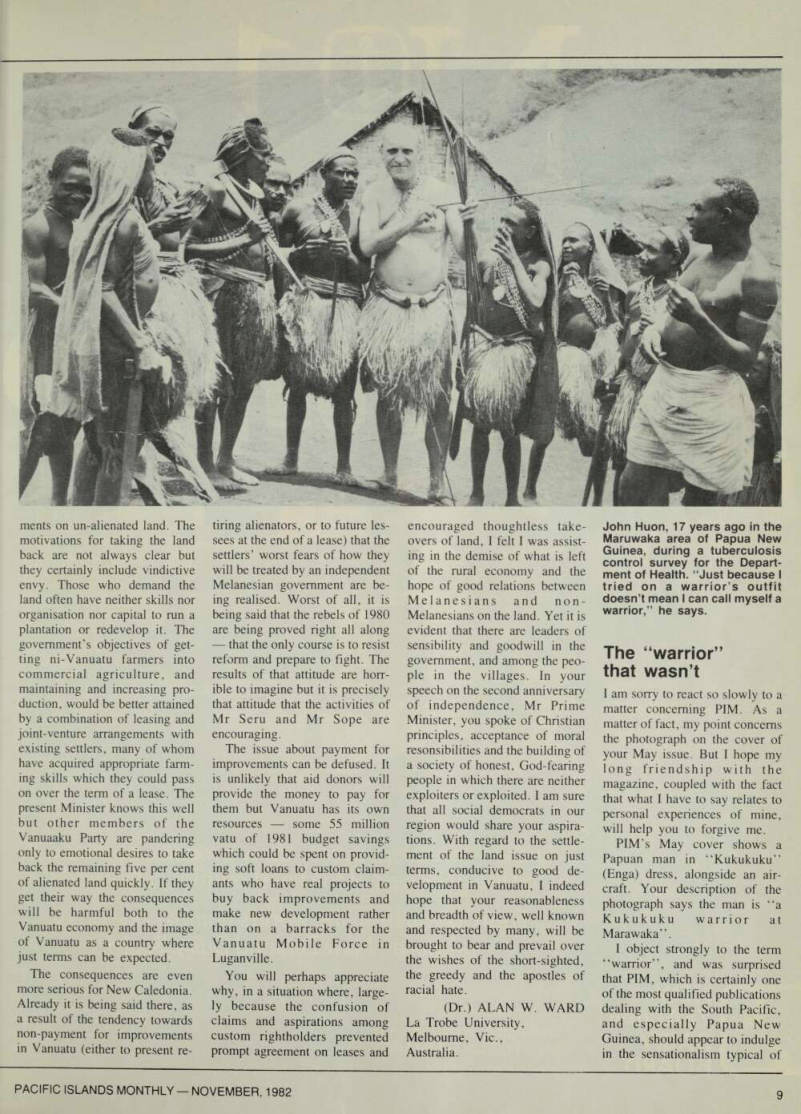
John Huon, 17 years ago in the Maruwaka area of Papua New Guinea, during a tuberculosis control survey for the Depart ment of Health. “Just because I tried on a warrior’s outfit doesn’t mean I can call myself a warrior,” he says.
most media treatment of the region.
Why should any Islander, clad in unusual and often anachronist ic attire, be automatically called a “warrior”? Would we use that expression about a soldier in one of our Western armies, who could live his whole life through without ever shooting at
anybody?
In spite of the well-known, and often over-reported, tribal
fighting, mainly in the Highlands
of PNG, this is not, and never has been, the main occupation of males bom in that area.
As a matter of fact the young man on PIM’S May cover was once our own “houseboy”. I brought him back with me from a medical patrol in his area in 1970. His name is Indan’ye, and he was employed by us also at Goroka Museum, as a gardener and a colourful assistant who, for example, demonstrated to visit ing tourists his skills in making fire using the techniques of the bush.
The same gentleman was
photographed by my friend,
James Sinclair, for an illustration in his book The Highlanders (p 99).
Our good Indan’ye certainly
does not deserve the description “warrior”. He never shot an arrow at anybody, and probably never even laid hands on the famous club of his ancestors. In fact, I think his father was killed in some fight, years ago. But that’s not enough to make the son a fulltime fighter.
J. Huon De Navrancourt
Atherton, Qld.
Australia
Down with von
Daniken!
While I agree with Jimmy Cor nell’s review of The Stones of Kiribati and its inconsistencies (PIM Sept p5l), I feel that it does not do enough to deter those who may wish to buy what the pub lishers call “a book”.
Many of us on Tarawa, after reading the section relevant to Kiribati, were appalled by the publicity-seeking inconsistencies and gross errors of fact. We were tempted to catalogue the errors page-by-page, but finally de cided the exercise was futile.
From the misleading (deliberate ly?) cover photograph, to the phosphate loading in Tarawa har bour, to the safari-like journey on Arorae, to the . . . the exer
cise in shallow, self-seeking au thorship continues.
I would have been happier if Jimmy Cornell had been stronger in his condemnation of such a fly-by-night as von Daniken, who, on his own admission, does not possess the necessary re search skills to find out where Kiribati is in his European libraries!
I am critical of von Daniken’s technique, but, more particular ly, I find it highly objectionable that he should use the cultural features of many different peo ples to feather his own nest, and most often at the expense of, and without giving credit to, these peoples.
H. J. Rosenboom
Tarawa Republic of Kiribati
Mystery of some
sunken stamps
I am one of your readers who lives and works on the Kwajalein Atoll (on Roi Namur).
I am a scuba diver and do a lot of shipwreck diving on a freigh ter that was sunk here during World War 11.
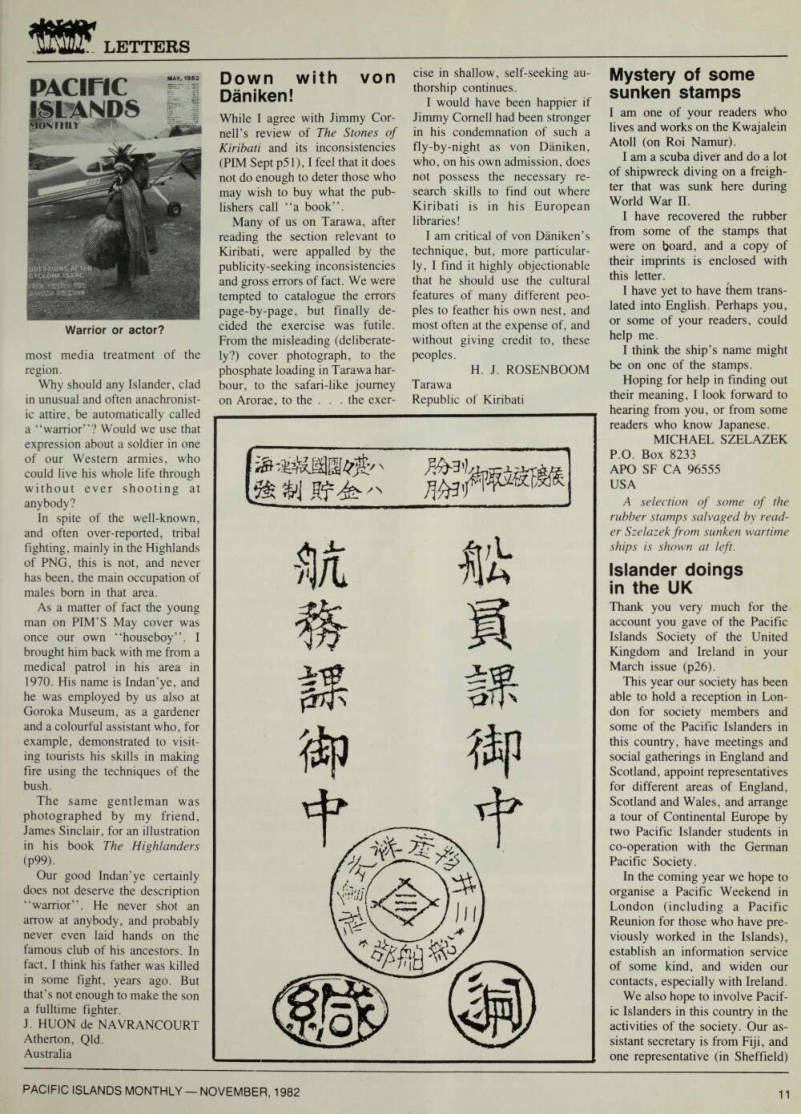
I have recovered the rubber from some of the stamps that were on board, and a copy of their imprints is enclosed with this letter.
I have yet to have them trans lated into English. Perhaps you, or some of your readers, could help me.
I think the ship’s name might be on one of the stamps.
Hoping for help in finding out their meaning, I look forward to hearing from you, or from some readers who know Japanese.
Michael Szelazek
P.O. Box 8233
Apo Sf Ca 96555
Usa
A selection of some of the rubber stamps salvaged by read er Szelazekfrom sunken wartime ships is shown at left.
Islander doings
in the UK
Thank you very much for the account you gave of the Pacific Islands Society of the United Kingdom and Ireland in your March issue (p 26).
This year our society has been able to hold a reception in Lon don for society members and some of the Pacific Islanders in this country, have meetings and social gatherings in England and Scotland, appoint representatives for different areas of England, Scotland and Wales, and arrange a tour of Continental Europe by two Pacific Islander students in co-operation with the German Pacific Society.
In the coming year we hope to organise a Pacific Weekend in London (including a Pacific Reunion for those who have pre viously worked in the Islands), establish an information service of some kind, and widen our contacts, especially with Ireland.
We also hope to involve Pacif ic Islanders in this country in the activities of the society. Our as sistant secretary is from Fiji, and one representative (in Sheffield)
Warrior or actor?
is from Tonga, and both ladies are married to men who served for many years in the Pacific.
We have as our first aim the care of Pacific Islanders in this country (in co-operation with other bodies), but we also seek to encourage interest in the Pacific Islands, provide information, bring together those concerned with Pacific Studies, and keep those who have previously work ed in the Islands in touch with developments there and with Is landers visiting here. We would be glad to know of any persons returning to the UK or Ireland after visiting or working in the Islands. Islanders who are visit ing, studying or settling in the UK or Ireland, or Islanders who would be willing to speak to members of our society, or de monstrate their particular art.
Information about the society can be obtained on request from the Assistant Secretary, Mrs Pamela Nielsen, 26A Waldemar Road, Wimbledon, London, SWI9 7LJ, or from the Secret ary, the Rev B.J. Macdonald- Milne, Queen’s College, Somer set Road, Edgbaston, Birming ham, 815 2QH, England.
I would be glad to receive information about Islanders in this country (UK) or Ireland, or those expected to come, so that they can be put in touch with local representatives of our soci ety in the areas to which they will be going. Names of those inter ested in the society could also be sent to me or to the assistant secretary.
We shall be glad to establish or strengthen links with similar societies elsewhere.
(Rev) Brian Macdonald
Milne
Birmingham England United Kingdom
“Francophobic” PIM
again
I am a reader of both 30 Jours and Pacific Islands Monthly , the two main magazines dealing with the Pacific Islands. However, my enjoyment of PIM is soured by the unflagging Francophobia evi dent in your pages. In every issue those villainous French are thoroughly taken to task. The pens of the stalwart Danielsson
pair of Tahiti positively ooze with venom.
What does PIM have to say about Indonesia’s annexation and continued occupation of western New Guinea, when did you last write about the American pre sence in Samoa and other is lands and what about a few articles on the past and present plight of the Aborigines? Are the French perhaps cramping the sty le of Australian neo-imperialists in the South Pacific?
If the journalism of PIM as pires to attain the level of that of 30 Jours one day, I suggest a more balanced view regarding things French and less plain pre judice to begin with.
J. Robinson
Port-Vila Vanuatu Writing of “Francophobia”, we take it reader Robinson is referring to the series of articles (PIM Jul Aug Sep) on the confi dential reports of French Resi dent Commissioners in Port-Vila inadvertently left behind by de parting French officials on Van itu’s ndependence in 1980. We can ffer reader Robinson our full assurance that if France's condominium part ner, Britain, had itself iade such a wonderful contribution to the cause of informative jo irnal ism PIM would have treated the windfall in exactly the same way.
We cannot acce that because Marie-Therese and Bengt Danielsson are sympathetic to such causes as the eventual inde pendence of French Pacific ter ritories, and an end to nuclear testing, they are “Fran cophobes”. Rather, it seems to us that they are writers who identify themselves with causes which have much support among Island peoples throughout the Pacific region. (Incidentally, we are sure reader Robinson will be suitably repelled by the “Fran cophobic venom” of Bengt Danielsson’s contribution in the pages of the present issue of PIM As for the journalism of PIM 1 ‘aspiring to attain the level of 30 Jours”, we would have thought the letter appearing in our July issue (p 7) would have helped to clear up this point.
It seems unfortunate that read-
er Robinson's copy of PIM invar iably appears to have its pages stuck together when the magazine carries — as it often does — articles on such subjects as U.S. policies ; n the Mic ronesia negotiations, or the at titude of the Reagan administra tion to such matters as the Law of the Sea Convention. — Editor.
Unity needed in
New Caledonia
September 24 was New Caledonia Day in Noumea and the warning went out to the visit ing tourists: Stay away from the festivities because there could be violence. But the day was the exact opposite of what had been predicted. The only trouble the ever-present police had to deal with was when a few people here and there made pests of them selves through drinking.
Despite warnings I went to the celebration area and mingled with the hundreds of Melane sians who had come from as far away as Lifou, Ouvea, Hien ghene and Koumac. The amaz ing thing was that there were only about 10 white people, in cluding myself, attending the celebrations and inspecting the stalls. Where were all the white Caledoniens? At home hiding, that’s where. Yet the day should be for all the people of New Caledonia, whether their skin be black, white or yellow. It’s our
national day. Yet I noticed the shops had their windows covered with wire mesh or steel shutters and the tourists were being ad vised to stay away.
Yet I walked freely around the area and talked to many of the people attending the celebrations or operating the political stalls.
The political stalls displayed large banners airing the ideas and ambitions of the people.
One possible development I can foresee is that too many political parties may divide in stead of unite the people. “Too many cooks spoil the broth” and tension and resentment could ar ise because of the confusing mul titude of ideas about independ ence. If we are to have an inde pendent New Caledonia we should all unite and work to gether for anew country. If we are to remain a divided commun ity, then we should divide it properly by splitting the island in two, calling one half Melanesian Caledonia and the other half French Caledonia. Then the indi vidual can decide which half he or she wants to live in. Let’s hope that such a division will not become necessary, but it does in fact seem to me that the attitude of some of the New Caledonia whites leaves much to be desired in co-operating with the Melane sian people who are also French citizens.
Jack D. Haden
Noumea New Caledonia
Jack Haden’s picture of one of the Noumea stands.