People
pp. 41-45 · Read in the full issue
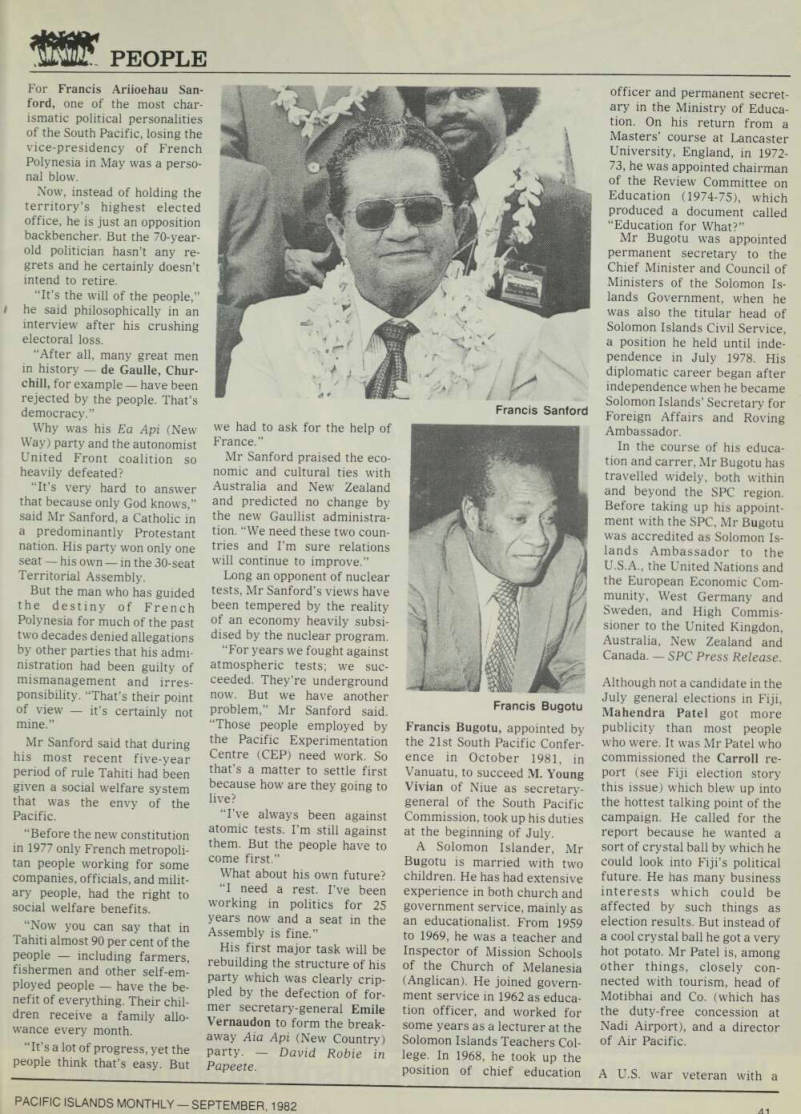
For Francis Ariioehau San ford, one of the most char ismatic political personalities of the South Pacific, losing the vice-presidency of French Polynesia in May was a perso nal blow.
Now, instead of holding the territory’s highest elected office, he is just an opposition backbencher. But the 70-year old politician hasn’t any re grets and he certainly doesn’t intend to retire.
“It’s the will of the people,” he said philosophically in an interview after his crushing electoral loss.
“After all, many great men in history de Gaulle, Chur chill, for example have been rejected by the people. That’s democracy.”
Why was his Ea Api (New Way) party and the autonomist United Front coalition so heavily defeated?
“It’s very hard to answer that because only God knows,” said Mr Sanford, a Catholic in a predominantly Protestant nation. His party won only one seat his own in the 30-seat Territorial Assembly.
But the man who has guided the destiny of French Polynesia for much of the past two decades denied allegations by other parties that his admi nistration had been guilty of mismanagement and irres ponsibility. “That’s their point of view it’s certainly not mine.”
Mr Sanford said that during his most recent five-year period of rule Tahiti had been given a social welfare system that was the envy of the Pacific.
“Before the new constitution in 1977 only French metropoli tan people working for some companies, officials, and milit ary people, had the right to social welfare benefits.
“Now you can say that in Tahiti almost 90 per cent of the people including farmers, fishermen and other self-em ployed people have the be nefit of everything. Their chil dren receive a family allo wance every month.
“It’s a lot of progress, yet the people think that’s easy. But
we had to ask for the help of France.”
Mr Sanford praised the eco nomic and cultural ties with Australia and New Zealand and predicted no change by the new Gaullist administra tion. “We need these two coun tries and I’m sure relations will continue to improve.”
Long an opponent of nuclear tests, Mr Sanford’s views have been tempered by the reality of an economy heavily subsi dised by the nuclear program.
“For years we fought against atmospheric tests; we suc ceeded. They’re underground now. But we have another problem,” Mr Sanford said.
“Those people employed by the Pacific Experimentation Centre (CEP) need work. So that’s a matter to settle first because how are they going to live?
“I’ve always been against atomic tests. I’m still against them. But the people have to come first.”
What about his own future?
“I need a rest. I’ve been working in politics for 25 years now and a seat in the Assembly is fine.”
His first major task will be rebuilding the structure of his party which was clearly crip pled by the defection of for mer secretary-general Emile Vernaudon to form the break away Aia Api (New Country) party. David Robie in Papeete.
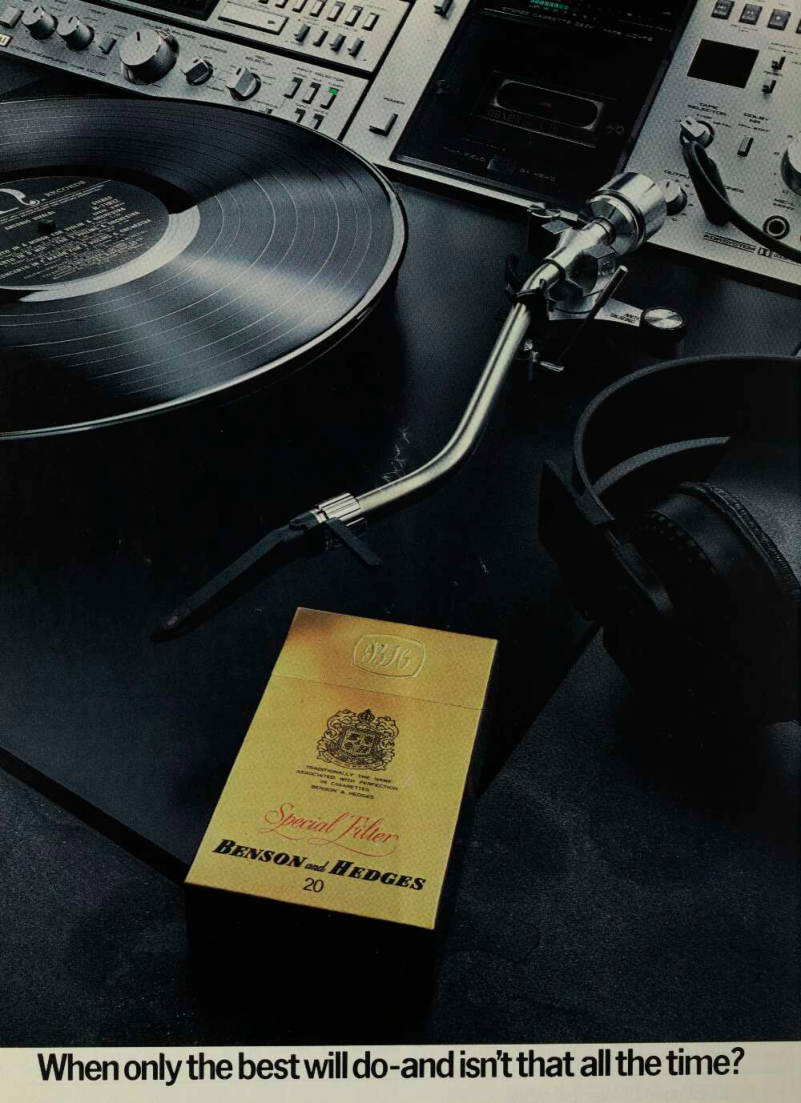
Francis Bugotu, appointed by the 21st South Pacific Confer ence in October 1981, in Vanuatu, to succeed M. Young Vivian of Niue as secretary general of the South Pacific Commission, took up his duties at the beginning of July.
A Solomon Islander, Mr Bugotu is married with two children. He has had extensive experience in both church and government service, mainly as an educationalist. From 1959 to 1969, he was a teacher and Inspector of Mission Schools of the Church of Melanesia (Anglican). He joined govern ment service in 1962 as educa tion officer, and worked for some years as a lecturer at the Solomon Islands Teachers Col lege. In 1968, he took up the position of chief education
officer and permanent secret ary in the Ministry of Educa tion. On his return from a Masters’ course at Lancaster University, England, in 1972- 73, he was appointed chairman of the Review Committee on Education (1974-75), which produced a document called “Education for What?”
Mr Bugotu was appointed permanent secretary to the Chief Minister and Council of Ministers of the Solomon Is lands Government, when he was also the titular head of Solomon Islands Civil Service, a position he held until inde pendence in July 1978. His diplomatic career began after independence when he became Solomon Islands’ Secretary for Foreign Affairs and Roving Ambassador.
In the course of his educa tion and carrer, Mr Bugotu has travelled widely, both within and beyond the SPC region.
Before taking up his appoint ment with the SPC, Mr Bugotu was accredited as Solomon Is lands Ambassador to the U.S.A., the United Nations and the European Economic Com munity, West Germany and Sweden, and High Commis sioner to the United Kingdon, Australia, New Zealand and Canada. SPC Press Release.
Although not a candidate in the July general elections in Fiji, Mahendra Patel got more publicity than most people who were. It was Mr Patel who commissioned the Carroll re port (see Fiji election story this issue) which blew up into the hottest talking point of the campaign. He called for the report because he wanted a sort of crystal ball by which he could look into Fiji’s political future. He has many business interests which could be affected by such things as election results. But instead of a cool crystal ball he got a very hot potato. Mr Patel is, among other things, closely con nected with tourism, head of Motibhai and Co. (which has the duty-free concession at Nadi Airport), and a director of Air Pacific.
A U.S. war veteran with a
Francis Sanford
Francis Bugotu
mission born of World War II returned to Papua New Guinea for Remembrance Day, July 23.
Jose Holguin wants to find the wreck of his 852 bomber, shot down near Rabaul by the Japanese on June 26,1943, and the remains of his fellow crewmen.
Mr Holguin was a navigator with the 43rd Bombardment Group.
He fought in a crew of eight and was the only man to sur vive the attack.
The 61-year-old retired officer he ended his service as a lieutenant-colonel in 1963 left Los Angeles, California, to travel to P.N.G. for Re membrance Day.
He said his greatest wish was to locate the aircraft wreck and to have the remains of his comrades transported home.
He began his search with the help of Bruce Hoy, who runs a museum of wartime relics in Port Moresby, and Brian Ben nett, in Rabaul, who has re searched the possible location of the wreck.
“If I find the wreckage I will say a few prayers for my comrades and then arrange for security measures until U.S. personnel can send the re mains back home,” Mr Hol guin said.
Mr Holguin said after the crash he had wandered in the East New Britain bush for three weeks before being found and taken care of by local people.
“I have always been grateful for this because although a stranger I was well taken care of,” he said.
He later spent two years in a Japanese prisoner-of-war camp in Rabaul. Of 64 prison ers only six survived.
The others died either from malnutrition or in the Allied bombing of Rabaul, Mr Hol guin said. From a report by Wally Hiambohn in The Papua New Guinea Post-Courier.
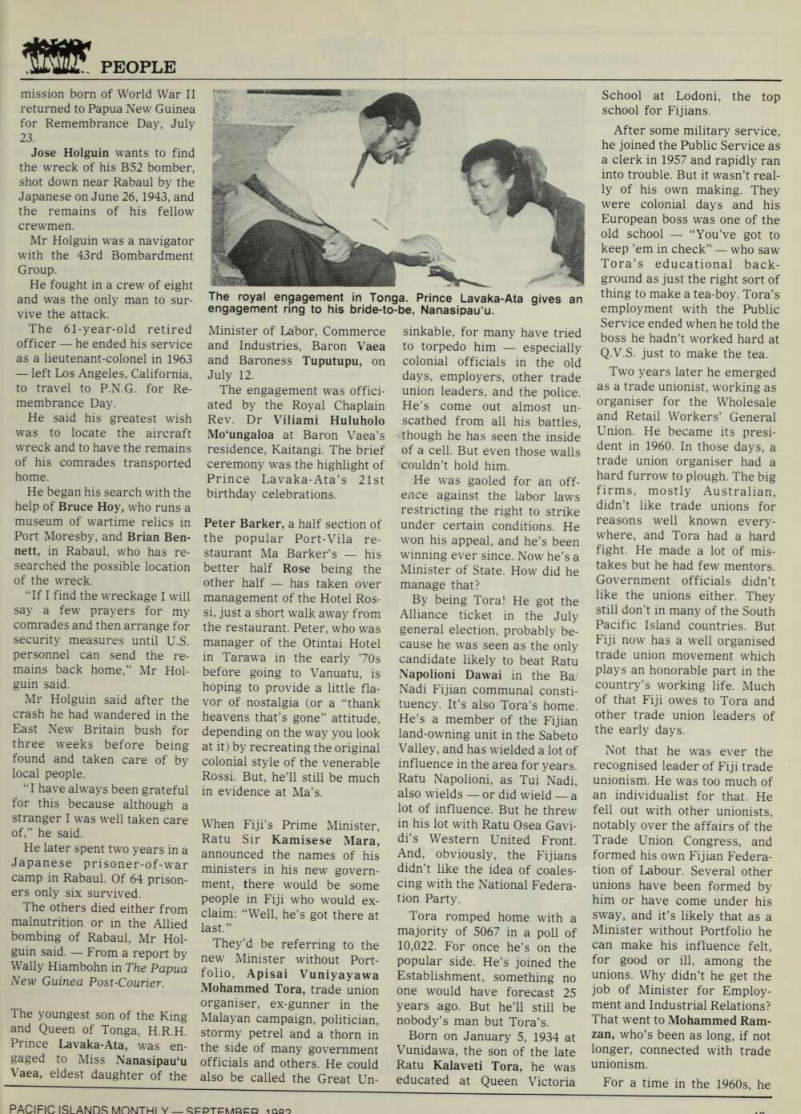
The youngest son of the King and Queen of Tonga, H.R.H.
Prince Lavaka-Ata, was en gaged to Miss Nanasipau‘u Vaea, eldest daughter of the
Minister of Labor, Commerce and Industries, Baron Vaea and Baroness Tuputupu, on July 12.
The engagement was offici ated by the Royal Chaplain Rev. Dr Viliami Huluholo Mo‘ungaloa at Baron Vaea’s residence, Kaitangi. The brief ceremony was the highlight of Prince Lavaka-Ata’s 21st birthday celebrations.
Peter Barker, a half section of the popular Port-Vila re staurant Ma Barker’s his better half Rose being the other half has taken over management of the Hotel Ros si, just a short walk away from the restaurant. Peter, who was manager of the Otintai Hotel in Tarawa in the early 70s before going to Vanuatu, is hoping to provide a little fla vor of nostalgia (or a “thank heavens that’s gone” attitude, depending on the way you look at it) by recreating the original colonial style of the venerable Rossi. But, he’ll still be much in evidence at Ma’s.
When Fiji’s Prime Minister, Ratu Sir Kamisese Mara, announced the names of his ministers in his new govern ment, there would be some people in Fiji who would ex claim: “Well, he’s got there at last.”
They’d be referring to the new Minister without Port folio, Apisai Vuniyayawa Mohammed Tora, trade union organiser, ex-gunner in the Malayan campaign, politician, stormy petrel and a thorn in the side of many government officials and others. He could also be called the Great Un
sinkable, for many have tried to torpedo him especially colonial officials in the old days, employers, other trade union leaders, and the police.
He’s come out almost un scathed from all his battles, though he has seen the inside of a cell. But even those walls couldn’t hold him.
He was gaoled for an off ence against the labor laws restricting the right to strike under certain conditions. He won his appeal, and he’s been winning ever since. Now he’s a Minister of State. How did he manage that?
By being Tora! He got the Alliance ticket in the July general election, probably be cause he was seen as the only candidate likely to beat Ratu Napolioni Dawai in the Ba/ Nadi Fijian communal consti tuency. It’s also Tora’s home.
He’s a member of the Fijian land-owning unit in the Sabeto Valley, and has wielded a lot of influence in the area for years.
Ratu Napolioni, as Tui Nadi, also wields or did wield a lot of influence. But he threw in his lot with Ratu Osea Gavi di’s Western United Front.
And, obviously, the Fijians didn’t like the idea of coales cing with the National Federa tion Party.
Tora romped home with a majority of 5067 in a poll of 10,022. For once he’s on the popular side. He’s joined the Establishment, something no one would have forecast 25 years ago. But he’ll still be nobody’s man but Tora’s.
Born on January 5, 1934 at Vunidawa, the son of the late Ratu Kalaveti Tora, he was educated at Queen Victoria
School at Lodoni, the top school for Fijians.
After some military service, he joined the Public Service as a clerk in 1957 and rapidly ran into trouble. But it wasn’t real ly of his own making. They were colonial days and his European boss was one of the old school “You’ve got to keep ’em in check” who saw Tora’s educational back ground as just the right sort of thing to make a tea-boy. Tora’s employment with the Public Service ended when he told the boss he hadn’t worked hard at Q.V.S. just to make the tea.
Two years later he emerged as a trade unionist, working as organiser for the Wholesale and Retail Workers’ General Union. He became its presi dent in 1960. In those days, a trade union organiser had a hard furrow to plough. The big firms, mostly Australian, didn’t like trade unions for reasons well known every where, and Tora had a hard fight. He made a lot of mis takes but he had few mentors.
Government officials didn’t like the unions either. They still don’t in many of the South Pacific Island countries. But Fiji now has a well organised trade union movement which plays an honorable part in the country’s working life. Much of that Fiji owes to Tora and other trade union leaders of the early days.
Not that he was ever the recognised leader of Fiji trade unionism. He was too much of an individualist for that. He fell out with other unionists, notably over the affairs of the Trade Union Congress, and formed his own Fijian Federa tion of Labour. Several other unions have been formed by him or have come under his sway, and it’s likely that as a Minister without Portfolio he can make his influence felt, for good or ill, among the unions. Why didn’t he get the job of Minister for Employ ment and Industrial Relations?
That went to Mohammed Ram zan, who’s been as long, if not longer, connected with trade unionism.
For a time in the 19605, he
The royal engagement in Tonga. Prince Lavaka-Ata gives an engagement ring to his bride-to-be, Nanasipau'u.
flirted with the Federation Party, later called the National Federation Party. He probably saw it as a ladder to higher things but it didn’t last. He fell out with Mr Koya and other leaders, and is on record as calling for the expulsion of Indians from Fiji. That was probably gallery play, because he hasn’t given any support to the Fijian Nationalist Party with its slogan “Fiji for the Fijians.” Which, for his sake, is probably as well because the nationalists took a hammering in the elections.
He had a colorful patch in late 1959 and early 1960 when he became one of the leaders of oil workers whose strike led to riots in Suva. As PIM re ported at the time, Tora “has developed a strong sense of mission and sees himself as a man of destiny. His model is Fidel Castro, on whom he is increasingly modelling him self in appearance.”
A reporter from The Fiji Times went to interview Tora
during the stormy times of the strike. He returned to the office, a little shaken, believ ing he had stared death in the face. What he had stared at was his “interviewee” wearing a Fidel Castro hat and omi nously sharpening a wicked looking knife.
As mentioned above, Tora had some war service. In 1952, he joined the 2 AA (Comp) Fiji Artillery and served as a corporal in a mortar platoon.
Then, from 1954 to 1956, he served in the Malayan Cam paign. Around that time, he became a Muslim.
PlM’s report on that phase of his life reads: “Through reading the Koran as a young man, he developed an interest in the Muslim faith. This in terest was strengthened by contacts made while he was serving in Malaya with the Fiji Infantry Regiment against the Communist terrorists. He re nounced Christianity, became a Muslim and adopted the name of Mohammed. In
Malaya he also developed an interest in, and sympathy for, the terrorists against whom he was fighting.” As you can see, Tora is a man of many parts, many facets, and his career as one of Her Majesty’s Minis ters of State will be watched with great interest.
He’d probably like to be Prime Minister! John Carter.
Guam’s Patty Chong Kerkos was “first runner-up” in the Miss Universe Pageant held in July in Lima, Peru. It was the first time that a Guam contes tant has won the title.
In the event that Miss Cana da, Karen Baldwin, is unable to fulfil her role as Miss Uni verse, Kerkos will assume the title.
The 18-year-old had earlier received the Miss Internatio nal Press award at a banquet where newsmen officially pre sented her with the crown. It was the first year that this award has been presented at the Miss Universe Pageant.
Kerkos lives with her family in Hyundai, Mongmong. She has lived on Guam for 11 years. She attends the Uni versity of Guam and plans to attend a fashion design school in France.
She was born in Seoul, Korea, and has lived in Japan, the U.S., Korea and now Guam, which she considers home.
Kerkos, who speaks five lan guages Korean, Japanese, English, Spanish and Chinese is also a gymnast, body builder, practises martial arts and is a modern dance instruc tor. Guam Visitors Bureau.
When Auckland-based Tahi tian Nat Mara flew to Paris 39 years ago his mission was sim ple to drop bombs. In July 1982 he flew back there.
Only this time it was to be feted as a wartime hero.
Natapu Mara, 60, was one of three Tahitians invited by the French Government to the annual Bastille Day parade on July 14.
Before flying to Paris, Mr Mara, who has lived in New
Zealand for the past 30 years, was feted by French High Commissioner Paul Noirot- Cosson in Papeete.
“It was a great honor for me to go back to Paris and see many of my old wartime com rades after so long,” he said.
Now a social worker for the Tahitian community in New Zealand and living in the Auck land suburb of Te Atatu, his first visit to Paris seems as vivid to him as if it had hap pened yesterday.
He still remembers with ex citement seeing the Eiffel Tower for the first time on that 1943 mission. But he is also sad that his task then was to drop bombs on a target in the city of his dreams.
Mr Mara has scars on his right leg which are permanent reminders of his service with the Free French Air Force.
His other wartime souvenirs include the Medaille Militaire, Croix de Guerre with three palms, Medaille de Resistance,
Medaille Commemoratif and the lanyard of the Legion d’Honneur.
The citation with the Croix de Guerre tells how he saved the life of a French pilot when their Boston medium-range bomber was shot down over the English Channel shortly before his 21st birthday.
In 1941, after the fall of France, Mr Mara had gone to New Zealand with 21 other Tahitian volunteers to join the Royal New Zealand Air Force but only 12 were accepted.
They were eventually trained in Canada and Britain and joined the Free French forces.
Six of the volunteers joined the Lorraine Squadron. Mr Mara was the only one of them who wasn’t either killed or taken prisoner. Two died in training, two were killed over
Europe, and another was cap tured by the Nazis.
Mr Mara, a wireless oper ator and air gunner, flew a total of 51 operational flights.
“They used to call me the last of the Mohicans,” he said with a chuckle. “They wouldn’t let me fly any more after those 51 missions.”
Ten years ago, he was awarded a French knighthood Chevalier dans I’Ordre national du Merite, second only to the Legion d’Honneur, for his social work in New Zealand.
His work among Tahitians includes interpreting for them in consultations with doctors, and arranging accommoda tion. About 500 Tahitians a year go to New Zealand for medical treatment. Mr Mara has also been president of the Tahiti Nui club in Auckland, and managed a group of Tahi tian dancers for more than 20 years.
He led the first group of Maori entertainers to visit Tahiti, and has exported pre fabricated houses to the French-speaking Pacific in collaboration with a brother in Noumea.
Though still a French Polynesian, Mr Mara is mar ried to a New Zealander, Julie, and the couple have five chil dren. They were delighted ab out his Paris trip.
When he got there, one place Mr Mara certainly didn’t miss was the famous girlie cabaret Folies Bergeres.
“The last time I went there I was never so embarrassed in all my life. I went with an Irishman and he just got so excited and carried away when everybody else was dead
quiet.”
David Robie in Auck-
land.
Seini Vakasiuola, a nurse and associate director of the Tongan Foundation for the South Pacific, took up a Nuf field Visitors’ Award in Au gust. The award was arranged by the United Kingdom Found ation for the peoples of the South Pacific (FSP) Miss Vaka siuola will spend five months in Britain exploring how Brit
ish voluntary agencies work, and attending a course in De velopment Studies at the Selly Oak Colleges in Birmingham.
Miss Vakasiuola has been deputy director in Tonga of the FSP programme since 1978. Previously she worked with the Niuola Women in De velopment Association and be fore that followed a career in nursing to become assistant deputy matron at Vaiola Hospital in Tonga.
The UK FSP was formed in November 1981 and aims to support projects and program mes in the South Pacific region.
This is the first Nuffield Visitors’ Award to a Pacific Islander.
Wayne Heffernan has taken up the newly created post of Air Pacific’s cargo sales mana ger in Australia. Mr Heffernan comes to the new job after experience in cargo covering 18 months with Air New Zea land and five years with the Australian domestic carrier Ansett.
Air Pacific’s cargo manager Seth Maharaj commented: “Mr Heffernan is needed be cause of the big increase in cargo movement between Aus tralia and Fiji.
“With our shared service on the Qantas 747 out of Mel bourne and Sydney, coupled with our daily service on our 737 out of Brisbane, our capability to move cargo has increased substantially.”
Air Pacific’s existing cargo representatives in the Austra lian States of New South Wales, Queensland and Victor ia will now report directly to Mr Heffernan.
Jane Dickhudt has been appointed editor of the Marianas Variety newspaper by publishers Abed and Paz Castro Younis.
Ms Dickhudt, 26, has served as associate editor of the paper since January 1981.
She succeeds Kurt Liepman, who has resigned.
An avid runner, Ms Dick hudt won the Guam Marathon women’s division last year.
Nat Mara