racing for 1983-84
p. 66 · Read in the full issue
A calendar of yacht racing for 1983-84
Yachts
The Cruising Yacht Club of Austra lia has released a calendar of yacht racing for 1983-84. Events listed are: • Seventh Club Med Australia- New Caledonia Race. Starting May 21, 1983, from Sydney, May 23 from Brisbane. The race is of 1080 and 720 nautical miles respectively. • Second Burns Philp South
Pacific Maxi Championship,
incorporating Cock o' The World Trophy Race. Starting December 14, 1983. Open to yachts between 45' and 70' lOR. • Southern Cross Cup Series, commencing December 16, 1983, concluding with the 39th Sydney- Hobart Yacht Race. This classic race is of 630 nautical miles. • The 1984 Inaugural Burns Philp Australia-Vanuatu Race.
Starting May 26, 1984, from Syd ney, May 27 from Brisbane. In the CYC’s opinion, this will become the race of the future in the Pacific.
Course: Sydney (Brisbane), Lord Howe Island, Norfolk Island, Anatom. Port Vila. The race is of 1480 nautical miles. lOR Division, Arbitrary Division, Cruising Sec tion.
BOBBY TURUA reports from Rarotonga, Cook Islands:
• El Puma Eixerit. After We
leave the South Pacific we’re not quite sure where we’ll anchor next.
We’ll go as the wind takes us.’
Those were the words of Senor Kiku Cusi, of the 11-metre El Puma Eixerit (pronounced Ahsherit) which came into Avatiu harbour in July.
Senor Kiku Cusi, who is sailing with his wife, a Barcelona-based national television personality and journalist, Senora Jeronia Vidal, is a journalist himself, who works in Spain for Barcelona’s Mundo Diario (Diary of the World) news paper. He also writes for a weekly
seafarer-type magazine called Yate
y-Motonautica.
Senora Vidal in her television work conducts interviews for a weekly current affairs programme, as well as presenting a women’s programme.
Both speak very little English.
But as Senor Cusi explained ‘We learn as we sail from port to port.’
Senora Vidal added that she has been able to improve her French while in New Caledonia and other French ports.
The couple left home, Catalonia, 20 months ago.
They crossed the North Atlantic passing through the Caribbean and Panama Canal, to drop anchor at their first Pacific port, the Galapagos Islands.
From there it was on to the Marquesas, the Tuamotus, Tahiti, Moorea the Leeward Islands, and now Rarotonga.
While in Rarotonga Senor Cusi and Senora Vidal will be gathering cultural materials on the Cook Islands.
They also propose to visit Aitutaki but will first ensure that they have adequate information regarding the boat channel and safe anchorage.
From the Cook Islands they hope to move to Tonga, Western Samoa, Wallis, Fiji, and Australia.
On return to Catalonia they prepare to travel via the Suez Canal
providing present political upsets
have calmed down. If not, ‘we’ll go via South Africa’. Cook Islands News.
Women crew
shine in
Sydney-Suva
race
The picture of the crew of ocean racing yachts as bearded, broad shouldered, hairy-chested, bare footed, sunburnt sailors clad in torn shorts and old T-shirts was certainly dispelled in this year’s fourth KB Sydney Suva yacht race.
Nor did they come ashore and drink huge quantities of dark rum or beer well, not that much.
In fact, many of the crews came ashore at Royal Suva Yacht Club in June, clean-shaven, neatly dressed in white shorts, monogrammed shirts and sailing shoes.
Of course, this may well have been due to some extent to the influence of the large number of women who sailed in the crews of both the racing and cruising yachts in this year’s race.
Nor did they sail as cooks one was the owner/skipper, and there were two women navigators. The others pulled their weight in every job expected of male crew mem bers.
Women were in the crews of at least seven of the yachts and in each case their seamanship brought strong praise from their fellow male sailors when they arrived in Fiji.
The Fiji Times.
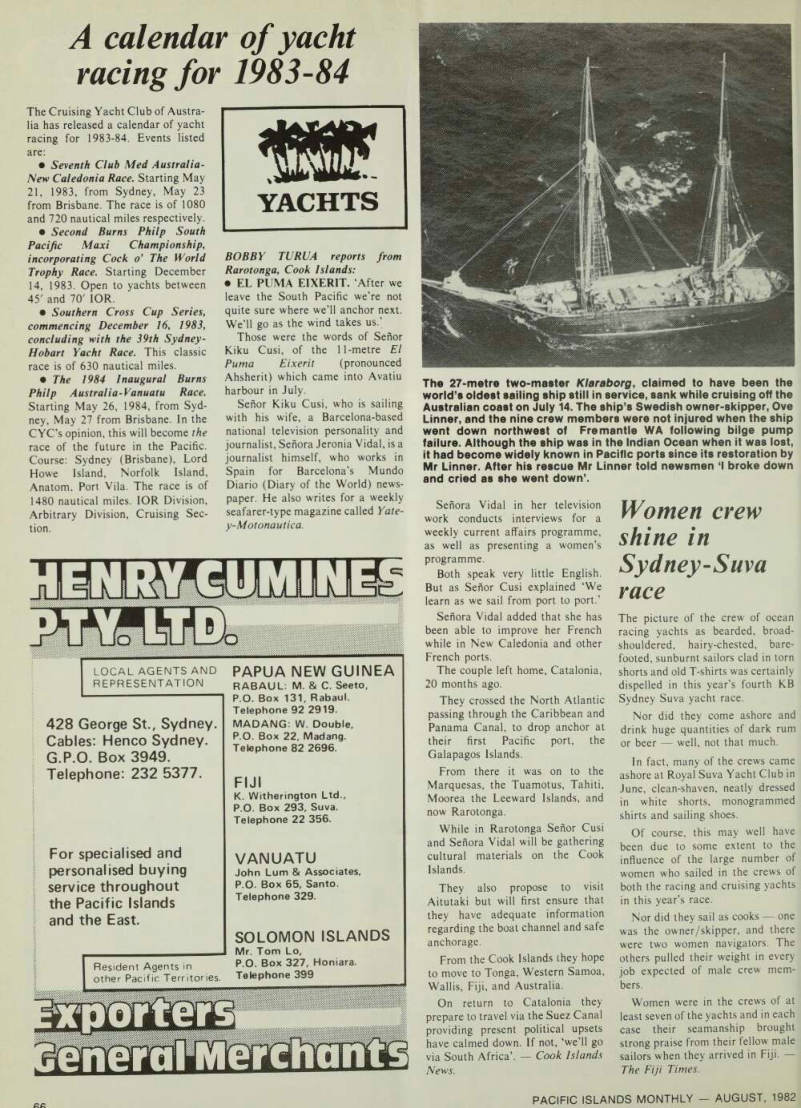
The 27-metre two-master Klaraborg, claimed to have been the world’s oldest sailing ship still in service, sank while cruising off the Australian coast on July 14. The ship’s Swedish owner-skipper, Ove Linner, and the nine crew members were not injured when the ship went down northwest of Fremantle WA following bilge pump failure. Although the ship was in the Indian Ocean when it was lost, it had become widely known in Pacific ports since its restoration by Mr Linner. After his rescue Mr Linner told newsmen ‘I broke down and cried as she went down’.