Sukuna biography: 'Fitting
pp. 47-51 · Read in the full issue

Books
Sukuna biography: 'Fitting memorial to a great man'
Ratu Sukuna: Soldier, States man, Man of Two Worlds. By Deryck Scarr. Published by Macmillan Education Ltd. UK, for the Ratu Sir Lala Sukuna Biography Committee. 1980
Sail Isbno 333 30690 2.
Ratu Sir Lala Sukuna Fiji’s first knight, first university graduate, first Speaker in the Legislative Council, first Fijian Secretary for Fijian Affairs, and, so far as this reviewer knows, only Fijian to serve in the French Foreign Legion, died in 1958, aged 70. (Apart from all the distinctions just mentioned, it is said that he was also the inventor of the tailored sulu with pockets ...) If he could have been con sulted subsequent to the event, he might have agreed that it was as well that he died when he did. Overseas experts were soon to descend on Fiji to decide that Fijians should be finally dragged out of communalism, whether they liked it or not, into an individual way of life.
If the character of the most influential Fijian of his time emerges correctly from the re cent Sukuna biography by Deryck Scarr, he would not have been in favour of some of the reforms proposed by such documents as the 1960 Burns Report, although many non- Fijians at the time hailed it as a blueprint for Fiji’s future. [A Commission of Inquiry was set up under the chairman ship of Sir Alan Burns a few months after Ratu Sukuna’s death. In an introduction to the report that eventuated, the commissioners outlined some of the obstacles to Fiji develop ment as they saw them, includ ing rapid population growth, an unequal distribution of land and the ‘dual system’ which gave the Fijians a separate adminis tration and which should be scrapped, they believed and absorbed into central adminis tration.] Even without Sukuna’s influence, Fijian chiefs dug their heels in on the sensitive
issues of their land and adminis tration, and such reforms as have occurred in the 20-odd years since the Burns Report was first delivered have been the result of political indepen dence, the effluxion of time, and
in spite of 1960 s blueprints
rather than because of them.
But that is another story.
Ratu Sukuna, Soldier, Statesman, Man of Two Worlds has been published by Macmillan Education Ltd for the Ratu Sir Lala Sukuna Biography Committee of six the Rt Hon Ratu Sir Kamisese Mara, the late S. B. Patel, Sir J. Rabukawaqa, J. S. Thomson, L. G. Usher and Dr I.Q. Lasaqa. Nothing is said in the book to indicate the exact function of this committee or when it was set up. But it can be assumed that part of its task
was to choose a biographer for what is a literary memorial to Ratu Sukuna. Deryck Scarr is an established Pacific historian at present attached to the Aus tralian National University, Canberra. Some years ago he spent considerable time in Fiji working on the archives of the Western Pacific High Com mission and from this came his book, Fragments of Empire, on the territories of that now defunct body. He is also author of a biography of Sir John Thurston an early Fiji Governor.
Ratu Sukuna was born on April 22, 1888, at Bau. He was named Josefa Lalabalavu Vunaalaila Sukuna, which he in time reduced to Lala Sukuna.
His Fijian pedigree was impec cable; his father was Ratu Madraiwiwi of the Royal house
of Bau; his grandfather was a cousin of Ratu Seru Cakobau who, with other chiefs, had ceded Fiji to Britain in 1874; and his mother was the eldest child of the Paramount Chief of Lau, in pre-European times of almost equal status to Bau.
But whatever young Ratu Sukuna’s standing as a Fijian Chief, in early colonial Fiji he could, without the right kind of help and a kind Fate, have ended up as some minor clerk in a government department, that being the niche preferred by the administration for bright Fijians.
He was saved from this firstly by his father who found a tutor for him in the person of a Charles Andrew, who later ran a school at Raki Raki. Andrew was an Oxford man and to him is attributed the famous Sukuna accent that was said to have the ‘bell-like tones of standard Southern English, as though he had studied diction with the Royal family’.
In 1902, when Sukuna was 14, his father sent him to a preparatory school in New Zea land, and later to the Wanganui Collegiate School. He matricu lated in 1906 and returned to Fiji hoping to continue to uni versity. But his father was already educating some of his other children in Australia and New Zealand, and could not do more for his eldest son at that time. Ratu Sukuna did, indeed, become a fifth-class clerk, and later a schoolmaster, and it was not until 1911 that the idea of university again surfaced. In that year his father interviewed the new Governor, Sir Henry May, and asked that his son be given four years’ leave of ab
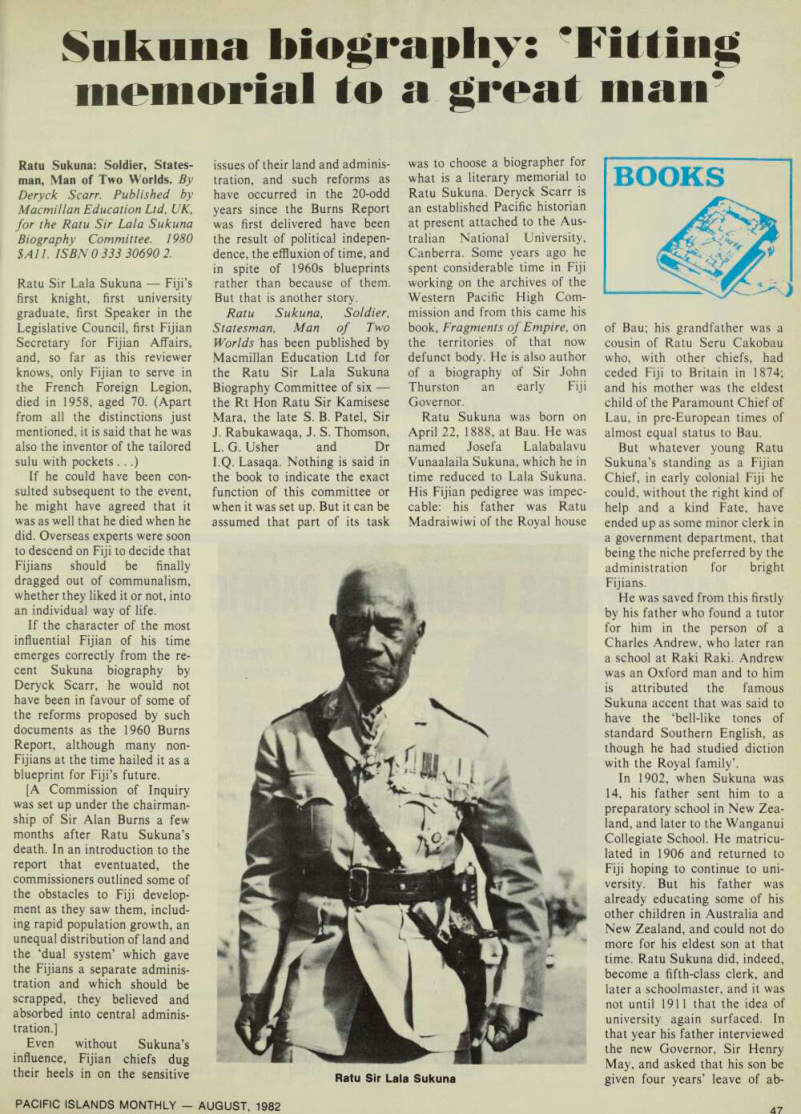
Ratu Sir Lala Sukuna
sence so that he could go to Oxford and to the English Bar to qualify as a Fiji magistrate, and eventually a District Com missioner.
May thought it too ambitious and suggested an Australian alternative. But Sukuna himself was adamant that it was to be British qualifications or noth ing.
A reluctant probationary year’s leave of absence was granted but no money went with it. This was finally raised from several of the Fijian provinces at the instigation of a few Fijian chiefs who were perceiving that prominent young Fijians needed the kind of education not then available in Fiji if they were to hold their own with contempor ary young Europeans who were being sent as administrative officers.
Sukuna accepted his people’s help in the manner in which it was given, knowing well enough that Fijian custom would ensure that he would be repaying the obligation for the rest of his life.
He entered Wadham Col lege, Oxford, in April 1913, just 14 months before the outbreak of World War 1, at which time he did what was natural for a Fijian that is, enlist. Or at least he tried to, being turned down by the British because of his race. Whereupon he crossed the Channel to France, and joined the Foreign Legion.
He won the Croix de Guerre at Arras in May 1915, and subsequently the Medaille Militaire. In September 1915 he was wounded, and, after he had spent three months in hospital, the British pulled enough strings to have him released from the Legion and put on a ship for Fiji. (Ratu Madraiwiwi when he heard of his son’s imminent arrival is said to have remarked that he regretted that he should have come home before his whole duty was done.) It was late in 1919 before Sukuna got back to Oxford.
From there he went to the Middle Temple in London to read for the Bar. Henceforth he would be ‘. . . quite willing to use legal jargon so that men should not forget his quali fications nor challenge him legally’, says his biographer, ‘but he never saw himself as a
lawyer, instead he regarded himself as a leader and, by compulsion, an administrator’.
He never, in fact, looked beyond service to his people and a belief in their traditional way of life. But these years in the
early 1920 s cemented his love
affair with England and English life. With true pragmatism he enjoyed his London club, his English friends, West End tailors or makers of shirts, and Test cricket matches at Lords or the Oval.
He returned to Fiji at the end of 1921 to take up his obli gations as head of his family (Ratu Madraiwiwi had died in the previous year), and the place of G. V. Maxwell on the Native Lands Commission (al though not with the same title).
The matter of Fijian land was to be his preoccupation until the end of his life, believing as he did that there was nothing more important than defining Fijians’ relationship with particular areas of land in a manner that was intelligible to them. His idea at that time was to draw up a two-part Fiji Doomsday Book, with a register of native lands, and a register of native landowners.
In 1932 Sukuna became, as well, District and Provincial
Commissioner of Lau, with headquarters at Lomaloma.
Lau remained his retreat through the 19305, particularly from the Legislative Council to which he, with great reluctance, allowed himself to be ap pointed. Legco, he believed, was generally worthless as far as Fijians were concerned, over the whole 40-odd years in which they had sat as appointed mem bers. Most having an imperfect understanding of English, slept through the boring, long speeches about matters that were foreign to them. Even after 40 years, Sukuna said in the late 19405, the position had changed ‘only slightly’. He said: Tn these days Native members do address the Council but only when pressed or provoked.’
Sukuna himself resented be ing at the receiving end of barbs from European or Indian mem bers in a place where what he considered good manners were at a discount. He religiously arrived late at Legco sessions, said as little as possible, and tendered his resignation regu larly, only to have it regularly refused.
His life in Lau came to an end with the 19405, and the passing of the Native Land Trust Bill, the ideas it embodied having been first introduced to the Great Council of Chiefs by Sukuna in 1936. The new legis lation invested all Fijian land in a Board which would adminis ter it, setting aside as reserves
what was needed for Fijian use in the foreseeable future and leasing out the rest, collecting and distributing the rents (less a percentage to finance the Board). Ratu Sukuna was to be Chairman and Chief Reserves Commissioner.
The work of setting aside reserve land began immediately in the sugar growing, largely Indian-populated, area around Ba, with Sukuna physically tramping over the land with his field staff, urging the Fijians in this western region to adopt a rational approach when their natural antipathy to Indian farmers was to reserve caneland wholesale.
Understanding the economic importance of its chief export crop to Fiji, Sukuna came down solidly on the side of Indian farmers in this region which possibly made him all the more bitter when, in the worst days of the Pacific War, with Fijians scrambling to join the fighting forces, Indians opted out and cane-growers embarked on a seven-months’ strike.
By this time work on reserv ing land had been put into deep freeze for the duration. But before the war was over, during the governorship of Sir Philip Mitchell, a fighting man whom Sukuna admired greatly and who saw eye to eye with him on Fijian traditional life, Sukuna became Secretary for Fijian Affairs, with the old Native Regulations Board reconsti
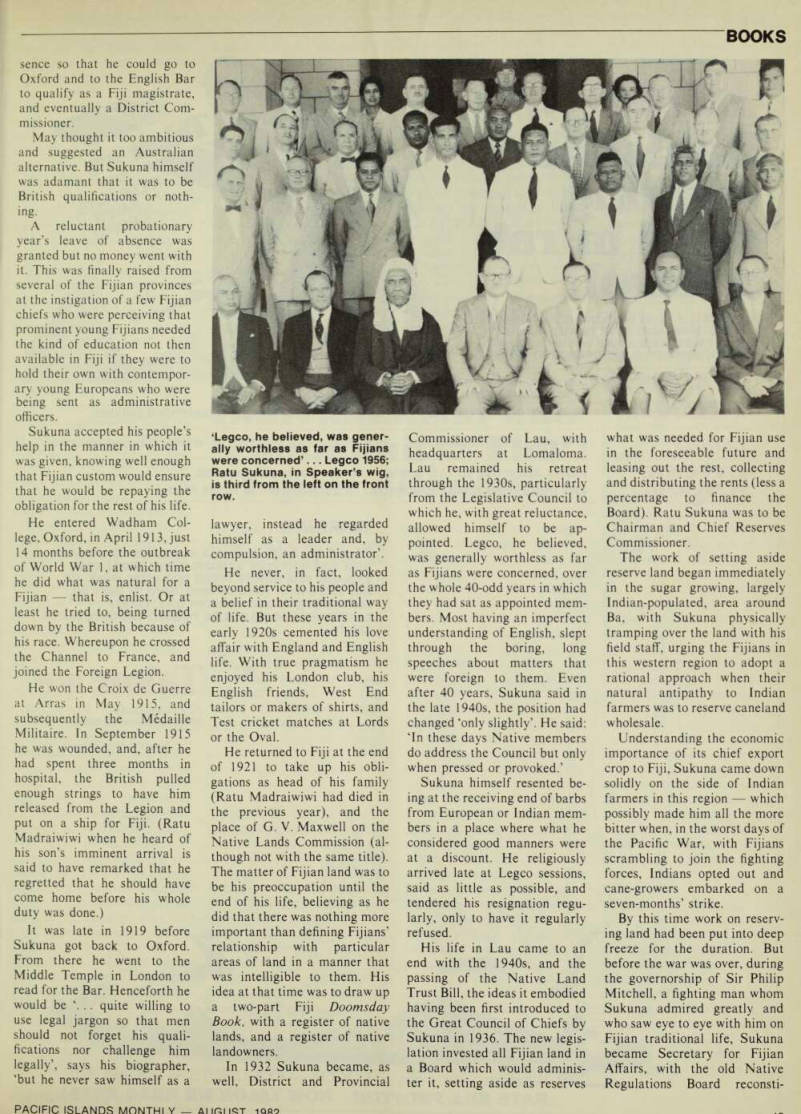
Legco, he believed, was gener ally worthless as far as Fijians were concerned’... Legco 1956; Ratu Sukuna, in Speaker’s wig, is third from the left on the front row.
tuted as the Fijian Affairs Board, the members of which were the Fijian members of Legco, plus Sir Henry Milne Scott as legal adviser. Each province also regained a Roko at its head, and European district officers were told to leave Fijian affairs alone.
Ratu Sukuna believed more than ever that the village communal system was the way for Fijians to continue to go; that there was nothing that Fijians acting individually could achieve that could not be achieved by communities prop erly led. Perhaps even he would have conceded, however, that “properly led’’ were the operat ive words in each case.
Unusually for a Fijian chief, Ratu Sukuna was 40 before he married although according to his biographer there were plenty of cross-cousins, Tongans as well as Fijians, to testify to his virility. In 1928 he had chosen as a wife Maraia Vosawale Tataweqa who, in the Fijian social order, was re garded as an unsuitable choice, being merely the daughter of a Native Stipendiary Magistrate and niece of a Roko Tui. Lady Maraia, as she became when Ratu Sukuna was knighted, died in 1956, and, near the end of his own life, he chose a successor from ‘the maidens sent up to (his house) for inspection’.
The Ratu Sir Lala Sukuna that emerges for this reviewer from this book is not so much a man of two worlds although he enjoyed playing in many European backyards, and num bered his friends among them in scores but rather a Fijian high chief with the natural dignity and manners capable of carrying him into any society.
In spite of his European friendships, he nevertheless re served the right to stand off and regard with amused cynicism many of the sacred cows of colonial Fiji, including the CSR Co, Big Business, and knighted merchants although the author’s own prejudices might have contributed to this im pression. Above all, he had the Fijian chiefly gift, when it suited him, of pulling down and retiring behind a metaphorical shutter, and thus presenting to the world a blank, impenetrable
face. This faculty was one that drove more than one governor to impotent, if unexpressed, fury.
In the last decade of his life land matters were still proceed ing slowly, often at the pace at which Sukuna himself could tramp over the land. This, and the reluctance with which he welcomed change in the Fijian communal system, provided fer tile ground for the reforming experts sent by the UK when the rush was on to rid itself of its last colonies.
During the 19505, Ratu Sukuna was increasingly in ill health and old for a Fijian still in office. On medical grounds he was persuaded to retire on his 70th birthday, and the follow ing month, May 1958, he set off
with his second wife for a last look at England, and to renew ties with old friends there. He did not make it — he died at sea when the ship was off Ceylon.
His body was flown back to Fiji, and buried at Tubou in Lau.
This book about a very com plex man must have been difficult to write. Certainly it is one that is difficult to review by someone not steeped in Fijian cultural history — of whom this reviewer is unfortunately an example.
But for those who are part of that esoteric Fiji circle, it is a fitting memorial to a great man — leader, scholar, soldier, hero, statesman — who had only one purpose in life, the ultimate
good of his people.
Judy
T udor.