to ‘guide’ the unguidable
pp. 27-29 · Read in the full issue

Political
Currents
French Policy In New Hebrides
The frustrations of trying to ‘guide’ the unguidable
In the second of a series of three articles HOWARD VAN TREASE discusses French policy in the then New Hebrides in the ’6os and ’7os as revealed in monthly reports to Paris by Resident Commissioners of the period. Their prime concerns emerge as the enhancement of French political influence and perpetuation of the French presence through the formation of Francophone political organisations, manipulation of Jimmy Stevens’
Nagriamel movement, and the hoped-for advantages for France from the activity in the New Hebrides of the Americans Peacock and Oliver. The documents were discovered in a carport at the former French Residency in Port-Vila following the declaration of Vanuatu’s independence on July 30, 1980.
In the urban areas the French Residency could depend on its own nationals to carry the responsibility for establishing political parties. As noted earlier, it was anticipated that educated ni-Vanuatu French speakers would be absorbed into these parties, which would allow the ‘evolution of their behaviour to be guided'.
The LCNH was the most important Francophone party to emerge, although there were others, most with a rural or regional base. This multitude of parties must have been seen as encouraging, since it appeared to bring into the political arena a wide variety of regional and Melanesian groups who appar ently identified with the French cause.
What most French officials did not fully understand was that the Anglophone/ Francophone rivalry which they
sought to foster was not the real substance of the political awak ening which was occurring dur ing the 19705. They found that early alliances fell apart or were difficult to maintain as tra ditional rivalries, which were often the real basis for the formation of new political groups in the first place, came to the surface.
As political activities intensified during the 19705, the French Residency found it more and more difficult to control the various parlies which they supported and as sumed to be under their influence.
Jimmy Stevens presented the most difficult problem for the French. In the early 1970 s he
appeared to be moving closer to their side. The French Resident Commissioner noted in January 1973; The Nagriamel pursues its_ flirtation with the French Adminis tration. On January 17 a large meeting brought together nearly 300 people in Fanafo. The leader of the movement, Jimmy Stevens, spoke at length .. . He urged families to unite and extend the influence of the Nagriamel to new islands, more particularly in the Banks where the fight will be close, because the Anglican priest, Rawcliffes. dislikes us and cannot hear to see us go hand in hand with the French.' . . . He also made a great propaganda effort for the French school which is to be opened in Fanafo. (Langlois, January 1973.) However, as the French had earlier suspected, Stevens proved an unreliable ally. He never appeared to weaken in his opposition to a National (later Vanuaaku) Parly victory in the race for independence. But at the same time the French learned that he was not in favour of their continued con trol either. In 1975, following the elections for the first Rep resentative Assembly, Stevens presented an ultimatum to the Joint Administration demand ing the withdrawal of both governments this hardly fitted the French plan to stay in Vanuatu forever.
The factor which the French Residency had underestimated was the Americans in par ticular Michael Oliver and Andrew Peacock whose influence by the mid-1970s had become far more important to Jimmy Stevens than that of the French.
Although the French had realised the risk of allowing American influence to increase in Vanuatu, in the late 1960 s they were willing to see American plans for land pur chases and sub-divisions go ahead.
It is in a favourable context that the American phenomenon appears . . . Briefly, if these investments extricate SFNH from the owner ship of their 70 000 hectares which are a burden ... it would be a good thing. But evidently this new pres sure might become a risk through the substantial means at the Americans' disposal. We might have to take second place and the archipelago might become another Bahamas or Hawaii. God forbid! It would be, however, useless to offset a movement whose advantages are certain, while the risks remain hypothetical. (Mouradian. October 1969.) In addition to giving French settlers a chance to unburden themselves of their properties.
the American presence also appeared to French officials as a way to lake some of the political pressure off themselves.
It appeared to be an opportunity on the one hand for allowing those French settlers who no longer have the wherewithal to develop their estates to sell them advan tageously. and on the other hand for having others, not only Frenchmen, confronted by the natives, should they insist on using the land ownership question politi cally. (Mouradian, September 1969.) Although the French Govern ment later sought to limit American influence in Vanuatu, it was never willing to force their permanent expulsion.
Likewise, the French were not opposed to Jimmy Stevens’ in volvement with such New Caledonian businessmen as Andre Le Conte, who proposed large projects involving Nagriamel-controlled land.
Viewed from another angle, it appears to be an opportunity for
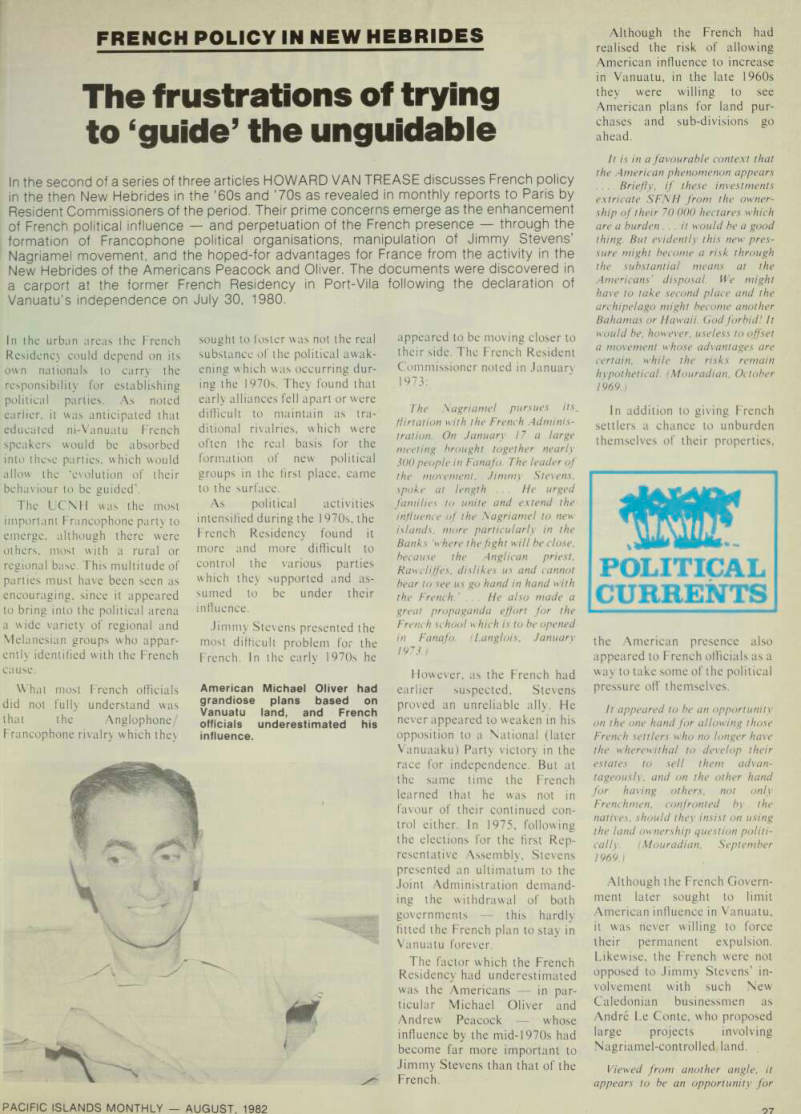
American Michael Oliver had grandiose plans based on Vanuatu land, and French officials underestimated his influence.
allowing the development of a complex state of affairs on Santo.
Nothing could be more damaging to our influence than to look on the district as a kind of arena where little French settlers and rural natives confront each other under the complaisant eye of the British.
That is why I am not at all against ■ seeing Jimmy Stevens throw him self into the arms of the New Caledonian millionaire Le Conte ... In other words, without ignor ing the possible inconvenience of ; this state of affairs, it is preferable ' to complicate the problem of Santo to our advantage. (Mouradian, April 1969.) The French, therefore, were willing to allow the already tense situation in Santo to deteriorate further to achieve their own policy objectives.
They thus demonstrated com plete lack of regard for the future stability of the group by allowing unscrupulous Americans into that part of Vanuatu where the history of cargo cult movements was greatest. Given the cult-like nature of the Nagriamel move ment itself, and the impact made by the American military forces in the Santo area during World War 11, French officials should have anticipated the results. However, political ex pediency appeared most im portant to the French Resi dency, and they were willing to take the risk of allowing the situation to gel out of hand, despite warnings from the British.
French officials never really trusted or respected Jimmy Stevens, but they felt that he and his movement could be used in the short run to their advantage.
Stevens’ behaviour, his costly journeys, his mistresses (who are honoured in the movement’s calen dar as 'ladies who gave themselves to the cause’!) are giving the slow thinking Melanesians doubts as to his integrity and the sincerity of his concern for the interests of his half brothers by race. As for me, I am not in a hurry to see him disappear from the scene, as there is the danger of his being replaced by tougher, more sincere leaders who will not have the same weaknessess of greed, venality and knavery, which make him. in the end, a valuable party to deals for inves tors who are not excessively worried by moral scruples. Stevens may be only a passing phenomenon in the conflict between a disorgan-
ised and retrogressive Melanesian society and a renewed and am bitious colonisation. Experience shows that his actions turn the wave of native demands away from the political goals which he could attain and leave the door open for European enterprise, provided that it is comprehensive. In that sense he could unwittingly help us to get through the few years necessary for fixing new frontiers of colonisation and for establishing it in a context of co-operation with the natives. (Langlois. June 1970.) In other words, the French were willing to tolerate Jimmy Stevens, since his activities at least initially did not appear to have the political overtones which could threaten their long term plans of implantation, i.e., ‘fixing new frontiers of colonis ation’ in Vanuatu. His willing ness to establish links with foreign investors especially Frenchmen from New Caledo nia was in fact one of the ways in which the French Gov ernment hoped to be able to ensure their continued influence and control.
Within a short time, however, French officials recognised their mistake in allowing the situ ation on Santo to deteriorate so far, and, in 1971, joined with the British in blocking the registration of sub-divided land.
By 1976, with his demands for the withdrawal of both Britain and France and for indepen dence, it was clear that Jimmy Stevens had been seduced by his new American friends and had all but deserted his French allies.
It seems to be clear that in this affair, from now on, the MANH
and other European allies of the Nagriamel have been outflanked by the action of the Americans, Oliver and Peacock ... The interference from American nationals is quite unwarranted and that is why we have asked our respective Govern ments to make Oliver and Peacock go through the procedure for visa application. (Gauger, January 1976.) Neither Oliver nor Peacock was discouraged by this action, and continued to maintain con tact with Jimmy Stevens. The
relationship ultimately led
Jimmy Stevens to open re bellion against the government
prior to independence.
Although the French were willing to co-operate to exclude Oliver and Peacock from the group, they were not willing to support harsher measures, such as closing down Stevens' illegal radio, which had been supplied to him by Oliver. The French Resident Commissioner ex plained the reason behind this
policy:
If we manage to cut off Jimmy Stevens from his American protec tion. his enterprise can rapidly be jeopardised and, no doubt, it will be easier to bring him back to reason. There is. however, a snag that has to be avoided namely, that, disappointed in his expec tation. his sympathy may turn towards the National Party, con sidered as a possible substitute for his desire for change. That is why I think the French Residency’s atti tude must remain supple towards a still recoverable and numerically important Nagriamel, even if we must remain close to the British attitude in order to re-establish law without confrontation. Social, economic and technical aid from France to the Northern District can
he used, once the lost sheep have come home, in order to prevent the temptation of another escapade towards those who preach our total and rapid eviction. (Gauger.
January 1976.) In the late 1960 s the French Resident Commissioner had been eager to see the situation on Santo become more com plex. By the mid-19705, how ever, French officials had begun to realise that they were on the verge of losing control of the political forces they had encour aged. To try to save the situ ation, French officials became more blatant in their policy of manipulation and attempted control of political develop ments.
This is most clearly seen in the period preceding the elec tion of the first Representative Assembly in November 1975.
Having analysed the results of the municipal elections in August, the French Resident Commissioner came to the con clusion that the ‘moderate' par ties were going to have an extremely difficult time in the Representative Assembly elec tion to follow. With this in mind, the French Resident Commissioner took upon him self an active role in developing a political strategy for the so called ‘moderate’ parties, and in organising their campaign.
Next month: Dipping into the pork barrel, the watershed case of Vincent Boulekone and the problem of independent Vanuatu.
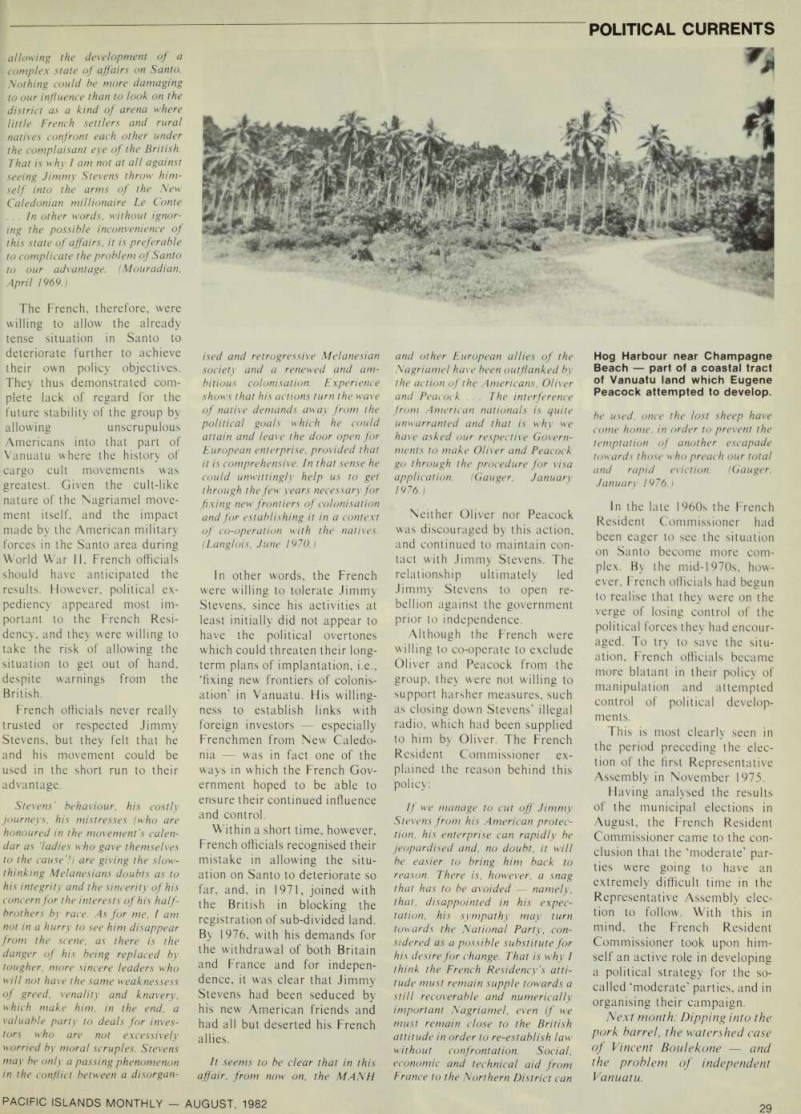
Hog Harbour near Champagne Beach - part of a coastal tract of Vanuatu land which Eugene Peacock attempted to develop.