la Malta Te Nunaa, a new political
pp. 21-23 · Read in the full issue

force in French Polynesia
Three members of the la Mana Te Nunaa party were elected to the Territorial Assembly of French Polynesia at the elections on May 23 (PIM July p 22). It was the first time the party had achieved representation at this level. In the following interview two of the party’s leaders outline its often original and innovative ideas.
At a press conference in the Territorial Assembly building, Papeete, on November 17, 1975, a group of young Tahitians announced the setting-up of a new political party, the la Mana Te Nunaa, or ‘Power to the People’.
After working in the various Tahitian political parties, the group of teachers and students involved, most of whom had studied in metropolitan France, decided to chart a new course for Tahiti, one which distanced them from the traditional oli garchic pressures on political organisations in the territory.
The following interview was conducted in Papeete by
Michel Bongiovanni
with JACQUI DROLLET, the party’s secretary-general, and
Jean-Paul Barral, Direc
tor of the party’s publication, Bulletin la Mana. • • • M.B. Could you explain just what la Mana Te Nunaa is?
J.D. It is a party advocating self-managed socialism, which works actively for Polynesia’s independence. The fight for independence has been in the party’s constitution since 1978.
We believe that this country belongs to the Maohi people, that this people exists, that it has a culture of its own, and that it therefore has a funda mental right to control its own fate.
We consider the French pres ence to be an accident of history and Polynesian independence as something that will inevitably, in its own time, come to pass.
Our party struggles to ensure that this country may one day rediscover its dignity in inde pendence.
J-P.B. What distinguishes us from the other parties is our determination to base our politi cal activity on education. It is in this sense that we speak of self management. There can be no possibility of political develop
ment without education. We don’t believe in spontaneous revolution: we believe in perma nent revolution. This means a transformation with education as the starting point. We’re the only Polynesian party to ap proach things in this way, and we’ve been doing so ever since March 1977, with the publica tion of our first Bulletin.
Certainly, our paper reports the facts of political and social life in the territory as they occur. But it also plays an educational role, discussing the ways in which the municipalities and the territory are organised, the rights of the parents of schoolgoers, the problems of school canteens, and so on. In this way we are giving real training to our acti vists. It is thanks to this ap proach that the party has grown and become firmly anchored among the people.
J.D. Unlike communism, our socialism is self-managed. For us the process of decision making is as important as the decision itself. In communism you have a situation of demo cratic centralism, with the base following decisions made at the top, whereas my job as sec retary is to transmit and apply decisions made by the members
of the party as a whole. This is what we call Polynesian social ist self-management.
M.B. What are your relations with Francis Mitterrand’s Socialist Party?
J-P.B. We have no special relations with the French Socialist Party, we have re lations with the French Left as a whole. We didn’t want to become part of the structure of the Socialist Party because we were pro-autonomy, then pro independence, which tended to make us shy away from joining in the French body politic. At an ideological level we feel close to the Socialist Party, and more particularly the trends within its ranks known as the Ceres and Rocard tendencies.
M.B. What are your economic policies?
J.D.: In economic matters we favour a turning-back, a com plete change of direction.
In 1960 there was a balance between the primary, secondary and tertiary sectors. But follow ing the advent of the Centre d’Experimentation du Pacifique (CEP) and the nuclear testing, the primary sector on which all our resources could be based collapsed, while the others grew enormously.
In 1982 the tertiary sector is
absorbing 80 percent of the labour force, while the primary sector accounts for barely five percent.
In order to achieve indepen dence we must change direc tion, pull the tertiary sector back to a reasonable level, and concentrate our activity on re viving the primary sector, de veloping agriculture in order to achieve self-sufficiency, de veloping fisheries in collabor ation with certain other countries to earn foreign exchange, developing tourism not capitalistic tourism, but a tourist industry turned towards the people, one in which the people are directly involved and developing renewable energy sources to achieve independence in mat ters of energy.
These are a few of the lines of action envisaged by our party in the short term. In the very long term it will be necessary to look at the problems of education, language and culture.
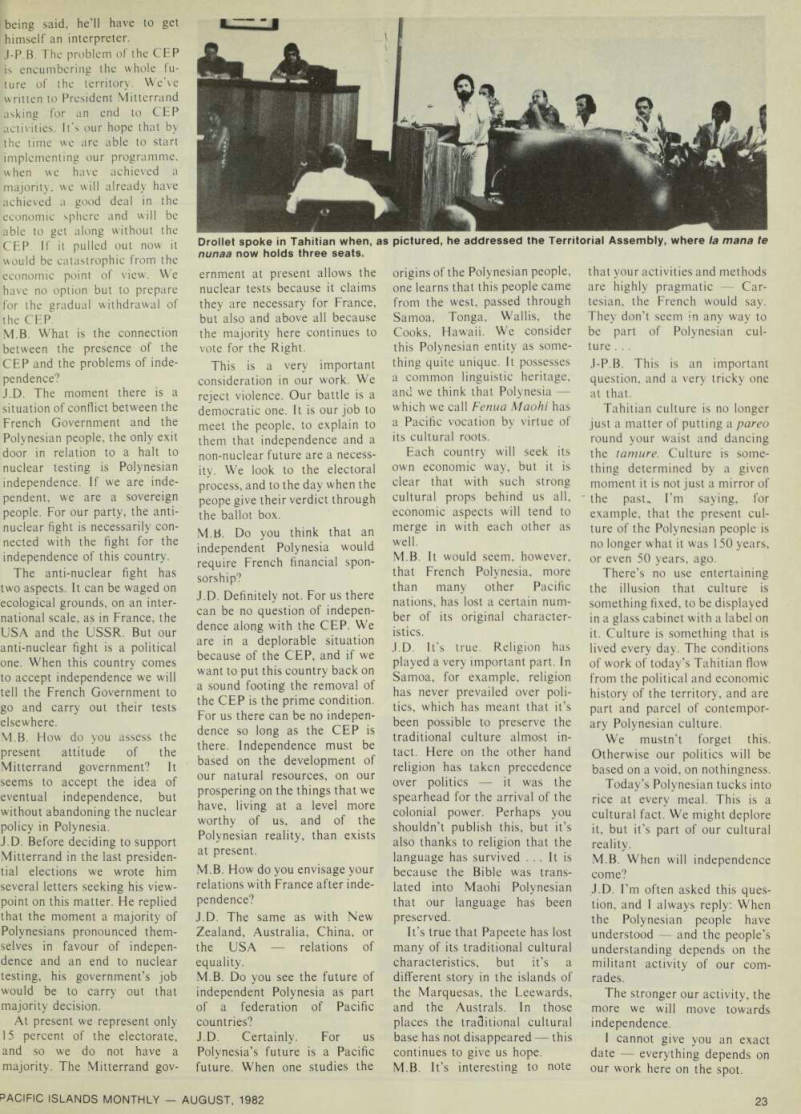
Now we have members elected to the Territorial As sembly I can assure you they will be speaking in Tahitian on all issues, and others will have to get used to that: if the High Commissioner finds he’s not understanding a word of what is
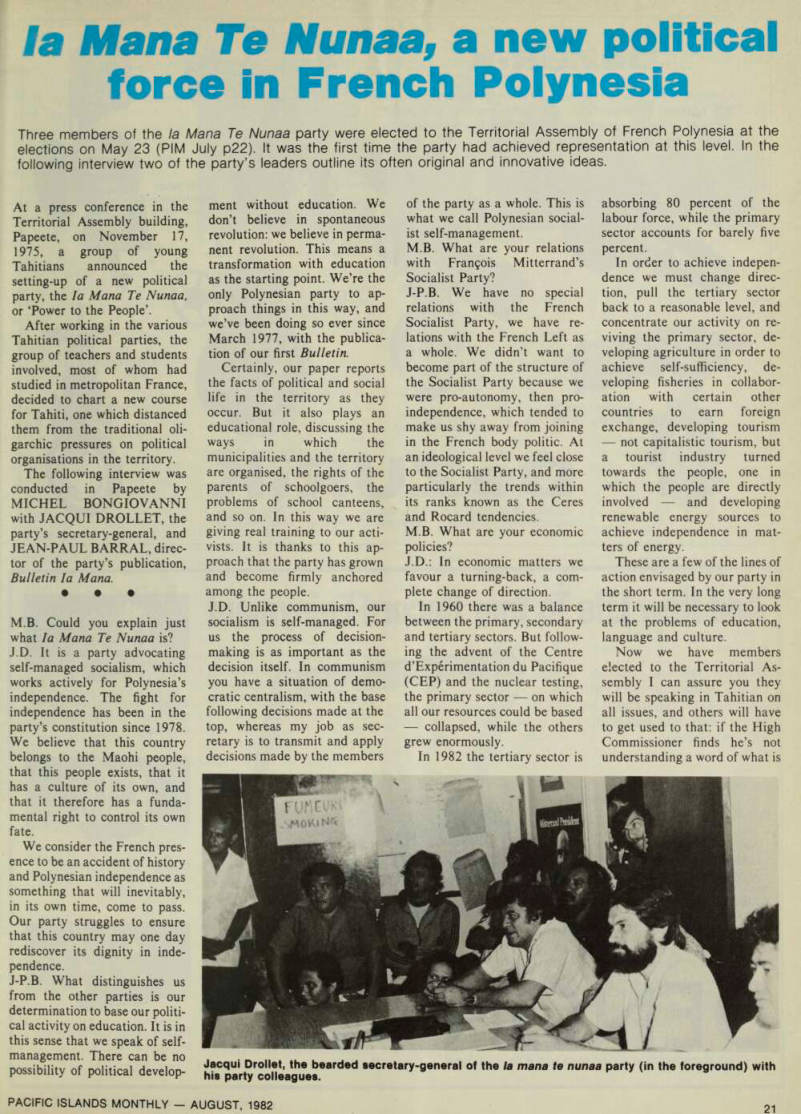
Jacqui Drollet, the bearded secretary-general of the la mana te nunaa party (in the foreground) with his party colleagues.
being said, he’ll have to get himself an interpreter.
J-P.B. The problem of the CEP is encumbering the whole fu ture of the territory. We've written to President Mitterrand asking for an end to CEP activities. It's our hope that by the time we are able to start implementing our programme, when we have achieved a majority, we will already have achieved a good deal in the economic sphere and will be able to get along without the CEP. If it pulled out now it would be catastrophic from the economic point of view. We have no option but to prepare for the gradual withdrawal of the CEP.
M.B. What is the connection between the presence of the CEP and the problems of inde pendence?
J.D. The moment there is a situation of conflict between the French Government and the Polynesian people, the only exit door in relation to a halt to nuclear testing is Polynesian independence. If we are inde pendent, we are a sovereign people. For our party, the anti nuclear fight is necessarily con nected with the fight for the independence of this country.
The anti-nuclear fight has two aspects. It can be waged on ecological grounds, on an inter national scale, as in France, the USA and the USSR. But our anti-nuclear fight is a political one. When this country comes to accept independence we will tell the French Government to go and carry out their tests elsewhere.
M.B. How do you assess the present attitude of the Mitterrand government? It seems to accept the idea of eventual independence, but without abandoning the nuclear policy in Polynesia.
J.D. Before deciding to support Mitterrand in the last presiden tial elections we wrote him several letters seeking his view point on this matter. He replied that the moment a majority of Polynesians pronounced them selves in favour of indepen dence and an end to nuclear testing, his government’s job would be to carry out that majority decision.
At present we represent only 15 percent of the electorate, and so we do not have a majority. The Mitterrand gov-
ernment at present allows the nuclear tests because it claims they are necessary for France, but also and above all because the majority here continues to vote for the Right.
This is a very important consideration in our work. We reject violence. Our battle is a democratic one. It is our job to meet the people, to explain to them that independence and a non-nuclear future are a necess ity. We look to the electoral process, and to the day when the peope give their verdict through the ballot box.
M.B. Do you think that an independent Polynesia would require French financial spon sorship?
J.D. Definitely not. For us there can be no question of indepen dence along with the CEP. We are in a deplorable situation because of the CEP, and if we want to put this country back on a sound fooling the removal of the CEP is the prime condition.
For us there can be no indepen dence so long as the CEP is there. Independence must be based on the development of our natural resources, on our prospering on the things that we have, living at a level more worthy of us, and of the Polynesian reality, than exists at present.
M.B. How do you envisage your relations with France after inde pendence?
J.D. The same as with New Zealand, Australia, China, or the USA relations of
equality.
M.B. Do you see the future of independent Polynesia as part of a federation of Pacific countries?
J.D. Certainly. For us Polynesia’s future is a Pacific future. When one studies the
origins of the Polynesian people, one learns that this people came from the west, passed through Samoa, Tonga, Wallis, the Cooks, Hawaii. We consider this Polynesian entity as some thing quite unique. It possesses a common linguistic heritage, and we think that Polynesia which we call Fenua Maohi has a Pacific vocation by virtue of its cultural roots.
Each country will seek its own economic way, but it is clear that with such strong cultural props behind us all, economic aspects will tend to merge in with each other as well.
M.B. It would seem, however, that French Polynesia, more than many other Pacific nations, has lost a certain num ber of its original character istics.
J.D. It's true. Religion has played a very important part. In Samoa, for example, religion has never prevailed over poli tics, which has meant that it’s been possible to preserve the traditional culture almost in tact. Here on the other hand religion has taken precedence over politics it was the spearhead for the arrival of the colonial power. Perhaps you shouldn’t publish this, but it’s also thanks to religion that the language has survived ... It is because the Bible was trans lated into Maohi Polynesian that our language has been preserved.
It’s true that Papeete has lost many of its traditional cultural characteristics, but it’s a different story in the islands of the Marquesas, the Leewards, and the Australs. In those places the traditional cultural base has not disappeared this continues to give us hope.
M.B. It’s interesting to note
that your activities and methods are highly pragmatic - Car tesian, the French would say.
They don’t seem in any way to be part of Polynesian cul ture . . .
J-P.B. This is an important question, and a very tricky one at that.
Tahitian culture is no longer just a matter of putting a pareo round your waist and dancing the tamure. Culture is some thing determined by a given moment it is not just a mirror of " the past. I'm saying, for example, that the present cul ture of the Polynesian people is no longer what it was 150 years, or even 50 years, ago.
There’s no use entertaining the illusion that culture is something fixed, to be displayed in a glass cabinet with a label on it. Culture is something that is lived every day. The conditions of work of today’s Tahitian flow from the political and economic history of the territory, and are part and parcel of contempor ary Polynesian culture.
We mustn’t forget this.
Otherwise our politics will be based on a void, on nothingness.
Today’s Polynesian tucks into rice at every meal. This is a cultural fact. We might deplore it, but it’s part of our cultural reality.
M.B. When will independence come?
J.D. I’m often asked this ques tion, and I always reply: When the Polynesian people have understood and the people’s understanding depends on the militant activity of our com rades.
The stronger our activity, the more we will move towards independence. 1 cannot give you an exact date everything depends on our work here on the spot.
Drollet spoke in Tahitian when, as pictured, he addressed the Territorial Assembly, where la mana te nunaa now holds three seats.