The strange , wonderful
pp. 65-68 · Read in the full issue
Yachts
The strange , wonderful world of the Salty Hams
PIM yachting correspondent JANE DeRIDDER, yacht Magic Dragon, is both yachtswoman and amateur radio operator. She holds the amateur radio call sign VEOMCG (Canadian high seas), VE7CCW (Canada), and ZLIBVU/ mm (New Zealand maritime mobile). In the article below she describes . . .
‘This is the Pacific Maritime Mobile Net. Will all stations stand by for any possible emerg ency or medical traffic. Emerg ency or medical traffic only . . .
Go now .. .’
This listening watch is kept daily on many yachts and in countless shore stations throughout the Pacific as fellow hams are linked together by the crisscrossing of RF waves bouncing off the reflective layers of the earth’s ionosphere.
There are increasing num bers of such SOLAS nets oper ated by amateur radio operators and dedicated to Safety Of Life At Sea. Widely spaced base stations stand by faithfully to pick up and relay signals from yachts and ships wishing to check in with daily position reports. Net Controls with the help of their shore relays accept and record check-ins, supplying weather forecasts, medical ad vice, mechanical, and other technical expertise, as re quested, shepherding their flock of ships safely into port, while a throng of silent listeners are at their mikes ready to help out if necessary. This unique and invaluable service is deeply appreciated by those of us who stand to benefit from the dedi cated vigilance of net members. ‘Hams’ are licensed amateur radio operators running exper imental radio stations from their homes. They constitute a global fraternity which has grown up with radio itself.
Often designing and building their own equipment, they have been instrumental in furthering the state of the art. Noted for public service during such dis asters as earthquakes, floods and forest fires, typhoons and tornadoes, they are sometimes able to supply communication when all other means fail.
Their ‘ham shacks’ may house tiers of electronic equip ment representing thousands of dollars. Linear amplifiers and
rotating beam antennas put them in touch with any part of the world, depending upon fre quency, season, sunspot ac tivity, ionospheric idiosyncracy, time of day or night. Or, the amateur radio station may be a single transceiver in a corner of a living room, in a car, in a plane, or aboard a yacht. For today’s compact single sideband transceivers are a far cry from the spark-gap trans mitters of the turn of the century or the bulky power hungry rigs of the more im mediate past.
An astonishing multitude of cruising yachts now carry five band single sideband trans ceivers operating over many thousands of miles on the 10, 15 and 20 metre portions of the amateur radio bands, and on 40 and 80 metres for shorter-range contacts. The radios they carry may be hybrid rigs in which all stages but the final are transistorised, and where plug in printed circuit boards make servicing a simple matter. But miniature all solid-state SSB rigs are becoming increasingly popular for shipboard use for they weigh a mere three kilograms or so and draw only about 340 milliamps in receive mode.
Maritime Mobiles or Mickey Mice as they are known can be heard on the ham bands arranging a rendez-vous, exchanging information on approaches and anchorages, or ganising the forwarding of mail, or engaging in a companionable rag-chewing ‘QSO’.
There is nothing like a chat with folks back home to re assure them of your safety at sea, via ‘phone patches’ in countries where third-party traffic is permitted. Co operative land stations ‘patch’ the voyager into their telephone systems, the understanding be ing that no business or commer
cial messages may be passed.
A licence is required to operate an amateur radio station. International agree ments require amateurs to be familiar with radio operation, regulations and theory, and to be able to communicate in Morse code. This latter ability can be important in emerg encies when voice may be unintelligible because of poor propagation, low batteries, or an overcrowded band. Meteoro logical info transmitted in ‘cw’ can be used to construct weather charts. One chap we know tapes the broadcasts to copy at a slower speed.
It is essential to get a ham licence before setting out on a cruise for it is very difficult or even impossible to obtain one once out of home waters. Some foreign nations will issue tem porary licences for use within their own territorial waters application to be made at the communications office on ar rival. Otherwise use of the ham rig can be limited to emerg encies only, at which time amateur radio operators may help a stricken vessel without fear of unlawfully working an unlicensed station.
For those of us without a technical background, getting a licence may be a challenge.
Radio clubs offer classes for beginners which some people find helpful. I used tapes to gain Morse mastery, finding several short practice sessions a day more effective than a single lengthy period of study. To bone up on basic electrical and radio principles and operating procedures, there are various study guides and radio publica tions available. Government de partment of communications bulletins provide knowledge of the regulations pertaining to amateur radio operation.
One of the most avid sea going hams we know seldom leaves his boat, shunning the ‘eyeball QSO’. A prisoner to his schedules, he lives for his radio contacts, a floating troglodyte, happy to pass his time resonat ing his antenna, giving out signal reports, comparing rigs, or just ‘reading the mail’.
Other blue-water cruisers prefer to do without ham radio. ‘Why encumber myself with skeds?’ ‘We chose this way of life in order to get away from ringing telephones and knocks
on the door.' ‘We don't want to clutter our yachts with multiband dipoles or quarter wave whips.’ ‘As a safety measure, forget it! We can’t expect anyone else to come to our aid. We are on our own.’ So go the objections.
However, most of us value contacts with friendly voices thousands of miles away, just as armchair operators enjoy vicari ous adventuring with sailors on
small ships.
Jane Deridder Re
ports from Kerikeri,
New Zealand:
• WINDSTAR. A Sparkman and Stephens 42, Windstar of Lahaina, Hawaii ventures further off the beaten track than most cruising yachts. Wally Sanger has visited Penrhyn, Rakahanga, Manihiki, the Danger Islands, Swains Island (where his was the first yacht to call in two years), Wallis and Rotuma Islands and Nauru. Windstar was nine months in Solomon Islands, and spent the 1980-81 hurricane season in Tuvalu. T can’t speak highly enough of the people here, particularly in Nanumea.’ With Merran Randall of Sydney who joined Windstar in Port-Vila, Wally managed to anchor for two nights in a roily anchorage off Norfolk Island. Here amateur radio oper ator John Anderson and his wife Florence showed the young couple around. John is well known to South Pacific yachtsmen for his detailed daily weather reports and forecasts to yachts making ocean passages.
Wally and Merran will head from New Zealand to Hong Kong via Fiji, Samoa, Papua New Guinea and the Philippines. • SHAMMY. When Bill Shamhart, general surgeon from Rosedale, California, himself underwent hand surgery, he retired early (‘Not early enough’) to cruise on his George Moore-designed, San Francisco-registered 15m ketch Shammy. Though the vessel was designed for a crew of eight, Dr Shamhart and his wife Carol usually sail the yacht themselves with the help of a British Hydro vane steering gear, a Benmar auto pilot and a 130 hp Cummins diesel.
They are joined from time to tinje by a son. When Carol returns to
New Zealand from a flying visit to family in California, she will find modifications to Shammy, includ ing a queen-sized bunk and a shower. The Shamharts hope to return to Noumea, the Loyalties and Vanuatu, then to visit Solomon Islands. • ANTARESII. A Euros 41, one of 300 or so of a series of 13m cruising yachts built by the French firm Amel, Antares II has carried Jean- Claude and Gertrude Stark and family from their home in La Rochelle to the Pacific via Madeira, the Canary Islands, Dakar, the Antilles and Venezuela. Seventeen
year-old Philippe stayed behind in
Tahiti to attend school and surf-sail.
Now it is 14-year-old Frederic’s turn to exchange lessons on board for formal schooling. The family is heading next from New Zealand back to Tahiti. Retired mechanical engineer Jean-Claude says that he is incredibly lucky in that his wife adores the sea and can produce a boeuf bourguignon in winds of Force 8 or 9, at which time, ‘Curiously it seems that the sea is calm’. • RAIREVA: Peter and Sandy Oehmen, who roamed the Pacific for years on their Ingrid ketch Freyja are in Taipei overseeing the construction of their new 13.7 m cutter. A modified Peterson 44 (13.5 X 3.9 X 1.98), but custom built to their specifications, she’ll be named Raireva which means ‘a restless soul who sails like a cloud on the trade winds from island to island .. .’ • BREEZE. New Zealander Ralph Sewell and his family, built the
brigantine Breeze in the traditional manner using adze, drawknife, slick, jack plane, caulking iron and mallet, crosscut saw and auger.
With three yards on the mainmast she is a copy of an early New Zealand coaster, built so that young people will be able to have an opportunity to know what a 19th century sailing ship looks like and feels like to sail and to maintain.
Planked with Coromandel kauri, fastened with copper nails and roves, caulked with oakum and cotton, she has pohutukawa knees, a coal range, a lead line and a traditional hand windlass. Shore boats are sail and oar-powered. The Sewells’ aim is to perpetuate almost forgotten arts, and to revive sea manship and self-reliance on water.
People interested in sailing in Breeze should write to Secretary, Small Ships Society, 153 Ocean View Road, Oneroha, Waiheke Island, Auckland.
TAM-TAM reports
from Port-Vila:
• JELLICLE. Two yachtsmen re turned to Vila on May 9 after a four-month ‘walkabout’ in Sydney, Australia.
Karie Kalo, aged 18, of Lumbukuti, Tongoa, and retired British Royal Navy Commander Mike Bailes spent just over a month at sea travelling to and from Australia on Mike’s 8m yacht Jellicle, powered solely by wind.
Karie and Mike left Vila on November 18 last year for Austra lia.
Karie has gained sailing experi
ence with Mike around Efate Island for the last two years and is commended by Mike as being ‘a good sailor and a good navigator’.
Karie told Tam-Tam that about 500 kilometres from Australia on their way back to Vanuatu, while they were drinking tea, their yacht accidentally ran into a whale, but luckily there was no damage done.
Mike and Karie worked a three hour shift on navigating their yacht
during their 20-day trip from Syd
ney to Vila.
Karie said he enjoyed the trip even though at times they ran into very rough weather.
Mike is now back with the Marine Training School and Karie has joined the Fisheries Depart ment.
Reporting on the result of the fourth Tauranga (New Zealand) Port-Vila yacht race in May, Tam- Tam said: The coveted trophy for the over all winner of the Fourth Tauranga- Vila Ocean Yacht Race was snatched by the Fidelis.
Skipper P.A. Williams said he owed the Fidelis’ success to his 10-man crew and added, ‘They are wonderful and I love them all.’
They had had exceptionally favourable weather on the way, and ‘on a good day’ they would cover more than 350 kilometres,’ he said.
The skipper said his yacht arrived at the entrance of Vila Harbour several hours ahead of the record time currently held by Nero, except that they ‘wasted’ four precious hours trying to locate the Pango Lighthouse which ‘should have been on’ to guide them in. ‘We would have broken the record had it not been for the absence of the light,’ a regretful P.A. Williams said. A Ports and Marine official admitted the light’s absence and explained that there was a minor fault with the gas lamp and that it was repaired the next morning.
The skipper said the Fidelis was the oldest yacht in the whole fleet and yet the fastest. It had partici pated in other international races including the Sydney-Hobart.
P.A. Williams said he would like to see the Port-Vila Yacht Club expand its activities and member ship, involving all interested groups including particularly, ni-Vanuatu, and acquire more equipment.
In this year’s race, the Rhiannon
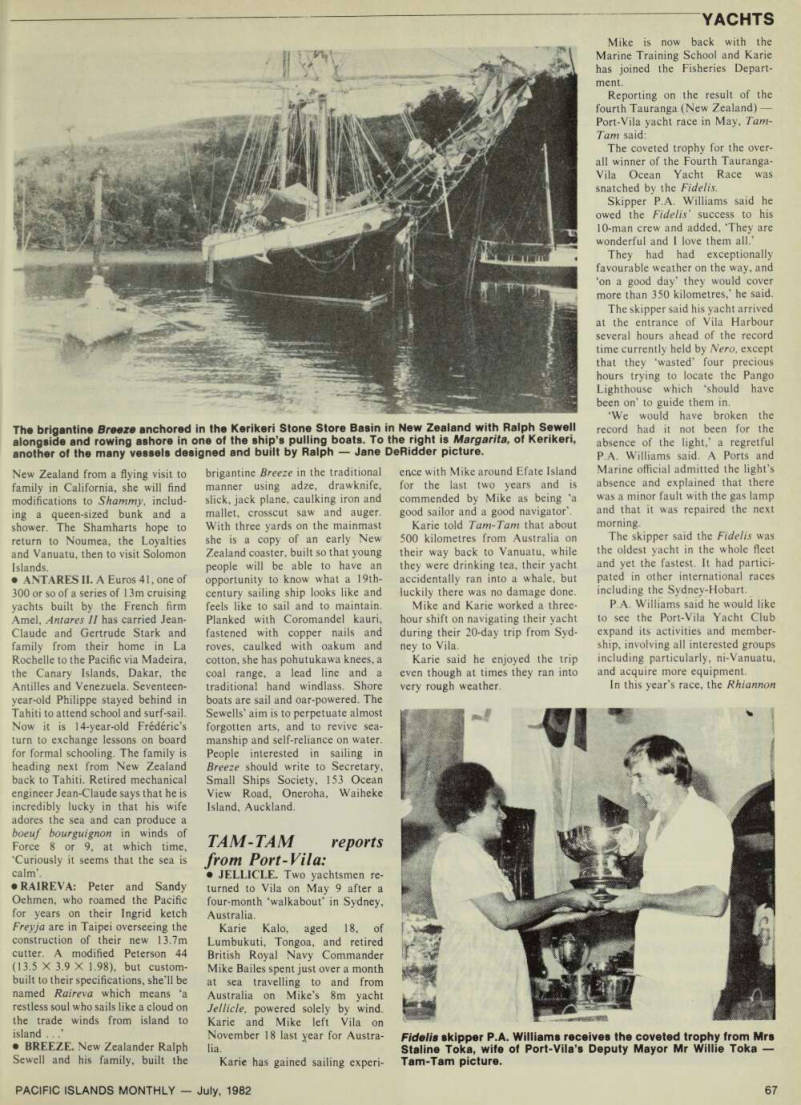
The brigantine Breeze anchored in the Kerikeri Stone Store Basin in New Zealand with Ralph Sewell alongside and rowing ashore in one of the ship’s pulling boats. To the right is Margarita, of Kerikeri, another of the many vessels designed and built by Ralph Jane DeRidder picture.
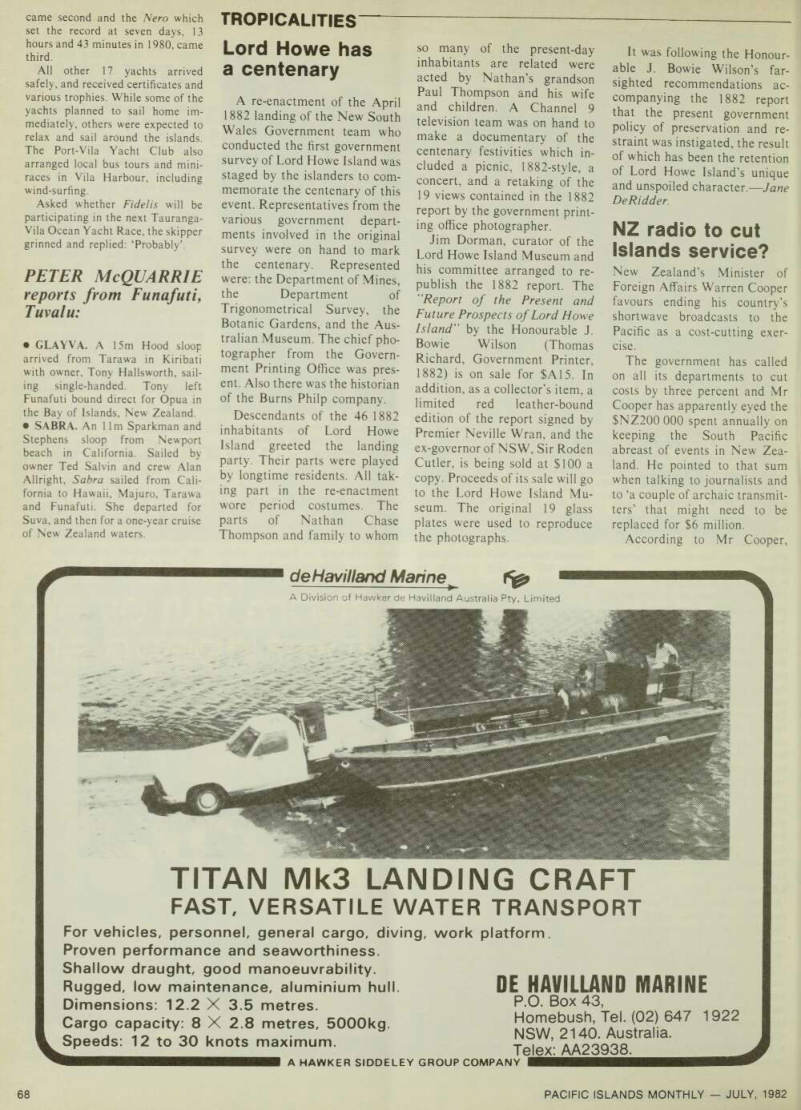
Fidelia skipper P.A. Williams receives the coveted trophy from Mrs Staline Toka, wife of Port-Vila’s Deputy Mayor Mr Willie Toka Tam-Tam picture.
came second and the Nero which set the record at seven days, 13 hours and 43 minutes in 1980, came third.
All other 17 yachts arrived safely, and received certificates and various trophies. While some of the yachts planned to sail home im mediately, others were expected to relax and sail around the islands.
The Port-Vila Yacht Club also arranged local bus tours and mini races in Vila Harbour, including
wind-surfing.
Asked whether Fidelis will be participating in the next Tauranga- Vila Ocean Yacht Race, the skipper grinned and replied: ‘Probably’.
Peter Mcquarrie
reports from Funafuti ,
Tuvalu:
• GLAYVA. A 15m Hood sloop arrived from Tarawa in Kiribati with owner, Tony Hallsworth, sail
ing single-handed. Tony left
Funafuti bound direct for Opua in the Bay of Islands, New Zealand. • SABRA. An 11m Sparkman and Stephens sloop from Newport beach in California. Sailed by owner Ted Salvin and crew Alan Allright, Sabra sailed from Cali fornia to Hawaii, Majuro, Tarawa and Funafuti. She departed for Suva, and then for a one-year cruise of New Zealand waters.