Vaai vs. Tupuola:
pp. 18-20 · Read in the full issue

Political
Currents
Vaai vs. Tupuola: Dramatic tale of a one-vote win
FELISE VA’A, writing from Apia, tells the story of the tense tussle between former Prime Minister Tupuola Efi and challenger Vaai Kolone which ended in a one-vote win for the latter, who thus became the country’s new PM. He also reports on the crucial April ruling by the country’s chief justice that no further parliamentary elections can be held under the electoral act as it now stands.
What a tremendous fight it was!
Former Prime Minister Tupuola Efi came from behind to almost snatch victory from the jaws of the Human Rights Protection Party.
The Human Rights party won the crucial battle for the post of prime minister when its leader, Vaai Kolone, was elected. But it was a Pyrrhic victory. For Vaai was elected with a majority of one vote ironically, the same margin by which Tupuola Efi beat him for the same job in 1979.
The election of the prime minister, speaker and deputy speaker on April 13 was the climax of 45 days of waiting, the longest waiting period ever between general elections and the election of a prime minister in the history of Western Samoa. It was also the maxi mum period of waiting allowed under the constitution.
It was generally understood that Tupuola’s party did not have the majority it needed to gain power. The waiting period was to enable its campaigners to woo Human Rights supporters.
In this they did an excellent job.
On election night, for in stance, the Human Rights party looked to be in a good position to secure more than an ad equate majority to form the new government. Eleven of its old members had been re-elected.
Eleven of the new members had, in the run-up to the elections, given their support to the party: their names were listed in advertisements pub lished in The Observer and The Samoa Times as supporters of the Human Rights party. This meant that after the general elections, the Human Rights party officially had 22 mem bers, two short of the majority needed to form a government in
the 47-member Legislative As sembly.
For Tupuola’s party, 11 old members of the House were re elected. Since it did not publish the names of its candidates, it was officially credited with only 11 members. This left 13 mem bers whose allegiance was un known, and one seat undecided because the election resulted in a tied vote.
It was obvious, therefore, that the issue would be decided by the remaining 14 members who had pledged allegiance to neither party. But it was not expected that the Human Rights people would have much difficulty finding the extra two votes. In fact, it was conservatively estimated that they would win with a majority of at least three votes.
This, however, was not to be.
Several Human Rights mem bers switched sides and ‘floaters’ all went over to
Tupuola. Thanks to a solid 24 hardcore members, however, the Human Rights party just managed to make it.
The outcome of the election of the prime minister was pretty clear when, on April 13, the new assembly elected a member of the Human Rights party, Nonumalo L. Sofara, as speaker. He won by one vote, defeating Dr Asi Faamatala, the nominee of Tupuola’s party.
The Human Rights candidate for deputy speaker, Atiifale Fiso, was elected unopposed.
The post of prime minister was contested, as expected, and Human Rights leader, Vaai Kolone, squeezed through by one vote. The 24 members of the Human Rights demon strated their loyalty when not one of them switched his vote to the other side. On Tupuola’s side, the floaters stuck with him, an indication that once their decision was made, they kept to it.
This, then, is the strength of the new parties: Human Rights 24, Tupuola’s party, which does not yet have a name, 23. Critics contend that the composition of the new House means the new government will not be able to govern effectively because of its small majority. But this is not necessarily so. Over the past three years, Tupuola’s govern ment has managed to function quite effectively with the same paper-thin majority. It man aged to introduce some very
important legislative measures.
Not only that, a government in power has a lot of means at its disposal to induce members of the opposition to switch. Thus, in his last term, Tupuola was able effectively to neutralise two members of the Human Rights party, Leota I. Ale and Sala Suivai, who were given influential jobs with the admin istration. Leota accepted a post as permanent representative to the South Pacific Commission, and Sala became Western Samoan representative in American Samoa.
But other, quite serious, prob lems confront the new govern ment. Tupuola’s party has filed 13 election petitions against it while it, in turn, has filed nine petitions against Tupuola’s party. Most allege treating and bribery. Among those facing such a petition is the new prime minister himself.
The hearing of the petitions, however, will take some time.
The most interesting thing about them will be the way they are dealt with by Chief Justice R. J. B. St John, who ruled just before the election of the prime
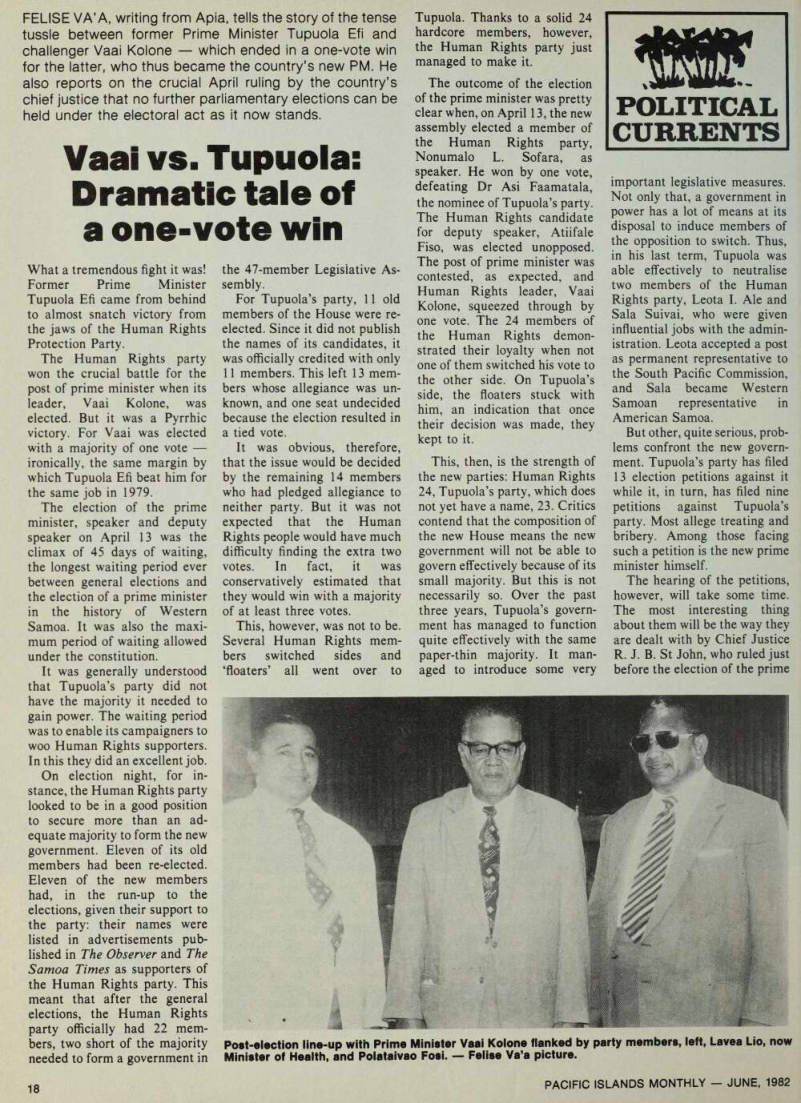
Post-election line-up with Prime Minister Vaai Kolone flanked by party members, left, Lavea Lio, now Minister of Health, and Polataivao Fosi. Felise Va’a picture.
minister that there can be no further parliamentary elections in Western Samoa because the present electoral law is dis criminatory and unconsti tutional. The judge said: ‘The effect of this judgment is that, unless reversed on appeal, or the constitution appropriately amended in the meantime, the next election of a member or members of parliament in this country cannot take place on the basis of the Act as it now stands.’
The judge’s finding is based on the fact that only the matai, or chiefs, and those on the Individual Voters Roll, can vote in Western Samoa a total of about 16 000 voters in a popu lation of 160 000. The judge said that nothing short of uni versal suffrage would satisfy the requirements of the consti tution.
In his post-election speech to the legislative assembly, Vaai said his new government will be based on Christian, democratic principles. He said MPs should consider themselves ‘the ser vants and not the masters’ of the people, and exhorted the new speaker and deputy speaker to be impartial in the adminis tration of their duties.
Vaai knows the country is watching him, and he is out to do a good job.