Balanced strength as parties
pp. 11-14 · Read in the full issue
prepare for Fiji elections
Never more balanced, never more confusing. This was the situation in Fiji in May as the country prepared for its fourth general election since attaining independence in 1970. The election will be held in July, and the background is described here by ROBERT KEITH-REID writing from Suva.
Racial issues continue to be a major factor in the politics of Fiji as the country prepares for its July general election. Two well-established parties, two smaller ones and some hopeful independants provide the main force of the campaigning. In a country in which half the popu lation of 650 000 is of Indian extraction, 46 percent indigen ous Fijian and the remainder made up of small numbers of Europeans, Chinese, mixed race people and others, racial awareness is fundamental to politics. The possible develop ment of Indian dominance in Fiji politics is viewed with some alarm by the other communi ties. It hasn’t happened yet, but it nearly happened in April, 1977, and it could happen in July.
Until 1977 few Indians them selves realised the extent of the political potential which the Indian community held. Then in April of that year the Indian dominated National Federation Party (NFP) won the general election by collecting half of the 52 seats in the House of Rep resentatives. But with power in its grasp, the party faltered. Its leadership was split, its strength was sapped by factional fighting and it lost its nerve in the atmosphere of community up set which followed the election result.
The Governor-General, Ratu Sir George Cakobau, waited while the NFP leaders bickered and fought. Then he stepped in and used constitutional powers to reappoint the Alliance Party leader, Ratu Sir Kamisese Mara, as prime minister. Ironi cally he was partly influenced in his intervention by information which came secretly from NFP members who opposed the then leader of the NFP, Siddiq Koya.
Ratu Mara’s Alliance Party remained in power as a minority
government for six months, after which a new election gave the party a clear majority to govern. The new majority was 36 seats in the 52-seat house.
What caused the temporary eclipse of the Alliance Party in 1977, and could the coming election produce a parallel situ ation? The ingredient which most affected the 1977 result was the erosive influence of a minority third party, the Fijian Nationalist Party. The Nationalists campaigned on a blatantly racial platform of Fiji for the ethnic Fijians, and they split the voting pattern. They won only one seat for them selves but they created a situ ation which allowed the National Federation to win seats which would otherwise have gone to the Alliance Party.
The coming elections could well produce a similar vote-splitting situation, although this time there will be two minority parties to complicate the issue.
The Fijian Nationalist Party is one of the two minority groups, and it is campaigning strongly on ethnic grounds. It again calls for Fiji for the Fijians, it wants 46 of the 52 House of Assembly seats re served for ethnic Fijians and it
wants all Crown and freehold land to be in ethnic Fijian hands.
The new minority group is the Western United Front (WUF), another grouping of ethnic Fijians. It was formed in July last year, largely through the efforts of Ratu Osea Gavidi an appealing, talented and politically astute chief from Nadroga in southwest Viti Levu. He had a falling out with the Alliance Party in govern ment about how the big Fiji pine forest scheme should be developed. The pine forests for the scheme were planted on large tracts of land owned communally by Fijians who accepted Gavidi as their leader.
Gavidi has always had a strong following, and in the 1977 election he stood as an independant and won a seat from the Alliance. His more recent falling out with the Alliance over the pine scheme has led him into a deal with the National Federation with the avowed aim of toppling the Alliance from government.
Another member of parlia ment who became an early WUF supporter is Isikeli Nadalo, formerly a member of the National Federation. And in
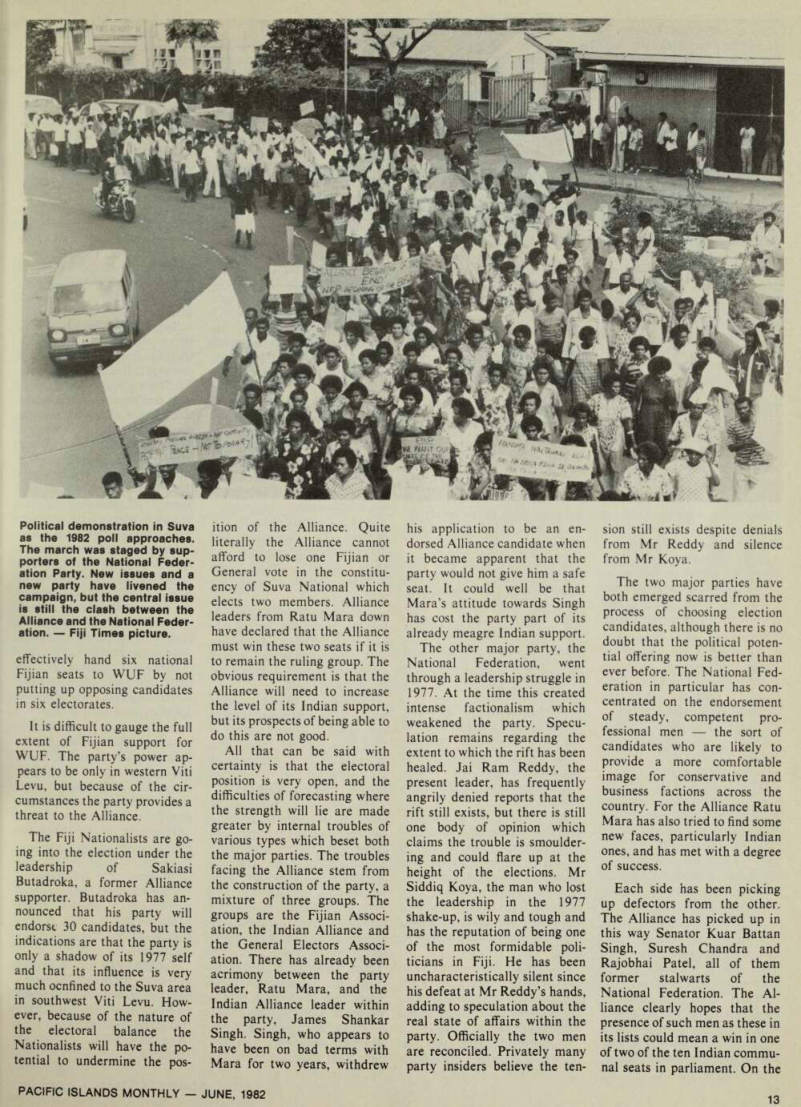
March WUF received yet another supporter when the Tui Nadi, Ratu Napolioni Dawai, defected spectacularly from the Alliance. He is a wealthy independent-minded chief from the Nadi area of western Viti Levu, and earlier he had an nounced that he would not be seeking re-election because he intended to concentrate on his business interests. Then he unexpectedly swung his al legiance to WUF and now intends to stand for re-election with WUF backing.
Although WUF is essentially a Fijian party it does not follow the hard-line racial policy adopted by the Fijian National ist Party. It describes its out look as multi-racial and says it believes in co-existence and co operation between all communi ties in Fiji.
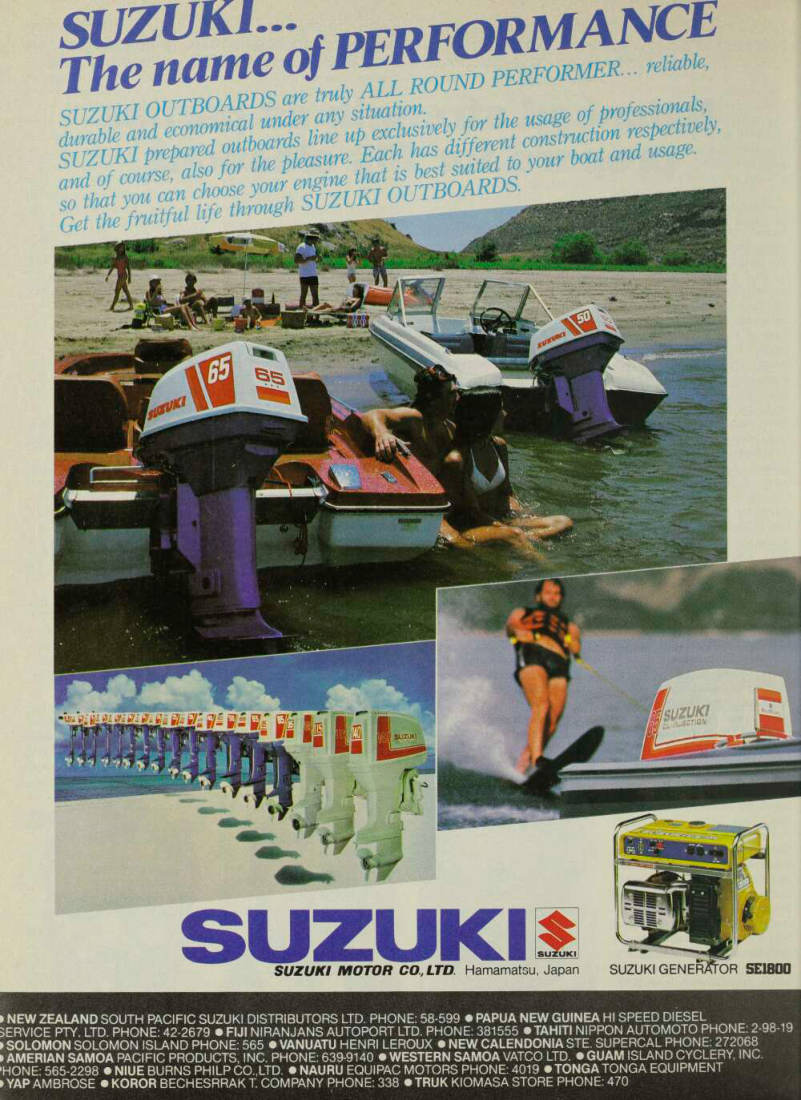
The coalition deal which has been negotiated between WUF and the National Federation will undoubtedly water down the all-Indian look of the Feder ation, and has been acclaimed by the Federation leader, Jai Ram Reddy, as the first truly multi-racial grouping capable of responding to the wishes of all communities. As part of the deal the Federation will
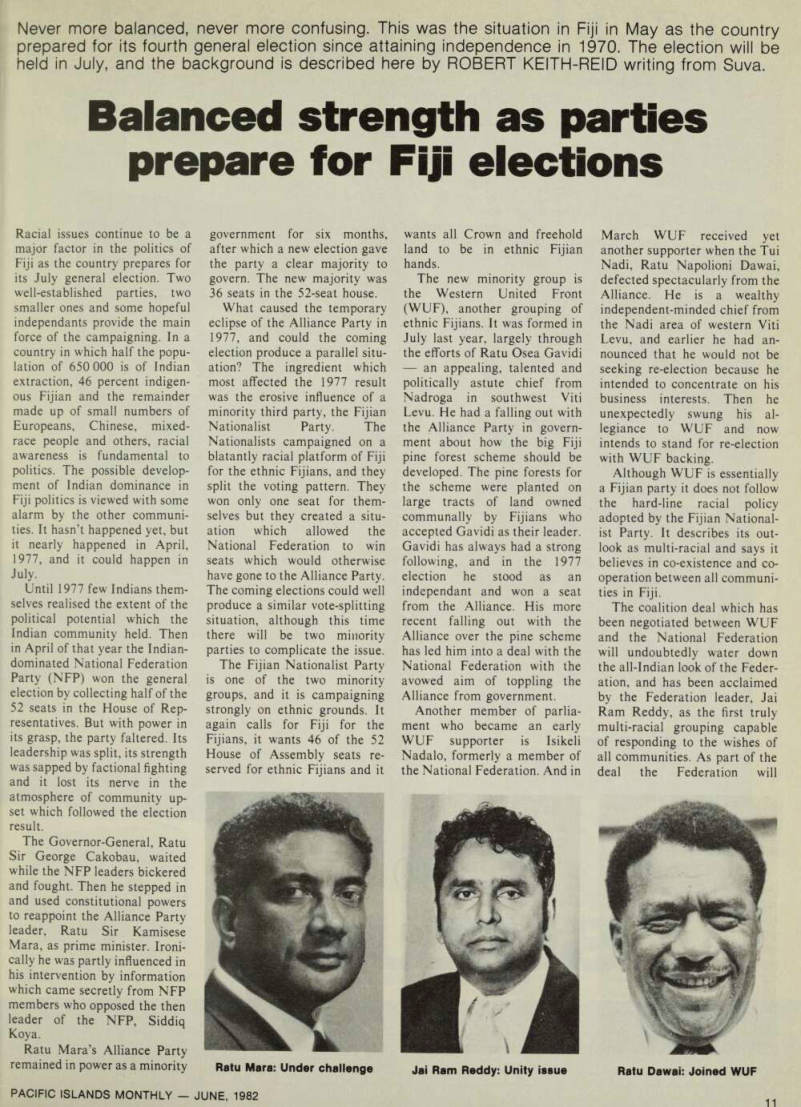
Ratu Mara: Under challenge
Jai Ram Reddy: Unity issue
Ratu Dawai: Joined WUF
ition of the Alliance. Quite literally the Alliance cannot r afford t 0 lose one Fl J lan or General vote in the constitu ency of Suva National which elects two members. Alliance , . e D . u , leaders from Ratu Mara down have declared that the Alliance must win these two seats if it is to remain the ruling group. The obvious requirement is that the Alliance will need to increase the level of its Indian support, but '* s P ros P eets of bein 8 ab,e t 0 do this are not good. . tbat can b ® sald wltb certainty is that the electoral P°i ltlo , n 15 v °P en ' and the dlfficulties of forecasting where the strength will lie are made greater by internal troubles of various types which beset both the major parties. The troubles facing the Alliance stem from the construction of the party, a mixture of three groups. The groups are the Fijian Associ ation, the Indian Alliance and the General Electors Associ ation. There has already been acrimony between the party leader, Ratu Mara, and the Indian Alliance leader within the party, James Shankar Singh. Singh, who appears to have been on bad terms with Mara for two years, withdrew
his application to be an endorsed Alliance candidate when it became apparent that the party would not give him a safe seat. It could well be that Mara’s attitude towards Singh has cost the party part of its already meagre Indian support.
The other major party, the National Federation, went through a leadership struggle in 1977. At the time this created intense factionalism which weakened the party. Speculation remains regarding the extent to which the rift has been healed. Jai Ram Reddy, the present leader, has frequently angrily denied reports that the rift still exists, but there is still one body of opinion which claims the trouble is smouldering and could flare up at the height of the elections, Mr Siddiq Koya, the man who lost the leadership in the 1977 shake-up, is wily and tough and has the reputation of being one of the most formidable politicians in Fiji. He has been uncharacteristically silent since his defeat at Mr Reddy’s hands, adding to speculation about the real state of affairs within the party. Officially the two men are reconciled. Privately many party insiders believe the ten-
sion still exists despite denials from Mr Reddy and silence from Mr Koya. , . T u he two ™J or P art ‘ es ha " e both emer f ed L scarred fr ° m tbe P ro “ as of choosing election = and,da * es ’ although there is no do “ b ‘ that the P ollt ‘ cal P t.al offering now is better than ever . e ore ' e atlona Fed ' eratlon « P a «'cular has con centrated on the endorsement . stead >' competent pro fess'°"al me " “ the ,. l so , rt of cand,dates who are likely to P rovlde f a more comfortable ‘ ma B e for r conservative and busmess factions across the F ° r the . A |lia "« Ratu Mara has also tried to find some new fac f' Particularly Indian °? es ’ and has met wlth a de B ree 0 success - Each side has been picking up defectors from the other, The Alliance has picked up in this way Senator Kuar Battan Singh, Suresh Chandra and Rajobhai Patel, all of them former stalwarts of the National Federation. The Al liance clearly hopes that the presence of such men as these in its lists could mean a win in one of two of the ten Indian commu nal seats in parliament. On the
effectively hand six national Fijian seats to WUF by not putting up opposing candidates in six electorates.
It is difficult to gauge the full extent of Fijian support for WUF. The party’s power ap pears to be only in western Viti Levu, but because of the cir cumstances the party provides a threat to the Alliance.
The Fiji Nationalists are go ing into the election under the leadership of Sakiasi Butadroka, a former Alliance supporter. Butadroka has an nounced that his party will endorst 30 candidates, but the indications are that the party is only a shadow of its 1977 self and that its influence is very much ocnfined to the Suva area in southwest Viti Levu. How ever, because of the nature of the electoral balance the Nationalists will have the po tential to undermine the pos
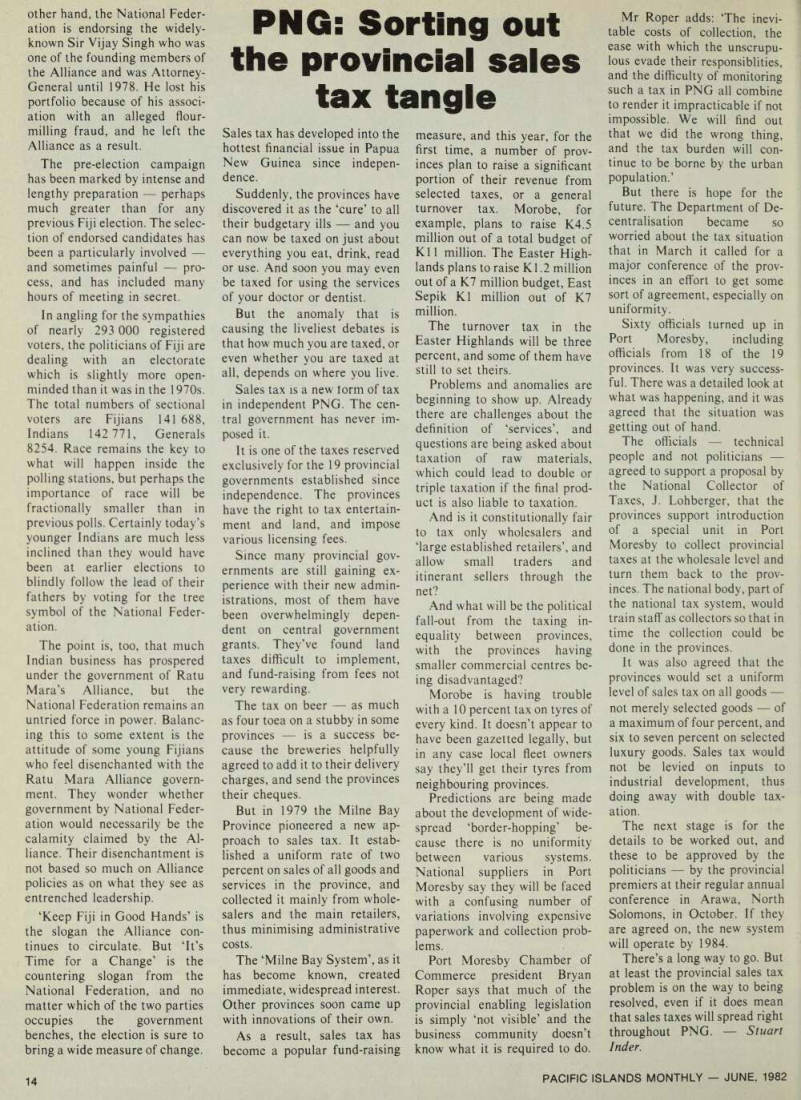
Political demonstration in Suva as the 1982 poll approaches.
The march was staged by sup porters of the National Feder ation Party. New issues and a new party have livened the campaign, but the central issue is still the clash between the Alliance and the National Feder ation. Fiji Times picture.
other hand, the National Feder ation is endorsing the widely known Sir Vijay Singh who was one of the founding members of the Alliance and was Attorney- General until 1978. He lost his portfolio because of his associ ation with an alleged flour milling fraud, and he left the Alliance as a result.
The pre-election campaign has been marked by intense and lengthy preparation perhaps much greater than for any previous Fiji election. The selec tion of endorsed candidates has been a particularly involved and sometimes painful pro cess, and has included many hours of meeting in secret.
In angling for the sympathies of nearly 293 000 registered voters, the politicians of Fiji are dealing with an electorate which is slightly more open minded than it was in the 19705.
The total numbers of sectional voters are Fijians 141 688, Indians 142 771, Generals 8254. Race remains the key to what will happen inside the polling stations, but perhaps the importance of race will be fractionally smaller than in previous polls. Certainly today’s younger Indians are much less inclined than they would have been at earlier elections to blindly follow the lead of their fathers by voting for the tree symbol of the National Feder ation.
The point is, too, that much Indian business has prospered under the government of Ratu Mara’s Alliance, but the National Federation remains an untried force in power. Balanc ing this to some extent is the attitude of some young Fijians who feel disenchanted with the Ratu Mara Alliance govern ment. They wonder whether government by National Feder ation would necessarily be the calamity claimed by the Al liance. Their disenchantment is not based so much on Alliance policies as on what they see as entrenched leadership. ‘Keep Fiji in Good Hands’ is the slogan the Alliance con tinues to circulate. But ‘lt’s Time for a Change’ is the countering slogan from the National Federation, and no matter which of the two parties occupies the government benches, the election is sure to bring a wide measure of change.
PNG: Sorting out the provincial sales tax tangle
Sales tax has developed into the hottest financial issue in Papua New Guinea since indepen dence.
Suddenly, the provinces have discovered it as the ‘cure’ to all their budgetary ills and you can now be taxed on just about everything you eat, drink, read or use. And soon you may even be taxed for using the services of your doctor or dentist.
But the anomaly that is causing the liveliest debates is that how much you are taxed, or even whether you are taxed at all, depends on where you live.
Sales tax is a new torm of tax in independent PNG. The cen tral government has never im posed it.
It is one of the taxes reserved exclusively for the 19 provincial governments established since independence. The provinces have the right to tax entertain ment and land, and impose various licensing fees.
Since many provincial gov ernments are still gaining ex perience with their new admin istrations, most of them have been overwhelmingly depen dent on central government grants. They’ve found land taxes difficult to implement, and fund-raising from fees not very rewarding.
The tax on beer as much as four toea on a stubby in some provinces is a success be cause the breweries helpfully agreed to add it to their delivery charges, and send the provinces their cheques.
But in 1979 the Milne Bay Province pioneered a new ap proach to sales tax. It estab lished a uniform rate of two percent on sales of all goods and services in the province, and collected it mainly from whole salers and the main retailers, thus minimising administrative costs.
The ‘Milne Bay System’, as it has become known, created immediate, widespread interest.
Other provinces soon came up with innovations of their own.
As a result, sales tax has become a popular fund-raising
measure, and this year, for the first time, a number of prov inces plan to raise a significant portion of their revenue from selected taxes, or a general turnover tax. Morobe, for example, plans to raise K 4.5 million out of a total budget of Kll million. The Easter High lands plans to raise K 1.2 million out of a K 7 million budget, East Sepik K 1 million out of K 7 million.
The turnover tax in the Easter Highlands will be three percent, and some of them have still to set theirs.
Problems and anomalies are beginning to show up. Already there are challenges about the definition of ‘services’, and questions are being asked about taxation of raw materials, which could lead to double or triple taxation if the final prod uct is also liable to taxation.
And is it constitutionally fair to tax only wholesalers and ‘large established retailers’, and allow small traders and itinerant sellers through the net?
And what will be the political fall-out from the taxing in equality between provinces, with the provinces having smaller commercial centres be ing disadvantaged?
Morobe is having trouble with a 10 percent tax on tyres of every kind. It doesn’t appear to have been gazetted legally, but in any case local fleet owners say they’ll get their tyres from neighbouring provinces.
Predictions are being made about the development of wide spread ‘border-hopping’ be cause there is no uniformity between various systems.
National suppliers in Port Moresby say they will be faced with a confusing number of variations involving expensive paperwork and collection prob lems.
Port Moresby Chamber of Commerce president Bryan Roper says that much of the provincial enabling legislation is simply ‘not visible’ and the business community doesn’t know what it is required to do.
Mr Roper adds; ‘The inevi table costs of collection, the ease with which the unscrupu lous evade their responsiblities, and the difficulty of monitoring such a tax in PNG all combine to render it impracticable if not impossible. We will find out that we did the wrong thing, and the tax burden will con tinue to be borne by the urban population.’
But there is hope for the future. The Department of De centralisation became so worried about the tax situation that in March it called for a major conference of the prov inces in an effort to get some sort of agreement, especially on
uniformity.
Sixty officials turned up in Port Moresby, including officials from 18 of the 19 provinces. It was very success ful. There was a detailed look at what was happening, and it was agreed that the situation was getting out of hand.
The officials technical people and not politicians agreed to support a proposal by the National Collector of Taxes, J. Lohberger, that the provinces support introduction of a special unit in Port Moresby to collect provincial taxes at the wholesale level and turn them back to the prov inces. The national body, part of the national tax system, would train staff as collectors so that in time the collection could be done in the provinces.
It was also agreed that the provinces would set a uniform level of sales tax on all goods not merely selected goods of a maximum of four percent, and six to seven percent on selected luxury goods. Sales tax would not be levied on inputs to industrial development, thus doing away with double tax ation.
The next stage is for the details to be worked out, and these to be approved by the politicians by the provincial premiers at their regular annual conference in Arawa, North Solomons, in October. If they are agreed on, the new system will operate by 1984.
There’s a long way to go. But at least the provincial sales tax problem is on the way to being resolved, even if it does mean that sales taxes will spread right
throughout PNG.
Stuart
Inder.