Tonga: Chaos and questioning in
pp. 13-15 · Read in the full issue
the wake of Cyclone Isaac
PIM correspondent in Nukualofa, PENNY HODGKINSON, describes the havoc wrought in Tonga by Cyclone Isaac and the problems and complexities of the task of putting things right.
Tropical cyclone Isaac slam med into Tonga on March 3.
Spawned north of Niue, he built up a wind force that peaked around 220 kilometres an hour on his wild south-westerly ram page.
He passed close enough to Vavau to rip into buildings, crops and anchored yachts with hurricane-force winds, devas tated the Haapai group which lay directly in his path, and came within 30 kilometres of Tongalapu at 1.45 pm, by which time barometric pressure was down to 976 millibars.
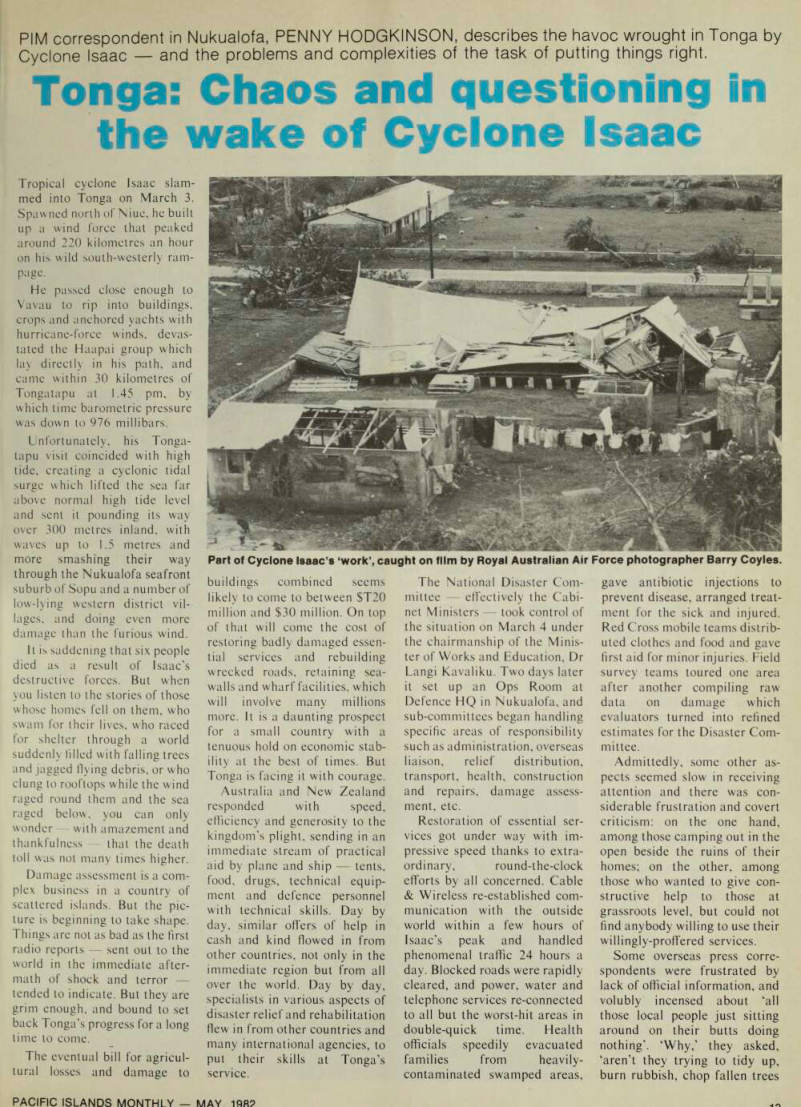
Unfortunately, his Tonga lapu visit coincided with high tide, creating a cyclonic tidal surge which lifted the sea far above normal high tide level and sent it pounding its way over 300 metres inland, with waves up to 1.5 metres and more smashing their way through the Nukualofa seafront suburb of Sopu and a number of low-lying western district vil lages, and doing even more damage than the furious wind.
It is saddening that six people died as a result of Isaac’s destructive forces. But when you listen to the stories of those whose homes fell on them, who swam for their lives, who raced for shelter through a world suddenly filled with falling trees and jagged flying debris, or who clung to rooftops while the wind raged round them and the sea raged below, you can only wonder with amazement and thankfulness that the death 101 l was not many limes higher.
Damage assessment is a com plex business in a country of scattered islands. But the pic ture is beginning to take shape.
Things arc not as bad as the first radio reports sent out to the world in the immediate after math of shock and terror tended to indicate. But they are grim enough, and bound to set back Tonga’s progress for a long lime to come.
The eventual bill for agricul tural losses and damage to
buildings combined seems likely to come to between ST2O million and $3O million. On lop of that will come the cost of restoring badly damaged essen tial services and rebuilding wrecked roads, retaining sea walls and wharf facilities, which will involve many millions more. It is a daunting prospect for a small country with a tenuous hold on economic stab ility at the best of times. But Tonga is facing it with courage.
Australia and New Zealand responded with speed, efficiency and generosity to the kingdom’s plight, sending in an immediate stream of practical aid by plane and ship tents, food, drugs, technical equip ment and defence personnel with technical skills. Day by day, similar offers of help in cash and kind flowed in from other countries, not only in the immediate region but from all over the world. Day by day, specialists in various aspects of disaster relief and rehabilitation flew in from other countries and many international agencies, to put their skills at Tonga’s service.
The National Disaster Com mittee effectively the Cabi net Ministers took control of the situation on March 4 under the chairmanship of the Minis ter of Works and Education, Dr Langi Kavaliku. Two days later it set up an Ops Room at Defence HQ in Nukualofa, and sub-committees began handling specific areas of responsibility such as administration, overseas liaison, relief distribution, transport, health, construction and repairs, damage assess ment, etc.
Restoration of essential ser vices got under way with im pressive speed thanks to extra ordinary, round-the-clock efforts by all concerned. Cable & Wireless re-established com munication with the outside world within a few hours of Isaac’s peak and handled phenomenal traffic 24 hours a day. Blocked roads were rapidly cleared, and power, water and telephone services re-connected to all but the worst-hit areas in double-quick time. Health officials speedily evacuated families from heavily contaminated swamped areas.
gave antibiotic injections to prevent disease, arranged treat ment for the sick and injured.
Red Cross mobile teams distrib uted clothes and food and gave first aid for minor injuries. Field survey teams toured one area after another compiling raw data on damage which evaluators turned into refined estimates for the Disaster Com mittee.
Admittedly, some other as pects seemed slow in receiving attention and there was con siderable frustration and covert criticism: on the one hand, among those camping out in the open beside the ruins of their homes; on the other, among those who wanted to give con structive help to those at grassroots level, but could not find anybody willing to use their willingly-proffered services.
Some overseas press corre spondents were frustrated by lack of official information, and volubly incensed about ‘all those local people just sitting around on their butts doing nothing’. ‘Why,’ they asked, ‘aren’t they trying to tidy up, burn rubbish, chop fallen trees
Part of Cyclone Isaac’s ‘work’, caught on film by Royal Australian Air Force photographer Barry Coyles.
Cyclone Isaac
for firewood, dig latrines, repair roofs, help the official teams clear rubble and set up tent towns?’
What they did not under stand, as they fumed about the apparent inertia, was the cul tural system that conditions the average Tongan to sit tight until he receives specific instructions from someone in authority. ‘Just wait and see,’ I said. ‘Once clear instructions come from the top, what you see as laziness will suddenly turn into hum ming activity. Tongans can work like nobody’s business as soon as they know what is expected of them.’ And so it proved.
During the first weekend after the cyclone I toured the worst-hit areas of Tongatapu. I saw chaos and near-total inac tivity, apart from the women who were washing clothes and cooking salvaged produce. Dur ing the second weekend, just after the call for self-help action had gone out on the national radio, those same areas were alive with action: rubbish disap pearing into bonfires, neat firewood slacks, woven pandanus and coconut thatch being turned into traditional Tongan fates, new foundations going in, new houscframes go ing up, shining sheets of corru gated iron being nailed on to unroofed houses, farm plots being dug and planted with quick-growing maize and kamula. The word had gone out. the wheels were turning again fakatonga.
It is going to be a long, slow climb back to pre-Isaac stan dards. Local food production will probably need supplement ing for up to six months, and export agriculture, on which the country is heavily dependent, could take two years to gel back into full swing. Rehousing the homeless and rebuilding the infrastructure will be an expens ive business and it is not yet known how all this will be financed.
With the emergency phase over and the long, slow rehabili tation phase beginning, a num ber of pertinent questions are being asked: two in particular.
The first of them is: ‘Why does everything have to start from scratch each time a disas ter hits?’
This is the question I hear on all sides from the Tongan people themselves. They realise their country lies smack in the middle of a disaster-prone re gion, and that cyclones and earthquakes are bound to strike it at intervals. ‘So why,’ they are asking, ‘docs our government not have a permanent standing committee of people trained and rehearsed in advance to take all necessary action from issuing preparedness and damage mitigation instructions during alerts to implementing recovery action immediately the emergency exists? ‘Why does there have to be such a long period of thinking and planning and organising, when the problems and the needs are always pretty much the same?’ (Admittedly they don’t word it quite that way, but rather more emotionally and diffusely. But that’s essentially what they are saying.) The second big question is being asked by frustrated specialists from international
aid agencies and other groups, who were quickly flown in to provide a pool of expertise on various facets of relief and rehabilitation. Their question is: ‘Why were we welcomed with
courtesy and gratitude, but then left to twiddle our thumbs in a vacuum while the National Committee, in camera, gets on with making its own assess ments, drawing its own con-
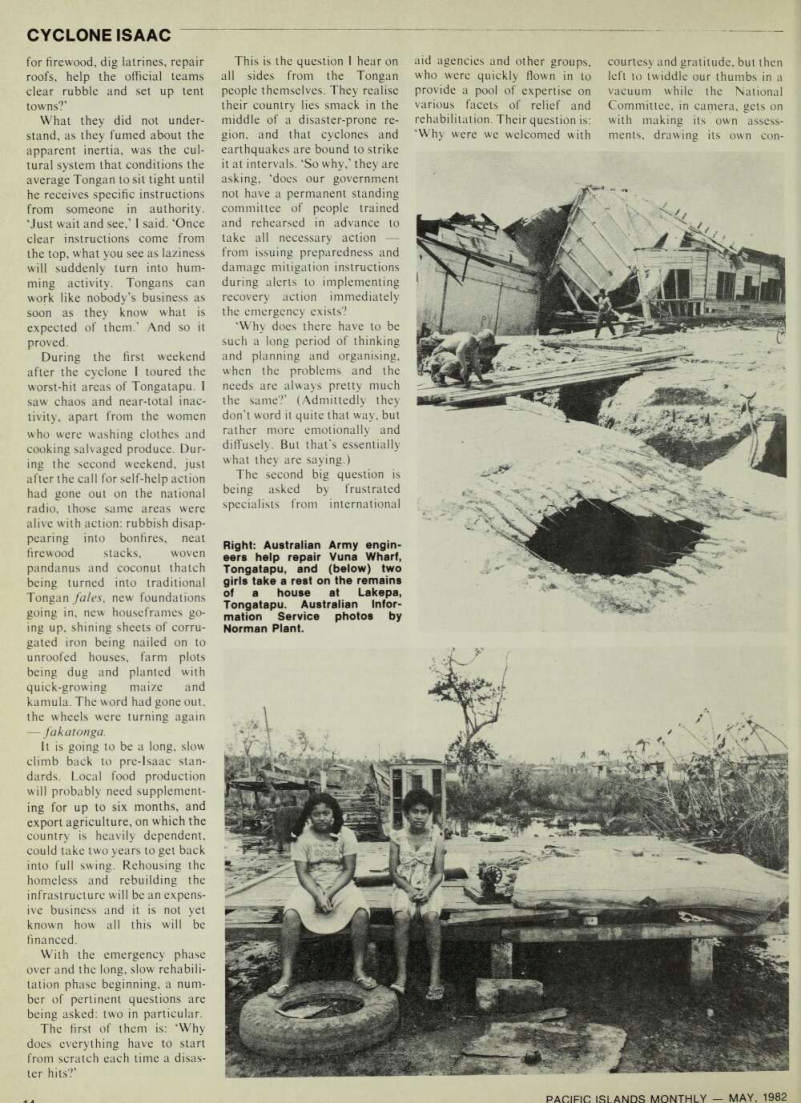
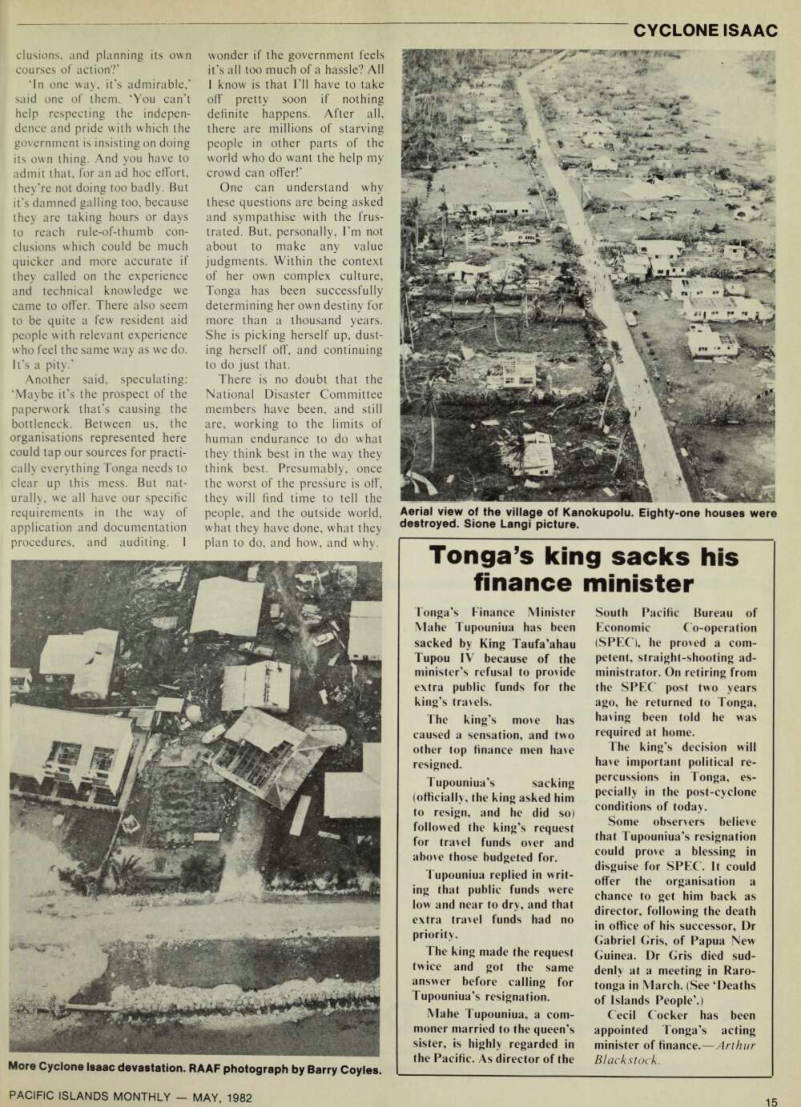
Right: Australian Army engin eers help repair Vuna Wharf, Tongatapu, and (below) two girls take a rest on the remains of a house at Lakepa, Tongatapu. Australian Infor mation Service photos by Norman Plant.
elusions, and planning its own courses of action?’ ‘ln one way, it’s admirable,’ said one of them. ‘You can’t help respecting the indepen dence and pride with which the government is insisting on doing its own thing. And you have to admit that, for an ad hoc effort, they’re not doing too badly. But it’s damned galling too, because they are taking hours or days to reach rule-of-thumb con clusions which could be much quicker and more accurate if they called on the experience and technical knowledge we came to offer. There also seem to be quite a few resident aid people with relevant experience who feel the same way as we do.
It’s a pity.’
Another said, speculating: ‘Maybe it’s the prospect of the paperwork that’s causing the bottleneck. Between us, the organisations represented here could tap our sources for practi cally everything Tonga needs to clear up this mess. But nat urally, we all have our specific requirements in the way of application and documentation procedures, and auditing. I
wonder if the government feels it’s all too much of a hassle? All I know is that I’ll have to take off pretty soon if nothing definite happens. After all, there are millions of starving people in other parts of the world who do want the help my crowd can offer!’
One can understand why these questions are being asked and sympathise with the frus trated. But, personally, I’m not about to make any value judgments. Within the context of her own complex culture, Tonga has been successfully determining her own destiny for more than a thousand years.
She is picking herself up, dust ing herself ofif, and continuing to do just that.
There is no doubt that the National Disaster Committee members have been, and still are, working to the limits of human endurance to do what they think best in the way they think best. Presumably, once the worst of the pressure is off, they will find time to tell the people, and the outside world, what they have done, what they plan to do, and how, and why.
More Cyclone Isaac devastation. RAAF photograph by Barry Coyles.
Aerial view of the village of Kanokupolu. Eighty-one houses were destroyed. Sione Langi picture.