Letters
pp. 7-11 · Read in the full issue


Spc-Spec:
Bureaucrats can’t decide
I would like to refer to your report on the proceedings of the South Pacific Conference which appeared under the title ‘lsland links unweakened but can the structure remain’ (PIM Dec 'Bl, pp 13-17).
On page 14 you quote me as saying ‘there is not as much overlapping as many people think’. While it is true that I made that statement, it is also true that the quotation is incom plete and could easily be read out of context.
The statement ‘there is not as much overlapping as most people think' was made during discussions on relationships be tween the South Pacific Bureau for Economic Co-operation and the South Pacific Commission.
Other pertinent comments were also made by me, and those have not been included in your report. For the benefit of your readers I would like to reiterate those comments so that the above quotation could be read in the proper context.
The secretary-general of the South Pacific Commission and I have made much effort to minimise duplication, and promote rationalisation of pro grammes. However, there is a limit to what the chief execu tives of the two organisations can achieve to promote rational isation and harmonisation of regional effort. As long as there exist two separate organisations with separate governing bodies, representing different member ships and interests, there are likely to be difficulties in achiev ing the highest level possible in rationalisation and harmonis ation of programmes.
I made it quite clear at the conference that both the South Pacific Bureau for Economic Co-operation and the South Pacific Commission arc answer able to their respective govern ing bodies, the Forum/SPEC Committee and the Confcr ence/Committec of Repres entatives of Participating Gov ernments, and arc duly-bound to implement decisions made by those governing bodies. To re duce duplication to a minimum
possible under the present ar rangements, it is necessary that country representatives attend ing SPC meetings are briefed on Forum/SPEC Committee decisions, and also conversely so that consistency of approach would be adopted by each country this would facilitate harmonisation in collective decision-making. For the highest level of rationalisation to occur, it would also be necessary to review and, where applicable, revise the mandates of SPEC and the South Pacific Commission to achieve har mony and complementarity.
This is a political matter and the necessary decision could only come from the respective decision-making bodies at the highest level.
The concerns that have been expressed about duplication would appear to apply even more strongly to costs each country has to pay to maintain the two institutions and to attend meetings convened by them. Apart from financial costs, the demands on small bureaucracies can also be ex cessive.
Representatives of some countries tend to believe that a single, more general, regional organisation could better serve the region than two organis ations. You are aware, of course, that SPEC is currently undertaking an exercise that is aimed at assisting the SPEC Committee and the South Pacific Forum to consider this matter further.
I was also reported as defend ing the existence of the two institutions. This conclusion is incorrect. It is not the role of a regional civil servant, like the director of SPEC, either to
defend the existence of the two institutions or to argue a case for a single institution. That role rightly belongs to country rep resentatives and political leaders. As long as the South Pacific Bureau for Economic Co-operation and the South Pacific Commission continue to exist, 1 am obliged to work closely with the secretary general of the South Pacific Commission so that maximum possible benefits may be achieved for the region within the constraints of existing ar rangements.
I did defend the secretary general of the South Pacific Commission and the director of SPEC from implied criticism that they were not doing enough to promote rationalisation of effort. Indeed, I went so far as to say that in essence the ball was (and is) in the court of the decision-makers, not the chief executives of the South Pacific Commission and the South Pacific Bureau for Economic Co-operation.
(Dr) G. B. Gris
(Director, South Pacific Bureau for Economic Co-operation Suva Fiji Dr Gris wrote the above letter in Suva on February 28.
His untimely death in Rarotonga on March 12 is reported in ‘Deaths of Islands People'. — Editor.
Tonga: Grace of
the Fairstar By now most PIM readers will have heard of the severe dam age inflicted on the Kingdom of Tonga when hurricane Isaac struck in early March.
The aid by neighbouring countries has been most ap preciated by Tonga, and reports reaching us indicate that the help in restoring services has been swift and efficient.
Tongans and Australians in Sydney have acted without de lay and have collected large quantities of clothing, bedding and household items. But we were faced with the problem of how to send the items to Tonga.
The Sitmar Line, before any approach had been made to them, offered space aboard their ship the Fairstar, and
when it left on its Pacific cruise on Sunday, March 14, it carried 43 lea chests full of aid items.
Our association would like to place on record its appreciation for the help received from the people in Sydney and particu larly the Sitmar Line and the captain and crew of the Fair star.
John Slender
Hon Sec, Tonga Australia Association Sans Souci, NSW Australia
The report was
exaggerated . . .
My husband and I continue to enjoy our subscription to the PIM, so I am writing to correct a serious error in the ‘Yachts' section of your January issue.
Bert E. Weston has written an article about early yachting in the Pacific, starling with Joshua Slocum. He gets up to the days just before World War II and describes my Mate’ hus band's two visits to the Huon Gulf and Salamaua in Yankee.
My husband is not as Mr Weston suggests the Male’ Cap tain Irving Johnson, but the very present one, alive and well and sailing.
I hope you will correct Mr Weston’s mistake so that old friends in the Pacific will not be misinformed. We continued our round-the-world voyages after World War II in the brigantine Yankee, very similar to the prewar schooner Yankee, and in all made seven 18-month cir cumnavigations from 1933 to 1958, with six years out for the war when my husband had command of a navy survey ship in the Pacific making charts of many areas we had sailed with sometimes inadequate charts.
Since I am writing you I would like to ask for us to be remembered to our old friend.
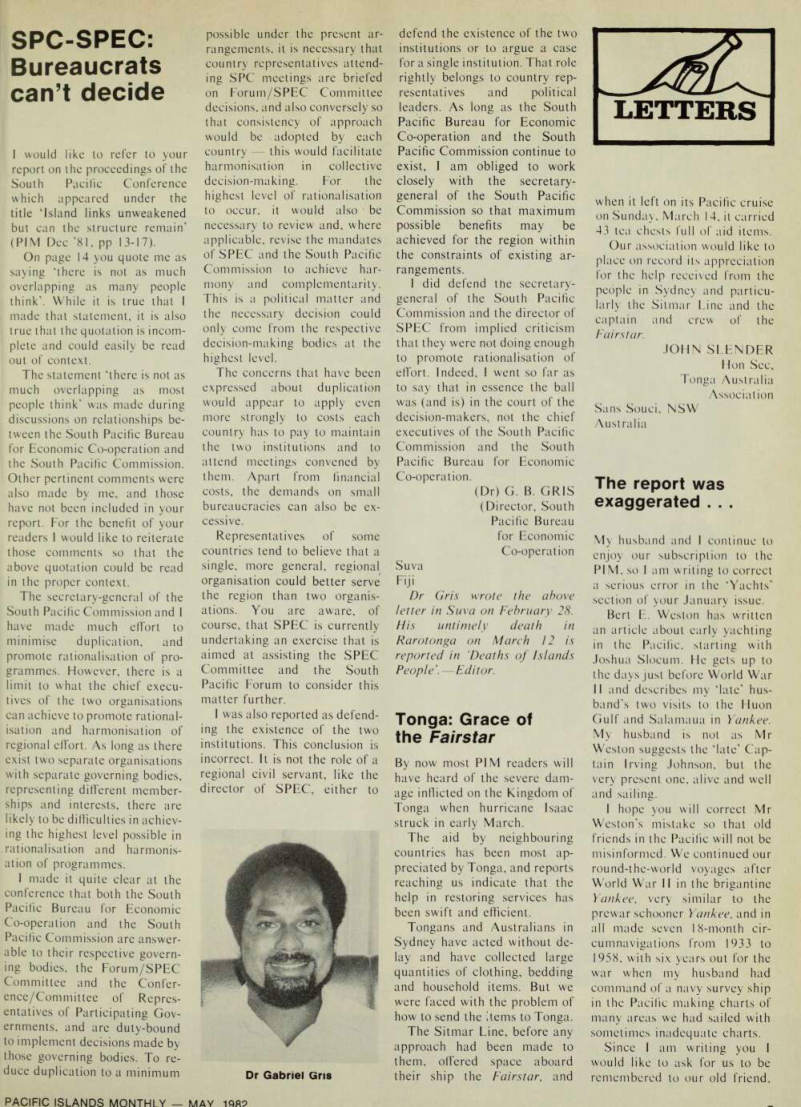
Dr Gabriel Gris
Mr Robson, who also is not ‘late’, I believe.
Electa Johnson
Hadley, Mass
I Usa
Thumbs up
on yachties (3)
We have just received our January 1982 issue of your fine publication, and I hasten to comment on the letter of Frank Lewis (p 8). Needless to say, I wholly and totally disagree with the philosophy of the gentleman from Rabaul. To each his own, of course.
Mr Lewis must be delighted with your January issue, for it devotes but two half pages to yacht movement accounts somewhat of a disappointment to me. I was pleased, though, to see the report on Hawaiki and the splendid McDaniel family.
We became acquainted with them during their most recent visit here in their fine vessel.
Equally line are the captain and crew of Hawaiki.
In the same January issue, Bert Jy. Weston provides an interesting account of the days when cruising yachts were few and far between. I found his account interesting and, as a lad, I, too, was interested in the account of the voyage of Stock’s Dream Ship, as published in National Geographic.
I believe that Mr Weston was in error in his statement that Svaap was wrecked in the Galapagos Islands. She did go ashore in the jungles of the Riyer Sambu, but she was refloated. Later, in the Galapagos, William A.
Robinson was stricken with appendicitis and almost lost his life. The U.S. Navy responded, from Panama, and the appendix was removed and the patient survived. The Svaap was aban doned but not wrecked in the Galapagos, at the time of the evacuation of the Robinsons. I believe that the Svaap was confiscated by the Ecuadorian Government and taken to Guayaquil.
Mr Weston also speaks of the late Captain ‘lrvine Johnston’, of the Yankee. I have not heard of the death of that great seaman, and I hope that the
report is false, as is Mr Weston’s spelling of Irving Johnson’s name. In spite of a few errors, I enjoyed reading Mr Weston’s account.
Again my compliments to Pacific Islands Monthly for a fine publication.
Bruce B. Mccloskey
Fort Lauderdale, Florida
Usa
Thumbs down
on yachties (3)
You asked (January issue) if any other reader cared to com ment on Frank Lewis’s letter about overdoing the Yachtie gossip column.
Yes, indeed. I endorse his comments 100 percent.
What’s needed in PIM is more basic transportation news, especially air transport. You’re missing a lot in this area. Air service is vital for the entire Pacific basin but little enough air news makes its way into your magazine.
For example, is there any new activity for that landing strip on Pitcairn? Are you pushing the idea? And how about the Tokelau islands any trans port news of there? And how about the Ogasawara Islands, any transport to there? Air Nauru keeps expanding but I get the news elsewhere, such as it is. How about Air Pacific and its problems? And Ansett’s efforts to buy into Air Polynesia?
PIM is a fine magazine but I have the feeling that it carries less topical info than it used to do.
Wayne W. Parrish
Washington DC
Usa
Point taken. A special avi ation issue of PIM is on the way up. Ansett’s dealings with Polynesian Airlines were, we feel, adequately covered in our February issue (psl). — Editor.
Limitations of Bislama I was disappointed to read in the February PIM of the recent enthusiasm in Port-Vila for the
wider use of the Bislama language.
It is understandable that new nations with a large number of vernacular languages should look for a common voice to express unity and national identity. There was a similar debate in India in 1947 about the wisdom of retaining English as the official language, and although it was adopted in itially, English was later aban doned in favour of Hindi.
But the conference in Vila, as reported by Donald Topping, failed to identify some of the obvious problems in using a ‘Pidgin’ language as the vehicle of education, commerce, and litigation, and assumed that a language which is suitable for the translation of the Bible, will be adequate for all other forms of communication.
This is nonsense. Not only is it philological nonsense, it is political nonsense, and totally
impractical.
There is no reason to doubt that Bislama, given time, would evolve into a language capable of fulfilling all the requirements of Vanuatu, just as English evolved from Anglo-Saxon, Latin and Greek. But Vanuatu cannot wait that long; it re quires access to the literature and technology of the 20th century before that century ends.
Spoken languages cannot be introduced by decree or by promulgating a standard dic tionary. Few people in the world speak Esperanto. The
Bislama announcement of the arrival in Vanuatu of the first consignment of the country’s new currency in the Vanuatu Government weekly Tam-Tam which appears in three languages Bislama, English and French, Academic Fransaise has failed to erase words like ‘weekend’ and ‘sandwich’ from French.
Even the Oxford English Dic tionary is obliged to issue a supplement from time to time, which recognises words that have become part of current usage, such as ‘supermarket’ and ‘commuter’, words which may have a dubious etymology, but which no amount of linguis tic restructure can remove. To speak, as the missionaries in Vila do so glibly, of ‘expunging Anglicisms’ from Bislama, is philologically naive.
Since Pidgin languages evolved as a means of communi cation between groups of people without a common language, the idea of a standard or definitive Pidgin, even of ‘good’
Pidgin, is also an illusion. As the groups who must communicate in this way are vastly different, the form of the language which effectively provides communication will vary from village to village, island to island, and from nation to nation; but no one form can be said to be more correct than any other. If mutual understanding is achieved, it must be ‘good’
Pidgin, whatever words are used. If Anglicisms are needed to provide vocabulary, they are
an integral and essential part of the language. Furthermore, uniformity has never been a feature of Pidgin; the links between the ‘Tokpisin’ of Papua New Guinea and the Bislama of Vanuatu are not as close as has been suggested. Anyone who has travelled widely in the region would know that unedu cated village people in Vanuatu really do not understand Tokpisin at all.
It is of particular interest, in view of some of the vested interests in Bislama, that the only language which has been successfully introduced in the modern world is Hebrew, the language of the Old Testament.
Those who know Biblical and Modern Hebrew are aware that the vocabulary of the Bible was quite inadequate of the needs of modern Israel, and the language has had to acquire many thousands of new words.
In spite of all attempts to coin appropriate words from Semitic roots, Anglicisms have poured in, and today Israelis talk quite normally of ‘university’, ‘sweaters’, and even ‘sandwiches’ (or, as they say it, ‘sandwichim’). The Bible trans lators, of all people, could be expected to know this.
Bislama is a colloquial language, of a type which has many parallels in the rest of the world, and as such it will survive, whatever linguists, poli ticians and others may decide.
If it is employed as a written language, especially as the me dium of education, its effect will be to arrest development. This is too high a price to pay for a hypothetical enhancement of national cultural awareness.
The younger generation of ni- Vanuatu, if they are to develop their country, require a litera ture wider than the textbooks of Western religion; they cannot wait for Shakespeare or the Encyclopaedia Britannica to be translated into Bislama, even if it were economically feasible to do so.
Expatriates, or nationals who are already bi- or tri-lingual, may indulge in the promotion of Bislama with the best of inten tions. However genuine their motives, the end result will still be to delay the advance of universal education in Vanuatu, or to channel its progress along
strictly sectarian lines.
(Dr) R. K. Likeman
Te Kuiti New Zealand
An ‘Anzus
Lake’?
A recent article in the Austra lian weekly magazine The Bull etin is of particular importance to Pacific Islanders. According to the report from Washington by John Edwards, a sentence regarding the Pacific has been added to the annual statement from the US Joint Chiefs of Staff in reference to the ANZUS treaty. It reads: ‘Aus tralia and New Zealand possess the best capability for assisting US power projection into the Pacific islands in response to crises there.’
As Edwards points out, the intention is that Australia and New Zealand are expected to ‘help out’ in asserting Western interests in the Pacific.
Of even greater interest though is Edwards’ discussion of a US National War College article by John Dorrance, who describes the South Pacific as ‘being in effect an ANZUS lake’. Of course the knowledge that the Americans regard the Pacific in this way is not new.
What appears to be new is the formalising of this opinion by its inclusion in an official statement of policy. The fact in itself is extremely important because, as Edwards says, if an un friendly government came to power in the region, or a
formerly friendly one offered
basing rights to a country the ANZUS partners didn’t like, the US would assume the right to intervene.
The situation is likely to arise, but when, and what action the ANZUS partners would take in the event, is hard to judge. In any case the machin ery for intervention in Pacific affairs is being established, and the ocean I have heard de scribed as an ‘American Lake’ is now to be officially recognised as such. Such power, these Americans, to turn oceans into lakes.
Elizabeth Jane Byrne
Darwin, NT Australia
Uniting the two Samoas As a Samoan citizen, born in Western Samoa but raised in American Samoa and the US, I would like to share some con cern with respect to the recent meeting between our two leaders, Prime Minister Tupuola Efi of Western Samoa and Governor Peter T. Coleman of American Samoa. The meet ing was reported in PIM (Nov ’Bl, p 6). The issues under consideration were an easing of relations between our islands, and the possibility of uniting the Samoas.
To me, it seems rather suspect that Governor Coleman has insisted on an easing and improvement of relations be tween our islands, and yet continues to resist the idea of a possible unification. Consider ing the long-standing animosity, hardship, and economic in equality that this separation has caused the Samoan people, many of whom find themselves cut off and divided from their family and friends, I feel it would greatly benefit both islands to combine our re sources.
Admittedly this is no easy thing, taking into account the complex nature of our past colonial history, differing governmental styles, etc. But I ask sincerely: Could this not be because of an obvious wish by the privileged few to ‘hold on to what they have’ rather than spread it around in a fair and equitable way amongst our people? The US has stated a desire to help both our islands.
But this would be much more feasible with a unification.
I think it is a myth that one side of our islands would gain advantage once unification oc curred, provided there is a sound and fair leadership dis played by all parties concerned.
I believe firmly in the mainten ance and strengthening of our Samoan identity, unity, cultural heritage all those things that make our country distinctive and unique in the world. I see no difficulty affirming these things, given a sound and sensitive regional philosophy on the part of our governments and the United States.
For those who fear a tamper ing with our culture by a superpower such as the United States, I would argue that the nature of reality requires assist ance from a benevolent con tributor. We have many financial, educational and social problems which require aid and, if given in a spirit of goodwill, a wish to help, then this aid I feel should be ac cepted. It is not fair that only a few should benefit when there is such a need for help for our entire and troubled homeland.
Felani A. Peters
Portland, Oregon
Usa
Academic book
reviewers’ lot
I am sympathetic to John McKenna’s request (PIM, Mar, plO) that serious academic books on the Pacific, usually with very small print runs, should be reviewed very soon after publication to ensure that island readers can order them with some hope of finding the desired item in print.
This is a perfectly reasonable thing to ask, but as a periodic reviewer of academic books for PIM, I realise the editor has little chance of meeting such a request, largely because most reviewers of these books fit the task into a heavy teaching and research load, and the instant review is just not possible.
I stand condemned at the moment, since I have a book to be reviewed for PIM which I accepted on the understanding that the review could not be done before May or June.
As a compromise could I suggest that the editor include a list of books received in the book section of PIM each month? I realise such infor mation is not as useful as a full review. But at least island readers would know quickly what had been published, and might sometimes order on that information alone.
(Dr) Caroline Ralston
Macquarie University North Ryde, NSW Australia Thanks for the suggestion.
It’s one we reckon we’ll be able to meet. — Editor.