Cables, satellites
pp. 53-56 · Read in the full issue
bring revolution in communications
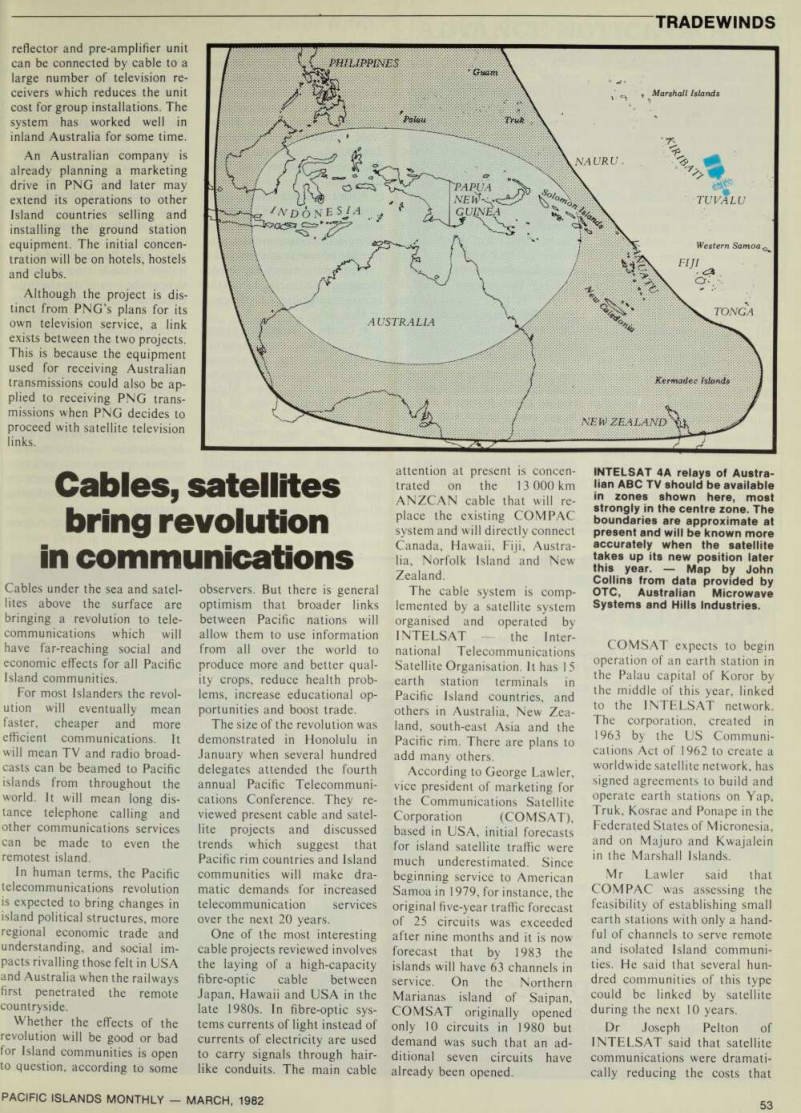
Cables under the sea and satel lites above the surface are bringing a revolution to tele communications which will have far-reaching social and economic effects for all Pacific Island communities.
For most Islanders the revol ution will eventually mean faster, cheaper and more efficient communications. It will mean TV and radio broad casts can be beamed to Pacific islands from throughout the world. It will mean long dis tance telephone calling and other communications services can be made to even the remotest island.
In human terms, the Pacific telecommunications revolution is expected to bring changes in island political structures, more regional economic trade and understanding, and social im pacts rivalling those felt in USA and Australia when the railways first penetrated the remote countryside.
Whether the effects of the revolution will be good or bad for Island communities is open to question, according to some
observers. But there is general optimism that broader links between Pacific nations will allow them to use information from all over the world to produce more and better qual ity crops, reduce health prob lems, increase educational op portunities and boost trade.
The size of the revolution was demonstrated in Honolulu in January when several hundred delegates attended the fourth annual Pacific Telecommuni cations Conference. They re viewed present cable and satel lite projects and discussed trends which suggest that Pacific rim countries and Island communities will make dra matic demands for increased telecommunication services over the next 20 years.
One of the most interesting cable projects reviewed involves the laying of a high-capacity fibre-optic cable between Japan, Hawaii and USA in the late 1980 s. In fibre-optic sys tems currents of light instead of currents of electricity are used to carry signals through hair like conduits. The main cable
attention at present is concentrated on the 13 000 km ANZCAN cable that will re- . • . rsw/m/ir' place the existing COMPAC system and will directly connect Canada, Hawaii, Fiji, Australia, Norfolk Island and New y , .
The cable system is complemented by a satellite system organised and operated by INTELSAT the International Telecommunications Satellite Organisation. It has 15 earth station terminals in Pacific Island countries, and others in Australia, New Zealand, south-east Asia and the Pacific rim. There are plans to add many others.
According to George Lawler, vice president of marketing for the Communications Satellite Corporation (COMSAT), based in USA, initial forecasts for island satellite traffic were much underestimated. Since beginning service to American Samoa in 1979, for instance, the original five-year traffic forecast of 25 circuits was exceeded after nine months and it is now forecast that by 1983 the islands will have 63 channels in service. On the Northern Marianas island of Saipan, COMSAT originally opened only 10 circuits in 1980 but demand was such that an additional seven circuits have already been opened.
rnyc T COMSAT expects to begin °P eratl , on of an earlb s j allon ' n tbe Pa l a “ ca JP ltal of Ko \ or , b V the ™ ,dd *® * h “ l,nk< : d If! the INTELSAT network, “'''’TT.’c c L ealed ln 1963 b > A the r Commum cal'°ns Act of 1962 t 0 create a worldw,de satellite ha j Slgned a B ree menls to build and operate earth stations on Yap, I rak - Ko f ae and Pona P e in the Federated Slates of Micronesia, and °" Ma J ur ° f" d Kwajalem ln lhe Marsha " lslands - Mr Lawler said that COMPAC was assessing the feasibility of establishing small earth stations with only a hand ful of channels to serve remote and isolated Island communi ties - He said lhat several hun dred communities of this type could be linked by satellite during the next 10 years, Dr Joseph Pelton of INTELSAT said that satellite communications were dramati cally reducing the costs that
Pacific Island communities were paying for their place in today’s world community. He said that soon after Tonga opened its satellite earth station it was able to negotiate better prices for its exports and lower prices for its imports because of a better continuous awareness of world trends. He said that the University of the South Pacific in Fiji was using satellite com munications for tutorials to distant students and the cost per student was five times less than for resident students.
Professor William H. Melody of Simon Fraser University in Canada expressed some reser vations to the conference about the benefits of the telecommuni cations revolution. He said that the social and cultural risks of the change were high. Professor Melody told delegates: ‘We are well aware that virtually all technologies have unintended harmful effects. The great plans and promises surrounding the green revolution in agriculture introducing into developing countries the technology of American farming, including
equipment, pesticides, ferti lisers, education, and infor mation have floundered, for the most part, as the longer term social and human conse quences have begun to work themselves out. Should we ex pect anything different from the communications revolution?’
Many, apparently, think so.
Telecommunications experts cite the success of the exper imental ATS-1 satellite in the Pacific that has been used widely by the University of the South Pacific and the Depart ment of the Interior Satellite Project (DISP) for medical consulting, experiments, and talks between members of re gional organisations.
ATS stands for Applied Technology Satellite, but the satellite is better known in the Pacific as PEACESAT Pan- Pacific Education And Com munication Experiments by Satellite. The application of ATS-1 to its present role stems largely from the work of Dr John Bystrom of the University of Hawaii, and the satellite's main terminals are at the Uni
versity of Hawaii, the Univer sity of the South Pacific in Fiji, the University of Guam, the Wellington Polytechnic in New Zealand, the University of Syd ney in Australia, the Papua New Guinea University of Technology and the South Pacific Commission in New Caledonia.
With the proliferation of sat ellite facilities for external links, the main problem now facing Island communities is to provide adequate internal links.
Here are some of the broad themes which emerged from the telecommunications conference in Honolulu; • Pacific Islanders them selves, rather than external powers, will need to exercise more control over communi cation networks. Prime Minis ter Sir Thomas Davis of the Cook Islands told the confer ence: The development of many small countries has been delayed by the inappropriate manner in which communi cations have been introduced, usually by outside interests try ing to do things in a way that
might work well in large affluent countries but that are inappropriate in small undevel oped countries like ours.’
A US-funded research pro gramme has suggested that Pacific Islands could develop their own integrated communi cations system using a new satellite, but the chief barriers would be raising $lOO million to build and launch the satellite and establishing a management formula. • The Reagan adminis tration in USA is not prepared to bear the cost of developing a Pacific-dedicated telecommuni cations system, but believes the private sector can be induced to invest in such a system.
According to Bernard J.
Wunder, assistant secretary for communications and infor mation of the US Department of Commerce, ‘there is a grow ing body of evidence than demonstrates telecommuni cations systems can generate respectable rates of return on investment, even in developing countries’. • International corporations
can be expected to compete more fiercely for Pacific island telecommunications business in the future. Western Union Tele graph, for instance, whose ser vices have been confined pri marily to the North American continent, intends to offer a ‘broad range of basic services between the US and all countries’, Thomas Mathai, a company vice president, said.
These would include telegram, telex, private wire, mailgrams, money order, telephone and news services. Western Union has three satellites in orbit over USA and will launch two more this year. • The flow of communi cations data across inter national borders will be a con tinuing source of controversy, at least for the next decade.
Speakers told the conference there was already confusion and uncertainty because institutions created by new technologies were threatening established in stitutions which had not yet developed effective tools to meet their telecommunications needs. Belinda Canton and Herbert Dordick of the Univer sity of Southern California in USA said that so much infor mation was now travelling back and forth across the Pacific that what they called ‘elite groups’ were now facing a crisis of authority. They said these elite groups felt they had to find ways of reacting to the flow of
information.
Paul Addison
in Honolulu.
Ansett regional
feelers extend
The arrangement under which the Australian company Ansett Transport Industries is manag ing Polynesian Airlines of West ern Samoa (PIM Feb p5l) may lead to an Ansett shareholding in the operation. This became evident in February as the two parties continued a series of negotiations which will alter the company structure of Polynesian along lines which have not yet been announced.
There were two other devel opments in February which point to the increasing involve ment of the Ansett group in Pacific regional aviation.
One was confirmation from Fiji that Ansett had made an
informal approach to take up a shareholding in Air Pacific. An involvement of up to 40 per cent was suggested, and the immedi ate reaction at ministerial level was described as ‘not unsympa thetic to the approach’. How ever, no firm decision is possible until the Fiji government, which owns the airline, discusses its attitude to releasing some of its equity. The airline’s financial problems suggest that some form of re-organisation must face the government in its airline policies.
The other development affecting Ansetl in the Pacific was an approach by the Cook Islands government for an Aus tralian airline operator to de velop services into the Cook Islands from regional countries.
Qantas, Trans Australia Air lines and Ansett were each suggested, but a deal with Ansett is seen as the most logical. Ansett has already re sponded to the invitation by holding preliminary talks on tourism and landing rights. Air New Zealand has long been the major force in regional aviation serving the Cook Islands, but the airline has been forced into a series of economies because of heavy operational losses. This is believed to be one of the major factors which prompted the Cook Islands government to approach Australian operators for a new-look series of air links.
The new developments affecting Ansett in the Pacific follow the formation last year of Air Vanuatu in which Ansett has a 40 per cent shareholding.
If Ansett can integrate a route structure (with or without equity) involving Vanuatu, Western Samoa, Fiji and the Cook Islands it will have estab lished a very firm base indeed.
New Caledonia is also not out of the question through Ansett’s Air Vanuatu link. Air Vanuatu flights already land in New Caledonia on the service be tween Australia and Vanuatu, but at present the stops are for fuelling only and do not include traffic rights. Mr Bryan Grey from Ansett’s head office in Melbourne has already ap proached New Caledonia officials for traffic rights, pre sumably on behalf of the Air Vanuatu operation, but little progress has been made. In any
event, air traffic rights to New Caledonia require approval from the government in France because of the New Caledonia territorial structure.
In Western Samoa, Ansett has already established its man agement structure on behalf of Polynesian Airlines and has appointed Mr Patrick Giles as general manager. The manage ment agreement came into effect on February 1 and will operate for five years.
A statement from the chair man of the airline, Mr E Annandale, said that nego tiations for the new company structure of the airline as distinct from the management structure were continuing.
Two separate companies would probably be formed, and there would be a concentrated pro gramme of training for Samoan staff.
Although the nature of the two proposed companies has not been defined, there is a general belief in the airline industry that one of the companies will be a nominal policy body de signed to protect the long-term
interests of Western Samoa as an airline operator in its own right and the other will be an operating company. Ansett could well have a majority interest in the operating com pany.
Bougainville is
down by 68%
Profit from Bougainville Cop per Ltd’s go'd and copper mine in Papua New Guinea fell by 68 percent for the year ended last December, the directors re ported in February. The princi pal shareholders in the mine are the Australian-based mining group CRA (54 percent) and the PNG government (23 per cent).
CRA is already going through a lean period because of reduced earnings from its other mines, and the drop will be a significant blow to the PNG government which is fairly heavily stretched financially and which relies strongly on the mine for budget revenue. Tax, royalties and di rect earnings as well as profit
dividends all affect the govern ment’s revenue when the mine has a below-average year.
The profit from the mine was K 22.8 million, compared with K 71.5 million the previous year.
The annual dividend dropped from 16 toea a share to five toea.
A major factor which de pressed earnings from the mine was a world-wide drop in copper and gold prices. To some extent the mine fared slightly better than would have been expected because there was an unexpectedly higher grade of ore during part of the year. This was only a minor development, however, and generally the grades of ore will gradually decrease as the Bougainville open pit becomes deeper in future years. The higher rate of recovery resulted in an in creased volume of sales for the year, but the depressed prices were the over-riding element in the company’s result.
Meanwhile, a domestic politi cal situation is delaying talks which should have been held last year to re-examine the agreement under which the
mine operates in PNG.
Bougainville Copper Ltd and the PNG government are sup posed to meet every seven years to discuss the practical oper ation of the agreement and to thrash out revisions which either party may propose.
The latest series of talks began last year as scheduled but had to be adjourned be cause of lobbying by the North Solomons provincial govern ment the provincial auth ority on Bougainville Island where the mine is situated. The provincial government receives revenue from the mine, but only through the national govern ment which reserves sole rights to collect and allocate revenue generated by the mine.
The provincial government is lobbying for a greater share of the money, but has failed to reach agreement with the national government. This has halted the scheduled review of the mining agreement because of uncertainties involved, and there is no indication of when the negotiations are likely to resume.