Hot stones and
pp. 41-43 · Read in the full issue

The Firevalkers Of Fiji
Hot stones and cold cash
Beqa Island of Firewalkers.
By John Bigay, Mason Green, Dr Freda Rajotte, Amelia Ravuvu, Mika Tubanavau, and Jesoni Vitusagavulu. Edited by Dr Freda Rajotte and John Bigay. Published by Institute of Pacific Studies, University of the South Pacific, xii and 161 pp. Price and ISBN unpro vided.
History will say what the im pact of tourism was on Fiji, and
in particular on the indigenous Fijians. Whether the undoubted economic benefits suffice to offset the rapid changes associ ated with the development of tourism must for the time being remain a matter of opinion.
Certainly, the Fijians of pre tourism, and early tourism, days presented a fine example of human behaviour.
Beqa Island of Firewalkers is an effort by six authors to ‘record for the people
of Beqa and Fiji a short geogra phy and history of the island’, as they say in their preface. Its four main sections deal with: physical geography; history; settlement and social organis ation; economic organisation; and some unique cultural fea tures.
It is in this last section that the authors devote two chapters to firewalking (vilavilairevo), and clearly show how this ancient ceremonial activity has been commercialised, under the pressure of the requirements of tourism, until is has almost lost its mystique.
If tourists expected some thing ‘different’ in Fiji, they certainly saw it in firewalking.
But it is now performed so often and in so many places, that it often produces an attitude bor dering on indifference.
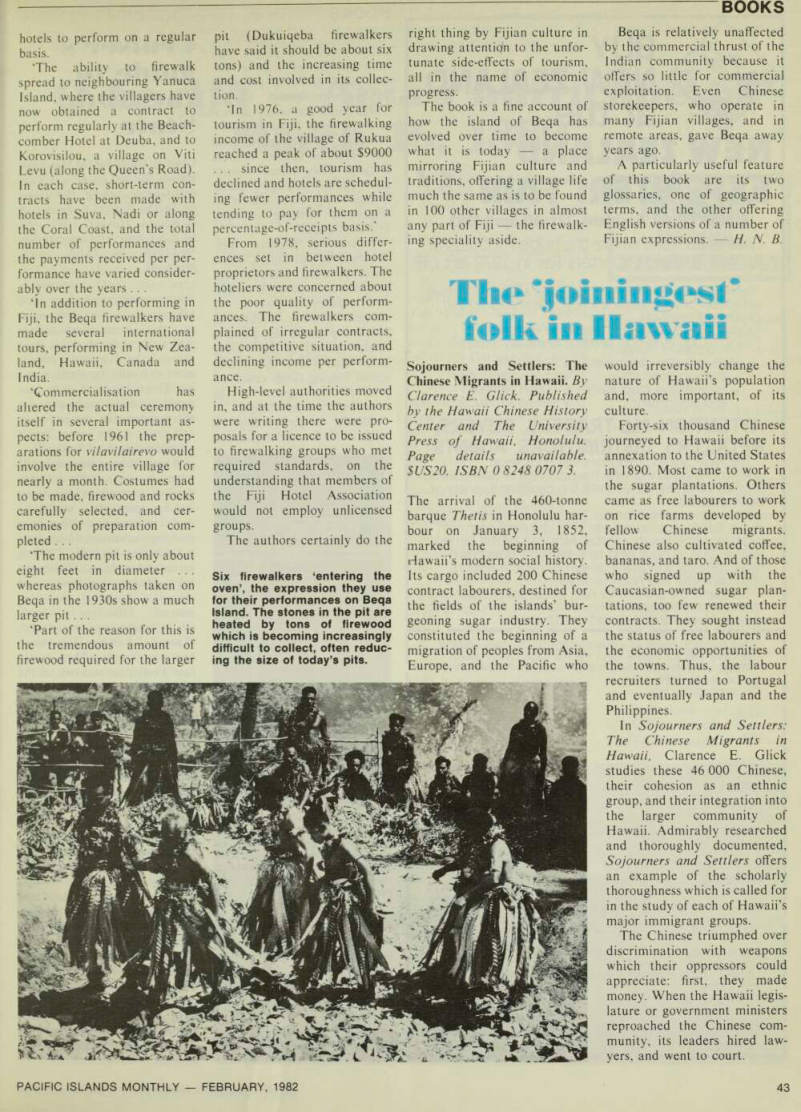
Vilavilairevo, which literally means ‘jumping into the oven’, is a skill which in the past belonged solely to the people of Sawau on Beqa, which lies off the south coast of Fiji’s main island of Vili Levu.
When this skill of walking barefoot on white-hot rocks was acquired cannot be dated, but legends describe its origins.
It was once the subject of restrictions the breaking of which could bring horrendous results as the gods took their revenge.
Once vilavilairevo was per formed only on special oc casions, such as for visiting royalty. Now it has spread to several other villages of Beqa, which make their own arrange ments with hotels to perform for tourists.
Its commercialisation began in 1958, when people from the Beqan village of Rukua per formed at the Hibiscus Festival in Suva.
Dakuibeqa was the first vil lage to perform for hotels, and was followed by Rukua, which made its first contract with the Korolevu Beach hotel in 1961, where they performed once a month for $4OO a time.
The authors describe the sequence of events: ‘Other vil lages became aware of the possibility of tapping the tourist industry with this unique art.
Dakuni, Dakuibeqa, Naceva and Naiseuseu all began signing contracts with various resort
hotels to perform on a regular basis.
The ability to firewalk spread to neighbouring Yanuca Island, where the villagers have now obtained a contract to perform regularly at the Beach comber Hotel at Deuba, and to Korovisilou, a village on Viti Levu (along the Queen's Road).
In each case, short-term con tracts have been made with hotels in Suva, Nadi or along the Coral Coast, and the total number of performances and the payments received per per formance have varied consider ably over the years. . .
Tn addition to performing in Fiji, the Beqa firewalkers have made several international tours, performing in New Zea land, Hawaii, Canada and India. ‘Commercialisation has altered the actual ceremony itself in several important as pects; before 1961 the prep arations for vilavilairevo would involve the entire village for nearly a month. Costumes had to be made, firewood and rocks carefully selected, and cer emonies of preparation com pleted . . . ‘The modern pit is only about eight feet in diameter .. . whereas photographs taken on Beqa in the 1930 s show a much larger pit.. . ‘Part of the reason for this is the tremendous amount of firewood required for the larger
pit (Dukuiqeba firewalkers have said it should be about six tons) and the increasing time and cost involved in its collec tion. ‘ln 1976. a good year for tourism in Fiji, the firewalking income of the village of Rukua reached a peak of about $9OOO .. . since then, tourism has declined and hotels are schedul ing fewer performances while lending to pay for them on a
percenlage-of-receipts basis.’
From 1978, serious differ ences set in between hotel proprietors and firewalkers. The hoteliers were concerned about the poor quality of perform ances. The firewalkers com plained of irregular contracts, the competitive situation, and declining income per perform ance.
High-level authorities moved in, and at the time the authors were writing there were pro posals for a licence to be issued to firewalking groups who met required standards, on the understanding that members of the Fiji Hotel Association would not employ unlicensed groups.
The authors certainly do the
right thing by Fijian culture in drawing attention to the unfor tunate side-effects of tourism, all in the name of economic progress.
The book is a fine account of how the island of Beqa has evolved over time to become what it is today a place mirroring Fijian culture and traditions, offering a village life much the same as is to be found in 100 other villages in almost any part of Fiji the firewalk ing speciality aside.
Beqa is relatively unaffected by the commercial thrust of the Indian community because it offers so little for commercial exploitation. Even Chinese storekeepers, who operate in many Fijian villages, and in remote areas, gave Beqa away years ago.
A particularly useful feature of this book are its two glossaries, one of geographic terms, and the other offering English versions of a number of
Fijian expressions.
H. N. B.
Six firewalkers ‘entering the oven’, the expression they use for their performances on Beqa Island. The stones in the pit are heated by tons of firewood which is becoming increasingly difficult to collect, often reduc ing the size of today’s pits.