Sox, surf and sand:
pp. 39-41 · Read in the full issue
Books
Sox, surf and sand: Tourism under test
Pacific Tourism: Contrasts in Values and Expectations. By Cynthia Z. Biddlecomb. Pub lished by Lotu Pasifika Pro ductions on behalf of the Pacific Conference of Churches, ii and 61 pp. No ISBN provided. Price SFI.BO.
Pacific Tourism: As Islanders See It. Edited by Ron Crocombe and Freda Rajotte.
Published by the Institute of Pacific Studies of the Univer sity of the South Pacific, in association with the South Pacific Social Sciences Associ ation. vi and 171 pp. No ISBN provided. Price SFS (hard cover), $3 (soft cover).
Everyone seems to have an opinion on tourism and these two books from Fiji, Pacific Tourism: As Islanders See It and Pacific Tourism: Contrasts in Values and Expectations , share a title, but not always the same ideas.
There must be about as many government reports, pro fessional publications, and pos ition papers about tourism now published as there are bro chures issued by national tour ism offices. On the one hand, the tourism-hungry governments seem to be bidding a seductive welcome, and on the other many of the reports cry out for caution.
In between are the central characters in the drama: the tourist hoping to ‘get away from it all’, and the eager local seeking to make a buck (or a franc) out of the alien hordes who seem to live so well and never work.
With the austral summer upon us, many office workers, families, retired folk, and other persons in the developed world are thinking about travel, and for most of them such excur sions will be ‘trips of a lifetime’.
They will be part of the five percent of the world’s popu lation that each year crosses an international boundary, many of them to take just a few weeks’ respite from the rigours of their daily lives.
On the other side, the weavers of Vavau are lining up
their baskets, and the carvers of Fiji whittling away at their take-away culture, in antici pation of the season of profits and plenty. Government tour ism offices have planned their budgets and advertising cam paigns. (The Fiji Visitors Bu reau, for example, recently an nounced plans to spend about $4 a head for the 200 000 visitors expected in 1982).
As the season approaches, the excitement in the air in a tourist area is as great as the pessimism expressed by some writers on the subject of tour ism.
Author Biddlecomb is herself a visitor to Fiji, but on a 14-month assignment from the Methodist Board of Global
Ministries. When her slim vol ume first appeared, it made the front page of one of the local newspapers. The report con tained mildly sensational refer ences to the ‘rape’ and ‘resent ment’ which could be expected by visitors if the profits from tourism were not shared more equitably in host communities.
Contrasts in Values and Ex pectations is intended for Pacific Islanders. The chapters end with four and in one case five questions for discussion.
Apart from criticism of ‘tour ism ghettos’, and the descrip tion of conflicts between local expectations of revenue and visitor values of relaxation, the book contains some useful com ments on study tours, visits to rural areas, and other additions to the conventional tourist agenda.
While strongly critical of some tourist attitudes, the book at the same time displays sym pathy for ‘tourists who have saved their pennies for years’ in order that they may one day flee the humdrum hell of their daily
lives to visit some ‘Pacific para dise’.
One central issue Biddle comb fails to discuss is the question of why package tours are so heavily planned and itineraries so restricted. The point is that the wealthy indus trial countries who supply most but not all of the world’s tourists are poor in time. For most vacationers, three to four weeks is all that can be afforded before they return to worries about mortgages, car repay ments, and their other everyday preoccupations.
Biddlecomb’s central point is that the churches should put the ‘holy’ back into holidays.
Clergy, whether ministering to visitors or locals, should strive to make their flocks aware of the meaning of what they are doing when they travel, and when they receive travellers.
The final chapter goes so far as to suggest that the churches
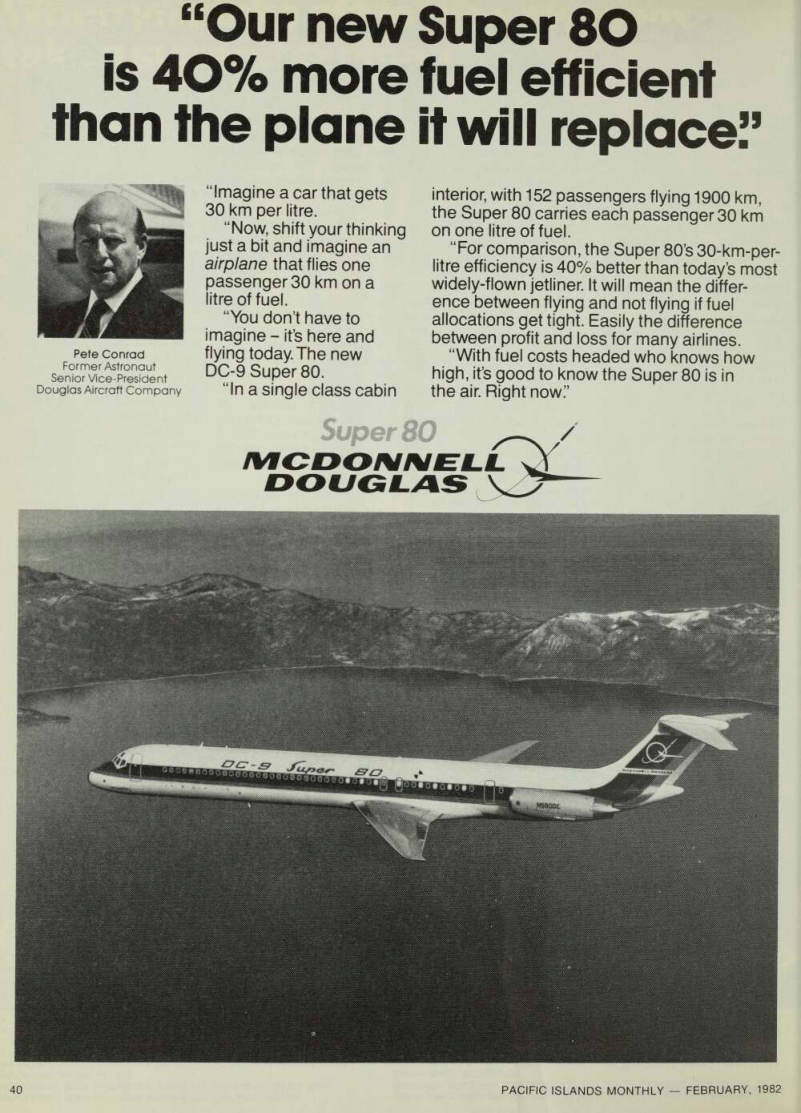
The Fiji tourist sell: It thrives on evocative names such as Para dise Point, Treasure Island, Castaway Island and Man Friday Resort. But what do the Island communities themselves get from tourism, and is organised tourism good or bad? Two books reviewed on these pages reveal wide diversities of opinion. - Picture from Trans Tours.
themselves should organise tours, stressing the concept of pilgrimage, as well as rec reation.
Certainly, the church organ isation on a world-wide scale is there. In medieval Europe, the church was the main organiser of travel. But whether the strict, almost puritanical, attitudes reflected by Biddlecomb will appeal to any large numbers of people, or prove capable of generating the kind of cash flow needed by export-poor tourist host countries, is another mat ter.
As Islanders See It is a different kind of book, in the recognised mould of the Insti tute of Pacific Studies. Except for editors Rajotte and Crocombe, all the other writers are nationals of Pacific Island states.
It struck me as ironic that just before the book’s launching
last year, there was a Fiji-wide tourism convention held in one of those oft-criticised luxury hotels. The theme was to urge more people to come to the country to boost the 58 percent occupancy rate under which many Fiji hotels were then labouring. It was at that con vention that Ms Jacqueline Hiue ‘the highest paid woman in Australia’ as she called herself made the quotable remark: ‘How would you market Fiji in the ’80s?
Like a can of beans!’ It is precisely attitudes such as this that are complained of by many of the Pacific Islander contribu tors to this book.
As Islanders See It deals with tourism in Tonga, Western Samoa, the Cooks, Fiji, Niue, Kiribati, Hawaii and parts of New Zealand. A tally of the opinions expressed in the 24
articles shows that 13 seem to be opposed to tourism, only five are unequivocally for its devel opment, while six try to balance good points with bad, and call for caution in the tourist indus try.
The Meleiseas’ academic piece on Western Samoa feels that tourism should be only the ‘icing on the ecomomic cake’, while little Niue hopes for an increase in its annual total of 300 bona fide visitors in order to justify its $250 000 hostelry, built with New Zealand aid.
Some of the articles such as the lead one by geographer Rajotte, and the Western Samoa piece referred to are academic exercises. But most are short impressions, derived from student papers prepared at the USP. (At least one of the Islander authors known to me
was surprised to see her third year class paper turn up in print in the volume. Some, such as Sarny’s ‘Crumbs From the Table’, a study of a tourist hotel, have been reprinted more than once.) As Islanders See It is very long on opinion, but rather short on facts.
The closing article, ‘Tourism in Reverse’, reports on inter views with 18 students, most of them on sponsored study tours of Fiji. It comes to the unsurprising conclusion that the shorter the stay, the greater the satisfaction with the time spent abroad.
Altogether, these two books shed some light on the tensions and disillusionments to which tourism gives rise. Central tour ist authorities, of course, do their very best to suppress all evidence of such ‘negative’ phenomena.
As I read about tourism, I can’t help recalling my first 18 years, spent in a small seaside resort, where, as kids, we used to paint ‘Tourists Go Home’ signs on walls and rockfaces during the night, before report ing for work in the (then) only industry in town.
Exploiter it may be, but tourism may also be the only commodity some communities have to sell. And for as many surly or careless out-of-towners as I endured, I also recall meeting good people just look ing for a good time.
I suspect that most hosts have
similar experiences.
Grant
McCall.
Trans Tours picture
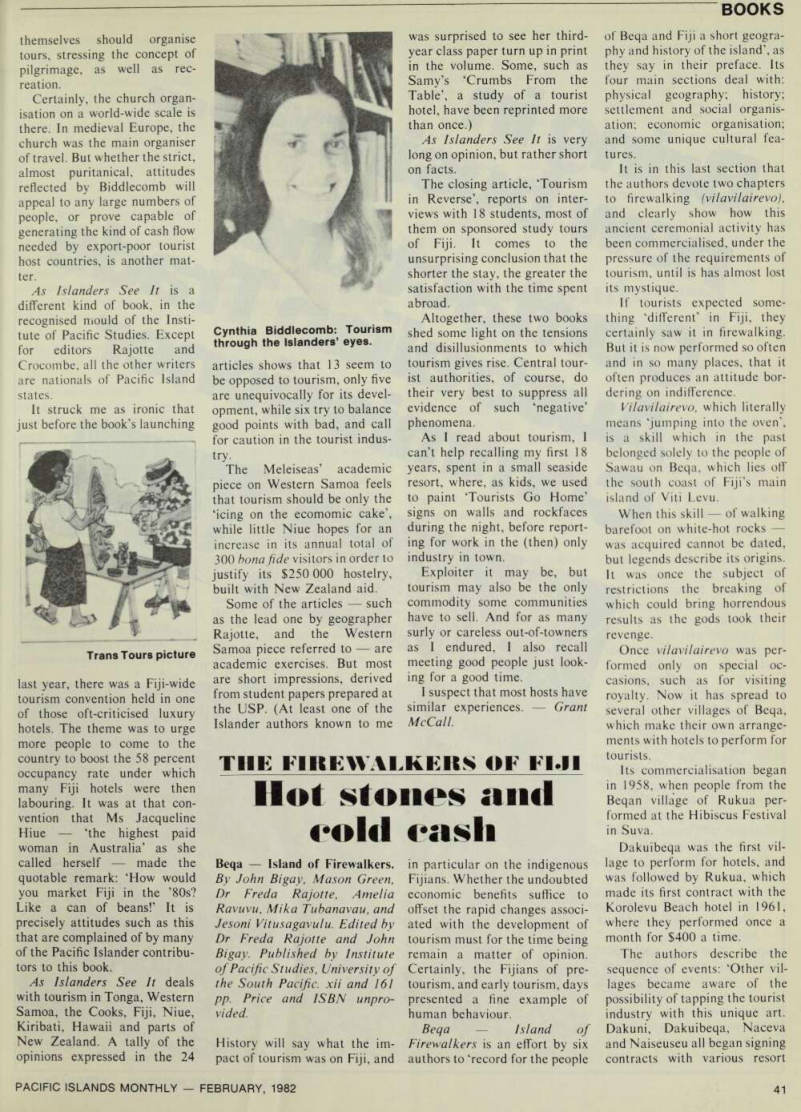
Cynthia Biddlecomb: Tourism through the Islanders’ eyes.