yachts were few
pp. 57-59 · Read in the full issue
Yachts
The days when cruising yachts were few and far between
One of the longest-running features in Pacific Islands Monthly deals with the movements, crews and vital statistics of yachts cruising in the Pacific Ocean. By the score they crisscross the seaways, explore the
island groups, and rendez-vous in major and minor ports of call.
It was not always thus. It was not until after World War II that large scale cruising became a popular way of life for so many people.
When Captain Slocum in Spray circumnavigated the world he and his small craft were possibly the sole ocean cruisers on the waters of the world at that time.
He was followed later by Ralph Stock in his Dream Ship. As a lad I eagerly followed the story of his wanderings as it appeared by instal ments in the now long-defunct Wide World Magazine.
In later years on the New Guinea goldfields I met up with an old tropical identity named Steve Randell who had been a crew member in Dream Ship during part of its world voyage. Another lone Pacific wanderer was a Frenchman, Alain Gerbault, in Firecrest.
In the early 1920 s great interest was created in Sydney by the arrival of a large diesel-powered luxury yacht owned by an American millionaire. This was Speejacks in
which the owner’s son and his new bride were making an extensive honeymoon cruise. While in Sydney one of the engineers became ill and
was replaced temporarily by a
schoolmate of mine in the person of
Frank Parkinson, who subsequently spent most of his working life as an
Burns Phi,p
sni P s ¥ r In the late 1920 s I was at Lae in New Guinea working with an air freighting company at this time the European population of Lae numbered 18 men, all connected with aviation when one morning ? -se three-masted schooner hove in sight and lay-to about a kilometre and a half offshore while a launch was lowered and brought a crew member ashore requesting pilotage to a safe anchorage. I undertook the job, was taken on board and after bringing the vessel close inshore, the anchor was dropped.
No ship of that size had visited Lae previously and it was not known that there was a deep bed of Markham River mud which, when shipping began visiting Lae, was to be the cause of burnt-out capstan winches and abandoned anchors and chains, The vessel was the Illyria owned by Cyrus Crane, a wealthy American manufacturer of plumb ing fittings. It was in the hands of his son, a university student, who was engaged in an extensive Pacific cruise with, as guest passengers, 10 of his university friends and two members of the faculty, professors of botany and marine life.
The crew comprised a captain and two deck officers, an engineer, a cook and two stewards, and half a dozen seamen whose work was shared by the passengers. The accommodation was in the luxury
class the vessel had cost $lOO 000 to build in the early 19205. Its present-day price would be staggering.
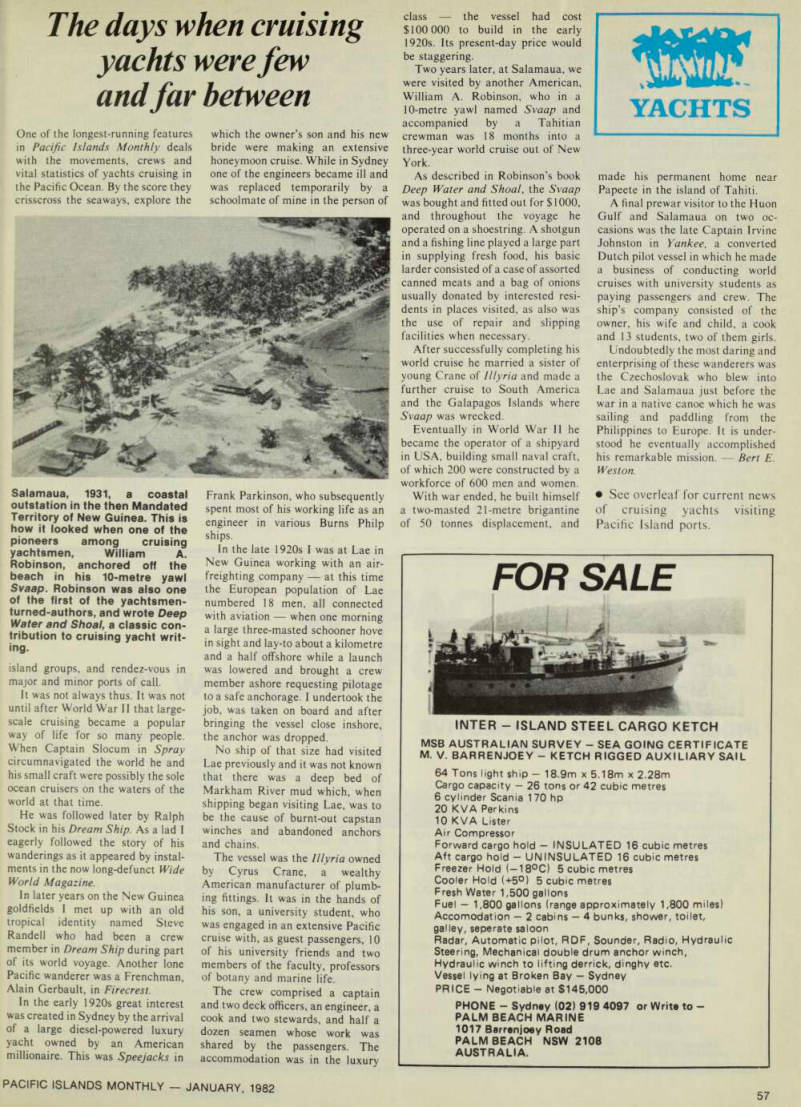
Two years later, at Salamaua, we were visited by another American, William A. Robinson, who in a 10-metre yawl named Svaap and accompanied by a Tahitian crewman was 18 months into a three-year world cruise out of New York.
As described in Robinson’s book Deep Water and Shoal , the Svaap was bought and fitted out for $ 1000, and throughout the voyage he operated on a shoestring. A shotgun and a fishing line played a large part in supplying fresh food, his basic larder consisted of a case of assorted canned meats and a bag of onions usually donated by interested resi dents in places visited, as also was the use of repair and slipping facilities when necessary.
After successfully completing his world cruise he married a sister of young Crane of Illyria and made a further cruise to South America and the Galapagos Islands where Svaap was wrecked.
Eventually in World War II he became the operator of a shipyard in USA, building small naval craft, of which 200 were constructed by a workforce of 600 men and women.
With war ended, he built himself a two-masted 21-metre brigantine of 50 tonnes displacement, and
made his permanent home near Papeete in the island of Tahiti.
A final prewar visitor to the Huon Gulf and Salamaua on two oc casions was the late Captain Irvine Johnston in Yankee, a converted Dutch pilot vessel in which he made a business of conducting world cruises with university students as paying passengers and crew. The ship’s company consisted of the owner, his wife and child, a cook and 13 students, two of them girls.
Undoubtedly the most daring and enterprising of these wanderers was the Czechoslovak who blew into Lae and Salamaua just before the war in a native canoe which he was sailing and paddling from the Philippines to Europe. It is under stood he eventually accomplished
his remarkable mission.
Bert E.
Weston.
• See overleaf for current news of cruising yachts visiting Pacific Island ports.
Salamaua, 1931, a coastal outstation in the then Mandated Territory of New Guinea. This is how it looked when one of the pioneers among cruising yachtsmen, William A.
Robinson, anchored off the beach in his 10-metre yawl Svaap. Robinson was also one of the first of the yachtsmen turned-authors, and wrote Deep Water and Shoal, a classic con tribution to cruising yacht writ ing.
The Fiji Visitors
BOREAL! reports from
Suva:
Many of Australia’s leading ocean racing yachts, including Admiral’s Cup and Clipper Cup contenders, are expected to compete in the 1 982 KB Sydney-Suva Yacht Race.
The race has recently been launched in Suva by the two organising clubs, the Royal Suva Yacht Club and the Middle Har bour Yacht Club of Sydney.
The Governor-General of Austra lia has been invited to start the race from Sydney on May 22.
The clubs are confident that there will be a record fleet in 1982.
Don Travers Re
ports from Tubuai 9
Austral Isi and s y French
Polynesia:
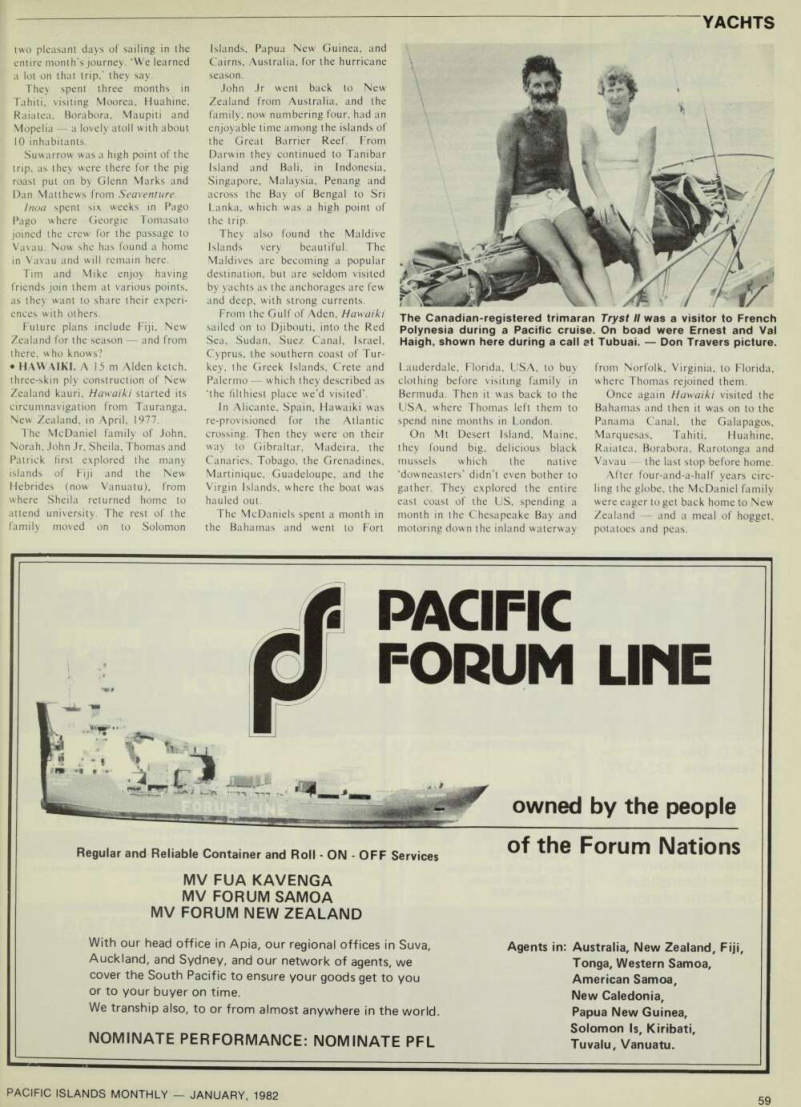
• TRYSTE 11. Al 2 m Hedley Nicol trimaran, with owners Ernest and Val Haigh, called at Tubuai last October from Raivavae and Tahiti.
The Haighs built their tri in British Columbia over the period 1966-68.
They have since pul 120 000 km under the keels, including a 1969-74 circumnavigation with four of their five daughters, and a 1977-78
Canada-New Zealand-Canada voy age with just themselves.
They began their present voyage last July from Canada and departed Tubuai for Rarotonga and Aitulaki in the Cook Islands, New Zealand and Australia (Tasmania).
Further plans are uncertain perhaps a second circumnavigation.
The word ‘tryste’ means ‘a journey in company’ in old Scottish.
Patty Kali Her Re
ports from Vavauy
Tonga:
• PELICAN This Golden Hind 9 m sloop is hull number 61 of the series.
It was built 14 years ago, but purchased by the present owners, the Hill family, two years ago in the Turks and Caicos Islands. They sailed her back to Florida and rebuilt her there.
In October, 1980, Janet, Robert and Tom Hill, who hail from Greenville, South Carolina, USA, left Florida for the Bahamas, Haiti, Jamaica and the San Bias Islands, where they were so enchanted they stayed two months.
From Panama they sailed to the Galapagos Islands where yachts are not allowed to remain for more than seven days. However, the Hills were
engaged in observing and photo graphing animal behaviour for sev eral weeks. They swam with sea lions ‘very safe and friendly so long as it wasn't mating season’ and found the penguins very friendly and inquisitive. Pelicans often landed on the boat and one picture of pelicans sitting on the lifelines of Pelican , flapping their wings to balance, is highly prized by the Hills. The parrot which was part of the crew at the lime and was normally nonplussed by visitors to the yacht, was driven to hysteria by the pelicans.
Next, Pelican visited the Marquesas (especially enjoying Uapou), the Tuamotus, Societies, and Pago Pago, before coming to Vavau. They are now spending the summer in New Zealand, with future plans indefinite.
• Seaventure. This 11 M
Freeport fibreglass sloop was bought new in San Francisco in February, 1980. Glen Marks and Dan Matthews then set out to learn to sail.
They left California in August of 'BO and arrived in Hilo, Hawaii, in need of a new engine which the manufacturer finally agreed to fly out for them.
On October 5, 1980, they were again headed for the South Pacific with dreams never fulfilled of
beautiful women swarming over their boat.
They spent five weeks in the Marquesas, visited the Tuamotus, Papeete. Borabora. Huahine, Raiatea, Tahaa, Moorea, and
Maupiti. On Maupiti they bought
Mortimer, a 19-kg pig, and moved him into the lazaret. 'He slept at our feet during the day. and was a much easier travelling companion than we
expected.'
On May 9, Mortimer was the star attraction of the ‘First and Last Annual Suwarrow Pig Roast', at tended by 27 people off 11 yachts.
From Suwarrow Glen and Dan sailed to Pago Pago and Apia, where Debbie Morrison joined them for the passage to Vavau and Fiji.
Seaventure will winter in New Zealand and return to San Francisco by November of 'B2. • INOA. The word means ‘name’ in Hawaiian, but in Eskimo it means ‘the soul of things’ and that is how owners Tim McCormick and Mike Sliefel feel about their fibreglass Westsail '32. They bought the boat in Honolulu in September, 1980, and started their adventure in December of that year.
The passage to Tahiti was a very
rough 28 days. They couldn't make
the easting to the Marquesas as
originally planned, and had only
two pleasant days of sailing in the entire month's journey. ‘We learned a lot on that trip,' they say.
They spent three months in Tahiti, visiting Moorea, Huahine, Raiatea, Borabora, Maupiti and Mopelia a lovely atoll with about 10 inhabitants.
Suwarrow was a high point of the trip, as they were there for the pig roast put on by Glenn Marks and Dan Matthews from Seaventure.
Inoa spent six weeks in Pago Pago where Georgic Tomasalo joined the crew for the passage to Vavau. Now she has found a home in Vavau and will remain here.
Tim and Mike enjoy having friends join them at various points, as they want to share their experi ences with others.
Future plans include Fiji, New Zealand for the season and from there, who knows? • HAWAIKI. A 15 m Alden ketch, three-skin ply construction of New Zealand kauri, Hawaiki started its circumnavigation from Tauranga, New Zealand, in April, 1977.
The McDaniel family of John.
Norah, John Jr, Sheila, Thomas and Patrick first explored the many islands of Fiji and the New Hebrides (now Vanuatu), from where Sheila returned home to attend university. The rest of the family moved on to Solomon
Islands, Papua New Guinea, and Cairns, Australia, for the hurricane season.
John Jr went back to New Zealand from Australia, and the family, now numbering four, had an enjoyable time among the islands of the Great Barrier Reef. From Darwin they continued to Tanibar Island and Bali, in Indonesia, Singapore, Malaysia, Penang and across the Bay of Bengal to Sri Lanka, which was a high point of the trip.
They also found the Maidive Islands very beautiful. The Maldives are becoming a popular destination, but are seldom visited by yachts as the anchorages are few and deep, with strong currents.
From the Gulf of Aden. Hawaiki sailed on to Djibouti, into the Red Sea, Sudan, Suez Canal, Israel, Cyprus, the southern coast of Tur key, the Greek Islands, Crete and Palermo which they described as ‘the filthiest place we’d visited'.
In Alicante, Spain, Hawaiki was re-provisioned for the Atlantic crossing. Then they were on their way to Gibraltar, Madeira, the Canaries, Tobago, the Grenadines,
Martinique, Guadeloupe, and the
Virgin Islands, where the boat was hauled out.
The McDaniels spent a month in the Bahamas and went to Fort
Lauderdale, Florida, USA, to buy clothing before visiting family in Bermuda. Then it was back to the USA, where Thomas left them to spend nine months in London.
On Mt Desert Island, Maine, they found big, delicious black mussels which the native ‘downeasters’ didn’t even bother to gather. They explored the entire east coast of the US, spending a month in the Chesapeake Bay and motoring down the inland waterway
from Norfolk, Virginia, to Florida, where Thomas rejoined them.
Once again Hawaiki visited the Bahamas and then it was on to the Panama Canal, the Galapagos, Marquesas, Tahiti, Huahine.
Raiatea, Borabora, Rarotonga and Vavau the last stop before home, After four-and-a-half years circ ling the globe, the McDaniel family were eager to get back home to New Zealand and a meal of hogget, potatoes and peas.
The Canadian-registered trimaran Tryst II was a visitor to French Polynesia during a Pacific cruise. On boad were Ernest and Val Haigh, shown here during a call at Tubuai. - Don Travers picture.