Can two opposite views of the past
pp. 24-29 · Read in the full issue

New Caledonia
Can two opposite views of the past be turned into one in the future?
Noted French historian Professor JEAN CHESNEAUX of the Sorbonne, Paris, recently made an on-the-spot study of the situation in the troubled French territory of New Caledonia. He found that there were glaring differences between the conceptions held of New Caledonia’s past by the Melanesian and French-descended communities, and argues constructively that it is not beyond the bounds of possibility that, should these conceptions become one in the future, the world could see New Caledonians of French origins living at peace in an independent New Caledonia in which the pre-eminent rights of the Kanak people are acknowledged. Professor Chesneaux’s article was written exclusively for PIM.
On September 24, 1853, France officially Took possession’ of New Caledonia. The past 128 years are perceived quite differently by the 60 000 Kanaks who at first became French ‘subjects’, and then French ‘citizens’, and by the 50 000 white Caldoches* who have been settled for gener ations on the main island. Cer tainly, the historical period is common to both communities they have shared it. But their historical conceptions of it are quite opposite.
For the Kanaks, it has been ‘a long night', a period of dispossession not only of their lands, but of their essential political being. Their utter re fusal to accept French power was expressed in silence and a dumb passivity, punctuated only by brief spasms of revolt such as those of 1878 and 1915, or waves of mass suicide such as occurred at the beginning of the 20th century. The Kanaks’ silence was interpreted quite wrongly by the whites as acquiesence. The considerable hold still exercised over the Kanaks by the Catholic and Protestant missions is due to the fact that, according even to representatives of the contem porary independence move ment, ‘they kept the Kanak people company throughout the long night’.
The Kanaks’ ‘folk memory’ itself was reduced to silence, going into a kind of hibernation.
It is waking up today. Old men now, when they feel they are among friends, will talk readily of the humiliations and mal
treatment associated with the corvee (compulsory labour) which was done away with only in 1945, at the same time as the whole system known as the indigenat a set of regulations defining the status and obli gations of indigenes, or ‘natives’. Today high chiefs AtaV and Noel, the leaders of the 1878 and 1915 insurrec tions, are publicly honoured, their names even appearing in graffiti on the walls of Noumea.
For the Kanaks, the past 128 years represent an immediate historical whole, a clear con tinuum of shared experience.
Their demand for the recog nition of ‘Kanak legitimacy’ stems from this sense of their continued and continuing exist ence as a race, and has its basis in history. Even if ‘Kanak collective self-awareness’, as an ethnic reference to all the tribes subjected since 1853 to French power, is a term of only recent origin, it is also a reality of only recent origin, a reality born of the rejection of French power.
Throughout these same 128 years, the ‘Caldoche’ settlers have been establishing them selves in New Caledonia. They came from France, but they also came from Algeria, Aden and Djibouti, Reunion, French trading establishments in India, and from Saigon, including its Chinese area. They followed the old sea route of the steamers plying between Marseilles and Noumea in the colonial period, thus giving rise to that high degree of cross-breeding which is typical of the Caldoches.
There are very few ‘white’ families established in New Caledonia for several gener ations who do not have at least one Algerian, Somali, Malabar
Indian, Vietnamese, or Chinese, ancestor . . .
Still today, Caldoche social life is steeped in antiquated colonial ways: meals eaten very early in the day, street names in Noumea, norms of social behav iour, type of education. The closeness to Australia, and the legacy of the penal colony, have endowed this Caldoche cultural identity with two quite singular features. Around 1860 the white colonists in New Caledonia began raising cattle in the large-spread, Australian fashion. In doing so, they at the same time adopted a whole social model; houses, ‘stores’, and streets laid out at right angles to each other in the little towns; ‘stations’, ‘stockmen’, and ‘rodeos’ in the country. The words in quotation marks have been adopted without change as part of the local French language.
The fact that New Caledonia served as a penal colony from 1864 to 1896 was long con sidered a taboo subject in polite circles. Such memories were not appreciated even if the name of the millionaire Right wing deputy to the National Assembly, Lafleur, comes straight from this criminal underworld of the past. Now, the subject is talked about in a relaxed manner. So much so that there’s no hesitation in discussing the ‘Reds’ of the Paris Commune who were depatched to New Caledonia in the years between 1872 and 1879. Anything judged likely to enhance the historical image of the white presence in New Caledonia is brought to the fore. There is great understand ing in Noumea for the convicts of the past. They were ‘poor
Political
Currents
folk, transported for doing] things that really didn’t amount I to much’.(But the same people] who voice these views are quite! pitiless when it comes to the! least sign of delinquency or] vandalism committed by the young, unemployed, Kanaks of 1 today.) For the same reasons, travel-] lers’ tales and other old texts! relating to New Caledonia are] being reprinted and are] being very well received; the] Caldoches are keen to assert! their historical position, their! roots in the country. But on one condition; nothing must be said about the essential thing, their] colonial origins. Except for! those who live in the bush, the ■ Caldoches don’t like being re-| ferred to as colons.
The Kanaks and the Caldoches thus have two very] different senses of history, they ! do not experience time in the same way. On the one hand there is a sense of permanence I and of the long-term past which I persists into the present in the \ form of protest and rejection. On the other hand there is a desire to affirm the historic ■ rights of the whites over this country to which they came as foreigners, and in which they s have created a whole patchwork I of highly diverse cultural j modes.
There is a similar contrast to
* Term used to denote New
Caledonian-born people of
French extraction.
be seen in the different ways in which the pasts of Kanak and Caldoche are inscribed upon the New Caledonian landscape.
For the Kanaks, land is the expression of the cosmic re lationship between man and nature. To be Kanak is to belong to a tribe, which is itself defined by the land space it occupies and brings to life. For a long time the land was shaped by the Kanaks’ ancestors, the ‘old men’, whose skills are still spoken of with pride. It is they who, at various places, created the petroglyphs, rock-carvings which represent a very ancient form of writing whose meaning is yet to be deciphered. On hillsides they established irri gated taraudieres, terraced farm gardens in which taro was grown. Their outlines can still be seen today. They also devel oped a technique of growing yams in long mounds, whose soil was painstakingly broken up, first with tools and then by hand, to make it lighter, and the growth of the yam plant easier.
This type of yam cultivation generally occurred on the lower slopes of hillsides. For gener ations this mound-style culti vation of yams was carried out on a collective basis, almost with ritual piety; the life-giving yam also represents the flesh of the dead.
But the process of colonis ation pushed all that aside.
For anyone who travels through the New Caledonian countryside today, it’s .common place to see free-roaming cattle walking on the remains of once fertile yam-growing mounds.
Fhe sight demonstrates the ex tent of the disaster that struck Kanak society when colonis ition got under way. When the Kanaks today demand the re urn of the land of which their ribes have been dispossessed, hey are asserting their essential dentity. Their attachment to he land represents an act of »olitical resistance, over and bove any economic criterion of development’ that might be put orward by the whites.
The Caldoche imprint on the tndscape is quite different. It espeaks a desire to master the lace, and is expressed in a long iventory of economic and pol ical schemes and endeavours, )me of which came to nothing,
and some of which have en dured. There are abandoned mines (as at La Balade), and forgotten dock installations along the coasts. There are factories and workshops, re conquered by the bush, of whose existence one can only learn from yellowed photo graphs. There are churches and mission buildings which remain in active use. Small military forts set on hillocks still serve as posts for the gendarmerie. Old prison buildings survive on Nou Island and the Isle of Pines only because of the excellence of their hewn stonework, which was carried out by convict labour. The Guide Bleu records all this for the benefit of tourists, but without making the slightest effort to bring out the inner meaning of all these constructions to be found in their particular locations. The ‘nickelisation’ of the landscape has had much more lasting
effects, and is much more per vasive, given that nickel ore remains New Caledonia’s main product and main export. There are huge orange-yellow gashes in the mountainsides, accumu lations of ‘deads’ in the valleys.
major mining installations, neat villages housing senior mining company employees as at Thio and Nepoui, and there is the Noumea factory, whose fires light up the town’s skies every night.
The Caldoche, especially if he is a town-dweller, has little sense of any inheritance in the form of buildings. Nineteenth century colonial Noumea, whose timber buildings were not lacking in charm, no longer exists except in the form of what is virtually debris like old Brisbane, or old Wellington.
For the Caldoches, their domi nant status is a self-evident fact, and, with some individual ex ceptions, they see no need to
assert it through a systematic programme of conservation of old churches and historic build ings. They have little practical use, and their upkeep is expensve. It’s easier and more profitable both for the real
estate and the building industry interests to replace them with new ones. This lack of concern for buildings inherited from the past is, as in Australia and New Zealand, typical of societies abruptly transplanted from Europe in the 19th cen tury. They were immediately caught up in the logic of immediate profits, with no time truly to express themselves through a built-up landscape, and to put down their roots in it.
When it happens today that one of the few remaining old buildings in Noumea is re stored, it is done to please the tourists and to indulge a current fad for ‘nostalgia’. Noumea’s old Town Hall has become a tourist information centre.
Nearby, a group of timber buildings has been renovated in lurid ‘pop’ style. It houses cinemas, luxury boutiques, and restaurants. It is known as ‘The Village', an attempt to evoke the ‘traditional’ which is pure commercial gimmickry.
Over the past 40 years the rate of passage of historical time has suddenly accelerated, in New Caledonia as elsewhere.
But the effects of this acceler ation have been perceived quite differently by the Kanaks and the Caldochcs. This is particu larly so in relation to three episodes.
In 1943-45, during the air and naval war in the Pacific, New Caledonia served as an advance base for the American forces. Among the hundreds of thousands of US soldiers who passed through the main island there were large numbers of black soldiers, and this fact alone stirred the Kanaks. With its numbers, its equipment, and its dynamism, the American army was the expression of a power far superior to that of France. In the Kanaks’ eyes, even if the moment had not yet come to say so openly, it was the end of the ‘white means French’ equation, the end of the French monopoly on a political man date. On the other hand, the American occupation made much less of an impact on the Caldoches. It offered them a model of daily life which was simpler and more relaxed than their own petty-bourgeois col onial formalism inherited from the 19th century. It also
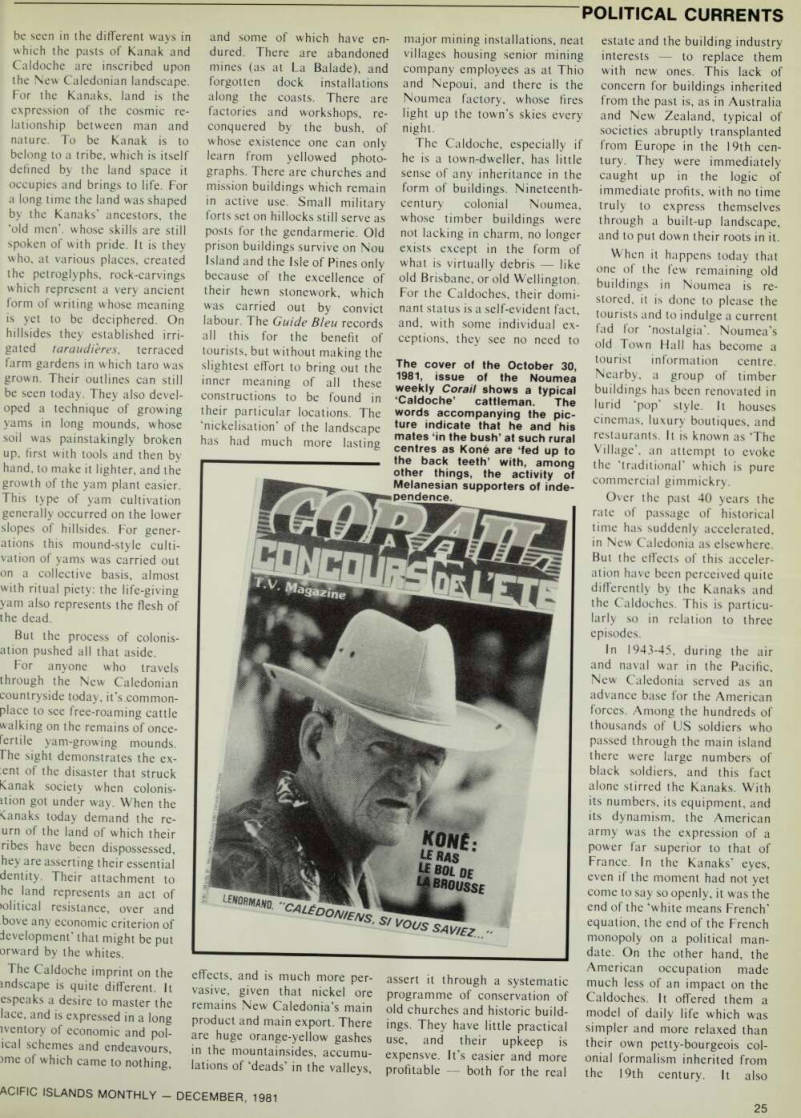
The cover of the October 30, 1981, issue of the Noumea weekly Corail shows a typical ‘Caldoche’ cattleman. The words accompanying the pic ture indicate that he and his mates in the bush’ at such rural centres as Kone are ‘fed up to the back teeth’ with, among other things, the activity of Melanesian supporters of inde pendence.
brought with it a vigorous and effective technology: in public works equipment, aviation, tele communications. The Cal dochcs have been adept in making use of the galvanised iron Quonset huts, or demi lunes (half-moons), left behind by the Americans as workshops or storage sheds.
The years 1950-60 saw the awakening of the Third World: liberation wars in Vietnam, Algeria, in the Portuguese col onies, the Bandung conference, and the massive influx into the United Nations of new, non- European stales. The Kanaks became aware, even if belat edly, of the echoes of this vast movement of decolonisation, particularly in the Pacific re gion. They have benefited from the diplomatic support for New Caledonia’s independence movement extended by the gov ernments of Papua New Guinea, Fiji, Solomon Islands, and Vanuatu, both in the UN and in direct contacts with the French Government. They have become aware of the links of a ‘Custom’ character which are being forged today between these countries: a Melanesian political-cultural linkage is tak ing shape and they know they belong to it, even if they are officially only an ‘Overseas Ter ritory’ (TOM), subject to Paris.
For the Caldoches, on the other hand, the drive for decolonisation induced only a mood of frosty withdrawal, es pecially in the 1970 s when it reached their doorstep.
But to the contrary, the ‘boom’ of the 1970 s was experi enced intensely by the Caldoches, who became intoxi cated with modernity. There was a leap forward in the extraction and production of nickel, and a surge in politico commercial dealings in imports and exports and the building industry, construction of hotels and luxury housing, and a race to acquire domestic electrical appliances and electronic audio visual gear. None of this, or hardly any of it, touched the Kanaks.
The Kanaks and Caldoches are not alone in New Caledonia.
There are also 30 000 people of Far Eastern or Pacific origins: Javanese and Vietnamese, who :ame in the 19305, Tahitians
and Wallisians imported during the boom period, both as docile labour and ‘reliable’ voters at election times. These minority groups in aggregate are com parable to the Kanak and Caldoche communities, es pecially in Noumea. However, they have practically no place in New Caledonia’s past. They have arrived too recently, and, more particularly, in the last analysis, they represent only a conglomeration of individual fates. They have been tossed across the Pacific by the exigencies of the labour market, or the vagaries of electoral politics. By the very conditions of their arrival in New Caledonia, they can have no collective historical conscious ness, and their attempts to assert their ethnic identity are made in an almost formalistic manner through a number of cultural associations (the Vietnamese, Javanese, etc, have their Amicales). Their presence is super-imposed, they have been more or less stuck on to the New Caledonian social fabric without putting down roots in the country and putting their imprint on it, as the Kanaks have done since time immem orial, and as the Caldoches have done in their fashion. There is no distinctive trace of their presence in the rural or city landscape, except the anonymous-looking concrete
housing blocks in which they have been lodged on the out skirts of Noumea, and the characterless modern church buildings where they foregather on Sunday mornings. They are there due to decisions taken by the whites. They are reduced to supporting the Caldoches on all matters of importance, while remaining in docile subordi nation to them.
And the future? What a paradox it is that the Caldoches, enamoured of mod ernity, having available to them the most ‘advanced’ techniques and the most ‘developed’ forms of social life, are desperately clinging to an outmoded politi cal set-up sheltered under the wing of their far-off metropolis.
While the Kanaks, who feel in their bones their Melanesian identity and attachment to their tribal lands, are asserting their right to independence that is, the right to define their future for themselves. The traditional ‘Custom’ they are standing up for so strongly doesn’t mean that they are longing for some vanished past they have said this time and again. It rep resents a point of departure towards a different future.
Can Kanaks and Caldoches live together in an independent New Caledonia? The Kanaks have never demanded that the Caldoches should go once their pre-eminent rights have been acknowledged. The Caldoches too are intimately tied to this land of their birth. When they set out to hunt deer, when they cook a dish of roussette, that strangely flavoured bat which feeds only on the nectar of
flowers, when they clear the bush from around their old timber houses, they are acting in an authentically Caldoche fashion. Their roots in the place cannot be placed on the same footing as the ‘legitimacy’ claimed by the Kanaks, but they are authentic nonetheless.
All Caldoches were not in toxicated by the boom, they don’t all approve of the struc tures of dominance set up in the country by France, they don’t all feel at ease when they go to Noumea, and some, when they talk about their convict ances tors, do so with a certain radical pride. How many of them are prepared to make a drastic reappraisal of the 128 years of white power? How many are prepared to face the facts of what their presence has cost the Melanesians, thus conceding all that in the eye of history has been fragile and false in that presence? It will no doubt be at this price that they may remain in this New Caledonian land which is, after all, ‘their country’ too. Will the new government of the Left in Paris prove able to promote the development of a Caldoche movement capable of seeing the future in these terms, in line with the Kanaks' claims? - Translated by Malcolm Salmon.
Belau: Story
behind bombs
Early in the morning of Tues day, September 8, Koror, the district centre and capital city of the Republic of Belau, was rocked by a bomb blast that devastated the office of the President of Belau, Haruo Remeliik (PIM Nov p 6).
The incident was entirely unexpected by observers out side Belau, despite the long drawn clamour there for better wages for government workers, which was the ostensible oc casion of the bombing. As by standers watched from a safe distance, the president’s office was broken into, and bombs with gunpowder charges were placed inside. The whole thing was carried out slowly and
methodically.
The action was in protest at the government’s refusal to negotiate on salaries. This is a
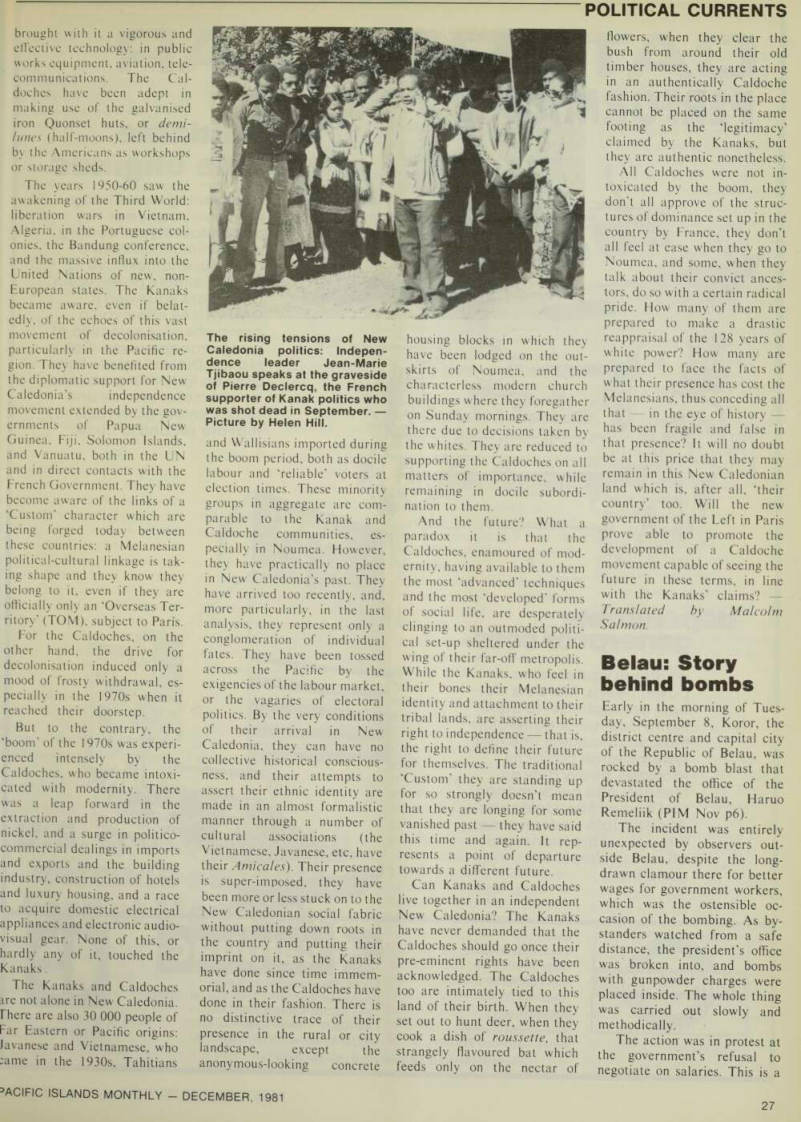
The rising tensions of New Caledonia politics: Indepen dence leader Jean-Marie Tjibaou speaks at the graveside of Pierre Declercq, the French supporter of Kanak politics who was shot dead in September.- Picture by Helen Hill.
particularly inopportune mo ment for wage negotiations since the various Micronesian governments are now getting reduced US federal aid, and must use what money they have to travel to the many meetings held in various parts of the world, the latest in Hawaii and the next in Washington, DC, to complete work on the Compact of Free Association and its attendant subsidiary agree ments. This, and other matters, have led to charges of over spending on travel by the execu tive branch, which has spent nearly SUSSOO 000 on it so far (time of writing: October 24) this year.
The Guam newspaper, Pacific Daily News, had a photo of the bombers in action, and a local television station sent one of their reporters, a Palauan woman, to interview govern ment officials, bombers and residents of Belau about the incident; her half-hour story was aired twice on television.
Later in the day, the Office of the President, the leadership of the Olbiil era Kelulau (legis lature), and members of the ‘Striking Government Em ployees’, with businessman Roman Tmetuchl as their rep resentative, signed an agree ment promising a $5O increase to lower classes of government employees and an increase of
525 to higher-paid employees
iffective October 1981. Other xunts in the five-point agree nent include a meeting of the resident with the high com nissioner concerning the de nands of the striking workers, einstatement of and withhold
ing of sanctions against the striking workers, and a promise by the strikers to return to work two hours after the execution of the agreement.
It is alleged that other build ings would have been bombed if the government had not nego tiated with the strikers.
In reaction to the involve ment of Mr Tmetuchl in this affair, there appeared a ‘Declar ation of Public Revenge’ writ ten anonymously in Palauan (without an English trans lation). It castigated Mr Tmetuchl, who had been an unsuccessful candidate for the office of president in the first election for the office held in 1980, alleging his use of the strikers’ demands to serve his own political and business aims, and naming four prominent people as his co-conspirators and supporters. There is no doubt of Mr Tmetuchl’s politi cal ambitions; he is already governor of Airai State in south eastern Babeldaob Island. But it is uncertain if his involvement in this matter will further his ends, or only harden and broaden his opposition.
In a recent television inter view seen on Guam, the high commissioner said those in volved in the bombing will be prosecuted once the situation in Belau allows a trial to be held in circumstances not likely to pro voke violence and to lead to additional acts of civil dis obedience. According to him, the agreement reached on September 8 does not preclude prosecution of those involved, as had been believed earlier.
Mark L. Berg on Guam.