Memorable
pp. 18-19 · Read in the full issue
visit from a man of the sea
Ever since President Mitterrand was elected, the big question to which everyone in French Polynesia has been trying to find the answer is: What does he plan to do with this, and the seven other overseas territories scattered around the globe like ‘the confetti of empire’ (to use the apt phrase coined by a French journalist)? The firm statement made in August by Defence Minister Charles Hernu that the nuclear tests at Moruroa will continue indefinitely (PIM Oct p 22) seemed to suggest that there will be no changes of a political character either.
However, coming close on the heels of Hernu, the new man in charge of overseas territories, Henri Emmanueli, saw fit to invite local party leaders to make suggestions as to how the present old-fashioned style of colonial rule might be liberalised.
This has resulted in a spate of proposals which all point in the direction of self-government for the territory, and, in most cases, envisage independence as the ultimate goal.
Such a line of development will, of course, be greatly helped if, in the future, the territory can achieve a greater degree of economic independence than it has managed in the past.
It was therefore with keen expectations that local Polynesian leaders awaited the visit of the first French Minister of the Sea, Louis Le Pensec, who arrived at Papeete’s Faaa airport on October 16. The fact that he hails from the French maritime province of Brittany, and grew up among the nation’s finest fishermen and sailors, suggested he was the right man to be looking into the requirements and potential of a territory that is 99.9 percent water. It should be added that with his jovial manner and low-key approach, he quickly endeared himself to his hosts. But they still found it hard to shake off the scepticism ingrained in them from repeated past experiences of unfulfilled government promises to develop the tremendous untapped resources of their surrounding seas.
Vice-President Francis Sanford (the French high com missioner is still president of the local council of government) has always believed that the future of the Polynesian people lies with the sea. He immediately put the minister’s intentions to the test by bringing up the touchy subject of the aberrant research policies hitherto pursued by the French oceanographic institute,
Cnexo.
This body has for almost 10 years been using its well equipped vessels searching for mineral nodules in the Pacific. But the results, instead of being communicated to the local government or territorial assembly in French Polynesia, have been made available exclusively to big private companies such as Rothschild’s Societe Le Nickel or Empain-Schneider.
To everybody’s surprise, the minister promptly came clean and gave a full account of the results of the CNEXO research.
But while his candour was appreciated, what he had to say brought little joy: CNEXO research had shown that there are no important fields of nodules in the 200-mile economic zone surrounding the five archipelagoes that make up French
Polynesia, and the poorest region turned out to be the last one explored the area south of Moruroa, where cataclysmic volcanic activities are constantly taking place at the bottom of the ocean.
Reports in the minister’s possession which were in no way secret, he said indicated that the richest deposits exist in the north Pacific, between California and Hawaii.
The work of the French research vessels has been so thorough that a quite accurate idea has been obtained of the extent and value of the nodule stocks in that region.
They cover an area of about 250 000 sq km, and the density is 10 kg of nodules per sq m. Their metal content is said to be manganese 25 percent, iron 10 percent, nickel 1.3 percent, copper 1.2 percent, and cobalt 0.25 percent. The real eye-opener came, however, with the blunt statement that France intends to extract three million tonnes of these nodules by the end of the 1980 s.
The revelations naturally aroused discussion as to what
benefits the territory might derive from these French mining operations. For example, it seems self-evident that it would be cheaper to build smelting plants in the islands of the Pacific than to ship untreated nodules back to France for processing. (Incidentally, the nearest French Polynesian islands to these great nodules deposits are the Marquesas, and this fact could explain a minor mystery which has long baffled us. Frequent visitors to the Marquesas over a number of years have been the
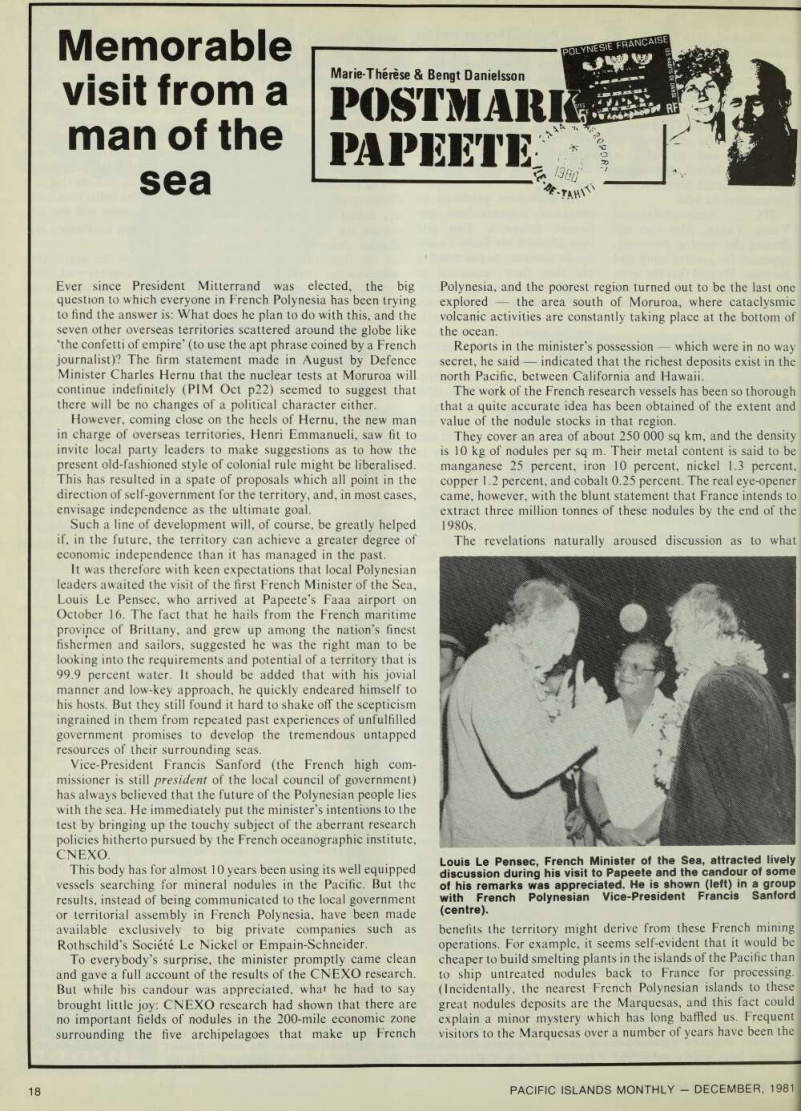
Louis Le Pensec, French Minister of the Sea, attracted lively discussion during his visit to Papeete and the candour of some of his remarks was appreciated. He is shown (left) in a group with French Polynesian Vice-President Francis Sanford (centre).
enterprising cousins of former President Giscard d’Estaing, all of whom represent big French business interests.) It is to be hoped, however, that the new regime in France will make a thorough study of these problems, and reconsider the whole scheme. The fact is that it involves tremendous ecological hazards which have hitherto received all too little attention.
These hazards arise from the fact that only 30 percent of the nodules’ content can be used, and that the residue 70 percent will constitute highly toxic waste material. If dumped back into the ocean, it will pollute the sea to such an extent that all pelagic fish will either be killed or scared away from this part of the Pacific.
The second criticism levelled at CNEXO by Francis Sanford and the other government councillors is that too much time and money have been spent on an experiment in shrimp-breeding in artificial ponds located on land at the organisation’s Tahiti headquarters. This project has always seemed quite pointless to
‘The political dividing line in the French Pacific does not separate socialists from conservatives. Leftwingers from Rightwingers, etc, but the colonised from the colonisers. ’
most Polynesian political leaders, who have time and again asked CNEXO to concentrate instead on sea-farming in the natural lagoon basins of the 80 atolls in the Tuamotu archipelago. To the undisguised delight of the old fighter Francis Sanford the new minister immediately ordered CNEXO to launch a three-year project along those lines, in spite of the director’s continued objection that fish kept in captivity must be fed regularly, a fact, he claims, which makes the profitability of this type of sea-farming highly doubtful.
It seems appropriate to mention here that a most interesting alternative, or complement, to fish-breeding has already been tried in the Tuamotus. Encouraged by the local Fisheries Department (which is thoroughly despised by the CNEXO people), many Polynesians, grouped in co-operatives, are already cultivating mother-of-pearl shells. The method is simple: they simply fix sticks of wood or plastic underwater or suspend them from floats, the spats fix themselves to the sticks, and in three years develop into marketable shells without having to be fed. Production in 1980 amounted to 25 tonnes worth CFPB million ($BO 000). Many of these Polynesian sea farmers have gone on from there to grow black pearls, and 1980 aroduction of these was 287 kg, which fetched a little over -FPIOO million ($1 million).
Main problems for the Polynesian pearl-growers is their nubility to master the grafting technique, which obliges them ; tiH to hire Japanese specialists for the job. They were therefore nightily pleased when the ever-obliging French minister iromised to establish a school where local lads can learn the Japanese technique. Since it has so far been a jealously guarded (apanese national secret, the implementation of this rash offer nay encounter some difficulties .. .
Continuing in his generous vein, Minister Le Pensec also >romised the setting-up of a University of the Sea in Tahiti (he yas understandably vague about the details). But he was quite pecific about another prestigious scheme: a major world onference on coral reefs will be held in Papeete in 1985, with 00 scientists in attendance.
The only sour note to be struck during the visit came from the Deal socialist party la mana te nunaa (not affiliated to, but of ourse in sympathy with, the French Socialist Party), which is ttractmg a steadily growing number of young Polynesians with s pro-independence and anti-nuclear programme. In a pointed üblic memorandum, it advised the slightly startled minister lat the development programmes he was advocating were all
wrong, and that the main effort should be concentrated on catching pelagic fish from locally owned vessels, a form of ocean exploitation in which the Polynesians had excelled for thousands of years. So why continue allowing as all previous French Governments had done huge fleets of foreign trawlers to scoop out of Polynesian waters an annual catch worth CFPIO billion ($lOO million), while paying fishing fees worth only CFPIB million ($lBO 000)?
As for the grandiose past, present and future farming and mining schemes, they all had the same basic fault: the main beneficiaries would be the big business companies, and the only role played in them by Polynesians would be that of low-paid workers, employed to do the dirty and dangerous jobs. A Socialist government, the memorandum said, should be the first to propose economic development based on productive units made up of kinship groups and co-operatives.
The next point made by the la mana leaders was that the university could very well wait, and that it was much more urgent and important to replace the present French-language and French-oriented curriculum in the primary schools with an education designed to prepare the children for a better and more useful life as Polynesians.
Then for good measure they tacked on a vigorous protest against the privileged position still enjoyed ‘by the upholders of the old-fashioned colonial system in the two French Pacific territories who continue to control the mass media, amass fabulous fortunes, exploit the poor and maintain the Polynesians and the Kanaks in economic, social and political ghettoes, and,
moreover, have the impudence to pose as spokesmen for their victims’.
To an outsider it may seem strange that the only criticism of the new French Government so far heard in French Polynesia comes from the local socialist party. But it only demonstrates a long-established and well-known fact: the political dividing line in French Polynesia (and of course also in New Caledonia) does not separate socialists from conservatives. Leftwingers from Rightwingers, etc, but the colonised from the colonisers.— Marie-Therese and Bengt Danielsson.
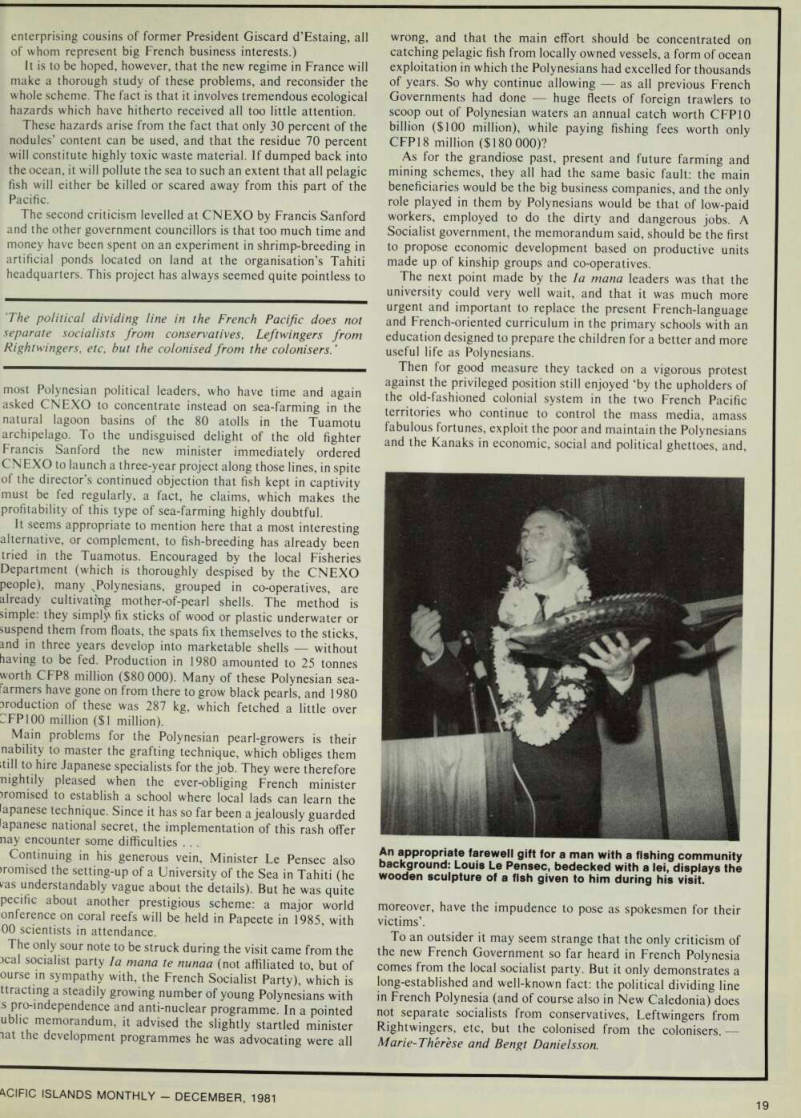
An appropriate farewell gift for a man with a fishing community background: Louis Le Pensec, bedecked with a lei, displays the wooden sculpture of a fish given to him during his visit.