Origins of
pp. 7-11 · Read in the full issue

Letters
Origins of Harold Gatty, aviator
In writing of the origins of Air Pacific (PIM Sep p 65) your Suva correspondent incorrectly refers to Harold Gatty as an ‘American aviator’.
Harold Gatty was born in Tasmania, Australia, and a monument has been erected at his birthplace in Campbelltown.
He served in the Royal Austra lian Air Force in command of air transport in the South Pacific during World War 11, md settled back in Fiji perma lently after the war, becoming i member of legislative council, md operating a copra plan ation.
Perhaps your correspondent s confused because it was American capital that financed iarold’s early, unsuccessful fforts to establish a tuna indus ry in Fiji, or because Harold’s round-the '°rld flight in 1931 was mnched in the IJS with merican aviator Wiley Post.
But Harold remained Austra an, and up to his death in 1957 i Suva always considered Fiji i home , as do I, his son, who as raised there.
Professor) RONALD GATTY ity University of New York ew York NY SA
lulling over
massacre reply to F. L. Ascencio’s ter (PIM Aug plO) I would e to make the following ints: 1) The point ©f my article IM Apr p 47) was that the linese sailor was unmentioned the monument. Even you, L. Ascencio, missed this as :t in your article. 2) The sub-title of F. L. cencio’s article reads; ‘lB7 irs ago the French and the
Samoans met at A’asu. The French lost 12 to o.’ However, at least one account says that 39 Samoans died. 3) How I missed F. L.
Ascencio’s article, I’ll never know. It was printed in a pamphlet entitled Amerika Samoa not to be confused with Captain Gray’s book of that title. Amerika Samoa was a short-lived, long-defunct, type-written, locally-distrib uted, very slim supplement to the government News Bulletin.
It is found in no Readers’ Guide and no back issues are kept even by local libraries. To find a copy I had to plough up dusty ‘archives’ in the bowels of the Administration Building. Keep watching these pages for my new article, The Search for Ascencio’s Missing Missive’.
Joseph Theroux
Pago Pago American Samoa
Torres reviewer
hits back
The replies (PIM Sep pp 7-9) to my review of John Singe’s book The Torres Strait: People and History by the author and by Mr Jones both misread and misconstrue what I wrote.
The central point of criticism I was making in PIM in my June review was that Mr Singe fails to out his stated purpose: to make his book ‘the Islanders’ story’. Somewhere between the telling of the facts to him by Islanders and the finished work he has managed to misread that story, and this can be illustrated in a host of ways.
Like Mr Singe I have found Islanders ready and able to tell people whom they trust the truth about their customs and
experience. When I read Mr Singe’s book I assumed that he had the good intentions which he now re-emphasises. I a,so sensed that it resulted from years of diligent and painstaking work.
When requested by the editor of PIM to review the book 1 was
aware that it contained many inaccuracies which were not only misleading but also damag ing to Islanders. I attempted to write about it as kindly as possible.
The context of the book and of my review is this: despite the onslaught by pearlers, missionaries, government bu reaucrats ‘protectors’, ‘man agers’, ‘government teachers’ on Island culture over more than 100 years and the subjec tion of Islanders to myriad ordeals, humiliations, re pressions and frustrations of initiative in the name of ‘better ment’, ‘civilising influences’ and cultural superiority, they have managed to survive as a people.
So much so that when Islander unity was put to the test by a proposal to shift the border in the 19705, Islanders who re mained in Torres Strait, and those who had found it necess ary to move to the mainland, replied unanimously.
Mr Singe appears to be only partially aware of this situation.
Perhaps he is unaware too of the current feelings of Islanders on their inalienable possession of their Islands and seas in long established custom. These were expressed in a poll conducted by the Torres Advisory Council in the Islands and the five communities in the northern peninsula area in July and August. The vote for freehold rights to their lands by the people at Bamaga on the main
land, where many Saibai Islanders now live, was just as overwhelming as that in the Islands.
The author’s belief that most Islanders living on the mainland are lost to their people and do not see their Islands again is currently being tested through Mr Bjelke-Petersen’s threat to abolish reserves without recognising customary land ownership by Islanders. Follow ing a public meeting in Townsville early in August, Islanders formed a land rights committee to fight for the return of the Islands to all Island people according to the established traditions of their forefathers.
Islanders’ move to the main land was associated with the collapse at the end of the ’sos of the pearling industry, within which they had been integrated for nearly a century, the con tinuing repressive situation me diated by Queensland Govern ment bureaucrats, and the DAIA-run second-rate schools sytem in the Islands.
Instead of giving credence to the erroneous conclusion drawn from a survey of Islanders in Townsville and Cairns in 1974 that Islanders on the mainland had ‘weak ties’ with the Torres Strait, Mr Singe could do something really helpful for his Island relatives, friends and informants. He might press governments to provide the
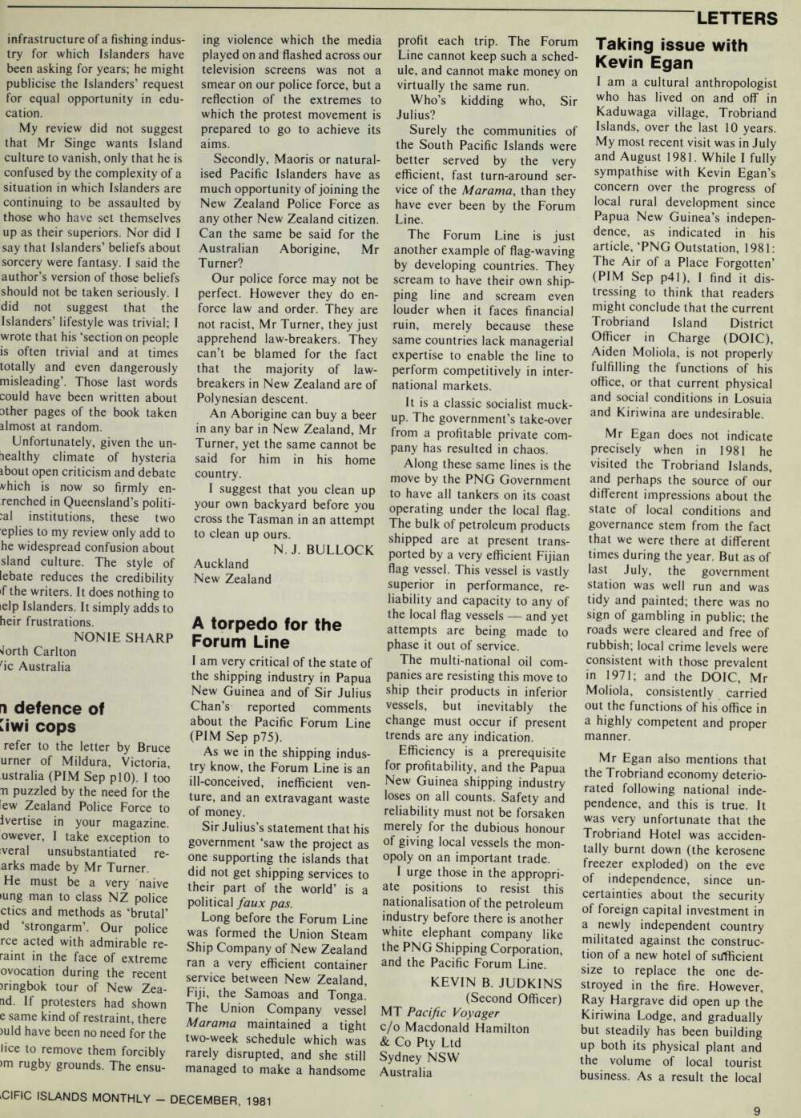
Yes-Harold Gatty was an Australian, and his son sets the record straight on this page.
Gatty (right) is shown soon after establishing Fiji Airways in 1951.
With him is pilot Fred Ladd, and the aircraft is a De Havilland DHB9A Rapide from the early fleet of the airline. The airline grew into Air Pacific, now the national flag-carrier.
infrastructure of a fishing indus try for which Islanders have been asking for years; he might publicise the Islanders’ request for equal opportunity in edu cation.
My review did not suggest that Mr Singe wants Island culture to vanish, only that he is confused by the complexity of a situation in which Islanders are continuing to be assaulted by those who have set themselves up as their superiors. Nor did I say that Islanders’ beliefs about sorcery were fantasy. I said the author’s version of those beliefs should not be taken seriously. I did not suggest that the Islanders’ lifestyle was trivial; I wrote that his ‘section on people is often trivial and at times
totally and even dangerously
misleading’. Those last words could have been written about ether pages of the book taken almost at random.
Unfortunately, given the un healthy climate of hysteria about open criticism and debate vhich is now so firmly en renched in Queensland’s politi cal institutions, these two eplies to my review only add to he widespread confusion about sland culture. The style of
lebate reduces the credibility
if the writers. It does nothing to ielp Islanders. It simply adds to heir frustrations.
Nonie Sharp
4orth Carlton r ic Australia
i defence of
[iwi cops
refer to the letter by Bruce urner of Mildura, Victoria, ustralia (PIM Sep plO). I too n puzzled by the need for the ew Zealand Police Force to Ivertise in your magazine, owever, I take exception to veral unsubstantiated re arks made by Mr Turner.
He must be a very naive »ung man to class NZ police ctics and methods as ‘brutal’ id ‘strongarm’. Our police rce acted with admirable re raint in the face of extreme evocation during the recent iringbok tour of New Zea nd. If protesters had shown e same kind of restraint, there )uld have been no need for the lice to remove them forcibly >m rugby grounds. The ensu
ing violence which the media played on and flashed across our television screens was not a smear on our police force, but a reflection of the extremes to which the protest movement is prepared to go to achieve its aims.
Secondly, Maoris or natural ised Pacific Islanders have as much opportunity of joining the New Zealand Police Force as any other New Zealand citizen.
Can the same be said for the Australian Aborigine, Mr Turner?
Our police force may not be perfect. However they do en force law and order. They are not racist, Mr Turner, they just apprehend law-breakers. They can’t be blamed for the fact that the majority of law breakers in New Zealand are of Polynesian descent.
An Aborigine can buy a beer in any bar in New Zealand, Mr Turner, yet the same cannot be said for him in his home country.
I suggest that you clean up your own backyard before you cross the Tasman in an attempt to clean up ours.
N. J. Bullock
Auckland New Zealand A torpedo for the
Forum Line
I am very critical of the state of the shipping industry in Papua New Guinea and of Sir Julius Chan’s reported comments about the Pacific Forum Line (PIM Sep p 75).
As we in the shipping indus try know, the Forum Line is an ill-conceived, inefficient ven ture, and an extravagant waste of money.
Sir Julius’s statement that his government ‘saw the project as one supporting the islands that did not get shipping services to their part of the world’ is a political faux pas.
Long before the Forum Line was formed the Union Steam Ship Company of New Zealand ran a very efficient container service between New Zealand, Fiji, the Samoas and Tonga.
The Union Company vessel Marama maintained a tight two-week schedule which was rarely disrupted, and she still managed to make a handsome
profit each trip. The Forum Line cannot keep such a sched ule, and cannot make money on virtually the same run.
Who’s kidding who, Sir Julius?
Surely the communities of the South Pacific Islands were better served by the very efficient, fast turn-around ser vice of the Marama, than they have ever been by the Forum Line.
The Forum Line is just another example of flag-waving by developing countries. They scream to have their own ship ping line and scream even louder when it faces financial ruin, merely because these same countries lack managerial expertise to enable the line to perform competitively in inter national markets.
It is a classic socialist muck up. The government’s take-over from a profitable private com pany has resulted in chaos.
Along these same lines is the move by the PNG Government to have all tankers on its coast operating under the local flag.
The bulk of petroleum products shipped are at present trans ported by a very efficient Fijian flag vessel. This vessel is vastly superior in performance, re liability and capacity to any of the local flag vessels and yet attempts are being made to phase it out of service.
The multi-national oil com panies are resisting this move to ship their products in inferior vessels, but inevitably the change must occur if present trends are any indication.
Efficiency is a prerequisite for profitability, and the Papua New Guinea shipping industry loses on all counts. Safety and reliability must not be forsaken merely for the dubious honour of giving local vessels the mon opoly on an important trade.
I urge those in the appropri ate positions to resist this nationalisation of the petroleum industry before there is another white elephant company like the PNG Shipping Corporation, and the Pacific Forum Line.
Kevin B. Judkins
(Second Officer) MT Pacific Voyager c/o Macdonald Hamilton & Co Pty Ltd Sydney NSW Australia
Taking issue with
Kevin Egan
I am a cultural anthropologist who has lived on and off in Kaduwaga village, Trobriand Islands, over the last 10 years.
My most recent visit was in July and August 1981. While I fully sympathise with Kevin Egan’s concern over the progress of local rural development since Papua New Guinea’s indepen dence, as indicated in his article, ‘PNG Outstation, 1981; The Air of a Place Forgotten’ (PIM Sep p4l), I find it dis tressing to think that readers might conclude that the current Trobriand Island District Officer in Charge (DOIC), Aiden Moliola, is not properly fulfilling the functions of his office, or that current physical and social conditions in Losuia and Kiriwina are undesirable.
Mr Egan does not indicate precisely when in 1981 he visited the Trobriand Islands, and perhaps the source of our different impressions about the state of local conditions and governance stem from the fact that we were there at different times during the year. But as of last July, the government station was well run and was tidy and painted; there was no sign of gambling in public; the roads were cleared and free of rubbish; local crime levels were consistent with those prevalent in 1971; and the DOIC, Mr Moliola, consistently carried out the functions of his office in a highly competent and proper manner.
Mr Egan also mentions that the Trobriand economy deterio rated following national inde pendence, and this is true. It was very unfortunate that the Trobriand Hotel was acciden tally burnt down (the kerosene freezer exploded) on the eve of independence, since un certainties about the security of foreign capital investment in a newly independent country militated against the construc tion of a new hotel of sufficient size to replace the one de stroyed in the fire. However, Ray Hargrave did open up the Kiriwina Lodge, and gradually but steadily has been building up both its physical plant and the volume of local tourist business. As a result the local
wood-carving industry, the mainstay of the Trobriand cash economy, has been recovering, and it is reasonable to expect that in the fairly near future the income derived from wood carv ings will approach the level attained before the Trobriand Hotel fire.
Susan P. Montague
Associate Professor of Anthropology Northern Illinois University DeKalb Illinois
Usa
More on HJM,
Rls
I enjoyed very much reading Joseph Theroux’s series on Harry Jay Moors (PIM Aug ppsl-57, Sep pps9-64).
Mr Theroux has erred, how ever, in stating that Robert Louis Stevenson ‘left Moors a photo of himself and his Caligraph typewriter’. Accord ing to my pirated edition of Moors’ book (With Stevenson in Samoa), Collins Clear-Type Press, London and Glasgow), it was Mrs Stevenson who pres ented Moors with a portrait of RSL ‘as a token of regard’ before she left Samoa. The famous Caligraph typewriter was acquired by Moors at an auction when much of the Vailima furniture, and part of the library, was sold.
While it is generally believed, as Mr Theroux points out, that Stevenson cut no great figure in the minds of most white men in Samoa, he was also, according to Moors, a prophet in the eyes of the Samoans, and ‘honoured as a man set apart from his fellows’. Interestingly, when Moors first met RLS he ac knowledged his station: ‘This was Stevenson RLS, “the best beloved initials in recent literature” and I knew it even before he spoke.’ Refer ring to Stevenson’s land pur chases, Moors says: ‘Vailima! it means “five waters”; but with the lapse of time the configuration of the country has altered, and you will only find two streams running there now.’
Perhaps the meaning ‘a handful of water’ is more appropriate.
As a result of a letter from me appearing in the journal Samoana in 1965 which asked if there were any Samoans alive who remembered RLS, I was
introduced by Eddie Stowers of 2AP to an 81-year-old Irish- Gilbertese, Mrs Mary Palu Tuioti. Invalided with elephan tiasis, she still possessed a remarkably sharp mind. She recalled that Tusitala’ as Stevenson was known to the Samoans always rode on a white horse, ahead of the ladies of his household when they passed Malifa, where as 10-year-old Mary Hall she lived in 1894. Mrs Palu said that on one occasion a rug, which always covered the buggy, worked its way down the back and fell off on the road. She and her younger sister saw this, and ‘remembering what they had been taught by the Catholic Sisters at Savalalo’, ran to pick up the rug and proceeded to chase after the buggy, calling out to the ladies as they made their way down to Apia. Finally the buggy stopped and, in appreciation for what the girls had done, the old lady presumably Stevenson’s mother gave them each a coin.
With the passage of time I doubt very much if there is a Samoan living today who would remember Stevenson.
Incidentally, RLS’s real name was Robert Lewis Balfour Stevenson, as his last will and testament of September 1893 revealed. An ad featuring land for sale near ‘Robert Lewis Stevenson’s’ old home carried in PIM for several months in 1980 was therefore not in error as some may have thought.
To end on a personal note;
when I addressed a Seventh-day Adventist end-of-year school gathering in Apia on December 4, 1964, and spoke about the life and works of RLS to mark the 70th anniversary of his death, I was flattered to be asked if, because of an apparent likeness, I was a relative of some kind (see picture PIM Mar 1963 p3l). Alas, Scots ancestry and a love of Samoa are all I have in common with the famed novelist.
John Milne
Bangkok Thailand A critic takes a
second bite
As Marie-Therese and Bengt Danielsson (PIM Aug pp 9-10) ask for a reply, I apologise for once again seeking space in your letters columns. 1) As Mr H. Lombard has written to me personally, and, I believe, in a new letter to PIM, he did not consider my letter ‘a rambling affair’, but clear, pre cise and to the point. I wished to say if the Danielssons care to read my letter carefully that I agreed with Mr Lombard’s observations. I did not write that he ascribes the present situation to ‘a hasty decolonisation’. 2) Sadly, I found myself reading in the same August issue of PIM an article by Associate Editor Malcolm Salmon on The Politics of the Vahines’, which brings new confirmation of Mr Lombard’s and my opinions. The letter of a nearly pure Tahitian (how many are there?) Mr H. Wright (PIM Aug plO) should also give matter for reflection to Marie- Therese and Bengt Danielsson
.. . On ‘politics’, they give evidence themselves in their ninth paragraph. 3) I wish only to repeat here what a friend of mine remarked to me in Papeete 20 years ago: ‘Would the Tahitians resign themselves to becoming “danc ing monkeys” for American tourists?’ Is such a future ac cepted by the Danielssons for their friends in independence?
As far as other ‘decolonised islands’ are concerned, I know more about Papua New Guinea than the Danielssons. I did not get publicity from a ‘rafting venture’, but worked obscurely for 20 years as a lay missionary, then a health officer, in the most remote parts of PNG. I vacci nated thousands of people on the West Irian border against smallpox, was in charge of campaigns against malaria and tuberculosis, worked among leprosy sufferers and kuru vic tims (with Dr C. Gajdusek, Nobel Prize for medicine, 1976).
I married a New Britain girl in 1963 and we have had four daughters.
We remain in contact with our second country (France is only third) through our friends who are still in PNG, or many mixed families in the far north of Queensland. We know, from the financial problems of the Chan government, tribal troubles in the Highlands, separatisms in New Britain or Bougainville, that there are not many people hapnv today in the former Territory This does not mean that they are ‘eager to return to the colonial fold’ (Danielssons dixit). I wish only to repeat the remark made by Mr Michael Somare a few years ago to the effect that ‘localis ation of the public service has been too rapid and too general’ a lesson for future free islands.
J. Huonde
Navrancourt
Atherton Qld Australia
Bravo, lambakey
Okuk!
1 would vote for Papua New Guinea’s Deputy Prime Minis ter Okuk if I were a constituent of his. I say this on the basis of what was written about his
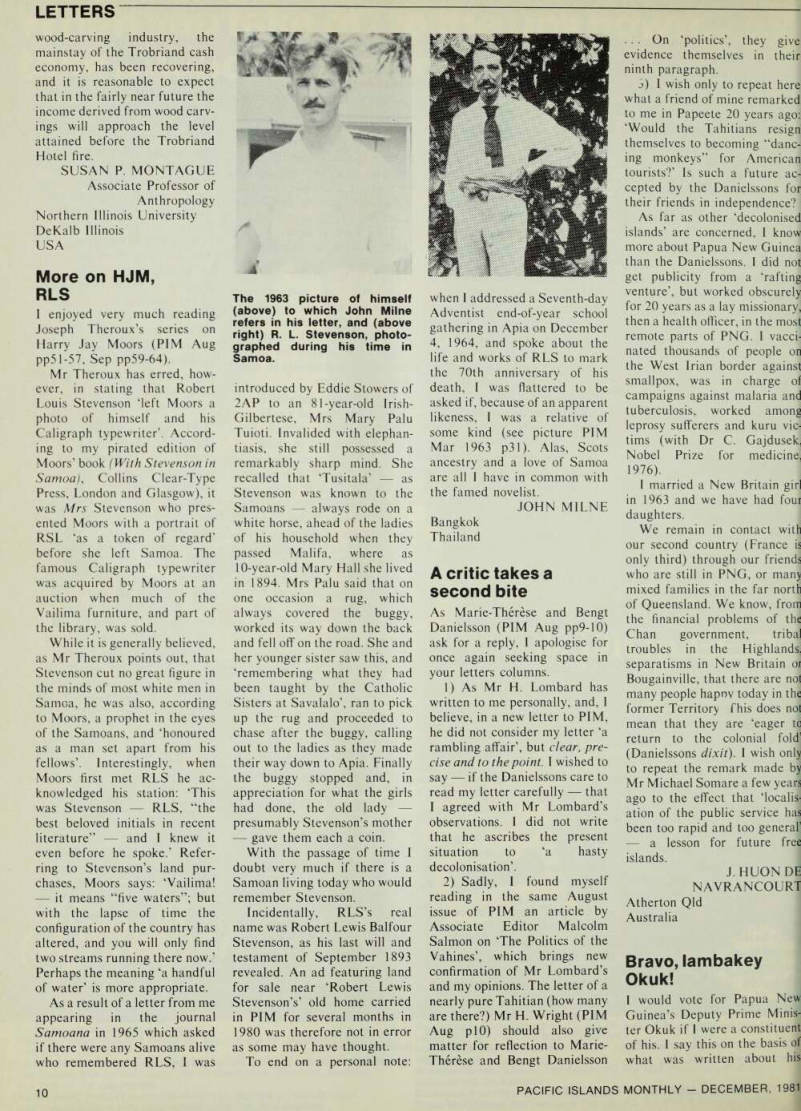
The 1963 picture of himself (above) to which John Milne refers in his letter, and (above right) R. L. Stevenson, photo graphed during his time in Samoa.
recent visit to Australia by Angus Smales (PIM Aug 1981 p5B).
PNG is fortunate to have a man active in its government who says what he means and means what he says. They are few and far between. Bravo Mr lambakey Okuk!
An incisive piece. Bravo Mr Angus Smales!
Thomas P. Butterfield
Pleasant Hill Calif
Usa
The item referred to by reader Butterfield was a straight news report of some of what Mr Okuk had to say during his visit to Australia. It n no way implied my or p lM’s political support for Mr Okuk. Angus Smales, Editor.
More on Tuvalu
controversy
note that a further letter from 4r Telavi Fati has been pub ished in PIM (Sep p 7).
I do not wish to prolong this orrespondence, but in view of 'hat is said in the letter re ared to I feel that your readers lay be interested in the result f the recent general election ith regard to Nanumea.
Mr Telavi Fati was a candi ate, and the result of the poll as that he came fifth among lose standing for election. I as re-elected.
I leave your readers to judge ho was making ‘wild and ill msidered’ statements, and ho better represents the ishes of the people of anumea.
Maheu Naniseni Mp
atangitonga anumea ivalu
emembering Prince
ee 800 :ame across your November ue of PIM (1980) yesterday, d since I’m originally from lau (born and raised) 1 lughl Ed inquire about the icle on Prince Lee 800 which a published on page 22 of it issue.
I would like to know if Messrs -hards and Peacock are do ; something for the 200th liversary of the death of nee Lee 800 in 1984. Also,
I’d like to know if there’s any published pamphlets or comic strips on sale at this time in relation to Prince Lee 800.
I’m prepared to meet all the expenses for I think it’s a very noble idea for all Palauans to celebrate Prince Lee Boo’s 200th anniversary. Palauans are slowly but surely forgetting their customs, their cultures and their histories. At the time 1 was in school we still had Micronesian history to study, but now that course has long been eliminated in order to make space for the new society.
At this time in Palau, anyone who’s 20 and under probably has never heard of Prince Lee 800.
Thank you for your co operation. Keep up the good work . . .
Jesse Ray Mikel
PO Box C-10994 Represa Calif
Usa 95671
Over to Messrs Richards and
Peacock.
Editor.
Ambassador’s good
oil on Easter Island
Professor R. Crocombe has seen fit to reply (PIM Oct p 7) to my letter (PIM Jun p 9).
I do not propose to enter into a polemic with him. He has formed his ideas and however one-sided his sources and emotionally coloured his views, they are only his concern.
I would be grateful, however, if you allowed me to clarify certain aspects of his reply, mainly for the benefit of PIM readers who, because of the connotations implied in Pro fessor Crocombe’s letter, might form an erroneous image.
The present system of gov ernment of Chile was ratified on September 11, 1980, when 67% of all Chileans and Easter Islanders are Chilean voted in favour of the new consti tution.
The mayor of Easter Island is Mr Samuel Cardinal!, a civ ilian. As 1 stated in my previous letter, Easter Island is one province of the sth Region of Chile, which comprises also the provinces of Petorca, Los Andes, San Felipe, Quillota, Valparaiso and San Antonio. In a Unitarian system such as ours, different from a federal admin
istration. Regional Adminis trators are and always have been appointed by the Central Government and are dependent upon the Minister of the In terior, a civilian. The Regional Administrator of the sth Re gion is indeed, an admiral, sitting at Valparaiso, Chile’s main military as well as com mercial port. He is not a ‘minister with special respons ibility for Easter Island’, and such a position does not exist in Chile.
As for the University of Chile, it has had for many years an extension programme for Easter Island since its academic responsibilities include research and extension in all Regions of Chile.
Professor Crocombe visited Easter Island for the confer ence on ‘The Pacific Com munity: Towards a role for Latin America’(October 1979).
As is customary in all inter national meetings where a country is host to a number of foreign authorities who are there as its guests, consider ation is given to their security.
We have recently seen this on the occason of the CHOGM in Melbourne.
It is regrettable that Pro fessor Crocombe has miscon strued these measures in Easter Island.
Thanking you for permitting me to clarify these points, I remain
Jorge Valdovinos
Ambassador for Chile in Australia Canberra ACT Australia
Where’s Melbourne,
Hobart?
I have been a PIM reader for 40 years, and would like to draw your attention to what seem to me omissions in the map of the Pacific which each month ap pears on the magazine’s title page.
The map takes in the east coast of Australia, and notes the positions of Brisbane, Sydney, and Canberra.
My question is: Why aren’t Melbourne and Hobart in cluded? I think both should rate a mention, especially in view of the fact that Melbourne has air connections to the Pacific (in
eluding the Air Nauru ser vices), and Hobart has the Ansett service to Christchurch, New Zealand.
Eric W. Trebilcock
(Formerly of Salamaua, Papua New Guinea.) Camberwell Vic Australia Thank you. It’s a good point, strengthened by the new air transport developments.
Editor.
U.S. sub base for Belau?
I recently read an article in The Times of Papua New Guinea (Oct 16-22, 1981) about a US submarine base planned for Belau in the Pacific, despite the Belau people’s overwhelming opposition to the project ex pressed in three separate refer endums (as reported by American scientist R. C.
Aldridge).
Can’t the US, the ‘civilised’ super-power, realise that we simple ‘primitive’ folk of the Pacific Islands are for a nuclear free Pacific, and do not want our islands and territorial waters to be military zones, and possibly made unfit for human habitation?
Both the US and France have much on their consciences in this respect. Consider Bikini and Moruroa atolls.
I know that this letter will carry little weight, and will be ignored. But let it be printed all the same.
Not only is the US presence in the Pacific frightening, it is also questionable. Consider the US involvement in Latin America, and how they have been involved indirectly or di rectly in every coup and counter-revolution over many years in that part of the world.
If you are genuine about our security, then stay. But if you are genuine only about your egotistical super-power arms race, and your experiments that could end in some form of genocide in our region, leave us alone.
I would rather die at an invader’s hand than by the hand of my defender.
L. X. Noman
Port Moresby Papua New Guinea