Meeting New Caledonian tourism
pp. 53-57 · Read in the full issue

Travel
Meeting New Caledonian tourism ‘pros’, Kolka and Patrick
For a week in September, PIM Associate Editor Malcolm Salmon, his wife Peta and their nine-year-old son Ben were in New Caledonia as guests of the Territory’s tourism authorities. In the first of two articles, Malcolm Salmon describes two day-trip destinations available to visitors to Noumea: He Ouen, or Turtle Island, and the lighthouse island of Amedee.
‘Beware Horse Bites Atten tion Cheval Tres Mechant Merci.’ The rather startling, roughly lettered, sign nailed to the trunk of a coconut palm greeted us as we arrived for a day’s visit to New Caledonia’s He Ouen, or Turtle Island (large sea turtles are frequent visitors to the place).
But the slim, barefoot, bronzed man in the colourful manu (local name for the pareu) who had come to wel come us at the plane was reassuring. Of the horse in question he said: ‘He’s a stallion and he has no mate.’ The man’s English had only the slightest trace of French accent. ‘He sometimes gets frustrated and children can misjudge his mood .. .’ The handsome beast who was the subject of the warning was grazing about 50 metres away, taking not the slightest notice of us.
So we could turn our full attention to the handsome hu man who was to be our host for the day: we were in fact in the presence of the redoubtable Kolka Muller, one of the pion eers of New Caledonia’s tourist industry, and a man described by one travel writer as ‘a host second to none in the South Seas’.
Mr Muller’s 12-year-old op eration is the Turtle Club Hotel, which consists of 14 local-style bungalows (containing 60 beds) set in the midst of an old coconut plantation by the water’s edge. Meals are taken in the Big Chief Hut, a large, pleasant, high-ceilinged build ing in Melanesian style contain ing restaurant and bar and a small shop where the main stock-in-trade appears to be fabrics hand-dyed and painted by Mr Muller’s wife Josy.
Hard and imaginative work over the years by Mr Muller and his staff (present number 15) has created a delightful
environment around the Turtle Club Hotel. But the cultivation has in no way detracted from the relaxed, ‘lotus eater’ atmo sphere which appears to be one of the main goals of the exer cise. We particularly liked the gloriously coloured parrot Coco, the gluttonous domesti cated sea eagle (nameless so far as we could discover), and the three extremely amiable Alsatian dogs (Mr Muller hails originally from Alsace?) who, along with that nasty sex starved horse, know the hotel grounds as their home.
Shortly after our arrival, together with about a dozen other Australians who were on longer stays on the island, we boarded the hotel’s powerful, twin-motored speedboat for the 7 km crossing to the uninhabi ted island of Mato which be longs to the Turtle Club.
On the way we stopped to look at coral on the sea bottom while Mr Muller went over the side spear-fishing for something fresh for lunch. He caught a coral trout and several strange looking sea creatures that I had no hope in the world of identify ing.
Once on Mato, the vigorous took to swimming and snorkel ling, or walking the 3 km circuit of the island. As for myself, I talked to Kolka Muller, who lay on the sand resting after his under-water exertions. ‘He’s working,’ I said with a hint of mockery as I indicated the 45-year-old king of Turtle Island basking in the sun.
He rose to the bait beauti fully. ‘There’s a lot of work in this life of mine,’ he said in a slightly admonitory tone. ‘Now, I didn’t want to go spear-fishing on that crossing. But it’s part of the programme. I don’t usually do this trip, my young assistant does. But he’s hurt his foot and couldn’t do the job today. So I’ve had to do it for him.’
He thought for a moment. ‘Don’t think it’s an easy life on an isolated island like the He Ouen. I suppose you’d call it a choice of a life.’
Kolka Muller first came to the Pacific to Tahiti about 25 years ago. The son of a
French journalist couple, he started a news service in Papeete, the Agence Tahitienne de Presse, which he ran for several years.
Then he moved to New Caledonia where he managed a hotel on the Isle of Pines for a while before branching out on his own at the lie Ouen.
In the course of the establish ment from scratch of his hotel he has had to learn everything from carpentry, plumbing and first aid, to pilot ing the light aircraft which he in time acquired for ease of access
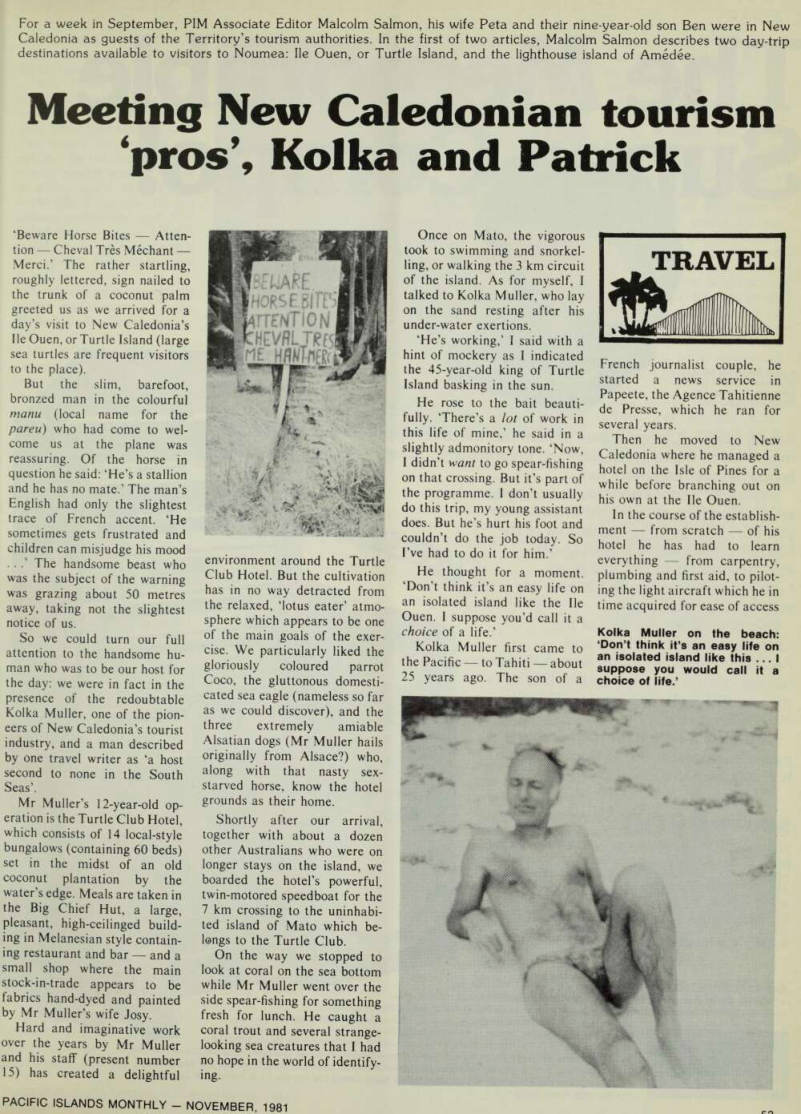
Kolka Muller on the beach: ‘Don’t think it’s an easy life on an isolated island like this ... I suppose you would call it a choice of life.’
to the mainland, and for the occasional sight-seeing joyride flights requested by guests. ‘Now I can run the place effectively because I can do everything that needs to be done better than anybody else.’
The remark was perhaps not notable for its modesty, but nobody who has seen Mr Muller in action would be likely to doubt that it was true. He is a tourism professional, and New Caledonian tourist officials would be the last to deny that the industry needs many more of his kind.
As the day wore on, we were to see much more of Kolka Muller’s professionalism in ac tion.
His daughter Catherine, an extremely well-favoured young lady of 15, had come with us on the trip to Mato. She appeared to have cut one of her fingers rather badly, and certainly was in no mood for catching sea snakes. But this is evidently part of the routine entertain ment provided for guests on the trip to Mato, and, at a sharp word from Papa, she made a slightly foot-dragging departure for a walk around the island in search of her quarry. She was back within the half-hour bear ing a plump and sleepy black and-white-banded specimen to the accompaniment of the regu lation ‘oohs’ and ‘aahs’ of the hotel guests present.
The young Frenchman with the foot injury for whom Kolka Muller stood in on the Mato trip probably now regrets the fact that the boss did his job that day.
After we had eaten the excel lent lunch that awaited us in the Big Chief Hut on our return from Mato, I heard Mr Muller giving him, in French, a quiet but firm dressing-down over the state of some of the diving masks and flippers which are kept for the use of guests in small lockers under the deck of the speedboat. Some were in an unusable state, and Mr Muller said the situation had to be put right and fast.
So the poor young chap I never caught his name, but we’ll call him Chariot le Boileux, or Charlie the Lame, for the occasion found his antici pated ‘sick day’ threatened.
Sure enough, at about 3 pm, we
saw Chariot limping down to the water and mounting a surfboard on which he hand paddled his way out to where the speedboat was moored. He spent the next hour or so hobbling about the deck picking out pieces of defective diving gear. Then he hand-paddled his way back with them for repair or replacement.
I should mention that on several occasions during our stay in New Caledonia I heard much more than I was meant to hear. The exchange between Kolka and poor Chariot was only one example. I had taken a deliberate decision not to go out of my way to let people know that I understand and speak French fairly well. I did this for a specific purpose. I wanted to check on one of the most persistent stories brought back by Australian visitors to New Caledonia. This is to the effect that the locals often feign not to understand English in order to embarrass visitors into attempt ing to speak French. After my little experiment, I can say that, speaking English almost con stantly as I did, I found no sign of any such thing. Whatever might have been the case in the past, it seems to be different today. Is this part of the lengthy
process of adjustment, and outward-turning, by the New Caledonians which is essential if the territorial government’s plan for a major development of tourism is to succeed?
But back to He Ouen.
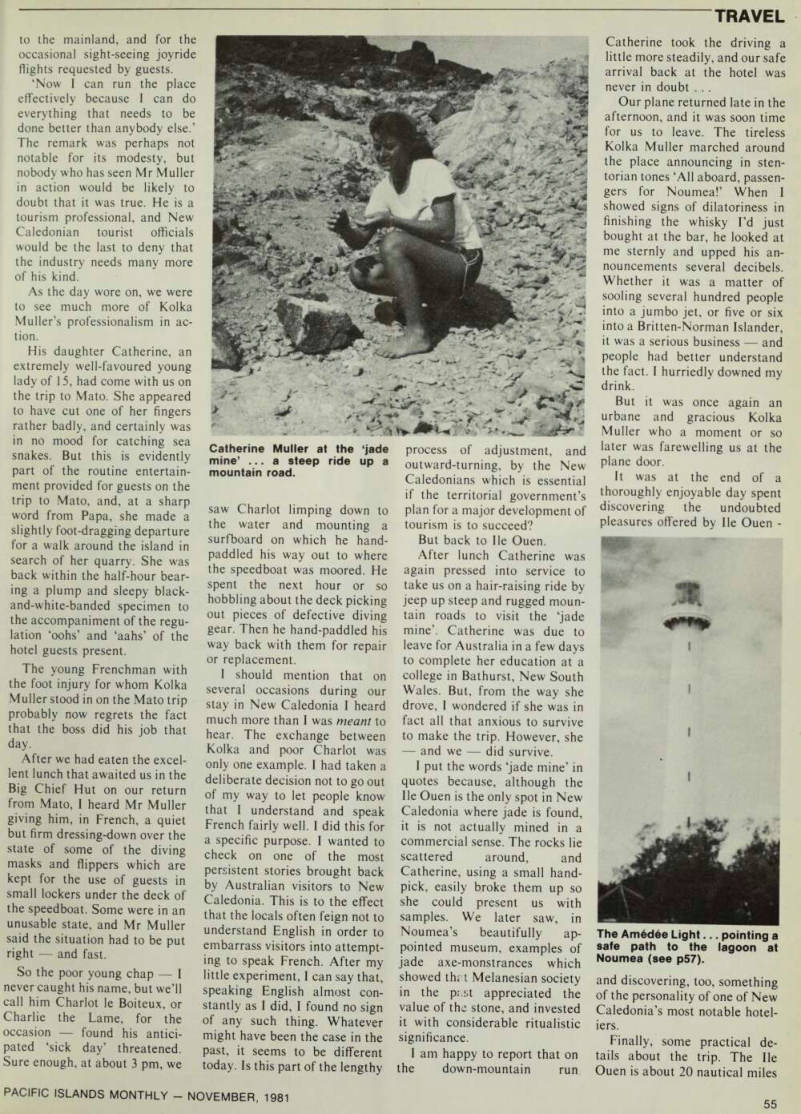
After lunch Catherine was again pressed into service to take us on a hair-raising ride by jeep up steep and rugged moun tain roads to visit the ‘jade mine’. Catherine was due to leave for Australia in a few days to complete her education at a college in Bathurst, New South Wales. But, from the way she drove, I wondered if she was in fact all that anxious to survive to make the trip. However, she and we did survive.
I put the words ‘jade mine’ in quotes because, although the He Ouen is the only spot in New Caledonia where jade is found, it is not actually mined in a commercial sense. The rocks lie scattered around, and Catherine, using a small hand pick, easily broke them up so she could present us with samples. We later saw, in Noumea’s beautifully ap pointed museum, examples of jade axe-monstrances which showed th< t Melanesian society in the past appreciated the value of the stone, and invested it with considerable ritualistic significance.
I am happy to report that on the down-mountain run
Catherine took the driving a little more steadily, and our safe arrival back at the hotel was never in doubt . . .
Our plane returned late in the afternoon, and it was soon time for us to leave. The tireless Kolka Muller marched around the place announcing in sten torian tones ‘All aboard, passen gers for Noumea!’ When I showed signs of dilatoriness in finishing the whisky I’d just bought at the bar, he looked at me sternly and upped his an nouncements several decibels.
Whether it was a matter of sooling several hundred people into a jumbo jet, or five or six into a Britten-Norman Islander, it was a serious business and people had better understand the fact. I hurriedly downed my drink.
But it was once again an urbane and gracious Kolka Muller who a moment or so later was farewelling us at the plane door.
It was at the end of a thoroughly enjoyable day spent discovering the undoubted pleasures offered by He Ouen -
and discovering, too, something of the personality of one of New Caledonia’s most notable hotel iers.
Finally, some practical de tails about the trip. The He Ouen is about 20 nautical miles
Catherine Muller at the ‘jade mine’ ... a steep ride up a mountain road.
The Amedee Light... pointing a safe path to the lagoon at Noumea (see p57).
to the southeast of Noumea.
Our flight there from Noumea by Air Caledonie Islander took just 15 minutes the return air fare was CFP3OOO.
Turtle Club Hotel tariffs seemed reasonable: CFP46OO a day for one person in a single room, CFP36SO each for a couple sharing a room with twin beds, and CFP36SO for each extra person. Prices include all meals. Children under two are lodged free of charge, and for children under six, there is a 50% discount. At the time of our stay in New Caledonia, September 1-9. exchange rates hovered around CFPIIS for the $A and CFP9B for the SUS.
A second memorable day trip that came our way was a visit to Amedee Island, site of an ex
ceptionally graceful-looking
lighthouse. The beneficent task of the Amedee Light, which was erected in 1862, only nine years after the French took possession of New Caledonia, is to guide ships through a narrow passage into the calm interior of Noumea’s lagoon.
For this trip we were in the hands of another professional but of a different kind from our friend at He Ouen. Patrick Helmy is a golf professional from San Francisco who had come to New Caledonia only about six months before our visit intending to practise his trade at the nine-hole Noumea course which he confidently
expected would be open for business at any minute. At least, that’s what he’d been told.
But, as they say in Noumea: ‘Our golf course is like the Loch Ness monster much talked about but never sighted.’ The golf course project has appar ently gone through many vicissitudes for a number of years now. I don’t know the details. I can only say that it is not yet functioning, even though a few fanatical devotees of the game hit a ball around parts of it from time to time.
The main problem, it seems, is that the nearby Dumbea River has a nasty habit of covering it with water at regular intervals.
Patrick could read the signs as well as anybody else if not better than most. After several months of waiting, he knew he had to do something else or get out of the Territory altogether.
About June this year he bought into the Mary D , a large pleasure cruiser which was once a familiar sight on the waters of Australia’s Sydney Harbour. (‘lt belongs to me and the bank,’ said Patrick.) Most days of the week Patrick and his trusty, mainly Polynesian, crew run cruises to Amedee Island with the Mary D.
The crossing from Anse Vata beach is about an hour and
three-quarters.
On the Sunday we went, the cruiser was packed, and on the voyage out the sea was rough enough to make one or two
schoolchildren seasick but not, I’m glad to say, young Ben. (This is as bad a crossing as you’ll ever have,’ said Patrick reassuringly.) But the run back to Noumea in the late afternoon was made in millpond con ditions.
The sea crossings, however, are less than the half of the Mary D experience. On the island, there was swimming, snorkelling, and the (to me uninviting, and unaccepted) challenge of climbing the nearly 250 steps to the top of the lighthouse for the view. Peta and Ben did it while I lolled on the beach. For the next couple of days Peta’s leg muscles were so stiff that she got under way in the mornings in a manner that made Chariot le Boiteux look as nimble as a mountain goat.
But the highlight of the day was the lunch, eaten from the long tables set under trees, and the ensuing entertainment.
With Patrick always the attent ive and unforcedly friendly host, and his crew demonstrat ing that they were just as strong on cooking and service as on seamanship skills, a splendid and generous Islands lunch was prepared and cooked before the eyes of the guests. They ate it with all the more zest for having breathed in those copious quantities of invigorating sea air and also, no doubt, because Patrick had demon strated a far from tight-fisted attitude in the matter of pre lunch drinks.
The lunch over, the guests were enticed by the gifted ship’s captain (now ‘master of cer emonies’) into an impromptu
version (mockery?) of a tamure.
The atmosphere generated was such that Ben rightly dubi ous about my dancing ability was quite impressed with my performance opposite a young Japanese lady. (‘You were pretty good, Dad,’ said he.) The Japanese girl had happened to pick me as an obviously harmless-looking partner in one (‘Choose a man you’ve never seen before’) segment of the affair. I agree with Ben. I think I did pretty well at trying to knock my knees together too.
Incredibly, Patrick’s crew members, after the labours of preparing and cleaning-up after the lunch, still had something in reserve. The trip back to Anse Vata was made a delight by their excellent, guitar accompanied singing. What was most impressive was that their numbers were chosen with an unfailing sense of just who was on board to be entertained.
There were lots of French songs, some Australian, some Canadian, some Japanese.
There was even a Spanish number in honour of a passen ger from the Philippines. The atmosphere was carefree, ‘spon taneous’. But their choice of material could not have been more carefully tailored to their audience. At CFP26SO per adult head, the Mary D experi ence is certainly good value.
Despite what looks like a highly successful operation with the Mary D , Patrick hasn’t forgotten his original purpose: secured to the main pillar in the passenger cabin of the cruiser was a dazzling white Yank-style golfbag, filled with a massive, glittering array of clubs (some of which actually had holes in their heads, a type of golfing implement I had never seen before). Patrick told me he planned soon to open a driving range on Amedee Island to which he hoped to attract many golfing visitors, particularly Japanese gentlemen. He feels he can give them much cheaper tuition than they can usually find at home. Whether wielding a golf club or hosting an Islands lunch, Patrick, too, is a pro fessional.
Next month: The Isle of Pines; the anatomy of New Caledonia’s plans for the devel opment of tourism.
Patrick Helmy ... professional golfer on another course
View out of the Amedee Light ... with nearly 250 steps to the top it’s an exercise for only the stout-hearted visitor.