Crossing the Pacific
pp. 71-73 · Read in the full issue

with oar and sail
Yachtsman Webb Chiles, who left San Diego on the US west coast in November 1978, is now in Malaysia and well on his way to singlehandling his 5.5-metre open yawl Chidiock Tichborne round the world in five years. JOHN B. HART writes here about the Pacific leg of the venture, and how Chiles made history late last year when he sailed into Cairns in northern Australia. It was the first US-Australia crossing in an open boat, and included a disastrous capsize east of Vanuatu.
‘I am striking a blow for small boats everywhere’ were the words of Webb Chiles when he put to sea from Mission Bay, San Diego, in November 1978 to cross the Pacific on the first leg of a five-year voyage round the world in an open boat.
There was no wind, so he rowed his 5.5-metre British-made yawl Chidiock Tichborne out to sea with 32 000 miles ahead of him.
Webb, now 38, first became known as a world voyager when he sailed the 11-metre cutter Egregi ous round the world in 202 sailing days in 1975-76. Storm Passage, his book about the voyage, is still a best-seller among nautical publica tions. His current exploit in Chidiock took him first from San Diego to the Marquesas, and de spite the lack of wind at the start he made the 3000-mile crossing in 34 days and nights surprisingly fast for such a small craft. He suffered one knockdown from a 50-knot wind gust, but the boat righted itself immediately and he sailed on with out further incident.
His first landfall was in Nuku Hiva’s glorious Taiohae Bay in the Marquesas, where Maurice McKittrick’s island store welcomed him with all the French vanilla ice cream he could eat. Fewer than 50 boats call at this mountainous Marquesan island each year. A small airstrip now receives one flight a week from Tahiti, but the visitor finds no hotels, no res taurants, no bars and no honkytonks n this remote north-eastern corner
)f French Polynesia where nothing
nuch has changed over the past 100 I'ears.
Ending nearly three weeks in the Marquesas, Webb pointed Chidiock toward Tahiti, 900 miles o the southwest, on January 3 979. After skirting the dangerous uamotu archipelago close to the uge atoll of Rangiroa, Webb raised ‘oint Venus light in a mere 10 days - a creditable performance.
Jearby was historic Matavai Bay 'here sailing captains Cook, Wallis nd Bligh had anchored in earlier enturies.
Next morning, instead of an uneventful couple of hours to Papeete harbour, a sudden tropical storm began to blow engineless little Chidiock Tichborne clear round the island of Tahiti the wrong way. It meant 1 00 extra miles in four rough days and nights. For one stretch Chiles was at the helm more than 33 hours straight, as Lindbergh was when he flew solo from New York to Paris. South of the isthmus separat ing Tahiti and Tahiti-Iti near Mataiea where Maugham wrote The Moon and Sixpence Webb had to row frantically to avoid being run down by a wide-swinging ship under tow. k lt was my closest call since leaving San Diego there’s danger even in Paradise’ was Webb’s comment later.
When Webb finally tied up in Papeete he slept solidly for 24 hours. Mum Stuart, from the water front hotel bearing her name (she died this year at the age of 84), said That nice American boy on little sailboat, he sleep such a long time with no wake-up at all. He very tired.’
Webb’s wife Suzanne flew from California to join him in French Polynesia, and they spent three
months on board Chidiock explor ing Tahiti and the outer islands of Moorea, Huahine, Raiatea, Tahaa and Borabora.
Alone again, Webb sailed Chidiock out of Borabora and after a slow 16-day passage sighted mountainous American Samoa.
The winds blew every which way except from the south-east as they are supposed to do,’ he said. On July 14 (Bastille day back in Tahiti) Chidiock found a mooring beneath the towering green hillsides which surround spectacular Pago Pago harbour. Suzanne rejoined him after a flight from Papeete, but there was little opportunity for local cruising because of the pounding surf and lack of safe anchorages.
Too Americanised’ was their com ment on Pago Pago and its hinter land.
Webb’s next stage was 340 miles south to the Vavau islands of Tonga, and he reached beautiful fjord-like Neiafu harbour on August 13 after a run of five days. Fifty miles further south lies yet another per fect group of cruising gems known as the Haapai islands. Webb found tranquil cruising in the islands of Tonga, but warned that it was easy for a yachtsman to become tempor arily lost because so many of the uninhabited islands look alike with their white sand beaches and good
anchorages.
Suzanne flew from American Samoa to join Webb for days of idyllic cruising among the Tongan islands, and then flew on to Fiji which was to be Chidiock’s next landfall. Early on September 6 Webb shaped a compass course of 275 degrees for Fiji, and he covered the 500 miles in a fast five days.
On September I 1 Webb steered
Chidiock into the Suva harbour area marked customs and pratique, and the officials merely smiled and wished him a pleasant stay in their
country. His reputation had gone ahead of him. Webb and Suzanne spent a month round the main island, Viti Levu, and the pictur esque outer islands. They found life in Suva particularly satisfying and spoke highly of the venerable Royal Suva Yacht Club and the Bay of Islands anchorage off the Trade winds Hotel.
In November, Chidiock was trailered to high ground near Suva to wait out Oceania’s December to March hurricane season. A loyal young civil service employee who had befriended the Chiles promised to protect the boat.
Webb and Suzanne booked pass age to Auckland aboard a luxurious yacht named Cyclone. Its owners.
Gene and Kathy Taatjes from Minnesota, USA, charter comfort able crewed cruises any where in the South Pacific. After a month’s visit to New Zealand, the Chiles were at home in San Diego for the remainder of the winter of 1980.
Webb wrote articles and gave slide shows about his voyage, the first leg of a history-making trip around the world.
The middle of April found Webb back in Fiji again, readying his little sailboat for more adventures at sea.
On May 7, with the tradewinds to speed him on his way, he set sail for the New Hebrides, now Vanuatu.
Three nights later Chidiock crashed into a submerged object and pitchpoled down the face of a wave. Her masts were shattered and she filled with water. ‘But we remained afloat,’ Webb says, ‘and right side up.' Nearly everything on board was lost, he continued, ‘even my bailing
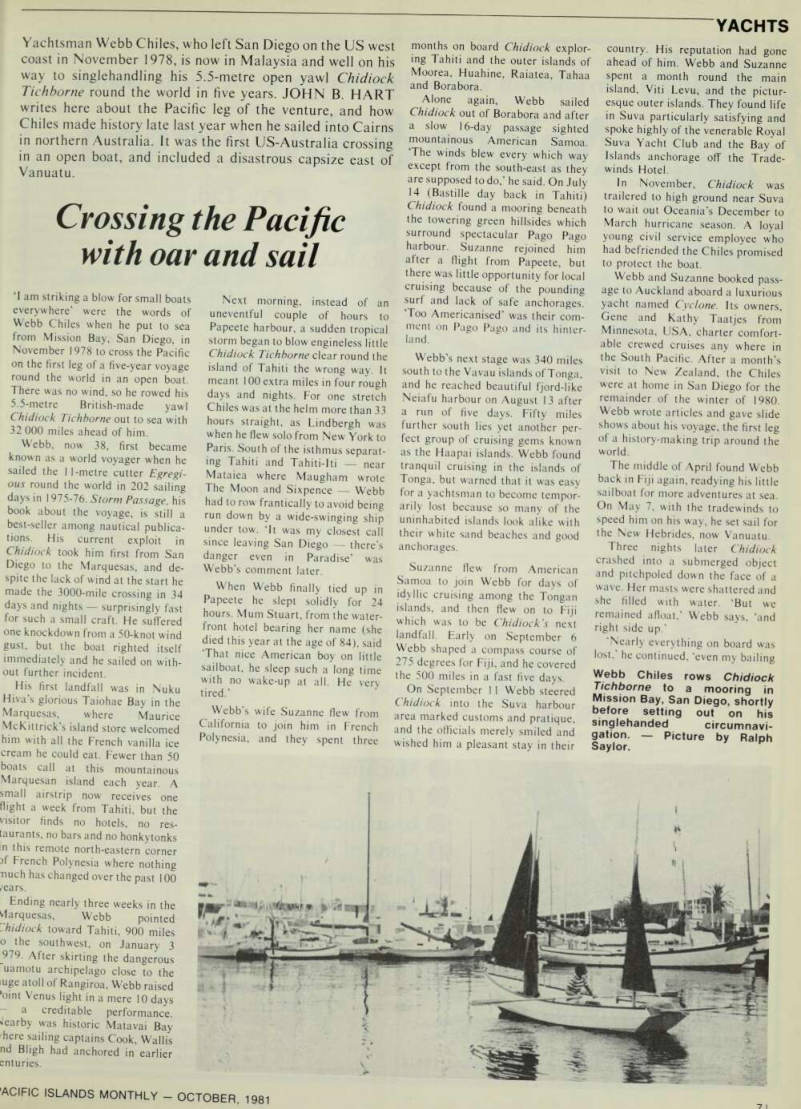
Webb Chiles rows Chidiock Tichborne to a mooring in Mission Bay, San Diego, shortly before setting out on his singlehanded circumnavi gation. Picture by Ralph Saylor.
bucket was torn out of its handle.’
Some $4500 worth of gear went over the side sextant, radio direction finder, food, clothing, charts, compass, and a new type writer. Somehow Webb inflated his Whaler raft, climbed in with emerg ency rations, and tied himself, the dinghy, and his boat all together to
await daylight.
The flimsy flotilla drifted ever so slowly for two weeks on a one-knot current 300 miles to safety. ‘From our position on the night of the collision,’ Chiles remembers, ‘the direction and rate of drift were what I expected.’ But he cut food to the bare minimum for survival just in case he missed his hoped-for land fall in southern Vanuatu. The next land lay a long, lonely 2000 miles beyond. So Webb’s skimpy diet consisted of four biscuits for break fast, a vitamin pill for lunch, half a can of tuna for supper, and six sips of water during the day.
When finally found by kindly residents of the remote island of Emae, Webb was huddled under a soggy blanket beside his liferaft on a beach. They saw to it that he was flown by Air Melanesia 50 miles to Port-Vila’s small but modern hos pital. Doctors found symptoms of malnutrition and exhaustion, plus a minor skin infection on his hands and feet. But luckily Chiles suffered
no lasting health problems as a result of his harrowing experience.
Recuperating at the home of his wife’s parents in New Zealand, Webb ordered repair parts for Chidiock from England and made plans for returning to his open-boat circumnavigation as soon as poss ible. Because he had been harbour bound for so long making ready to set sail again after the bad luck, Chiles felt ‘bogged down’ in the South Pacific Islands. So on October 9, 1980, he embarked on a bold passage straight across the Coral Sea to Cairns, some 1500 miles westward.
Since Chidiock had been towed
from Emae to Port-Vila for refitt ing, Webb swung north again to cross the track he followed while drifting in May. He wanted to make certain the epic voyage around the world continued without a break in course, and by sail preferably but with oars when necessary. After two years and thousands of miles at sea, Father Neptune allowed a ‘fast, smooth, comfortable trip’ toward a huge, easy-to-find target the obliging continent of Australia. In fact, during the first 8 days and 1000 miles of true tradewind sailing Webb never had to touch a line or trim a sail.
A noon sight on October 23 put
Chidiock only 60 miles off the outer edge of the Great Barrier Reef, and about 30 miles south of Cairns. By evening, navigation lights became visible as the tiny yawl made for Fitzroy Island. Within 10 miles of Cairns itself, Webb finally saw the famous reef (or parts of it) beneath his keel for the first time. ‘Why not anchor for the night right here?’ he asked himself. The water is shallow, the moon bright, the sea smooth. And the coastal forecast is for calm conditions.’
After Webb furled his sails and raised the centreboard, Chidiock went aground briefly on a falling tide. So land, at least the coral kind, was actually reached only 15 days out of Port-Vila.
It took him all the following day to reach an anchorage near the aboriginal mission in the lee of Cape Grafton, and every single breath of air was utilised. Then Sunday October 26 was truly a day of rest with no wind at all. Even on Monday, Webb had to row halfway to Cairns before finding a helpful sea breeze to carry him in to port.
About noon, after convincing harbour officers he had actually arrived from a foreign country, Webb telephoned Suzanne. She was already with friends in Brisbane, further south on the coast, awaiting his call.