Manihiki-and loving it
pp. 55-61 · Read in the full issue
Travel
Adjusting to the pace of life on Manihiki-and loving it
Dr STEPHEN R. WEINSTEIN and his nursing sister wife Elisabeth ran the medical service on remote Manihiki atoll in the northern Cooks for several months last year. Here he turns in an engaging account of everyday life on Manihiki, where traditional ways survive much more strongly than in southern islands such as Rarotonga.
The northern group of the Cook Islands consists of Penrhyn, Rakahanga, Manihiki and Pukapuka, all coral atolls lying about 10°S latitude and joined to the outside world by the irregular visits of the inter island ships, Mataora and Manuvai of the Silk & Boyd Line every six to eight weeks, a round trip which takes about two weeks. Only Penrhyn has an airstrip, but it is not served by commercial flights.
My wife Elisabeth and I were stationed in Manihiki for four months in early 1980, she as staff nurse and myself as medi cal officer, both employed by the Cook Islands Health De partment. Elisabeth was not my wife when we arrived, but had become so by the time we left.
Partly because of their iso lation, the northern islands pre serve the old way of life to a greater extent than Rarotonga and her neighbours in the south.
We were in Rarotonga for about a month before embark ing, which was barely long enough to pick up a rudimen tary knowledge of Cook Islands Maori, an eastern Polynesian language related to New Zea land Maori, and to Tahitian.
We were also able to gather basic information on the north ern atolls from several people from there now living in Rarotonga.
We were to sail on the Mataora , a former North Sea freighter. It is hardly a comfort able ship by tourist standards, but serves its purpose of convey ing passengers and goods be tween the islands of the Cook group with occasional trips to Samoa and Fiji.
The loading of supplies took several days, and, when com plete, the cargo hatch was covered and a tarpaulin spread over the deck to protect the ‘deck passengers’ from sun and rain. ‘Cabin passengers’, such as ourselves, often preferred to sleep on the deck also, instead of in the small stuffy cabins reeking of diesel oil.
It took four days to reach Penrhyn where we had our first glimpse of an atoll as a thin rim of coconut palms suddenly ap pearing over the horizon. The next thing we knew, we had entered the lagoon through a passage in the reef and tied up at the wharf. There were a few yachts also moored in the la goon, Penrhyn being the only
island in the northern group with anchorage within the la goon, the other islands seldom seeing any yachts.
Prayers were said and a small service, conducted by the islands’ pastor, who is also the father of the Mataoro's skipper.
Captain Ben Paranapa, was held on board before anyone disembarked. As we had ar rived on a Sunday, no cargo was unloaded until next day.
On Penrhyn, we spent much time in the company of the fisheries officer, Chris Friberg, who had formerly been a skip per on both the inter-island ships and had studied to be a martial arts expert in Korea and Hong Kong.
Two days later, the ship continued to Rakahanga, where passengers and cargo were fer ried ashore in rowboats.
Rakahanga boasts of one car and an interesting collection of hand-lettered road signs.
The journey from Rakahanga to Manihiki only took three hours, and halfway between we could see both islands, a point of some importance in earlier times when canoes travelled between the two atolls without navigational aids.
Manihiki is an atoll com posed of several coral islets and a lagoon about four or six km across. The main settlement of about 200 people is at Tahunu, and across the lagoon is the other village of Tukao. The population is entirely Polynesian, except for four Europeans Father Philip, the Catholic priest, and Peter Cummings, a former com mander in the Royal Australian Navy, who, together with his two sons, operates a farm for cultured pearls in the lagoon.
The other islets are uninhabi ted, but covered with coconut trees. One islet, Porea, has a little brackish water, and is particularly beautiful.
The houses in the villages are of varying design, some older ones thatched with coconut fronds, the newer ones built of brick or fibreboard. The post office is the centre of adminis tration, combining its services with the housing of a police office, radio shack, and the only legal liquor outlet which is very reasonable! And, com pared with Rakahanga, Mani hiki has no car but two trucks and a few motorbikes.
The chief administrative officer (CAO) represents the central government and often has a superhuman job to do to keep everyone satisfied. The
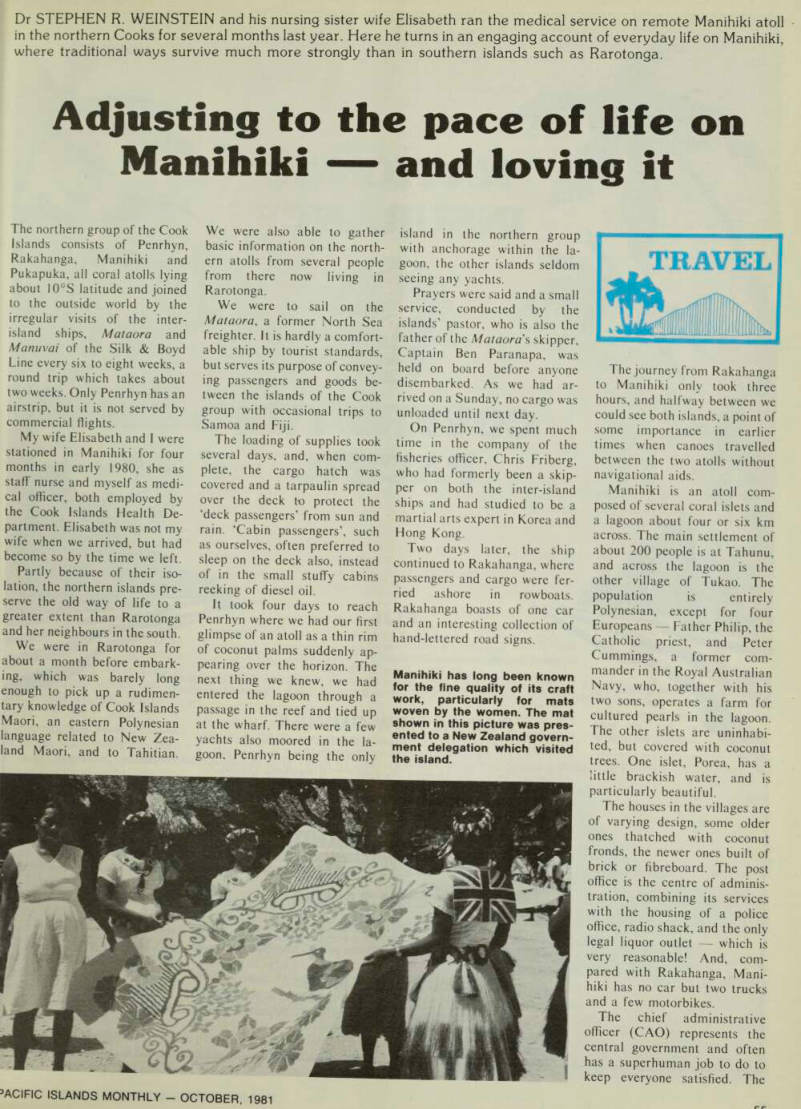
Manihiki has long been known for the fine quality of its craft work, particularly for mats woven by the women. The mat shown in this picture was pres ented to a New Zealand govern ment delegation which visited the island.
CAO on Manihiki is Mr Honu Ben, a native Manihikian, who saw home for the first time in 20 years when he returned from Rarotonga to take the position.
We became close friends and he was subsequently best man at our wedding.
The CAO makes daily calls to Rarotonga by radio to handle a variety of affairs ranging from copra and pearl shell prices to the trials of offenders. The radio in the post office uses morse code, and during our stay a new radio-telephone service was be gun, which enabled people to speak to their relatives in Rarotonga and New Zealand.
In recent years, there has been a large migration, mainly of young people, from Manihiki to these places, reducing the popu lation from around 1000 20 years ago to the present 350.
We soon got down to work, which consisted of seeing patients with minor complaints in the three-bed hospital next to our house. Twice a week, a child health clinic was held, during which mothers brought in their babies for weighing. A few ;imes each week we crossed the agoon by boat to see patients in he small clinic in the village of
fukao. Often, after finishing
vork, we would walk around the
Ullage, drinking coconuts and
talking to the people while we waited for the boat to take us
back to Tahunu. Most com plaints were minor colds, gastro-enteritis and various cuts and sores. Two babies were born during our stay, one at home and one in the hospital. Because of the island’s isolation, a minor flu epidemic would break out at intervals of six to eight weeks, coinciding with the ship’s visit, arriving with germs and viruses from the other islands. This was usually our busiest time. We also paid an occasional visit to the school to examine the chil dren and sometimes were called to the home of a patient too sick (or merely disinclined) to visit the hospital. On the whole our workload was light, regular hours being from eight until noon on weekdays, with the rest of the time spent fishing, cook ing and socialising, which seemed to be the mainstay of atoll life.
In May 1980 we carried out a diabetes survey for the South Pacific Commission and the Southern Memorial Hospital in Melbourne, and had an almost 90% turnout. It was an advan tage knowing nearly all the people personally when asking for their co-operation and pre paring the survey. The CAO’s wife Sister Purutu Ben, also a nurse in Manihiki, was of great
help to Elisabeth and me in this diabetes work, the results of which are to be published in The New Zealand Medical Journal.
Traditional Maori medicine still plays an important role in treating illnesses, and we ob served several traditional prac tices: for example, for treating thrush of the mouth, the scraped inside bark of an iron wood tree is applied to the lips; for headaches, seven frangipani flowers are rolled in a banana leaf at low tide and cut in half.
Much Maori medicine relies on massage, leaves and coconut oil.
We also knew the island’s bone setter, the ancient skill of set ting broken bones being passed from father to son. He is loane Kaitara, who is also considered one of the islands’ best fishermen.
Much of the atoll life re volves around fishing, either in the lagoon, or the sea. Atoll dwellers have an endless store of skills and fishing lore. Several different techniques are used for different species of fish. One method is to use a lantern (formerly a burning coconut husk) in a boat at night to attract flying fish which are caught with hand nets as they are drawn towards the light.
Also at night fish can easily be speared by torchlight in the lagoon, as they are sleepy and slow to react. One species of fish, the kuperu, is caught by swimmers underwater, using a miniature hook and line with coconut for bait. Various fish can be attracted by different
sounds, such as crayfish which seem to respond to the rubbery sound of biting one’s snorkel!
The easiest way to catch fish is probably in one of the fish traps, which are walls of coral rock enclosing pools in which fish become trapped at low tide.
During our stay, a 90 kg turtle was caught by Tekaki Williams, another renowned fisherman and pearl diver. There are seasonal fish and small sharks in the lagoon which one chases away by hitting the surface of the water with cupped hands.
Larger sharks outside the reef are treated with far more re spect, however, and fishing trips to the sea are preceded by a short prayer in the boat, just as are voyages to other islands.
Because of the poor soil on the atolls, the sea is the main source of food. Giant clams are collected and made into a delicious stew with coconut milk. Taro, the Polynesian staple food, as well as most fruits, cannot grow in coral soil and the only fruits we had were bananas, pawpaws and bread fruit. Elisabeth quickly became a skilled cook with the ‘raw materials’ available and we miss many of the island recipes and foods.
We also brought stocks of sugar, flour and rice from Rarotonga, which, together with daily fishing expeditions.
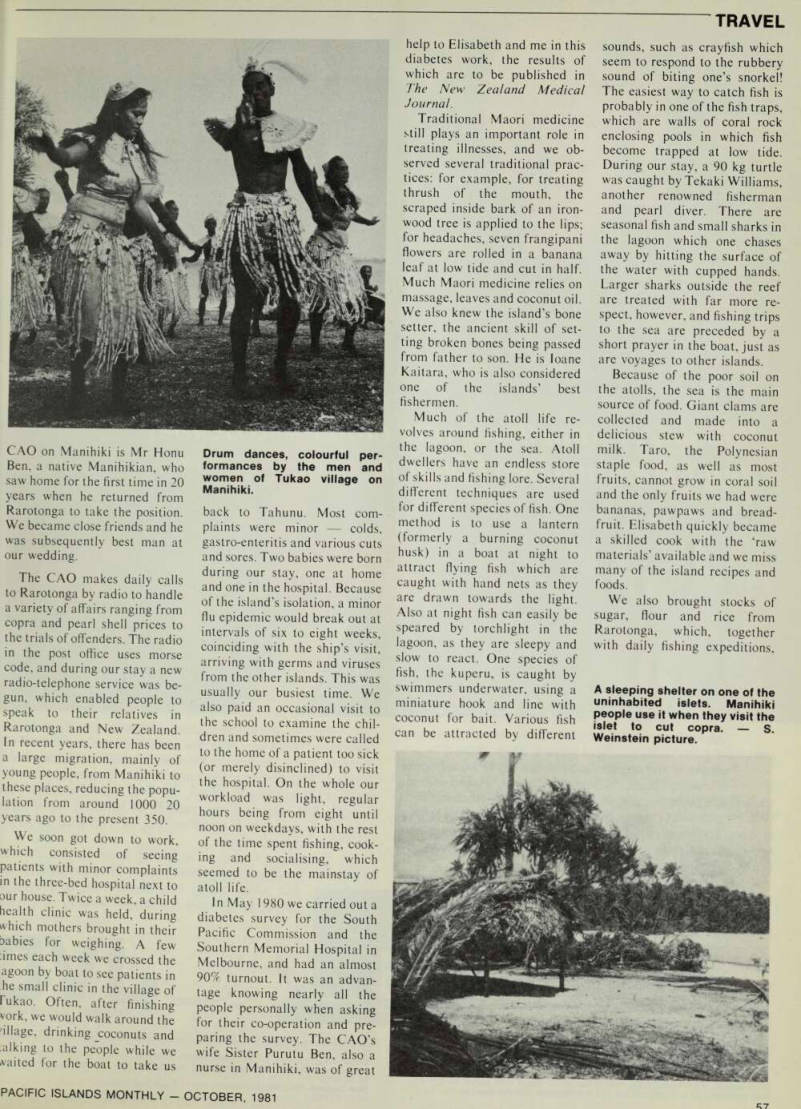
Drum dances, colourful per formances by the men and women of Tukao village on Manihiki.
A sleeping shelter on one of the uninhabited islets. Manihiki people use it when they visit the islet to cut copra.
Weinstein picture.
considerable gifts of food from the local people, and an oc casional visit to one of the small shops for luxuries such as cocoa or cheese twisties, lasted us pretty well. We ate about one tin of beef a week as well, usually on a Sunday when fishing and all other work was prohibited. Though I speared a few small fish nearly every day, it was Elisabeth who scored our largest fish, hooking a 5.5 kg tuna. She also hooked a shark, which we did not eat, although we kept the teeth and jaws.
A great delicacy, which now adays only lives on the more remote Pacific Islands, is the coconut crab which looks like a lobster, climbs trees and opens the nuts with its heavy claws.
Although it lives on land, it returns to the water to lay eggs.
It is usually active at night, when it is mostly caught. The meat is delicious, eaten the traditional way, dipped into the rich oily fat in the crab’s tail.
Although officially illegal, homebrew is sometimes made by fermenting coconut juice, unlike the southern group where orange or pineapple juice is fermented. Homebrew drink ing is accompanied by certain rituals, the usual way of drink ing being from a single commu nal cup passed from hand to hand and drained at a single gulp. We heard the following remark on one occasion; ‘Beer is for women, homebrew is for men, and whisky is for Papaa (Europeans)’.
Religion plays a greater role in Manihiki than in urbanised Rarotonga, most people belong ing to the Cook Islands Christian Church (CICC), an Dffshoot from the London
Missionary Society whose mem
bers brought the gospel to the Cook Islands in the 1860 s at ibout the same time as the
ffackbirders were kidnapping
vorkers for the Queensland ugar plantations from some of he Northern Cooks.
The head of the CICC in Manihiki is the Rev Timote, nd the Catholic Mission is leaded by Father Philip, who Iso has Manihiki’s largest li brary of books, which he kindly -t us use. There is also a small ongregation of Seventh-day adventists and a single adher nt of the Hare Krishna sect,
who acquired this persuasion while working in New Zealand.
The proper dress for church is broad-brimmed straw hats for the ladies and shirts and long trousers for men. Special white dresses and suits are kept by some people for special holidays such as Easter, when coconut juice takes the place of wine during the service. The Rev Timote invited me to give the sermon one Sunday, which 1 did, with him interpreting my words into Maori.
There were two funerals dur ing our stay, and on these occasions the whole population gathers together as one family at the home of the deceased, and speeches and hymn-singing alternate throughout the night while coffee and ship’s biscuits are served. The burial itself is usually held the following day to forestall decomposition in the hot climate, and is followed by a wake which continues for another two days with various speakers elaborating on the virtues of the deceased. At the end of the wake, a huge feast is held. Gravestones can be very elaborate and in some cases are protected by little corrugated iron roofs or sheds.
The two main export indus tries of Manihiki are copra and pearlshell. The coconut groves on the various islets, all with their specific owners, are worked on a rotating basis, with one islet at a time open for coconut gathering. This is de signed as a conservation measure, to let the unworked groves regenerate. The island council directs which islets are ‘open’. On weekends, we would go with the Ben family across the lagoon to their coconut land
and help with the gathering. We camped out in a little hut and enjoyed beautiful sunsets over the lagoon and a bright starlit sky at night with the sound of surf pounding the reef behind us.
The conservation of the pearl ing industry is also under the control of the island council.
Pearl diving is restricted to certain times of the year, and only oysters with a span of not less than 18 cm can be taken.
Six families have licences, which were granted in Queen Victoria’s time, to use diving equipment consisting of ancient hand-cranked compressors and copper diving helmets. The rest gather pearlshell by free-diving.
The unofficial depth record is held by loane Kaitara, with a depth of 20 fathoms and a duration of five minutes. For the 1980 pearling season, two divers came up from Rarotonga with modern motor-drive com pressors that they had been licensed by the government to use. An interesting juris dictional dispute arose when the island council refused to let them use the machines. The matter was deferred, however, when the opening of the lagoon was postponed because of the flu epidemic which had fol lowed the last ship’s visit.
The oysters are of the large black-lipped variety, taken mainly for the shell. Only oc casionally is a natural pearl found. On the pearl farm, cultured pearls are made by implanting moulds, after which the oysters are left for a year in
wire-mesh boxes in the lagoon. ‘Boat day’ is always an eagerly awaited event, with people gathering at the landing waiting for mail, news of rela tives, ‘fresh foods’ and other goods.
One of the highlights of the I year was the visit to the north ern group of islands by Cook Islands Premier Dr Thomas Davis, and the New Zealand representative, Mr Lindsey Watt. Several weeks prior to the visit, there were nightly re hearsals of drum-dances in the public square behind the post office, and costumes were made.
A general clean-up was also carried out in both villages.
The official party’s progress by air to Penrhyn and on to Rakahanga by the Manuvai was eagerly followed over the radio until finally the ship was visible on the north-eastern hor izon. Towards sunset the guests finally stepped ashore from the rowboat on to the decorated landing, and were welcomed by schoolchildren and a reception line of Who’s Who in Manihiki.
Speeches of welcome and danc ing at the landing followed and later that night a feast was held in Tahunu with more dancing and speeches. After spending the night at the CAO’s official residence the premier’s party, in a convoy of boats, crossed the lagoon to Tukao in the morning where another feast was pre pared. After the dancing and speechmaking, gifts of woven mats and hats were presented to the guests.
Although the visit to Manihiki only lasted 24 hours, it was the first by a Cook Island premier in over 10 years and was greatly appreciated, even though there wasn’t time for him to discuss everything of interest, and to meet everyone.
The village clean-up took the form of a tutaka, an institution alised village inspection which is seldom carried out in the southern Cooks any more. A number of officials, including the CAO, doctor, chairman of the island council and some times the priest, with others, walk through every home in the village, technically looking at the state of sanitation. But the event is more an opportunity for every household to display its status symbols and handicrafts.
The Cook Islands Christian Church at Tahunu is a focal point of community activities. -S. Weinstein picture.
Most of the homes we walked through were in a state of near perfect cleanliness and order, with hand-made bedspreads, hats, photos of family members, and an occasional cassette player prominently displayed.
Also inspected were gardens, household animals, the cookhouse which is often a separate building and toilets, which in Manihiki are built over the lagoon and reached by catwalks on stilts. This has not been known to cause any health problems as the fish quickly consume all waste. The tutaka is started and finished with prayers and speeches, conclud ing with a small feast for the party who did all the walking.
There are a few stately old houses built at the turn of the century by European traders and furnished in 1890’s style with what then would have represented enormous wealth on an atoll visited once a year by a small copra schooner.
Among the most popular trade items in those days were iron bedsteads, pedal-operated Singer sewing machines and seachests, which are still found in many homes. The traders left many descendants on the island, one such being George Ellis, whose grandfather left England at the age of 16, had many adventures on ships and islands all over the Pacific, and finally married and settled down in Manihiki. There he taught the people to build wooden long boats of planks, many of which are still lying about rotting, and ane which is still in use. It was ;he one still in use that was used 'or a voyage to Rakahanga in Vlay, 1980. The occasion for his voyage was the sudden leath of the Catholic priest in Rakahanga, which required -ather Philip to go there for the uneral. Two 25-hp outboard notors were hooked on and the >oat was skippered by Teokotai Villiams, another trader de cendant, navigating with an 'ld brass ship’s compass in a reen box. Permission for the oyage had to be obtained from
Larotonga by radio. After
ompleting their mission, the oyagers returned safely, bring ig a few bags of flour and some
ledicines from Rakahanga.
uch voyages were more corn ion in the old days, until the
government prohibited them, because of so many boats being lost. Some made it to other islands weeks later, but many perished. It was known to the island boatmen that if one failed to reach Rakahanga in a day, the normal sailing time, there was a possibility of reach ing Samoa in a week by follow ing the winds and currents.
Some survivors of such drift voyages still live in Manihiki.
On one such trip, seven men set out from Manihiki, and after getting lost at sea, suffering thirst, hunger and storms, four of them reached the (then) New Hebrides alive a couple of months later.
Elisabeth and I were married on March 21, 1980. I paid $6 at the post office and an official notice was displayed.
Typewritten invitations were sent out to about 100 people, but of course the whole island was welcome to attend. Various families donated a total of eight pigs, many chickens, fish, and all types of other foodstuffs, loane speared 10 large crayfish.
The night before the wedding was extremely busy, with bak ing and cooking going on until well past midnight. The pigs were slaughtered and cleaned down .at the landing prior to putting them in the under ground earth oven overnight.
Sitting with Honu on the veran dah of the mission house the next day I waited for Elisabeth.
The ceremony was given in Maori by the Rev Timote, first wedding he had performed for Europeans. Outside the church the Boys Brigade formed a guard of honour, their
brass belt-buckles polished with lime for the occasion. Three volleys from a shotgun were fired and the procession walked back to the residence where the reception was held. After speeches, singing and dancing by the VIPs, the guests filed past and gave their gifts straw hats, lengths of trade store cloth, two bottles of whisky, and banknotes in envel opes. The money was recycled to the church and also helped pay for the store-bought foods.
In the evening, drinks and ukelele music were followed by a dance on the post office verandah. An official announce ment of the event was made on the Cook Islands radio in Rarotonga.
Among the most memorable people we met was Mehau George, whose death on May 19, 1981, was reported in September’s PIM. At 87 he was the oldest man in Manihiki, a skilled woodcarver and crafts man. He was also the islands’ only World War I veteran, Second Maori Battalion, and could still sing all the verses of ‘lt’s a long way to Tipperary’.
There was also Charlie Poiri, who claims descent from King Kamehaweto I of Hawaii, through one of his ancestors who served on a whaling boat in the last century. Charlie still keeps contact with relatives in Hawaii.
The only visitor to Manihiki apart from the inter-island ship
during our stay was the re search vessel Machias of Honolulu, on charter to the Cook Islands Government, ex ploring the seabed for manga nese nodules, phosphate and precious corals, all of which they found.
The w\.ek before our depar ture was filled with visits to say farewell to old friends, culminating in a dinner where members of the island council sang traditional songs, more gifts were presented, and a few tears were shed. We also said goodbye to a black kitten, Tom Tom, who had attached himself to us.
The return voyage lasted 10 days, and we enjoyed the com pany of fellow-passenger Judge Jock McCawley, whose several decades in the islands provided a rich store of yarns. We stopped at Rakahanga to load copra and disembarked into the landing boats by torchlight, after the ship’s electricity failed. We spent a few more days in Penrhyn, and saw the old aircraft wrecks from when the island was an American air base in World War 11. We also crossed the lagoon to visit Penrhyn’s second village, Tetautua.
Every island in the Cooks has one or more members of the Marsters family living on it.
This family originated when a British captain, Marsters, settled on Palmerston atoll with his Polynesian wives (three altogether at different times) in the 19th century. The hundred or so people on Palmerston today are all his descendants, bear the same surname and speak their own dialect of English as spoken 100 years ago.
For potential visitors to the northern Cooks, I should men tion that the first boatload of tourists was scheduled to arrive on board the slightly more comfortable Manuvai shortly after our departure. The plan was that they would be billeted in private homes as there are no hotels, and the people were eagerly looking forward to this arrangement. Their experiences were described by James C.
Simmons in PIM May, 1981.
From my own time there, de spite the discomforts, I would highly recommend the trip.
Manihiki fisherman: Aluminium dinghy, coconut palm oars.-S.
Weinstein picture.