-and crusading politician
pp. 59-64 · Read in the full issue

Yesterday
HJM: Showman, author, farmer -and crusading politician
JOSEPH THEROUX concludes his two-part series on the remarkable life and times of HARRY JAY MOORS, Samoa’s ‘Misimoa’ (for first part see PIM Aug p5l). Theroux’s story provides ample grounds for admiring as he writes ‘a man, long neglected, who had vision, toughness, sensitivity, and a sense of adventure enough for a Robert Louis Stevenson creation, and who was something more than a footnote to history’.
In 1892 a wandering actor and ex-Rough Rider named Charles Mason Mitchell gave Moors the idea of taking a group of Samoans to the Chicago World’s Fair (properly, the World’s Columbian Expo sition). Since Moors’ business was going smoothly (even though a trusted manager had embezzled the sum of $lOOO in 1891), and possibly because he needed a break from the rivalries and bickerings, not to mention violence, of the contin ual warfare, he was much taken with Mitchell’s proposal. With lelp from Joe Strong (‘. .. a ?enial fellow .. .’), they col ected a dozen Samoans, two lozen Wallis Islanders, five fongans and a Fijian, ‘along vith tapa costumes, weapons, ire sticks, canoes, kava bowls, :eremonial headdresses’, and,
J. C. Furnas writes in Anatomy of Paradise, ‘a knockdown Samoan house’.
It was at this time that there occurred the first split between Fanny Stevenson and Moors.
Fanny writes in her journal of July 4, 1893: ‘Mr Moors is not here having gone to the Chicago Fair. For some reason, only explainable by Joe Strong, he is our bitter enemy; more particu larly Lloyd’s and mine, we being Joe’s pet aversion.’
(Strong was the black sheep at Vailima, eventually asked to leave.) But when the tribal wars were discussed at a dinner, Fanny thought enough of him to drink ‘the health of H. J.
Moors, my worst enemy and the only white man clinging to Samoa who is not a coward’.
But it also appears that Fanny was not one of Moors’ favour ites. She and her daughter were extravagant, and Moors, as Stevenson’s financial adviser, was in a position to know that it cost Stevenson $6500 a year to keep up Vailima. Fanny also writes in that entry that she heard gossip in Fiji about Moors’ ‘clouded reputation’, but ‘I refused to listen . . . That kind of talk always angers me’.
It is possible that this is a reference to his illegitimate sons, but Moors’ daughter Priscilla believes that Fanny was possessive and jealous of the time Stevenson spent with Moors. It is interesting to note that while Fanny carefully does not include Stevenson as one of Moors’ enemies, she and Lloyd did darkly suggest that Moors ‘profited’ too much from Stevenson but Moors was already a wealthy man who in fact took risks for the Stevensons, as when he bought Nassau Island.
The islanders meanwhile per formed on the Midway Plaisance in Chicago as part of the Congress of All Nations.
The island girls, however, ‘were required to cover their bosoms and all the dances were prob ably chosen from the more decorous part of the Samoan repertory’, Furnas tells us. In addition they put on ‘ kava ceremonies, war dances and sitting sivas ’ {sic: a sitting dance is called a sasa). Furnas also reports that ‘part of the troupe later signed with Barnum and Bailey for the next circus season’ and that Moors
.. . ‘seems to have made money’.
He evidently did, for on his return home he began buying large tracts of land behind Apia and on Savaii, where he planted cocoa and grazed horses and cows. He bought Sophia Island, now Niulakita, in the Ellice (Tuvalu) group. He bought hun dreds of acres at Papalaloa, Ululoloa, Fasitoouta, Palauli and Pago Pago, and was one of the biggest exporters of copra.
In 1904, copra was bought at 1 'H a pound, and sold in ’Frisco for 3tf a pound.
He also bought Nassau Island in the Cooks for S4OOO, from a Captain John Ellacotl, after having originally nego tiated the purchase for Stevenson, who later decided against buying. Moors and Stevenson had plans to spend a writing holiday on Nassau, the Scotsman offering to help the American. He urged Moors to write ‘of your early experiences among the islands. You can do it, Moors do it admirably, I m sure and I’ll help you over all the rough places. In return, you will be able to help me in many ways’. (From With Stevenson in Samoa.) It would no doubt have been a more interesting collaboration than Stevenson’s and Lloyd Osbourne’s which produced The Wrecker and The Wrong Box. Moors called those joint efforts ‘harmful’, predicting the critics’ responses and raising Fanny’s ire.
But the collaboration was not to be. Moors returned to the States, and while in New
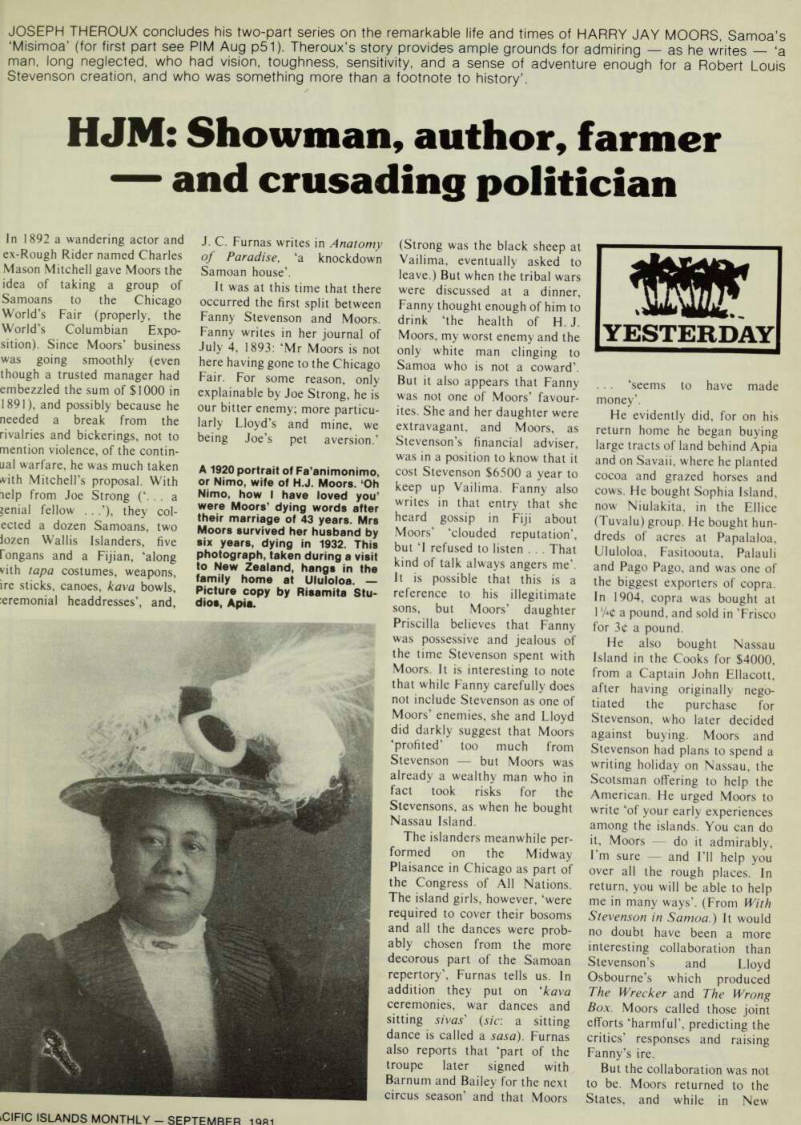
A 1920 portrait of Fa’animonimo, or Nimo, wife of H.J. Moors. ‘Oh Nimo, how I have loved you' were Moors’ dying words after their marriage of 43 years. Mrs Moors survived her husband by six years, dying in 1932. This photograph, taken during a visit to New Zealand, hangs in the
family home at Ululoloa. -
Picture copy by Risamita Stu dios, Apia.
Orleans read that Stevenson had collapsed, due to a cerebral haemorrhage, and was buried atop Mt Vaea. He left Moors a photo of himself and his Caligraph typewriter. (The photo is owned by grandson Oliver, while the typewriter has been lost.) Fanny left Samoa with her family and had no more dealings with Moors. She was not to refer to him again until his book which irked her so came out. * * ♦ Always interested in new inven tions and developments in the world. Moors kept up steady
:orrespondences. Needing
x>ats to bring copra from his Dlantations and those of the Savaii Squires, he wrote away or books on boatbuilding and, Irawing on his experience as a nechanic, had the first motor >oat in Samoa. He eventually milt three motorboats, the Quickstep, the Pat (his son iarry Jr’s nickname), and the losabel, a 19-metre schooner amed for his second daughter, le was one of the first in Samoa ) play a phonograph and drive Model T Ford, which his aughter says he backed into lany coconut trees before he lastered it. He corresponded ith Jack London (they once ad plans to co-author a novel) ad H. Rider Haggard (whose rother, Bazett, was the British and Commissioner in Samoa), e was an early riser, regularly ‘tting up between 5.30 and 00, after only four or five mrs sleep, ‘which is enough r any man’, he used to say. He auld usually take his children, aoever was not away at school, r a swim and then sit down to English breakfast: ham and gs or lamb chops or steaks. \ would work for a time in the ice, his front window looking t to Apia’s Beach Road and m visit one of his nearby ires or walk down to Matautu supervise the boatbuilding, nchtime was a large, chaotic air, his shop clerks and •ourers eating at the kitchen find the Apia store, with the inese cook (later a -tuguese cook arrived) madly ving up eggs and stew.
Jis afternoons would be
taken up riding in his horsedrawn carriage, or later the Ford, out to Fasitooula to inspect the plantations. Dinner was never delayed, for, his daughter says, ‘he never worked late, never made his work a burden’. He was always inviting guests to dinner, Carruthers, Annandale, Stowers (the same names in Apia today), visitors to Apia, always the gregarious, generous host, saying, ‘I guarantee you’ll have a good time,’ and he’d regale them with stories of the islands, the wars, his adventures. Occasion ally there would be consulate parties, but Moors was a family man. A typical evening would find him playing games with the children (he was always the wolf) or giving dramatic read ings of Treasure Island or Uncle Tom’s Cabin. Even dur ing business hours he would conspire in a game of hide-and seek, allowing the nook of his desk to be used as concealment
and looking up innocently from his work when the ren egade was asked for. It was Nimo who disciplined the chil dren, not Harry. She strapped them when necessary and sent them to Sunday School. She led the regular evening prayers, while Moors, never a church goer, would, nonetheless, sit meditatively. When the chil dren slept, he would go to his overflowing bookshelves which included hundreds of volumes of well-thumbed Dickens, Thackeray and Shakespeare. * ♦ ♦ Still the adventurer at 50, he was invited to the Louisiana Purchase Exposition (the St Louis World’s Fair of ‘Meet Me in St Louis’ fame) in 1904 and
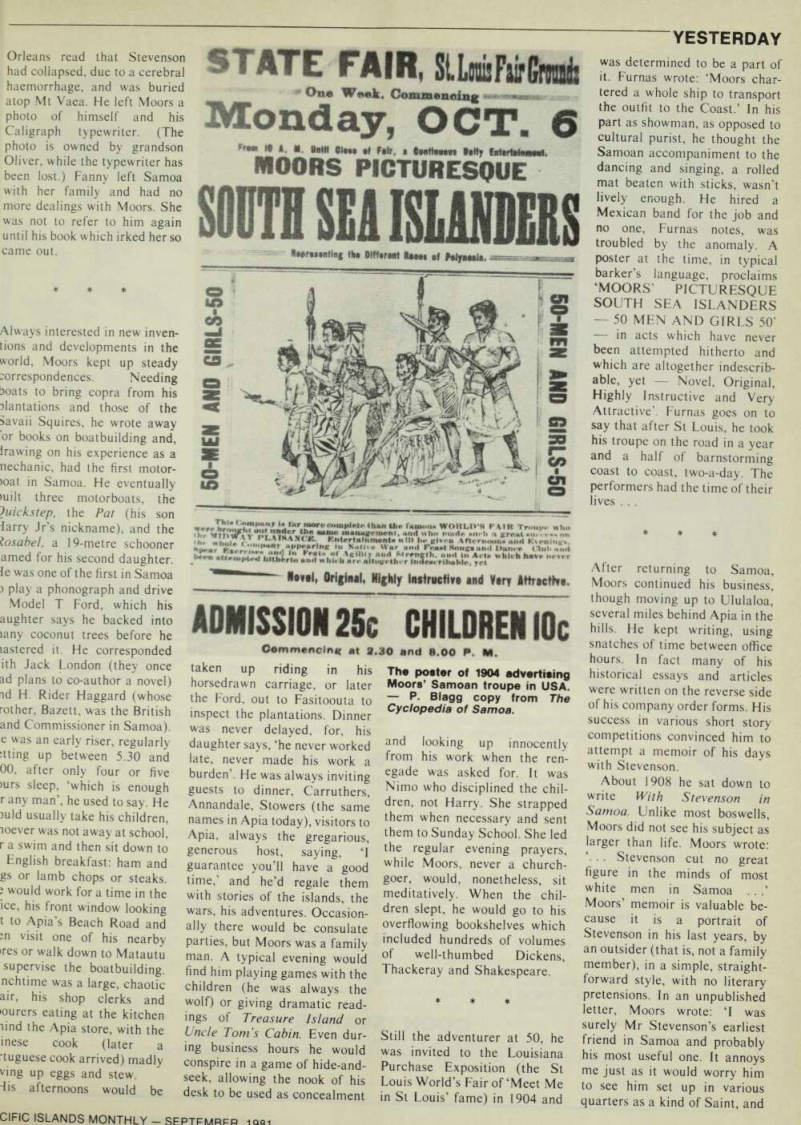
was determined to be a part of it. Furnas wrote: ‘Moors char tered a whole ship to transport the outfit to the Coast.’ In his part as showman, as opposed to cultural purist, he thought the Samoan accompaniment to the dancing and singing, a rolled mat beaten with sticks, wasn’t lively enough. He hired a Mexican band for the job and no one, Furnas notes, was troubled by the anomaly. A poster at the time, in typical barker’s language, proclaims
‘Moors' Picturesque
South Sea Islanders
— 50 Men And Girls 50’
in acts which have never been attempted hitherto and which are altogether indescrib able, yet — Novel, Original, Highly Instructive and Very Attractive'. Furnas goes on to say that after St Louis, he took his troupe on the road in a year and a half of barnstorming coast to coast, two-a-day. The performers had the time of their lives . . . * * ♦ After returning to Samoa, Moors continued his business, though moving up to Ululaloa, several miles behind Apia in the hills. He kept writing, using snatches of time between office hours. In fact many of his historical essays and articles were written on the reverse side of his company order forms. His success in various short story competitions convinced him to attempt a memoir of his days with Stevenson.
About 1908 he sat down to write With Stevenson in Samoa. Unlike most boswells, Moors did not see his subject as larger than life. Moors wrote: . . Stevenson cut no great figure in the minds of most white men in Samoa . .
Moors’ memoir is valuable be cause it is a portrait of Stevenson in his last years, by an outsider (that is, not a family member), in a simple, straight forward style, with no literary pretensions. In an unpublished letter, Moors wrote: ‘I was surely Mr Stevenson’s earliest friend in Samoa and probably his most useful one. It annoys me just as it would worry him to see him set up in various quarters as a kind of Saint, and
The poster of 1904 advertising Moors’ Samoan troupe in USA. - P. Blagg copy from The Cyclopedia of Samoa.
I assure you that he never made any such pretensions.’ The book, a basic source for Stevenson scholars, was pub lished in 1910 by Small, Maynard and Company, and was quickly sold out. But a second edition did not appear.
Indeed, copies are hard to come by. A publisher in Britain issued it in a pirated edition, but naturally Moors heard nothing of the results and re ceived no compensation.
Reading that ‘the women folk’ coddled Stevenson, were extravagant, or that Lloyd Osbourne was ‘conceited’, in furiated Fanny, playing the demanding role of a great man’s widow. She must also have been put off by paragraphs like this: T sometimes wonder if Stevenson would have done better work if he had never married. True, his marriage was a happy one; but I make bold to >ay that neither was his charac ter bettered by it, nor his art Denefited. He was very fond of iis wife and easily led by her; ‘Fanny” was like a king she xmld do no wrong.’ Fanny eplied, in a letter to a friend: ‘A vhole book of misstatements ms been published by the dllage grocer of Apia, one floors ... The book also con ains much barely concealed mimus.’ One must forgive : anny, I suppose, for she did tot publish this opinion, or her ively and entertaining diary of he Samoan years, which is a ompendium of garbled facts, onfusions, Samoan misspell igs and her own misstate lents. That was left for others 3 do, thinking they were boost ig her. * * ♦ Jo doubt Harry meant it when e said back in 1899 that he was -tiring from politics. But 1914 rought World War I and a Jew Zealand military adminis ’ator, the first of several, Co rnel Robert Logan, to arrest ie German authorities and ike charge of Samoa.
After serving for a year on ie Reparation Claims Board, loors was publicly acknowl- Jged for his fairness, honesty id hard work by Col Logan. At ie presentation Logan said (at Moors ‘spent a lot of his
valuable time over the board and (that) he refused any re muneration’. Logan drank his health, led three cheers and awarded him a silver platter inscribed; ‘Presented to H. J.
Moors as a slight recognition of services rendered to the British Military Occupation of Samoa, 1915.’ Moors was surprised at all this and expressed the thought that his services were over-valued. He complimented Logan and said that ‘there was no room for dissatisfaction’ about Logan’s administration.
But these were polite, public words which gave no hint of their animosity, for, as The Samoa Times reported, ‘not many months previously, and on the very steps of the Court House, Colonel Logan had practically told (Moors) that he was worse than a plague of grasshoppers . ..’ The paper went on to say that the remark was ‘amusing’ and ‘long since forgotten’. Far from it.
New Zealand had no experi ence in the colonising business, unless you count the misman agement of the Cooks. Logan had even less. No doubt his crowning success was the way he dealt with the epidemic of pneumonic influenza in 1918.
The S.S. Talune was quaran tined at Suva and Levuka in Fiji, but Logan neglected to quarantine it in Apia because he had friends he wanted to invite ashore. Eastern (or American) Samoa was quaran tined and not one person died from the epidemic. But over a fifth of the population of West ern Samoa died. During the epidemic the authorities in Eastern Samoa offered medical assistance. Not only was it refused, communication was shut off between the two islands by Logan, who later could not recall any such offer.
A subsequent Royal Com mission established ‘negli gence’.
One story (in N.A. Rowe’s Samoa Under the Sailing Gods) tells of a Protestant missionary who travelled to Mulifanua collecting church contributions. His carriers were infected and he left them in villages as he passed through.
On his return trip to Apia, he was met by his previous con tributors, now infected and dy-
ing, who had no money for food or medicine. They begged him for part of the money they had „• V. U • 1 . , c / given him, but he refused.
The people boiled over with fever. To cool their fiery bodies, they went into the sea. But this made them succumb even faster.
Moors found himself busy cooking up large vats of rice and distributing fruit, clothes and blankets. He urged people to stay away from the water and try to sweat out the fever, Finally, however, there was nothing to do but tie on a mask, as protection from the stench of death, and pitch in to dig mass graves.
Among those praised for their services during the epidemic was H. J. Moors. But Moors loathed both Logan and his ‘deficiencies’. He wrote and eventually travelled to Wellington to have Logan removed. Moors wrote in May of 1918: T at least could never make any truce with this man (who) controls all of the expenditures, all of the appointments, and all of the public utilities . . .
No trial, I am satisfied, can be fairly conducted and a just verdict be reached if opposed to his will or interest. The whole structure of affairs here is
permeated and ruined by his ruthless conduct . . . this man has been retained while his deficiencies were well known Moors documented Logan’s abuses and mismanagement and sent the details to Wellington, saying: ‘Believe me, these papers come from a determined man who fears no official, governor, or diplo mat, and who will pursue his course to a finish and on schedule.’ After all, Moors had watched many of the 8000 die in the ’flu epidemic, including his son Mark, Logan ‘is said to have an antipathy to Americans,’ Rowe tells us in his book, and, though Moors is not mentioned by name, one can guess who one of the Americans was.
A group of leading Samoans met with Logan to discuss the causes of the epidemic. ‘He had allowed himself to be angered by their questions and had walked out of the meeting. (A grave insult to a Samoan.) The
The early house which Moors built for R.L. Stevenson, show ing Stevenson and his wife standing, and Moors seated in the foreground. The other seated man is described as Tin Jack. - P. Blagg copy from Our Samoan Adventure.
Samoans had been so upset by his attitude that they had pre pared a petition for the transfer of the territory to American control,’ Davidson wrote in Samoa Mo Samoa.
Logan, back in New Zealand on leave, did not plan to return.
He said that ‘the petition had originated, not from the Samoans, but from H. J. Moors (who) has always been antagon istic to the administration, and who has on more than one occasion stated that he would do all in his power to upset my administration' He described the chiefs as tools of Moors and the others as ‘some minor Samoan chiefs’. Davidson com ments: ‘These allegations were patently the production of a deeply embittered man.' But Davidson probably does not give Moors enough credit: Logan seemed closer to the truth.
Moors, though 64 years old at the time, growing heavy and losing his hair but not his energy, was indirectly success ful: Logan, the incompetent dictator, was out.
The great disappointment of Harry Jay Moors’ life was that his son, Harry Jr (Afoafouvale Misimoa), born in 1899, did not follow him into business. He was, however, a brilliant student at Stanford and eventu ally became Secretary-General to the South Pacific Com mission. Another son, Daniel Walker, had died as an infant back in 1887. Moors’ four daughters, Ramona (Miranda), Rosabel, Sophia (named for the island where she was born), and Priscilla, grew up and married into families that united Apia’s business community.
Ramona married Carruthers- Hetherington Carruthers is still an Apia business. Sophia married Hellesoe, from an Apia business family. Priscilla mar ried Muench and went to live in Germany. Rosabel married Olaf Frederick Nelson (called ‘Frederick the Great’ by his political opponents) with whom Moors amalgamated in 1922, creating the largest business operation and the first regis tered local company in Samoa, ‘O. F. Nelson and Company
Limited’, in which all the Moors had shares. They were not arranged marriages, Priscilla says. Like their father they married for love, not business ties.
It was Nelson, as courageously involved in poli tics and as successful in busi ness as H.J. Moors, who became one of the leading figures of the Mau, the independence move ment. And Nelson’s grandson, and so Moors’ greatgrandson, Tupuola Efi, is now Prime Minister of Western Samoa. * * * In the last few years of his life, Moors kept busy, making oc casional trips to the States, on family visits and business, and writing his recollections for The Samoa Times.
On Saturday, March 13, 1926, Harry Jr drove his father down from Ululoloa to see a film at the Tivoli Theatre.
During the show. Moors began to get pains in his chest and asked his son to drive him home.
Helped into the house, Moors
made his way to his wife’s room.
He took her into his arms, Nimo, Fa’animonimo of the family of Asiono, his wife of 43 years, and said, ‘Oh, Nimo, how I have loved you!’ and his heart gave out. He was 72 years old.
His death was written up in the March 19 edition of The Samoa Times. The notice re counted some of his achieve ments and concluded: The fu neral was attended by practi cally the whole of Apia, inter ment being made in the family burial ground. The Rev H.
Darville read the funeral ser vice. Deceased is survived by his widow, one son and three daughters.’
In an age bereft of heroes, we read of the days when the world appeared smaller and simpler, and our hearts swell. But the world was never simple and living in it was never easy. All the more reason to admire a man, long neglected, who had vision, toughness, sensitivity and a sense of adventure enough for a Stevenson cre ation, and who was something more than a footnote to history.