German New Guinea as
pp. 53-56 · Read in the full issue
Books
German New Guinea as seen by German eyes
German New Guinea The Annual Reports. Edited and translated by Peter Sack and Dymphna Clark. Published by Australian National University Press, Canberra, 1979. xvii and
403 Pp. Sa29, Isbn
0 7081 1806 2.
Three European nations have governed parts of eastern New Guinea. The British went there in 1884, in response to Austra lian pressure and German ac tivity. They didn’t particularly want to be there. The Austra lians went in 1906, after years of sporadic anxiety about their own security. They knew why they were there, but not what they should do. The Germans came in 1885, seeking land, labour and raw materials. They knew why they had come, and what they wanted the country to become. They alone, at this time, had both a sense of destiny, and the willingness to make a vision a reality.
They were going to make a German colony, profitable to the Fatherland, and beneficial to its inhabitants. They were >oing to combine German set ters and expertise and capital vith New Guinean land and abour, to make everyone richer md happier. They were not roubled, as the British were, by he magnitude of their responsi )ilities or the rights of the lative people they intruded ipon, nor were they distracted
like the Australians by compet ing internal and frontier devel opment. They had both the questions and the answers, and they set to with tremendous imagination and energy.
Except for a short period under imperial officials in 1889-92, between 1885 and 1899 north-eastern New Guinea was administered by the New Guinea Company under im perial charters. Thereafter until 1914 it was run by the imperial government. During these 30 years the Germans adjusted their expectations more closely to their circumstances, but throughout they hoped and ex pected to make New Guinea a supplier of raw materials to German industry, and a source of profit. The company particu larly, pressed by shareholders wanting dividends, planned and spent lavishly. It laid out towns with streets and sites, bought ships to transport produce, es tablished a relatively elaborate administrative structure, made preparations to sell land to settlers before it had been got from its owners, conducted field trials on more cash crops than are now grown in Papua New Guinea, and undertook or subsi dised botanical, medical and scientific research of world value. It explored, cleared, built, experimented, prescribed.
After 1899 the government maintained this essential policy, less confidently and more subtly
but no less fixedly until by 1914 New Guinea outstripped Papua in everything Europeans valued save gold and pearls.
But those gains were won at a fantastic cost in life, happiness, and dreams. The company, as the Australians put it, came a cropper. A succession of man agers died, tidal waves de stroyed buildings, malaria, cholera and smallpox swept the settlements, head office sacked officials for over-spending, pests attacked crops and New Guineans wouldn’t attack the pests indeed after a time they would not be educated to labour (pi 9) at all. Settlers wouldn’t come, boats sank, prices fluctuated almost every conceivable affliction visited the company. Over the years its hopes wilted before the New Guineans and their en vironment until in despair it surrendered its administrative mandate to the government. No such intensive effort to make New Guinea like Europe was ever again attempted, but dur ing the imperial period the search for profit continued, the hopes and the despair were
less, the caution and the successes greater.
This story is told, consciously and unconsciously, in these Annual Reports, 12 issued by the company, 15 by the im perial administration. They are an invaluable record, as meticu lous and as informative as one could possibly expect public documents to be. Here for the first time they are gathered together and translated into English. I don’t think, as the translators seem to, that they will change the picture Austra lians have of the German period, but they allow us to see much more clearly the men and the hopes behind the events, and they make us more keenly aware of what treasures must lie in other untranslated German material, such as Nachrichten and the mission reports the latter especially contain much material which will interest present-day Papua New Guineans.
Not everyone will agree with all the editorial decisions the translators have taken. Their work, they say, was done pri marily for Papua New Guinean readers. At present Papua New Guineans are more intersted in their indigenous than their European past, but in the future I think they will appreciate this translation. At the same time, for examples, not all the poss ible German place-names have been identified with their mod ern equivalents; and the trans lators have left in German some words they felt were incapable of adequate translation. While this may be so, others in Papua New Guinea less competent than they will now have to attempt a translation. And while everyone will accept that economy demanded some de letions from the text, I wonder whether the statistics, surely of interest to Papua New Guineans, should have been omitted, or, if this had to be, whether copies might better
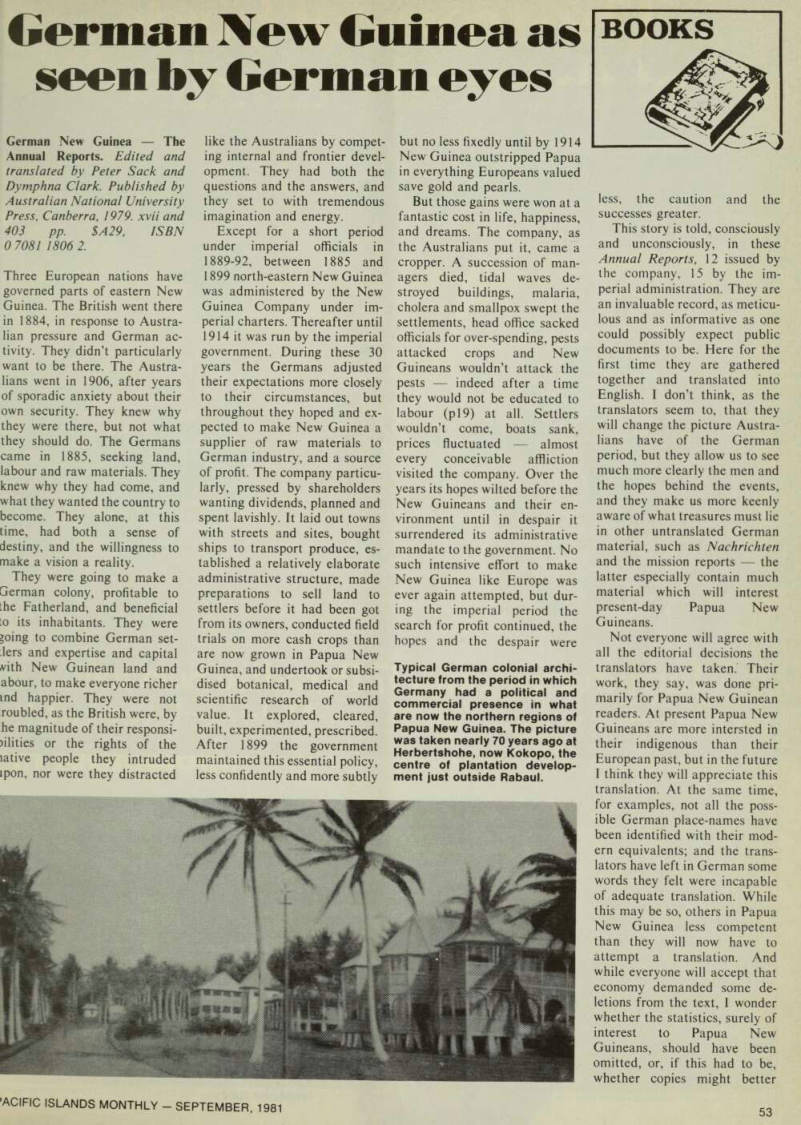
Typical German colonial archi tecture from the period in which Germany had a political and commercial presence in what are now the northern regions of Papua New Guinea. The picture was taken nearly 70 years ago at
Herbertshohe, now Kokopo, the
centre of plantation develop ment just outside Rabaul.
have been lodged in Port Moresby than in Canberra.
Again, much of the introduc tion discussed the trials of translators rather than hints for historians, and so was one trial which I thought unnecessary.
Yet one consideration over rides all this. Translation is a service to others, and a re searcher would be churlish to repay so generally competent a work and so great a gift with quibbles. European colonialism is a mere speck on the broad page of New Guinea’s story, but I hope the translators will go on to show us more of what happens when men who dare and presume much invade cir cumstances so alien to their
expectations.
Bill Gammage.