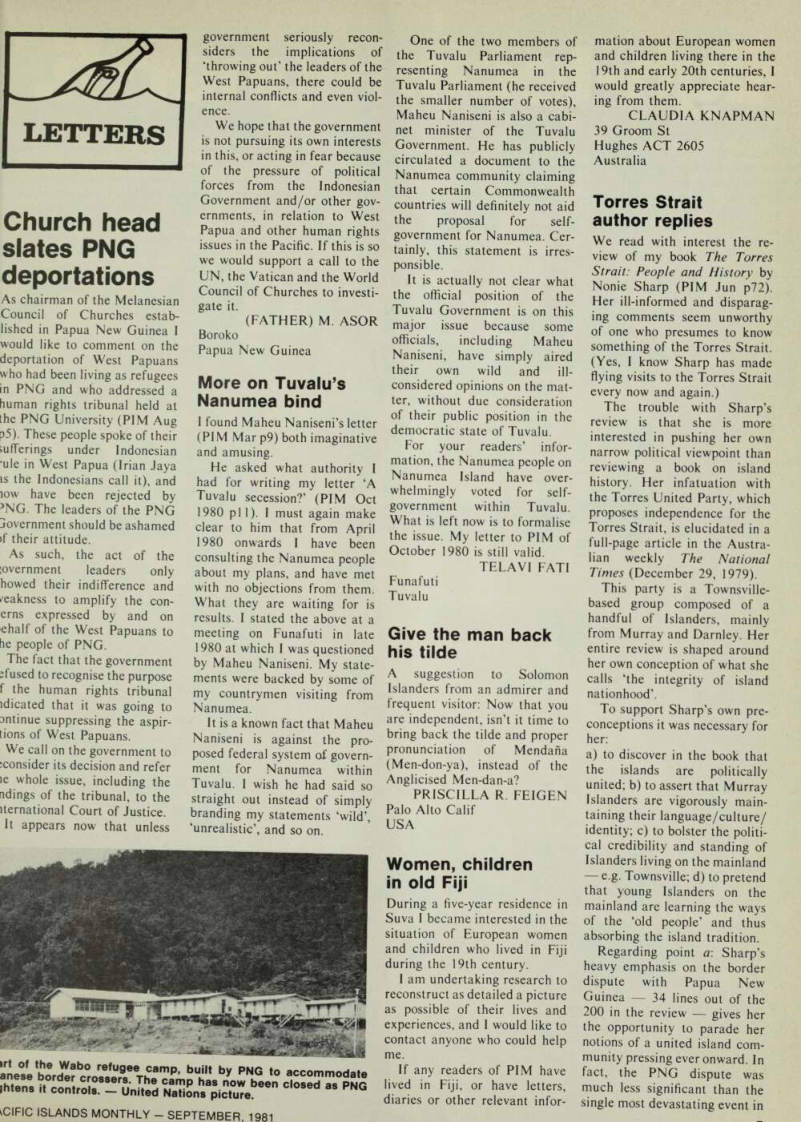
[?]rt of the Wabo refugee camp, buillt by PNG to accommodate
pp. 7-10 · Read in the full issue

Letters
Church head
slates PNG
deportations
As chairman of the Melanesian Council of Churches estab lished in Papua New Guinea I would like to comment on the deportation of West Papuans who had been living as refugees in PNG and who addressed a human rights tribunal held at the PNG University (PIM Aug t)5). These people spoke of their >ufferings under Indonesian •ule in West Papua (Irian Jaya is the Indonesians call it), and low have been rejected by ■MMG. The leaders of the PNG jovernment should be ashamed if their attitude.
As such, the act of the ;overnment leaders only howed their indifference and /eakness to amplify the con erns expressed by and on ehalf of the West Papuans to he people of PNG.
The fact that the government -fused to recognise the purpose f the human rights tribunal idicated that it was going to Dntinue suppressing the aspir tions of West Papuans.
We call on the government to its decision and refer ie whole issue, including the ridings of the tribunal, to the iternational Court of Justice.
It appears now that unless
government seriously recon siders the implications of ‘throwing out’ the leaders of the West Papuans, there could be internal conflicts and even viol ence.
We hope that the government is not pursuing its own interests in this, or acting in fear because of the pressure of political forces from the Indonesian Government and/or other gov ernments, in relation to West Papua and other human rights issues in the Pacific. If this is so we would support a call to the UN, the Vatican and the World Council of Churches to investi gate it.
(Father) M. Asor
Boroko Papua New Guinea More on Tuvalu’s
Nanumea bind
I found Maheu Naniseni’s letter (PIM Mar p 9) both imaginative and amusing.
He asked what authority I had for writing my letter ‘A Tuvalu secession?’ (PIM Oct 1980 pll). I must again make clear to him that from April 1980 onwards I have been consulting the Nanumea people about my plans, and have met with no objections from them.
What they are waiting for is results. I stated the above at a meeting on Funafuti in late 1980 at which I was questioned by Maheu Naniseni. My state ments were backed by some of my countrymen visiting from Nanumea.
It is a known fact that Maheu Naniseni is against the pro posed federal system of govern ment for Nanumea within Tuvalu. I wish he had said so straight out instead of simply branding my statements ‘wild’, ‘unrealistic’, and so on.
One of the two members of the Tuvalu Parliament rep resenting Nanumea in the Tuvalu Parliament (he received the smaller number of votes), Maheu Naniseni is also a cabi net minister of the Tuvalu Government. He has publicly circulated a document to the Nanumea community claiming that certain Commonwealth countries will definitely not aid the proposal for self government for Nanumea. Cer tainly, this statement is irres ponsible.
It is actually not clear what the official position of the Tuvalu Government is on this major issue because some officials, including Maheu Naniseni, have simply aired their own wild and ill considered opinions on the mat ter, without due consideration of their public position in the democratic state of Tuvalu.
For your readers’ infor mation, the Nanumea people on Nanumea Island have over whelmingly voted for self government within Tuvalu.
What is left now is to formalise the issue. My letter to PIM of October 1980 is still valid.
Telavi Fati
Funafuti Tuvalu
Give the man back
his tilde A suggestion to Solomon Islanders from an admirer and frequent visitor: Now that you are independent, isn’t it time to bring back the tilde and proper pronunciation of Mendana (Men-don-ya), instead of the Anglicised Men-dan-a?
Priscilla R. Feigen
Palo Alto Calif
Usa
Women, children
in old Fiji
During a five-year residence in Suva I became interested in the situation of European women and children who lived in Fiji during the 19th century.
I am undertaking research to reconstruct as detailed a picture as possible of their lives and experiences, and I would like to contact anyone who could help me.
If any readers of PIM have lived in Fiji, or have letters, diaries or other relevant infor
mation about European women and children living there in the 19th and early 20th centuries, I would greatly appreciate hear ing from them.
Claudia Knapman
39 Groom St Hughes ACT 2605 Australia
Torres Strait
author replies
We read with interest the re view of my book The Torres Strait: People and History by Nonie Sharp (PIM Jun p 72).
Her ill-informed and disparag ing comments seem unworthy of one who presumes to know something of the Torres Strait. (Yes, I know Sharp has made flying visits to the Torres Strait every now and again.) The trouble with Sharp’s review is that she is more interested in pushing her own narrow political viewpoint than reviewing a book on island history. Her infatuation with the Torres United Party, which proposes independence for the Torres Strait, is elucidated in a full-page article in the Austra lian weekly The National Times (December 29, 1979).
This party is a Townsville based group composed of a handful of Islanders, mainly from Murray and Darnley. Her entire review is shaped around her own conception of what she calls ‘the integrity of island nationhood’.
To support Sharp’s own pre conceptions it was necessary for her: a) to discover in the book that the islands are politically united; b) to assert that Murray Islanders are vigorously main taining their language/culture/ identity; c) to bolster the politi cal credibility and standing of Islanders living on the mainland e.g. Townsville; d) to pretend that young Islanders on the mainland are learning the ways of the ‘old people’ and thus absorbing the island tradition.
Regarding point a: Sharp’s heavy emphasis on the border dispute with Papua New Guinea 34 lines out of the 200 in the review gives her the opportunity to parade her notions of a united island com munity pressing ever onward. In fact, the PNG dispute was much less significant than the single most devastating event in
[?]rt of the Wabo refugee camp, buillt by PNG to accommodate [?]anese border crossers. The camp has now been closed as PNG [?]htens it controls.-United Nations picture.
modern island history: the ar rival of Europeans. Yet Sharp dismisses in 10 lines the book’s treatment of this subject.
On point b: I defy Sharp to produce a single adolescent Murray Islander who can con verse correctly in Meriam.
Sharp gives the impression that Meriam is not mentioned in the book. In fact it has five separate page references in the index.
Point c : On the standing of Islanders on the mainland.
Sharp herself in 1979 called these people ‘push-outs’ and wrote: ‘. . . many Islanders have been told they are “deserters’’ and have lost their traditional land rights.’ Sharp admits that my view has ‘the stamp of academic respectability’ and it also has the advantage of statistical backing: more than 50% of Islanders do live on the mainland, and have done so for more than a decade. She falls back, in some desperation, on a description of reunions at the Thursday Island jetty to back her claim that there is a close association between those who stay at home and the ‘push outs’.
Point d : Sharp takes for granted the active propagation of island language/culture on the mainland, and infers that I would like to see it ‘vanish altogether’.
Every day I teach Torres Strait Islanders who are second generation mainlanders, and who do not know anything of islander language, dance or history, and precious little in the way of cooking and singing.
Some are reluctant even to admit their family’s island of origin, about which they know nothing. I have seen the same process at work with my nieces and nephews in Cairns during only a few years of urban living.
It is not good. I would like to see it otherwise. But let us be realistic.
My own children are bi lingual, but only due to the sustained efforts of my wife and her family. Attempts are. now being made to have islander
language/culture introduced
into the state school system.
People are trying.
A more disturbing aspect of the review is Sharp’s descrip tion of island belief in sorcery, providence and incantation as
‘fantasy and fiction’. Each item in the relevant chapter was related to me by a trusted relative or friend, or I saw the thing with my own eyes. I thought the day had passed when indigenous people’s firmly held beliefs could be denigrated in such a manner. My wife’s reaction was ‘She is calling us liars’.
Sharp describes as ‘often trivial’ the section on people.
An account of some aspects of their lifestyle such as fishing, turtle, dugong, old gods, is vitally important to the people at grassroots level. These mun dane, everyday activities appar ently offer no prospect of excit ement for Sharp’s politically biased appetite.
The reviewer in her last sentence fatuously suggests that we ‘ask Islanders to tell us themselves in their own story’.
The gall of this deskbound academic beggars description.
I am called either father, god father, uncle or brother-in-law by scores of Islanders. Does she infer that I do not know what they think and believe? My 10 years fishing, hunting, garden ing, travelling, talking and liv ing with Islanders put me in a position to write the Islanders’ story in my own way, using information, sentiments and ob servations arising from my life with them. Naturally I sifted out the information I felt appro priate to my purpose, as any prudent writer would. Then I find information from my Islander friends labelled as ‘fic tion’ or ‘trivia’. And I, in turn, am castigated by Sharp for being too ‘European-centred’!
The contradictions in her re view are truly breath-taking in scope. 1 see the section on Saibai in my book as a combination of European and Islander observa tions approximating as nearly as is possible to the truth. One might have expected that the participation by Saibai Islanders in telling their story might find favour with our reviewer. In fact Saibai does not rate so much as a mention in Sharp’s review.
We are all working towards self-determination in the Torres Strait, I trust, just as we were in pre-independence PNG. How ever, dreaming is not seeing. In
PNG, when I worked there, almost 100% of primary staff teaching positions and a large proportion of secondary teach ing positions were occupied by locals. There is just one qualified Islander primary teacher in Queensland.
The Torres Strait people are confronted by massive social, educational and economic prob lems, as I have said in the book.
Sharp does Torres Strait Islanders little service by mak ing light of these problems.
John Singe
Port Douglas Qld Australia (This letter cut to match length of original review.)
Torres Strait
again
I protest against the quality of literary criticism displayed in the book review ‘Mark Missed on Torres Strait’ (PIM Jun p 72).
I read: ‘Fantasy and fiction are so tightly interwoven in the seven-page chapter on “Magic and Death’’ that it should not be taken seriously.’
But then I don’t find any of Mr Singe’s specific claims re pudiated. I know that Mr Singe spent many years here sitting down with older Islanders gath ering the information he pres ented in this chapter, and that my knowledge of the subject, accumulated while teaching here for six years, generally concurs with his.
If Ms Sharp, during one of her occasional fleeting visits to the Straits, has been told in confidence some contradictory secrets by the old men, and if Mr Singe, myself and others have been surreptitiously misin formed for years, then please allow us a glimpse of the real facts.
Then we read a circumlo cution about Mr Singe giving ‘expression to wishful thinking in some quarters that island culture and Islanders would vanish altogether. . Any fears the author expresses for the survival of Islander culture are real. The book was written to educate people about that cul ture. Indeed, it is used at Thursday Island High School for that purpose. Apart from a few anthropological theses and
one short ‘official’ history on the Straits, Mr Singe’s book is the only reference available on the area.
Then Ms Sharp takes us to Thursday Island jetty to wait for the airlines launch and observe cultural ties between the islands and the mainland.
Tears and smiles down at the wharf aside, the fact is that educational planners recognise a 2% per annum net migration from the Straits to mainland centres, ‘wishful thinking’ or not. I don’t see many of my former students again after they’ve finished school here.
At least now there is likely to be one book in the Town Library where they choose to settle that they can put their finger on and say: ‘This is the story of my people.’
Larry Jones
Education Officer Cathedral College Thursday Island Qld Australia Those NZ police ads Seeing the New Zealand police in action on television during the South African Springbok Rugby tour, and witnessing their brutal tactics and strongarm methods, reminds me to write and wonder about the advertisements the New Zealand police force regularly places in PIM. I am puzzled as to the reason for such advertis ing.
Is it for recruiting? If so that seems strange, given the fact that few Maoris and even fewer Pacific Islanders are members or are likely to become mem bers of New Zealand’s police.
Given the well-known and frequently demonstrated anti- Polynesian, anti-islander and Maori bias of the police in New Zealand, it seems strange that they should advertise in PIM.
Is it intended as a not so subtle warning to Island people that ‘Big Brother New Zealand Police’ are watching? All Island people and their friends, re membering the actions of such police organisations as the ‘Task Force’, must, like me, wonder about the PIM adver tisements.
Bruce Turner
Mildura Vic Australia