is recalled
p. 44 · Read in the full issue
Png- Australia
A special link is recalled
War Dance: A Story of the 2/3 Aust Inf Battalion, AIF. By Ken Clift. Published by P. M.
Fowler and 2/3 Battalion Assn, 5 Ashby Street, Kingsgrove, 2208, Australia. 5A14.50 inch postage. No ISBN.
There is always a basic reason when an industrially advanced nation helps a developing nation. As regards Australia and Papua New Guinea, what Australia perceives to be her defence interests is the reason why even now, almost six years since PNG became an indepen dent state, Australia uncon ditionally gives that country about SA24O milllion and cer tain technical assistance each year.
Sometimes, there is also a secondary reason for aid. In the case of PNG and Australia, it is the gratitude of thousands of Australians for the help that the islanders gave them during World War 11. Every Austra lian over 50 years of age clearly remembers that Papua New Guineans carried wounded Aus tralian soldiers, rations, ammu nition and equipment during the fighting along the Kokoda Trail and in other areas of battle. What Papua New Guineans did for Australians at that time is now a part of Australian history.
On page 317 of War Dance there is a photograph of Papuan carriers gently handling a
stretcher with a wounded Dig ger over difficult terrain. The text on the same page reads: There were still over 400 wounded back at Myola dress ing station on the trail to the rear of Templeton’s Crossing.
The wounded were being evacu ated back over the trail to Owers Corner and thence to Moresby and Rouna Falls hos pitals by native bearers, but it was a nightmare journey for the seriously wounded, many of them not surviving.’
War Dance is about the experiences of the 2/3rd Aus tralian Infantry Battalion, one of the three battalions in the 16th Brigade of the 6th Div ision, 2nd Australian Imperial Force. The 2/3rd Battalion fought in the Western Desert of Africa, Greece, Crete, Syria, and New Guinea. Of the 3300 men who belonged to it some from its beginnings in 1939 until 1946 when it was dis banded, 136 were killed in action, 35 died of wounds, 44 from other causes, and four were missing in action. The battalion earned 56 decorations for bravery and 49 mentions in despatches. No other unit of the 2nd AIF took part in more battles.
Ken Clift, the author of War Dance, has used the battalion’s war diary, recollections of some of its members, material from
the official Australian war his tory, and books such as Bloody Buna, written by an American war historian. War Dance is much more like what old soldiers talk about in the pubs after the annual veterans’ march on April 25, Anzac Day, than most other unit histories.
World War 11 in the Pacific is part of the histories of the nations of the Pacific. Man> villagers bore the brunt of war, sometimes as much as the soldiers. For some, such as the men of the Pacific Islands Regiment and the Royal Papua and New Guinea Police Force, there was soldiering alongside Australians and Americans; for others, labouring and supplying food often severely disrupted their daily lives. For all, the war was a momentous period.
Today’s young people of the Pacific need to know about that period so that they wil better understand the present.
The bravery and unselfish ness of the men of the 2/3rdl Battalion and of many thou sands like them, the: steadfastness and endurance of the village people and, lest we: forget, the many Australian andl Papuan New Guinean lives lost: during Warld War 11, are the: ‘credit’ on which we continue toi draw. Books such as War Dance'
remind us of this.
Harry H.
Jackman.
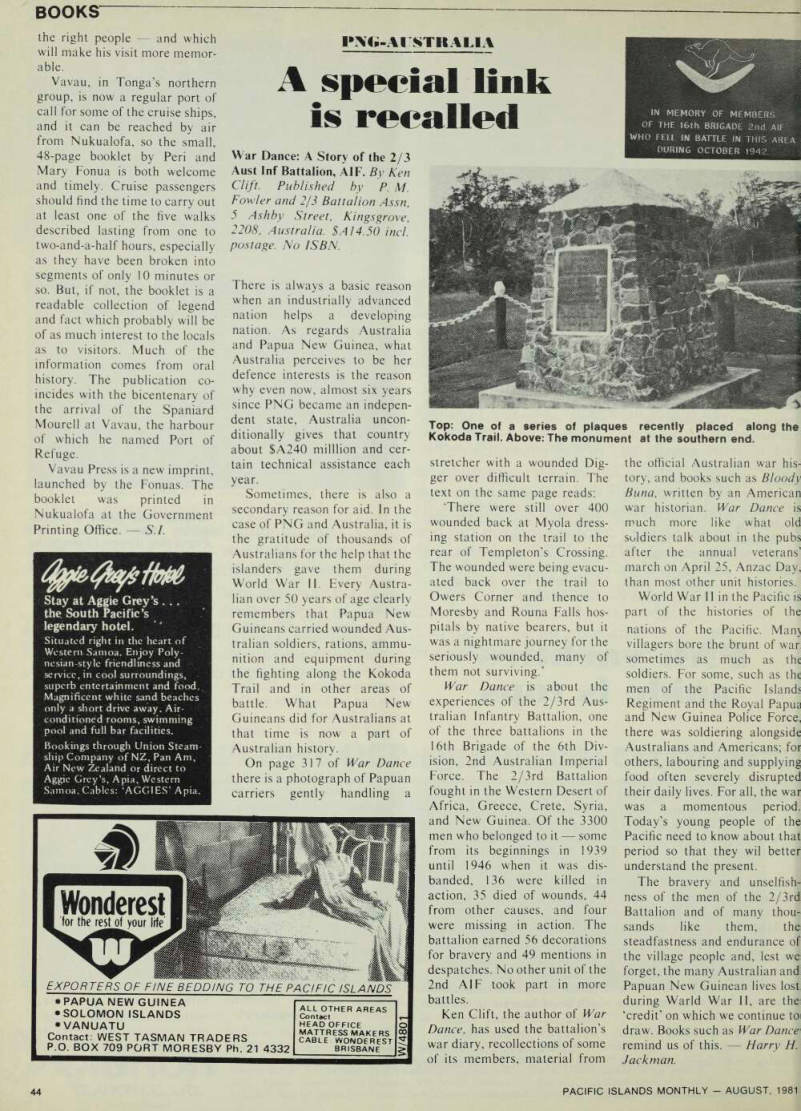
Top: One of a series of plaques recently placed along the Kokoda Trail. Above: The monument at the southern end.