growing its 'bananas'
pp. 47-48 · Read in the full issue
Multi-ethnic Hawaii is growing its 'bananas'
Books
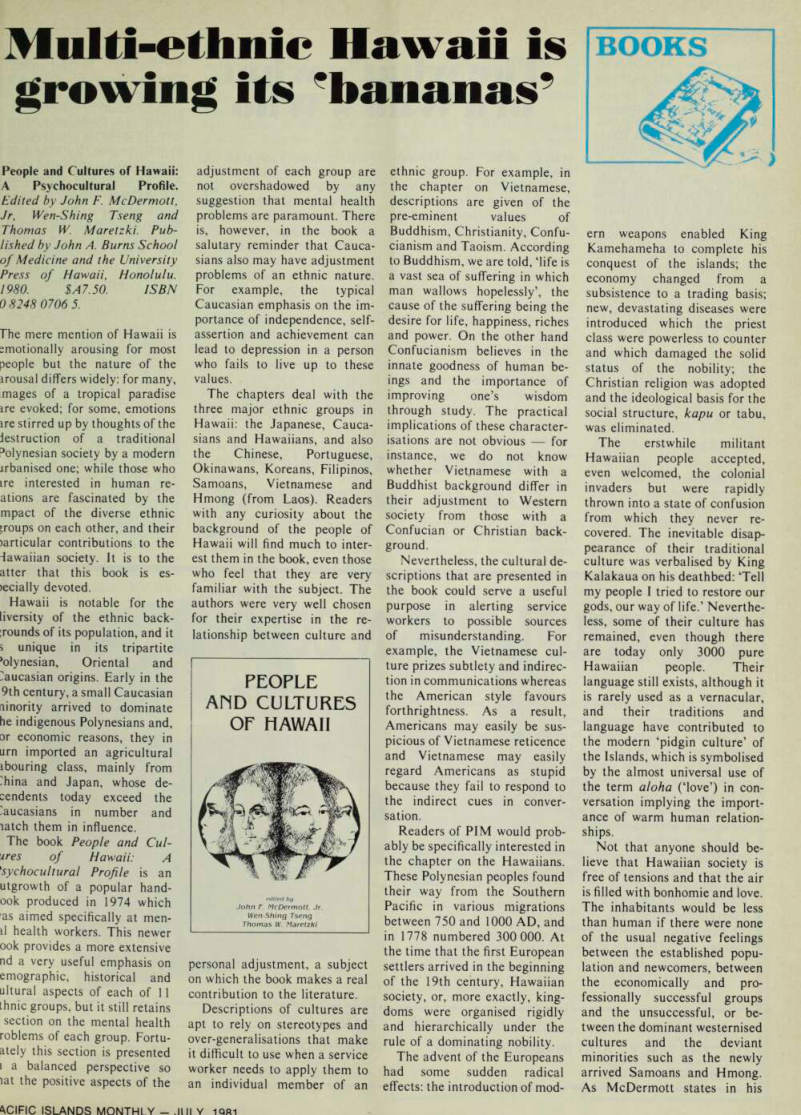
People and Cultures of Hawaii: A Psychocultural Profile.
Edited by John F. McDermott, Jr, Wen-Shing Tseng and Thomas W. Maretzki. Pub lished by John A. Burns School of Medicine and the University Press of Hawaii, Honolulu.
1980. 5A7.50. Isbn
0 8248 0706 5.
The mere mention of Hawaii is emotionally arousing for most people but the nature of the arousal differs widely: for many, mages of a tropical paradise are evoked; for some, emotions are stirred up by thoughts of the lestruction of a traditional Polynesian society by a modern irbanised one; while those who ire interested in human re ations are fascinated by the mpact of the diverse ethnic ;roups on each other, and their )articular contributions to the -lawaiian society. It is to the atter that this book is es iccially devoted.
Hawaii is notable for the liversity of the ethnic back ;rounds of its population, and it 5 unique in its tripartite ’olynesian, Oriental and Caucasian origins. Early in the 9th century, a small Caucasian ninority arrived to dominate he indigenous Polynesians and, or economic reasons, they in urn imported an agricultural ibouring class, mainly from China and Japan, whose de cendents today exceed the Caucasians in number and latch them in influence.
The book People and Cul ures of Hawaii: A I sychocultural Profile is an utgrowth of a popular hand ook produced in 1974 which as aimed specifically at men il health workers. This newer ook provides a more extensive nd a very useful emphasis on emographic, historical and ultural aspects of each of 11 thnic groups, but it still retains section on the mental health roblems of each group. Fortu ately this section is presented 1 a balanced perspective so lat the positive aspects of the
adjustment of each group are not overshadowed by any suggestion that mental health problems are paramount. There is, however, in the book a salutary reminder that Cauca sians also may have adjustment problems of an ethnic nature.
For example, the typical Caucasian emphasis on the im portance of independence, self assertion and achievement can lead to depression in a person who fails to live up to these values.
The chapters deal with the three major ethnic groups in Hawaii: the Japanese, Cauca sians and Hawaiians, and also the Chinese, Portuguese, Okinawans, Koreans, Filipinos, Samoans, Vietnamese and Hmong (from Laos). Readers with any curiosity about the background of the people of Hawaii will find much to inter est them in the book, even those who feel that they are very familiar with the subject. The authors were very well chosen for their expertise in the re lationship between culture and
personal adjustment, a subject on which the book makes a real contribution to the literature.
Descriptions of cultures are apt to rely on stereotypes and over-generalisations that make it difficult to use when a service worker needs to apply them to an individual member of an
ethnic group. For example, in the chapter on Vietnamese, descriptions are given of the pre-eminent values of Buddhism, Christianity, Confu cianism and Taoism. According to Buddhism, we are told, ‘life is a vast sea of suffering in which man wallows hopelessly’, the cause of the suffering being the desire for life, happiness, riches and power. On the other hand Confucianism believes in the innate goodness of human be ings and the importance of improving one’s wisdom through study. The practical implications of these character isations are not obvious for instance, we do not know whether Vietnamese with a Buddhist background differ in their adjustment to Western society from those with a Confucian or Christian back ground.
Nevertheless, the cultural de scriptions that are presented in the book could serve a useful purpose in alerting service workers to possible sources of misunderstanding. For example, the Vietnamese cul ture prizes subtlety and indirec tion in communications whereas the American style favours forthrightness. As a result, Americans may easily be sus picious of Vietnamese reticence and Vietnamese may easily regard Americans as stupid because they fail to respond to the indirect cues in conver sation.
Readers of PIM would prob ably be specifically interested in the chapter on the Hawaiians.
These Polynesian peoples found their way from the Southern Pacific in various migrations between 750 and 1000 AD, and in 1778 numbered 300 000. At the time that the first European settlers arrived in the beginning of the 19th century, Hawaiian society, or, more exactly, king doms were organised rigidly and hierarchically under the rule of a dominating nobility.
The advent of the Europeans had some sudden radical effects: the introduction of mod-
ern weapons enabled King Kamehameha to complete his conquest of the islands; the economy changed from a subsistence to a trading basis; new, devastating diseases were introduced which the priest class were powerless to counter and which damaged the solid status of the nobility; the Christian religion was adopted and the ideological basis for the social structure, kapu or tabu, was eliminated.
The erstwhile militant Hawaiian people accepted, even welcomed, the colonial invaders but were rapidly thrown into a state of confusion from which they never re covered. The inevitable disap pearance of their traditional culture was verbalised by King Kalakaua on his deathbed: Tell my people I tried to restore our gods, our way of life.’ Neverthe less, some of their culture has remained, even though there are today only 3000 pure Hawaiian people. Their language still exists, although it is rarely used as a vernacular, and their traditions and language have contributed to the modern ‘pidgin culture’ of the Islands, which is symbolised by the almost universal use of the term aloha (‘love’) in con versation implying the import ance of warm human relation ships.
Not that anyone should be lieve that Hawaiian society is free of tensions and that the air is filled with bonhomie and love.
The inhabitants would be less than human if there were none of the usual negative feelings between the established popu lation and newcomers, between the economically and pro fessionally successful groups and the unsuccessful, or be tween the dominant westernised cultures and the deviant minorities such as the newly arrived Samoans and Hmong.
As McDermott states in his
closing chapter ‘many of these tensions are related to social class as much as race’.
Treatments of racial relation ships often overlook this con tamination of class and ethnic background, but the question still remains of how to explain why certain groups tend consist ently to fall into the middle or the working class. In particular it appears that the individual istic, achievement-oriented cul ture that is reflected in the typical Western value system is becoming predominant and that social success and respect in Hawaii will more and more go to those who play that ‘game’ well.
These changes are embodied in the local term ‘banana’ which is applied to Westernised Japanese to signify that they are ‘yellow on the outside but white inside’.
The predominant Hawaiian culture is still very much in a state of flux but there can be no doubt that the society will be a polyethnic multicultural one for
a long lime to come.
Ronald
Taft.