Yachts
pp. 87-89 · Read in the full issue

Levu. Spellbound was Scottish built in 1962 of oak, teak and pitch pine by Weatherhead and Blackie on the Firth of Forth, a fishing yard that was engaged in building North Sea trawlers until oil was found in the area and they closed for want of skilled help . . . Irwin brought Spellbound in 1974 when he sold his Devon veterinarian’s practice to go cruising on his own boat. He says he ‘followed the Milk Run through the Pacific’ touching on Tahiti, Tonga and the Cook Islands before pausing in Fiji.
Robin and Siteri plan to return to Fiji to resume the work they have been doing. Eventually they would like to go back to blue water cruising but on a smaller vessel, perhaps one of around 11.5 m. Says Robin, ‘lt would be nice to be able to go about without even touching a sail!’ On Spellbound the Irwins must carry two or three extra hands
*Ane Deridder Re
ports from Kerikeri y New
Zealand:
XI PHI AS. The cruising com tunity was shocked to hear of the eath of young Nathan Vanderpool i the Kerikeri River in February, he four-year-old child was fishing om the deck of the 8.5 m Bristol hannel Cutter Xiphias (PIM pr p 69) when he disappeared. His 3dy was found by divers. A mem •ial service at St James Church blocking the Kerikeri Stone liore Basin was attended by iends from shore and from many the cruising yachts in the Bay of lands, all of whom share the rrible loss with Celia his mother id Amy his sister, for Nathan had uched the hearts of all who knew m. Celia and Amy and Roger Isen flew back to Southern Cali rnia soon after the tragedy.
SPELLBOUND. This Falmouth
gistered 15.8 m auxiliary ketch
s been travelling around Fiji for e past five years with owner, )bin Irwin, and his Fijian wife teri. They have been engaged in a agramme to help Fijian farmers come involved in cattle, pig and iry farming. Part of an overseas I scheme, Irwin describes himself a ‘livestock development officer’. i be cruising on your own boat and the same time feel you’re doing nothing worthwhile is satisfying,’ maintains. They have been trav ing in the eastern islands the u Group and Lomai Viti as II as on the main island of Viti
to sail the yacht and a full-time crew member just for maintenance. • FLEETWOOD. Randy and Jamie Brown sailed their ‘one-ofT 12 m Alden cutter Fleetwood to New Zealand by way of a less frequented route. They sailed from Mexico to Hawaii, then swung through the Line Islands to Penrhyn and thence to Suwarrow. It was only there that they began meeting up with the many cruising boats flock ing from Polynesia. They then visited American Samoa, Tonga and Fiji. By keeping initially off the beaten track they felt they were not just one of a herd. ‘The Line Islands alone were worth the trip utterly unspoiled,’ they said. There they encountered only one other yacht, the 12 m Atlantis which they first met at Fanning Island, then at Christmas Island. Atlantis spent the hurricane season in Fiji, while Fleetwood sailed to New Zealand for the southern summer. Built 36 years ago for the Chicago to Macinac Island Race an event which she won four years in a row Fleetwood was a black-hulled yawl. Pampered for a good many years, the yacht was hauled out and put in a shed each winter. ‘We left the mizzen mast behind in San Diego to make the trip,’ Randy said. ‘She goes just fine without it.
Actually it was a deterrent, and made us carry weather helm.’ He added, ‘She’s a good fast passage maker!’ • KIWI. Kiwi is one of the Atkin ‘Little Ranger’ ketches in which Dick and Sherri Lenz of San Diego returned to New Zealand for the second year running after visiting Fiji, Vanuatu and New Caledonia in the interim. When Sherri flew back from Auckland to California for a month of family visits, she was missed by her maritime mobile contacts on the amateur radio bands. Sherri, a ham radio operator who laughingly refers to herself as
‘The Mouth of the South’, conducts an informal net so that fellow cruising yachtsmen can keep in touch with each other. Dick re marked on the blustery weather this past year. ‘We broke the windvane two days out of Fiji, and the jib boom on the passage from Port-Vila to New Caledonia. It’s been a windy season.’ He was busy with repairs and maintenance, in preparation for their departure in April for the Australs. He and Sherri are return ing to French Polynesia which they consider one of the most beautiful groups in the Pacific with its variety of terrain its high mountains, coral reefs, and lagoons. Dick added, ‘The chief disadvantage has always been its high cost of living, but with the way things are going it’s no longer that much more expensive than anywhere else . . .’ • LAZY LADY. Linda and Jack Stanley are also back in New Zea land this year. In fact. Jack is hoping to get permanent residency here. He has a job lined up in Auckland in his field which is electronics. ‘We had originally in tended to do a circumnavigation but there is so much to see in the Pacific it seems absurd to go around the world,’ Jack explained. Lazy Lady is a 10.36 m Angleman ketch.
Linda and Jack set off from San Diego for Maui in June ’7B, put Lazy Lady on a Rhumb Line course and 15 days later discovered that they were the winning vessel in the Ancient Mariners' Race, beating the more experienced competitors, all of whom had strategically sailed north or south in order to find more favourable winds. Lazy Lady then sailed through the Marshalls and the islands of Kiribati, arriving in Suva just in time to shelter from Hurrican Meli. After a happy summer in New Zealand the Stan leys beat their way to Vavau, and had a hair-raising trip through Fiji’s Lau Group. While Jack meandered
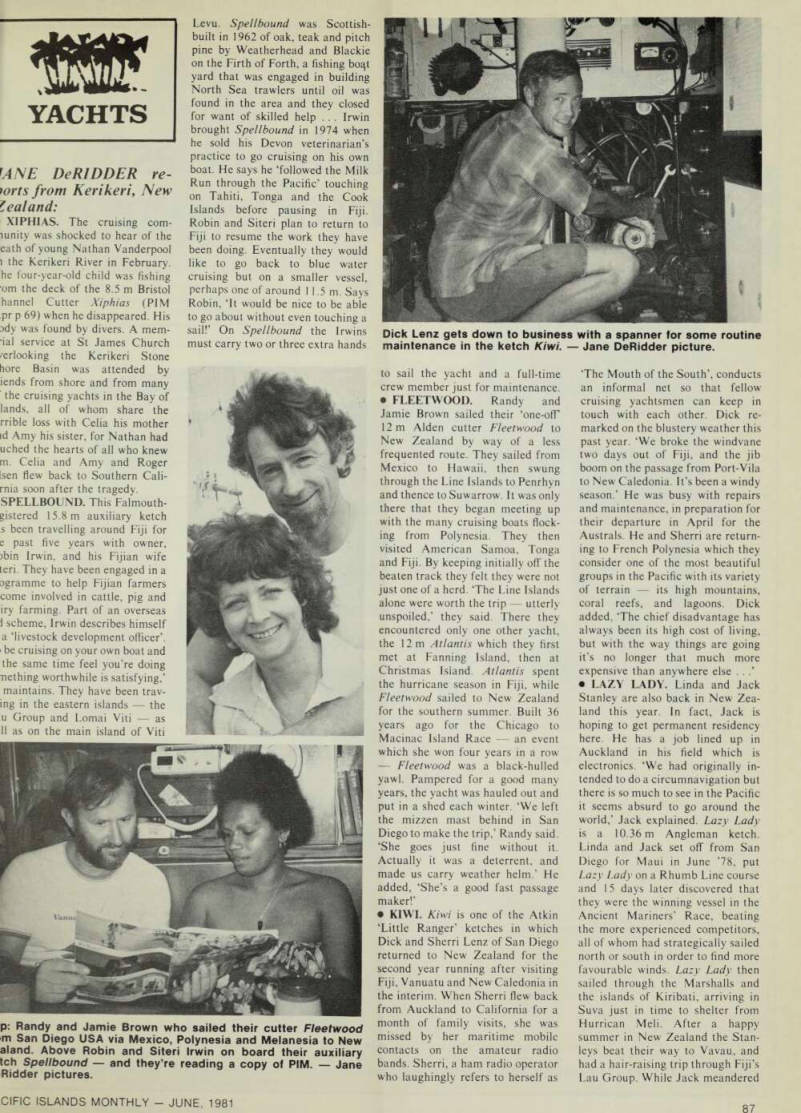
[?]p: Randy and Jamie Brown who sailed their cutter Fleetwood [?]m San Diego USA via Mexico, Polynesia and Melanesia to New [?]aland. Above Robin and Siteri Irwin on board their auxiliary [?]tch Spellbound and they’re reading a copy of PIM. Jane Ridder pictures.
Dick Lenz gets down to business with a spanner for some routine maintenance in the ketch Kiwi. Jane DeRidder picture.
bout Fiji for the next several nonths, Linda took her annual visit 3 California leaving Jack to look fter Farquate and Snicklefritz, the hip’s cats. When I was aboard azy Lady, Snicklefritz, the Closet )ueen, was not in evidence. (He pparently makes a nuisance of imself at night.) But Farquate was lost sociable, tossing bits of sheep dn down from the vegetable ham lock as well as a matted multi iloured tangle of wool which inda described as ‘something that it’s been knitting for years’.
BOKONON. Herb Linder’s and
largo Callaghan’s Minneapolis
gistered Islander 36 stands out om other yachts in the cruising ;et with its brown acrilon weather oths, cockpit dodger, sail cover
id permanent sailing awning
e latter has already ‘withstood a nail gale’. This homey vessel is led with multi-coloured cushions id shelves of books, and there are 'O guitars on which Herb and argot play country western and Ik music. It is also guarded by a
;arsome Panamanian watch kitty
lied Chagres’, who when left one on the boat will not permit lyone to come aboard. Herb and argot lived and worked in Pan na where they bought the 11m )op. They left in March of’79 and (lowed the ‘standard route’ to ilynesia, Suwarrow, Pago Pago,
pia, Tonga, Fiji and New Zealand,
icy hope next year to explore jstralia. Herb and Margo are ppy with the boat and everything out cruising which has so far been eventful, except for ‘just enough
)rms to keep it interesting’. Proud
the Islander’s performance, they me first in the first Annual Opua jgatta and third in Suva’s Hibis s Regatta.
PESCARUS. Pescarus is imanian for seagull. This 8.7 m )lden Hinde bilge keeler received z name when a previous owner, ick for a name, sat in a Romanian fe mulling over his problem. scarus’s present owners are Dr ichael Couch and his wife Lindy
who had only intended to be away from the UK for two years when they left nearly six years ago. Lindy was a science teacher, and Michael was doing a residency in a London hospital before they set off in their little plywood yacht. They have now made their way half-way around the world, working as they go. They spent a year in Barbados where Michael worked in the outpatients’ clinic of a government hospital. He also ran the hospital’s intensive care unit. Lindy worked in a demolition gang in San Francisco. Together they delivered a Gulfstar 43 from Tahiti to California. More recently, Michael practised medicine for a year in Sydney. The Couches’ son Mischa was born there. Lindy took Mischa back to England for a two month visit with grandparents. It was here that the little fellow learned to walk. Just arrived back on Pescarus after an appalling series of flights from Heathrow to Kerikeri during the disruptive air port strikes, Mischa seemed quite at home and sure-footed as he played in the cockpit secured to the boom by safety harness. • WESTWIND. Jack Bugay, Southern California lawyer, de scribes Westwind, his Polaris 43, as
a ‘performance cruising boat’. The Robert Perry-designed yacht is No 24 of a line of 13.5 m cutters built in the Chien Yu yard in Taiwan.
Number One of the series Sunflower, belonging to Al and Beth Liggett came third in the 1980 China Sea Race, Cruising Division, while two other Perry designs took first and second places, proving as Jack says that a cruising boat can be comfortable, strong and move. ‘l’ve done a good deal of ocean racing on various sizable racing yachts, but find Westwind satisfying to sail.’ With California teacher, Denise Medina, Jack has been cruising since the vessel was completed in August ’7B. They lived in Hong Kong for a while, then spent four and a half months in the Philippines before making their way to New Zealand via Palau, Papua New Guinea, the Solomons and Vanuatu. Talking of the fascination of their way of life, they mentioned in particular a coffee-buying ex pedition they went on with a native truck driver in the Highlands of New Guinea, through the Asoka Valley and other remote areas.
When I met Jack and Denise they were at Smith’s Boat Yard in Whangarei meticulously repainting and revarnishing the entire interior of Westwind, servicing motors and pumps, re-doing everything ‘just so there aren’t any problems’. Explain ing why they were repainting the hull after only two and a half years, they said that the paint was scoured in a Hong Kong typhoon in ’79. ‘You should have seen the mast. It was stripped of paint.’ After secur ing Westwind with three anchors and plenty of chain, they left her to her own devices and sheltered in a flat ashore. There the air condit ioners blew through the wall and into the room. ‘We’d have been safer if we’d remained on the boat.’
Denise’s and Jack’s plans are unde cided. ‘Tonga and Fiji next most likely. We’ll continue on slowly . . .’
JOAN D. PEASE reports
from Papeete, Tahiti:
• Moana Lua. An 11.5 M
wooden cutter, Moana Lua, is returning to Sydney, its home port, from a Pacific cruise. Since leaving Australia in March 1980, Peter Fry and Jenny Watts have sailed the vessel to New Zealand, Rarotonga, Tahiti, Pitcairn, Easter Island, Robinson Crusoe Island, Peru, the
Galapagos, Marquesas, Moorea,
Huahine and Borabora.
The cutter, which was built in 1933, suffered a severe knockdown after sailing from New Zealand.
Jenny was swept overboard by the wave which engulfed the vessel.
Although Peter was able to get Jenny aboard without too much difficulty, Moana Lua was severely damaged. Coamings were de stroyed, the dog house knocked loose, the dinghy was washed over board and crushed beyond repair, and the windvane was broken.
They changed course for Rarotonga and were allowed a six week visa to complete repairs. Since they worked on the boat during their stay and had little time to see the island, Peter and Jenny decided to stop at Rarotonga on their return to Australia.
When they arrive home they will have travelled 20 000 nautical miles. They have seen Pacific islands where few yachts call. ‘We were the 13th boat to visit Pitcairn Island in the past 12 months the eighth to call at Easter Island and the fourth at Robinson Crusoe,’
Peter said.
They were treated to a warm wel come in many islands, especially Pitcairn where Steve Christian went out in a launch to take them ashore. ‘A tractor was waiting on the beach to take us up to the village,’ Jenny said. ‘We were invited into a home where dinner was already prepared and 10 people were waiting to meet us,’ she added. When the wind changed direction three days later they had to sail away, but during their stay they were guests in the homes of many of the 60 people now living on the island. • FLORES. A 10.3 m aluminium sloop, Flores is calling at anchor ages in French Polynesia. The craft is owned by Francois and Cathy de Soyres from southern France. The couple are circumnavigating with their children, Marie, two-and-a half, Manuel, five, and Raphael, seven. When they leave Tahiti they plan to sail to Fiji and will stop in Australia before entering the Indian Ocean. • YANKEE TAR. A 12 m fibre glass sloop owned by Hollywood actor Hal Holbrook, Yankee Tar is anchored in Opunohu Bay, Moorea, French Polynesia. Hal sailed the sloop to Tahiti from Hawaii last
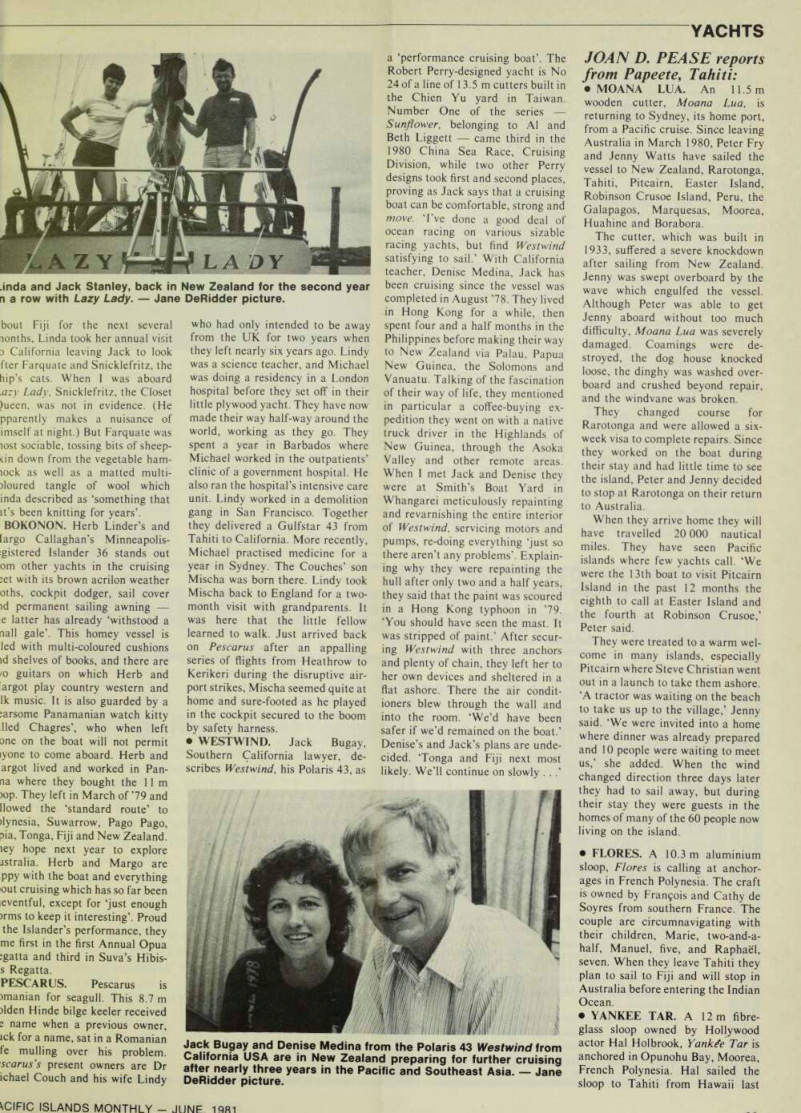
inda and Jack Stanley, back in New Zealand for the second year [?] a row with Lazy Lady. Jane DeRidder picture.
Jack Bugay and Denise Medina from the Polaris 43 Westwind from California USA are in New Zealand preparing for further cruising after nearly three years in the Pacific and Southeast Asia. Jane
DeRidder picture.