Mr Speaker
pp. 30-33 · Read in the full issue

Tropicalities
PNG phone
speaker was
Mr Speaker
The Papua New Guinea tele phone system has lost a rare claim to fame it no longer has recorded messages given by the third man in the land, outranked only by the governor general and the prime minister.
For several years the recorded voice which has been giving switching information to tele phone subscribers has belonged to the man who is now Speaker of the National Parliament, Sevese Morea CBE.
But a recent operating fault erased Mr Morea’s voice from the magnetic drum which auto matically provides the messages from the international tele phone exchange in Lae. New recordings have had to be made, and a new voice has been used.
The story behind the use of Mr Morea’s voice goes back to the days before he entered parliament. He was one of the first Papua New Guineans trained by the Australian Broadcasting Commission in Australia and PNG as an an nouncer, commentator and news reader. He continued to work for PNG’s own broadcast ing authority, the National Broadcasting Commission (NBC) which was formed shortly before independence.
When PNG established a new microwave-link telephone service which incidentally is one of the most technically advanced in the world it called on the NBC to provide top-quality recorded messages for automatic subscriber infor mation. The job went to Mr Morea, and his voice remained in use until the recent acciden tal erasure.
Technicians said they had made arrangements for another voice ‘because you can’t very well go up to the speaker of parliament and ask him to do it again’. At latest report the
technicians themselves had made a temporary recording and had called on the NBC to make a new permanent one.
Peacesat is
10 years old
The Pan-Pacific Educational and Communications Exper iments by Satellite Peacesat to you was 10 years old on April I, a ‘birthday’ occasion celebrated widely throughout the Pacific.
The Peacesat operation be gan on April I, 1971, when the first educational satellite link was established between the University of Hawaii campuses at Manoa and Hilo. This link followed granting of permission by the US National Aeronaut ics and Space Administration (NASA) for Dr John Bystrom of the University of Hawaii to direct the experimental use of the then more than four-years old ATS I satellite for edu cational exchanges.
Soon the link became inter national, with the addition of a terminal at the Wellington.
New Zealand, Polytechnic where the late Tony Harley established the operation, and became associate director of the
project, and later of a terminal at the University of the South Pacific (USP) campus in Suva, where the then Vice-Chancellor Dr Colin Aikman saw the po tential of satellite communi cations.
Before 1972 was out Tonga, American Samoa, Papua New Guinea (Lae), and Saipan had joined the network. Rarotonga became operational on ATSI in 1972, and with Noumea joined Peacesat in the following year.
Later USP set up terminals in Niue, Tarawa, Honiara, Porl- Vila, Apia and Tuvalu. The University of California at
Santa Cruz, the University of Sydney and San Diego State
University joined.
Peacesat is unique and has demonstrated to the world the potential for a wide-coverage international linking of edu cational institutions for the holding of conferences on almost any and every topic of interest.
The ATSI satellite used for the link is approaching 15 years of age, and has broken all records for longevity among geo-stationary satellites.
Polynesians a
Hollywood hit
Celebrated US band leader Count Basie was upstaged in March by a Polynesian dance group which was visiting Hollywood for the 30th annual conference of the Pacific Area Travel Association (PATA).
The group was there to promote the Western Samoa carrier Air Polynesia’s new ‘Discover Polynesia’ package. The par ticular occasion was a reception and dinner at the Hollywood Palladium for the 1500 PATA delegates.
Tahiti-based US travel writer A 1 Prince describes the events in a report published in Cook Islands News: ‘The Polynesian group was scheduled to perform during the reception while Count Basie was to be the star attraction during dinner .. . Members of the Polynesian group greeted all arrivals at the Palladium with shell necklaces, and then tried to stage a dance show for everyone attending the recep tion. ‘But while the foyer proved to be just big enough for the show, the 1500 people at the reception were so tightly packed in the connecting corridor that only those up front could see the show. ‘So Tahiti Minister for Tour ism Alex Ata arranged with PATA officials, who arranged with Count Basie and his or chestra, for the Polynesian group to perform at the begin ning of dinner inside the huge Hollywood Palladium. ‘The results were spectacu lar. The audience fell in love with the group, although most had no idea whether they were watching a dance from Tahiti, Tonga, the Cook Islands or
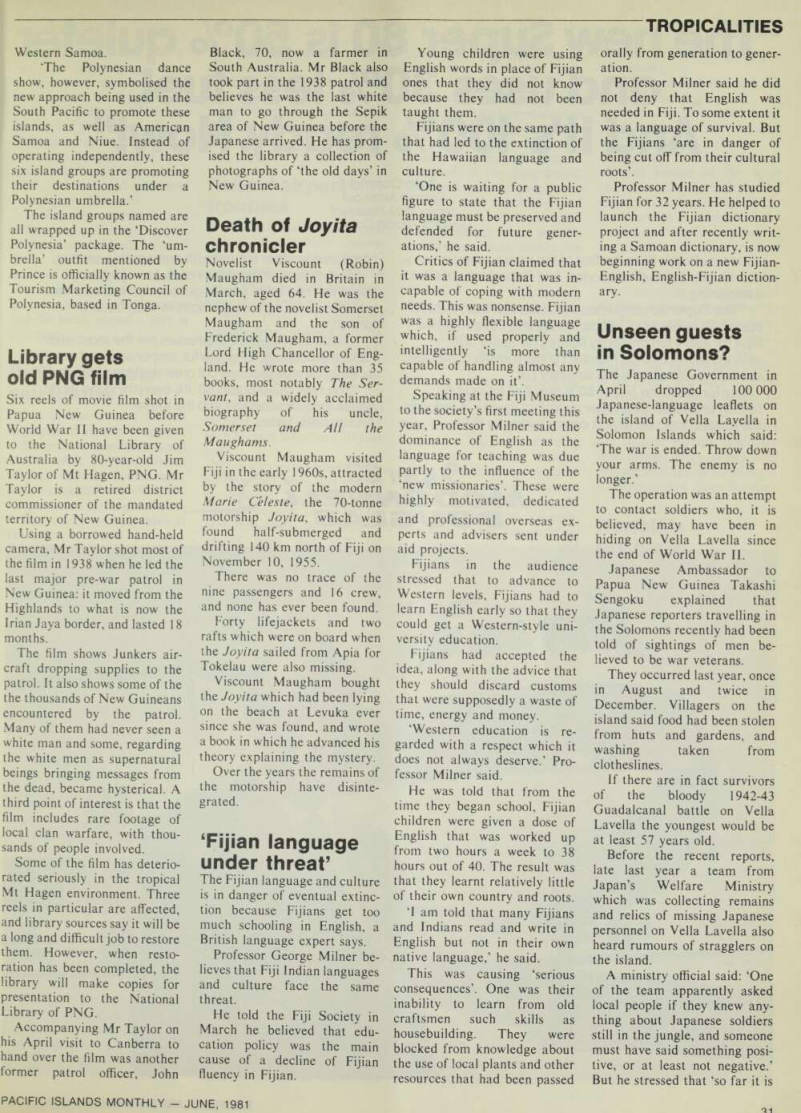
After 84 years on display in Australia a rare ceremonial drum is being returned to Vanu atu for the national cultural collection in Port Vila. Mrs
Grace Molisa, deputy secretary
of the department of the prime minister in Vanuatu, received the drum in Sydney during a recent visit to Australia (see also Political Currents, this issue). Picture shows Mrs
Molisa (centre) receiving the
drum from Mrs Christine Klug man of the museum trust and Dr Jim Specht, curator of Pacific Anthropology at the museum.
Only about four other similar drums are known to survive, and they are all in museums.
AIS photograph by Robert
Macoll.
Western Samoa.
The Polynesian dance show, however, symbolised the new approach being used in the South Pacific to promote these islands, as well as American Samoa and Niue. Instead of operating independently, these six island groups are promoting their destinations under a Polynesian umbrella.’
The island groups named are all wrapped up in the ‘Discover Polynesia’ package. The ‘um brella’ outfit mentioned by Prince is officially known as the Tourism Marketing Council of Polynesia, based in Tonga.
Library gets
old PNG film
Six reels of movie film shot in Papua New Guinea before World War II have been given to the National Library of Australia by 80-year-old Jim Taylor of Mt Hagen, PNG. Mr Taylor is a retired district commissioner of the mandated territory of New Guinea.
Using a borrowed hand-held camera, Mr Taylor shot most of the film in 1938 when he led the last major pre-war patrol in New Guinea; it moved from the Highlands to what is now the Irian Jaya border, and lasted 18 months.
The film shows Junkers air craft dropping supplies to the patrol. It also shows some of the the thousands of New Guineans encountered by the patrol.
Many of them had never seen a white man and some, regarding the white men as supernatural beings bringing messages from the dead, became hysterical. A third point of interest is that the film includes rare footage of local clan warfare, with thou sands of people involved.
Some of the film has deterio rated seriously in the tropical Mt Hagen environment. Three reels in particular are affected, and library sources say it will be a long and difficult job to restore them. However, when resto ration has been completed, the library will make copies for presentation to the National Library of PNG.
Accompanying Mr Taylor on his April visit to Canberra to hand over the film was another former patrol officer, John
Black, 70, now a farmer in South Australia. Mr Black also took part in the 1938 patrol and believes he was the last white man to go through the Sepik area of New Guinea before the Japanese arrived. He has prom ised the library a collection of photographs of ‘the old days’ in New Guinea.
Death of Joyita
chronicler
Novelist Viscount (Robin) Maugham died in Britain in March, aged 64. He was the nephew of the novelist Somerset Maugham and the son of Frederick Maugham, a former Lord High Chancellor of Eng land. He wrote more than 35 books, most notably The Ser vant, and a widely acclaimed biography of his uncle, Somerset and All the Maughams.
Viscount Maugham visited Fiji in the early 19605, attracted by the story of the modern Marie Celeste, the 70-tonne motorship Joyita, which was found half-submerged and drifting 140 km north of Fiji on November 10, 1955.
There was no trace of the nine passengers and 16 crew, and none has ever been found.
Forty lifejackets and two rafts which were on board when the Joyita sailed from Apia for Tokelau were also missing.
Viscount Maugham bought the Joyita which had been lying on the beach at Levuka ever since she was found, and wrote a book in which he advanced his theory explaining the mystery.
Over the years the remains of the motorship have disinte grated.
‘Fijian language
under threat’
The Fijian language and culture is in danger of eventual extinc tion because Fijians get too much schooling in English, a British language expert says.
Professor George Milner be lieves that Fiji Indian languages and culture face the same threat.
He told the Fiji Society in March he believed that edu cation policy was the main cause of a decline of Fijian fluency in Fijian.
Young children were using English words in place of Fijian ones that they did not know because they had not been taught them.
Fijians were on the same path that had led to the extinction of the Hawaiian language and culture. ‘One is waiting for a public figure to state that the Fijian language must be preserved and defended for future gener ations,’ he said.
Critics of Fijian claimed that it was a language that was in capable of coping with modern needs. This was nonsense. Fijian was a highly flexible language which, if used properly and intelligently ‘is more than capable of handling almost any demands made on it’.
Speaking at the Fiji Museum to the society’s first meeting this year. Professor Milner said the dominance of English as the language for teaching was due partly to the influence of the ‘new missionaries’. These were highly motivated, dedicated and professional overseas ex perts and advisers sent under aid projects.
Fijians in the audience stressed that to advance to Western levels, Fijians had to learn English early so that they could get a Western-style uni versity education.
Fijians had accepted the idea, along with the advice that they should discard customs that were supposedly a waste of lime, energy and money. ‘Western education is re garded with a respect which it does not always deserve.’ Pro fessor Milner said.
He was told that from the time they began school, Fijian children were given a dose of English that was worked up from two hours a week to 38 hours out of 40. The result was that they learnt relatively little of their own country and roots.
I am told that many Fijians and Indians read and write in English but not in their own native language,’ he said.
This was causing ‘serious consequences’. One was their inability to learn from old craftsmen such skills as housebuilding. They were blocked from knowledge about the use of local plants and other resources that had been passed
orally from generation to gener ation.
Professor Milner said he did not deny that English was needed in Fiji. To some extent it was a language of survival. But the Fijians ‘are in danger of being cut off from their cultural roots’.
Professor Milner has studied Fijian for 32 years. He helped to launch the Fijian dictionary project and after recently writ ing a Samoan dictionary, is now beginning work on a new Fijian- English, English-Fijian diction ary.
Unseen guests
in Solomons?
The Japanese Government in April dropped 100 000 Japanese-language leaflets on the island of Vella Layella in Solomon Islands which said: The war is ended. Throw down your arms. The enemy is no longer.’
The operation was an attempt to contact soldiers who, it is believed, may have been in hiding on Vella Lavella since the end of World War 11.
Japanese Ambassador to Papua New Guinea Takashi Sengoku explained that Japanese reporters travelling in the Solomons recently had been told of sightings of men be lieved to be war veterans.
They occurred last year, once in August and twice in December. Villagers on the island said food had been stolen from huts and gardens, and washing taken from clotheslines.
If there are in fact survivors of the bloody 1942-43 Guadalcanal battle on Vella Lavella the youngest would be at least 57 years old.
Before the recent reports, late last year a team from Japan’s Welfare Ministry which was collecting remains and relics of missing Japanese personnel on Vella Lavella also heard rumours of stragglers on the island.
A ministry official said: ‘One of the team apparently asked local people if they knew any thing about Japanese soldiers still in the jungle, and someone must have said something posi tive, or at least not negative.’
But he stressed that ‘so far it is
only a kind of rumour, and we have no evidence’.
Seven years ago a former first lieutenant in the Japanese Im perial Army Hirod Onoda was found in the wilds of the Philippines and persuaded to surrender. Onoda had not heard that World War II had ended in 1945, and continued a one-man campaign for 29 years.
Is that a record about to be eclipsed by still longer stayers on the Solomons’ Vella Lavella?
We’re not holding our breaths until we find out. Our hunch is that maybe communications problems between the Japanese and the locals played a part in this story.
Brainwork gets
you Goofy...
Fiji is to host a 1981 Mental Olympics in Suva in August.
The event follows the success of the 1980 Fiji Invitational Mental Abilities Tournament, which attracted over 400 con testants from Fiji high schools.
The newly named Mental Olympics, to be held on August 24-27, will include an old-style English Spelling Bee, a current events quiz, and contests in mathematics, verbal reasoning, mechanical reasoning, and ab stract reasoning. There will also be tests of knowledge in science, geography and history, and a test of general mental abilities.
The eleventh event is to be a chess tournament. Contestants can take part in any number of events even all 11 if they wish to.
The organising committee this year is inviting overseas intermediate and secondary schools to send participants.
Overseas visitors are promised ‘expert guided tours of interest ing underwater sites and cul tural centres’.
The committee apparently believes that after the intense cerebral activity of the Olympics, the young partici pants are entitled to some light relief among prizes offered this year are trips to Cali fornia’s Disneyland, sponsored by the Fiji Visitors Bureau.
Chief sponsoring organis ations for the Olympics are Air New Zealand, Air Pacific, Desai Bookshops, Fiji Teachers Union, Fijian Teachers Associ
ation, and the Jaycees of Suva and Nausori.
Persons wanting further de tails should write to the Sec retary, Committee for the 1981 Mental Olympics, PO Box 2071, Suva.
Rabaul airport
troubles
Traditional landowners around Rabaul, Papua New Guinea, want the equivalent of SAI7 million before they will allow the land to be used for exten sions to the town’s airport.
But PNG Government officials have rejected the de mand, claiming another airport could be built for the price.
The Matupit people’s de mands include $195 000 for each hectare of land purchased outright, or $7150 a year for each hectare taken on a 10-year lease.
They also want compensation for trees and crops that need to be removed, including $lO4O for each coconut tree, $260 for each fruit or nut tree, $l3O for ‘useful’ trees, and $l3O for edible plants and ferns.
About 60 pilots employed by PNG’s national airline Air Niugini had refused to use the airport for several days on grounds that towering coconut palms lining each side of the runway made landings unsafe.
The ban was lifted after officials reached a part settlement with the landowners and some trees were trimmed, but negotiations
continue
Michael Prain in
Port Moresby.
Calling all
inventors!
Seven broadcasting authorities in Pacific Island countries are co-operating with the British Broadcasting Corporation in England in an inventions com petition open to radio listeners in developing countries. The competition is being conducted in conjunction with the BBC’s Hullo Tomorrow!, a taped radio programme which is broadcast to the world and which is made available for local use in developing country radio broadcasts.
Listeners are being asked to send in details of small-scale
equipment, or adaptations of equipment, which they have designed for local use and from, locally-available materials.
Inventions and developments which are considered simple and practicable for developing country communities will be described in the programme.
They will also be judged for ingenuity and suitability, and prizes of tools will be awarded to the designers whose projects are considered best. Total value of the prizes will be more than
Sa6Oo.
Pacific broadcasting authorities which are co operating in the project, and which have entry forms for the competition, are: Cook Islands Broadcasting Corporation, Rarotonga; National Broadcast ing Commission, Boroko, Papua New Guinea; Solomon Islands Broadcasting Commission, Honiara; Fiji Broadcasting Commission, Suva; Govern ment Broadcasting Depart ment, Apia, Western Samoa; Kiribati Broadcasting Auth ority, Bairiki; Radio Vanuatu, Port-Vila. Other broadcasting authorities in Africa, Asia and the Caribbean are also taking part.
Maxime’s new
chair
Speaker of the Vanuatu Rep resentative Assembly Maxime Carlot now has a new chair to sit on as he presides over assembly proceedings.
Standing 1.8 m high, the chair was designed by Port-Vila artist Rick Fraser. Carved on it are the Vanuatu motto and coat of arms. This work was done by an Australian carver.
The chair is an independence gift from Australia to Vanuatu.
It was presented to the new nation by Australian High Commissioner Michael Ovington and received by Vanuatu Prime Minister Walter Lini.
Kolonia tower
to be saved
The US Heritage Conservation and Recreation Service has announced a grant of SUS3O 000 for the stabilisation of the old Catholic church bell tower in Kolonia, Ponape State,
in the Federated States of Micronesia.
The grant will be used for general cleaning-up of the structure and for needed struc tural stabilisation of the apse and belfry tower.
The belfry tower and apse are all that remain of the large church which was built by the Capuchin fathers in 1909. Dur ing World War II much of the church was razed by the Japan ese military for construction materials.
The bell tower is one of the rare surviving examples of German colonial architecture in the Pacific area. Unfortunately, years of neglect and the tropical climate have combined to weaken the structural integrity of the tower, and some portions are thought to be in danger of collapse.
The present plan is to protect the famous Ponape landmark from further decay, as well as to provide safe access for visitors.
Micronesian News Service.
Norfolk’s
dry blow
Norfolk Islanders are still scratching their heads about the ‘dry cyclone’ (Cyclone Freda in fact) whose 60-knot winds struck the island earlier this year.
The Norfolk Islander wrote in a front-page report: ‘After the long dry spell we have experienced, we were waiting in anticipation of the usual beneficial downpour which accompanies a cyclone. We were prepared to put up with the wind and that was all we got, no rain at all! ‘The hot, dry wind played havoc with the gardens and trees, all being severely burned.
Literally thousands of avocado pears (and we were expecting a bumper crop this year) were blown off. One lady who has a prize mandarin tree kept it alive by hosing it all day (in the middle of a cyclone, mind you!). ‘The hope that Freda would bring rain and ease our long stretch of hot, humid weather, came to nothing. Freda has gone on to give New Zealand a good drenching, and Norfolk looks all burnt up. ‘Maybe we should plant more trees . ..’